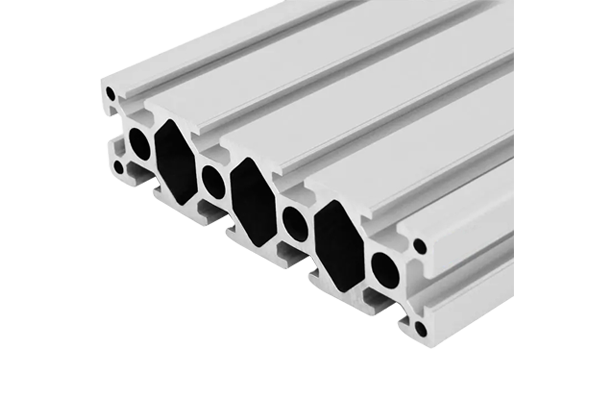
PG40 160×40 mm Ten Slot Heavy Aluminium Strut Profile for Cantilever Arms
A 160 x 40 mm ten slot heavy PG40 aluminium strut profile with round M6 corner holes and an 11 mm web. For cantilever arms and machine beams with tapped or locally loaded connections.
| Material | Aluminium |
|---|---|
| Alloy Grade | 6063-T5 |
| Temper | T5 |
| Section Size | 160 x 40 mm |
| Slot | 10 x 10.2 mm groove, 8 mm mouth, 40 mm pitch, outer pair 120 mm apart, M8 |
| Length | 6 m stock, cut to drawing to +/-0.5 mm |
| Tolerance | EN 755-9 / GB/T 6892, wall +/-0.15 mm |
| Surface | Mill finish / clear anodised / black anodised |
| MOQ | 150 |
| Lead Time | 20-30 days after deposit for mill finish |
| Loading Port | Shanghai / Ningbo |
| Supply Ability | 250 t per month |
| Payment Terms | T/T 30% deposit + 70% before shipment | L/C at sight |
| Trade Terms | FOB | CIF | EXW |
| Certifications | ISO 9001:2015 | EN 755-9 | RoHS | REACH |
Structural framing · PG40 heavy wide beam
A PG40 160 x 40 mm ten slot heavy aluminium strut profile is the heavy-wall version of the standard 160 x 40 mm beam in the same range. The envelope, the slot layout, the 40 mm pitch and the 10.2 mm groove are identical; what differs is the internal wall thickness and the corner hole form, which is a round 5 mm hole tapped M6 rather than the square hole of the standard section. It weighs about 6.6 kg/m against about 5.8 kg/m for the standard version.
The honest thing to say about the heavy version is that it is not primarily a stiffness upgrade. It gives about 20 per cent more second moment of area for about 14 per cent more weight, which is a fair exchange but not a dramatic one. What it actually buys you is a beam that can be drilled, tapped and loaded locally without the joint being the weak point — and that is a different reason to buy it altogether.
Identical outside, different inside
Because the envelope and the slot layout do not change, every bracket, end cap and cover that fits the standard 160 x 40 mm section fits this one. The two sections are interchangeable on the drawing, which is exactly why it is worth knowing what the difference actually is rather than assuming heavier is better.
| Standard 160 x 40 mm | Heavy 160 x 40 mm | |
|---|---|---|
| Envelope | 160 x 40 mm | 160 x 40 mm |
| Slots | 10 x 10.2 mm on a 40 mm pitch | 10 x 10.2 mm on a 40 mm pitch |
| Corner holes | 5 x 5 mm square, tapped M6 | 5 mm round, tapped M6 |
| Internal wall | Thinner | Thicker, 11 mm web |
| Weight | approx. 5.80 kg/m | approx. 6.60 kg/m |
| Second moment of area | approx. 540 cm4 | approx. 650 cm4 |
| Gain in stiffness | Reference | About 20 per cent |
| Cost in weight | Reference | About 14 per cent more |
Twenty per cent is not a reason on its own. If all you need is more stiffness, going from a 120 x 40 mm section to a 160 x 40 mm one gives about 140 per cent. Paying 14 per cent more weight for 20 per cent more stiffness is a poor exchange by comparison — so buy the heavy version for what it does to the connections, not for the stiffness.
First question: is the standard version stiff enough?
Before considering the heavy version at all, check whether the standard 160 x 40 mm beam meets the deflection limit. The table below is for a simply supported beam with a central point load, at an L/500 deflection limit, using the standard section’s 540 cm4.
| Span | Maximum central load at L/500 | Deflection at a 5 kN load | Verdict |
|---|---|---|---|
| 1.0 m | approx. 36.3 kN | approx. 0.3 mm | Comfortable |
| 1.5 m | approx. 16.1 kN | approx. 0.9 mm | Comfortable |
| 2.0 m | approx. 9.1 kN | approx. 2.2 mm | Inside the limit |
| 2.5 m | approx. 5.8 kN | approx. 4.3 mm | Right at the limit |
| 3.0 m | approx. 4.0 kN | approx. 7.4 mm | Outside the limit |
If your span and load sit comfortably inside that table, the standard section is the right buy and the heavy version adds weight for nothing. If they sit outside it, the heavy version will not rescue you either — 20 per cent does not close a gap that large. The fix at that point is a mid-span support or a deeper section.
Second question: does the beam have tapped or locally loaded connections?
This is where the heavy version actually earns its place, and the reason is the corner hole form.
| Criterion | Standard version | Heavy version |
|---|---|---|
| Corner hole form | Square, 5 x 5 mm | Round, 5 mm — a full thread all the way round |
| Thread quality | Uneven, the square corners cut into the thread flank | Uniform, and the tapping load is spread evenly |
| Chip clearance when tapping | Square corners trap swarf and break taps | Round hole clears easily |
| Stress concentration at the hole | Higher at the square corners | Lower in a round hole |
| Local load capacity | Thinner web under a foot or a clamp | 11 mm web takes a bolted foot or a clamp load better |
| Behaviour under vibration | Adequate | Better, because the joint is less likely to fret |
Using a heavy cantilever beam
- Design the root connection first A cantilever fails at the root. Size the root plate and the bolts before anything else, and use the M14 bore rather than the slots.
- Keep the 160 mm dimension in the plane of the load The 40 mm dimension carries almost nothing. Laid flat, the beam is about sixteen times softer, so the orientation is not negotiable.
- Use the round corner holes for any tapped connection That is the whole point of the heavy version. Tap into the round hole and use the full thread depth available.
- Check the tip deflection at the working load, not at the rated load A cantilever arm usually has a service load and an occasional peak load. Design the deflection on the service load and check the peak separately.
- Add a gusset or a stay at the root if the tip is still soft A diagonal stay from the root to the beam converts tip bending into direct force in the stay, which is far more efficient than thickening the beam.
Frequently asked questions
What is the difference between this and the standard 160 x 40 mm section?
Internal wall thickness and the corner hole form. This version has round 5 mm corner holes tapped M6 instead of square 5 x 5 mm ones, and a thicker internal web. The envelope and slot layout are identical.
Is the heavy version much stiffer?
About 20 per cent, at about 14 per cent more weight. That is a fair exchange but not a large one, so do not buy it for stiffness alone.
Why does a round corner hole matter?
A round hole takes a full, uniform thread and clears swarf when you tap it. A square hole cuts into the thread flank at its corners and traps chips, which is why square corner holes are used for clearance and round ones for threads.
Should I use this or step up to a 200 x 80 mm beam?
If the issue is deflection, step up. The 200 x 80 mm section is far deeper and gives many times the stiffness. This section is for when the 160 x 40 mm envelope is fixed and the connections are the problem.
Can you supply it tapped?
Yes. Tell us the hole pattern and the thread depth and we will drill, tap and deburr the corner holes and the M14 bore to drawing.
Send the beam’s connections, not just its span
Tell us whether the beam is tapped, whether anything is bolted directly to it and whether it sees vibration. We will say whether the heavy version is worth its weight and quote the machining.
Request a QuoteRelated Products
 PG40 120×40 mm Eight Slot Aluminium Strut Profile Standard Beam for Table Frames
A 120 x 40 mm eight slot PG40 aluminium strut profile standard beam with…
 PG40 120×40 mm Eight Slot Heavy Aluminium Strut Profile for Machine Bases
A 120 x 40 mm eight slot heavy PG40 aluminium strut profile with round…
 PG40 80×40 mm Six Slot Super Light Aluminium Strut Profile for Enclosures
An 80 x 40 mm six slot super light PG40 aluminium strut profile with…
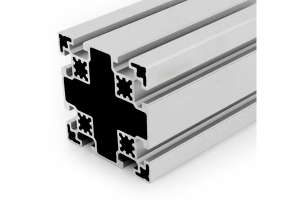 PG45 90×90 mm Eight Slot Aluminium Strut Profile M10 Column Section
A 90 x 90 mm eight slot PG45 aluminium strut profile with 8 x…
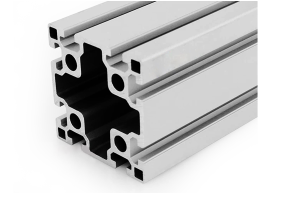 PG45 90×90 mm Eight Slot Heavy Aluminium Strut Profile for Heavy Machinery Frames
A 90 x 90 mm eight slot heavy PG45 aluminium strut profile with thicker…
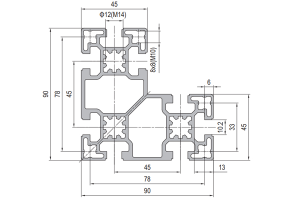 PG45 90×90 mm L-Shape Eight Slot Aluminium Strut Profile Corner Column for Frames
A 90 x 90 mm L-shaped eight slot PG45 aluminium strut profile with two…
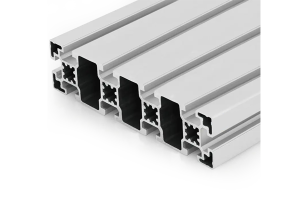 PG45 180 x 45 mm Ten Slot Aluminium Strut Profile Wide Gantry Beam
A 180 x 45 mm ten slot PG45 aluminium strut profile at about 6.20…
 PG50 100×100 mm Eight Slot Aluminium Strut Profile for Heavy Machine Columns
A 100 x 100 mm eight slot PG50 aluminium strut profile with two slots…
