Aluminium Conduit Profile 160×80 mm Cable Duct Extrusion with Two Sided Mounting for Machine Frames
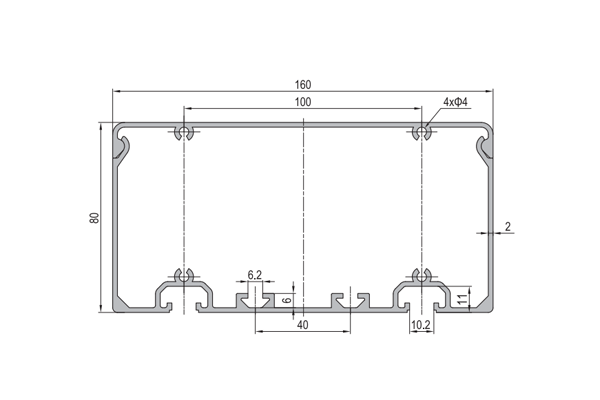
160 x 80 mm aluminium conduit profile duct in 6063-T5 with a 2 mm wall and four Ø4 mm holes, two through each wide face. Can be fastened from either side or used as a spacer between two frames.
| Material | Aluminium |
|---|---|
| Alloy Grade | 6063-T5 |
| Temper | T5 |
| Section Size | 160 x 80 mm |
| Slot | T-slot 10.2 mm groove, 8 mm mouth, 40 series |
| Length | 6 m stock, cut to drawing to +/-0.5 mm |
| Tolerance | EN 755-9 / GB/T 6892, wall +/-0.15 mm |
| Surface | Mill finish / clear anodised / black anodised |
| MOQ | 300 |
| Lead Time | 18-28 days after deposit for mill finish |
| Loading Port | Shanghai / Ningbo |
| Supply Ability | 400 t per month |
| Payment Terms | T/T 30% deposit + 70% before shipment | L/C at sight |
| Trade Terms | FOB | CIF | EXW |
| Certifications | ISO 9001:2015 | EN 755-9 | RoHS | REACH |
Cable management · Aluminium duct
A 160 x 80 mm aluminium conduit profile is a rectangular duct with a 2 mm wall, four Ø4 mm holes, two through each of the two wide faces, and a 10.2 mm T-slot along one narrow face. It is extruded in 6063-T5, weighs about 2.35 kg/m and is supplied cut to length, drilled or machined. The internal free area is about 119 cm2.
The holes through both faces are what set this section apart from the smaller ducts, and they change what the part is for. A duct with holes on one face can only be hung from one side. A duct with holes on both can be bolted to a frame above it, stood on a frame below it, or clamped between two frames and used as the spacer that holds them a fixed distance apart. On a machine where a duct run also has to tie two sub-assemblies together, that turns one extrusion into two jobs.
A duct that can be fastened twice
Mounting is normally the last thing considered on a duct run, and it is the thing that most often forces a change of section. A duct with holes on one face commits you to hanging it, because there is no way to reach the fixing from the other side. If the space above the run turns out to be occupied by a guard or a cable tray, the duct has to come out and be replaced.
Two fixing planes remove that risk. The same section can be bolted up to a frame, stood on a bracket below, or fastened through both faces to two separate structures. The run can also be fixed at both ends and left free in the middle, which is what you want on a long duct where the extrusion expands more than the steel frame it is attached to.
| Mounting arrangement | Fixing used | When it is the right answer |
|---|---|---|
| Hung from a frame above | Two top-face holes | The usual case on a machine frame |
| Stood on brackets below | Two bottom-face holes | Where the space above is taken |
| Fixed to both frames | All four holes | Where the duct also sets the frame spacing |
| Fixed at the ends only | One hole per end | Long runs that need to expand freely |
Support spacing and side-wall bowing
A duct on a long unsupported span does not fail by breaking. It fails by bowing. The cable bundle rests on the bottom of the duct and pushes the two side walls outward, and the walls bend until the lid gap closes. Once that happens the lid will not seat and the run has to be stripped and supported again.
A 2 mm wall is thin, and local bending stiffness in a wall scales with the cube of its thickness. Doubling the wall thickness makes the wall about eight times as resistant to bowing; the 2.5 mm wall on the 200 x 80 section is roughly twice as stiff as this one. That is why this section is a good choice for a run supported regularly and a poor choice for a long free span.
| Support spacing | Behaviour with a full bundle | Verdict |
|---|---|---|
| Every 1.0 m | No visible movement, lid seats freely | Comfortable |
| Every 1.5 m | Slight bow, lid still seats | The practical limit |
| Every 2.0 m | Visible bow, lid tight at the supports | Too far, add a support |
| Every 3.0 m | Walls bow, lid gap closes between supports | Not acceptable |
Using the duct as a spacer between two frames
Because the section has holes on both faces and an 80 mm height, it can be bolted between two parallel frames and used to hold them apart. That is a common pattern on machine enclosures, where a duct run down the side of a frame also sets the distance between the frame and a guard panel.
Doing it that way needs two things that a normal duct run does not. The frames have to be parallel to within the tolerance the duct can absorb, because the duct is rigid in that direction and will not bend to suit. And the fixings have to be tightened in a sequence that does not pull the duct out of line, because tightening one end fully first bows the section and leaves the other end standing off its frame.
Fitting the run
- Decide which face is the fixing face before drilling The two wide faces are identical except for the holes. Choose the face that will be against the structure, because that decides where the lid ends up and which side the cable entries open onto.
- Mark the fixing positions from one datum end Mark every support position from a single datum rather than chaining measurements from the previous support. Over a run of several metres the chained error is larger than the hole clearance.
- Fit the supports before the duct Put the brackets or rails in place first and check them for line. Fixing supports to a duct that is already hanging is slower and usually ends with the duct used as the straight edge.
- Keep fixings clear of the lid tongue The narrow face with the T-slot is where the lid seats. Anything that lands on that face has to sit below the tongue, or the lid will stand proud.
- Deburr the ends and the drilled holes A 2 mm extruded wall leaves a sharp edge, and so does a drilled Ø4 mm hole. Deburr both, especially where cables will be pulled past the edge.
This duct or the 120 x 60? Choose the 160 x 80 where the run has to be fixed from either side, where it doubles as a spacer between two frames, or where the bundle is large enough that a single fixing plane would put the fixings in the way of the cables. Choose the 120 x 60 where space is tight and the run is short.
Frequently asked questions
Why does this duct have holes through both faces?
So it can be fastened from either side. A duct with holes on one face commits the installation to one direction; with two fixing planes the same section can be hung, stood on brackets, or bolted between two structures.
How far apart should the supports be?
About 1.5 m for a duct carrying a full bundle. Beyond that the side walls begin to bow outward under the weight of the cables and the lid gap closes, which is what makes the lid stop seating.
Can I use it to hold two frames apart?
Yes, and it is a common pattern on machine enclosures. The frames have to be parallel to within what the duct can absorb, because the section is stiff across its 80 mm height and will not bend to follow a tapering gap.
What fits the T-slot on the narrow face?
The slot is 10.2 mm with an 8 mm mouth, so it takes standard 40-series M8 slot nuts and hammer-head bolts. That means the duct can be mounted on any 40 series bracket without a special part.
Do you supply it drilled to a pattern?
Yes. We drill the Ø4 mm holes to your pattern, cut to length, machine cable entry openings to drawing and supply the lid with the duct, so the run arrives ready to fit.
Tell us which faces you will fix and what the run carries
Send the run layout and the cable list. We will confirm the section, drill the Ø4 mm holes to your pattern, advise on support spacing and quote the duct, the lids and FOB pricing.
Request a QuoteRelated Products
 Aluminium Conduit Profile 200×80 mm Cable Duct Extrusion 2.5 mm Wall for Long Production Line Runs
200 x 80 mm aluminium conduit profile duct in 6063-T5 with a 2.5 mm…
 Agricultural Framework Aluminium Profile System 45×45 mm T-Slot for Shelving and Storage Racks
A bolted 45 x 45 mm T-slot aluminium profile framing system for agricultural shelving,…
 Conveyor System Aluminium Profile Extrusion Frame 45×60 mm for Belt and Roller Lines
A bolted conveyor frame in 45 x 60 mm T-slot aluminium profile with 45…
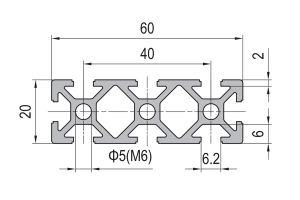 PG20 60 x 20 mm Eight Slot Aluminium Strut Profile Wide Miniature Rail
60 x 20 mm eight-slot aluminium strut profile with 6.2 mm grooves on a…
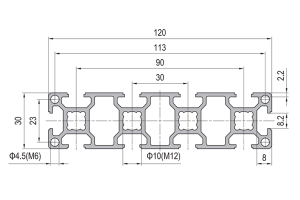 PG30 120 x 30 mm Ten Slot Aluminium Strut Profile Wide Multi Slot Rail
A 120 x 30 mm ten slot PG30 aluminium strut profile wide beam with…
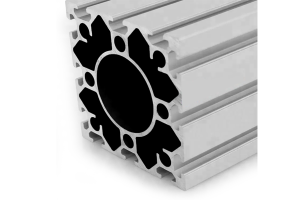 PG40 120×120 mm Twelve Slot Aluminium Strut Profile with 62 mm Centre Bore
A 120 x 120 mm twelve slot PG40 aluminium strut profile with a 62…
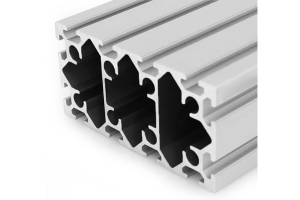 PG40 160×80 mm Twelve Slot Aluminium Strut Profile Heavy Beam for Gantry Frames
A 160 x 80 mm twelve slot PG40 aluminium strut profile heavy beam with…
 PG40 80×80 mm L-Shape Eight Slot Aluminium Strut Profile Corner Section
An 80 x 80 mm L-shape eight slot PG40 aluminium strut profile corner section…
