PG30 60×60 mm Eight Slot Aluminium Strut Profile Heavy Duty T-Slot Extrusion for Robot Pedestals
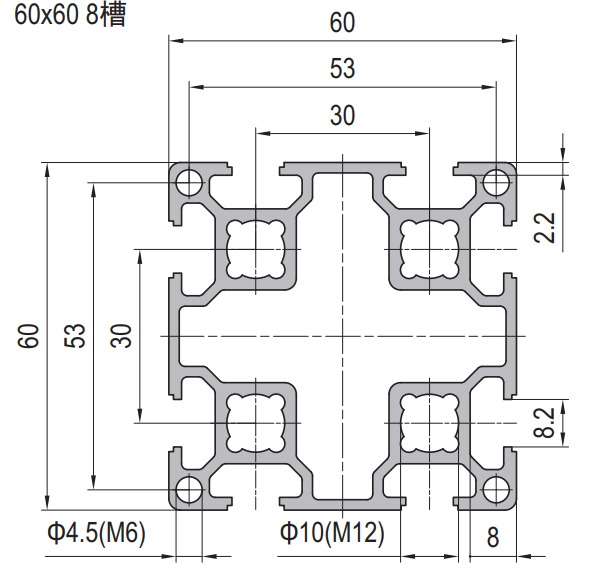
60 x 60 mm eight slot PG30 heavy duty aluminium strut profile in 6063-T5 with two 8.2 mm grooves per face. For robot pedestals, machine columns and heavy frames.
| Material | Aluminium |
|---|---|
| Alloy Grade | 6063-T5 |
| Temper | T5 |
| Section Size | 60 x 60 mm |
| Slot | 8 x 8.2 mm groove, 6 mm mouth, two per face, 53 / 30 mm pitch, M8 |
| Length | 6 m stock, cut to drawing to +/-0.5 mm |
| Tolerance | EN 755-9 / GB/T 6892, wall +/-0.15 mm |
| Surface | Mill finish / clear anodised / black anodised |
| MOQ | 300 |
| Lead Time | 18-28 days after deposit for mill finish |
| Loading Port | Shanghai / Ningbo |
| Supply Ability | 500 t per month |
| Payment Terms | T/T 30% deposit + 70% before shipment | L/C at sight |
| Trade Terms | FOB | CIF | EXW |
| Certifications | ISO 9001:2015 | EN 755-9 | RoHS | REACH |
Structural framing · PG30 heavy section
A 60 x 60 mm eight-slot strut profile is a large square aluminium extrusion with two T-slots on each of its four faces, on a 53 mm pitch across the faces and 30 mm between the centre pair. The groove is 8.2 mm with a 6 mm mouth, so it takes 30-series M8 hardware. The centre bore is Ø10 mm tapped M12, the corner holes are Ø4.5 mm tapped M6, and the wall is 2.2 mm at the flange and 8 mm through the web. It is the lighter of the two 60 x 60 systems — the 10.2 mm groove version uses heavier hardware and heavier walls. We extrude it in 6063-T5 and supply it cut, drilled, tapped or machined.
The reason to think carefully about a 60 x 60 is that the failure mode changes at this size. Bending stiffness rises with the cube of depth, so a 60 mm section is eight times stiffer in bending than a 30 mm one. Torsional stiffness does not rise anything like as fast — it depends on how the material is closed around the perimeter rather than how far it is from a single axis. On a large member the bending case therefore tends to pass easily while the torsion case quietly becomes the one that governs. A robot pedestal, a heavy column or a gantry leg loaded off-centre is a torsion problem dressed up as a bending problem.
At 60 mm, torsion starts to govern
It is worth being precise about why, because it explains a lot of surprises on large frames. For bending, what matters is how far the material sits from the neutral axis, so stiffness scales roughly with the cube of the section depth. Double the depth and the bending stiffness goes up about eight times. For torsion, what matters is how the material forms a closed loop around the section and how thick that loop is. Depth helps much less, and an open or slotted profile is far worse at torsion than a closed tube.
The practical consequence is that as sections get bigger, bending stops being the governing case and torsion takes over. A designer who checks only the bending case on a 60 x 60 member will find it passes comfortably, and will then be surprised when the machine rocks or the frame racks sideways under a load applied off the member’s centreline.
| Effect | How it scales | Consequence on a large section |
|---|---|---|
| Bending stiffness | With depth cubed | Rises very fast, rarely governs |
| Torsional stiffness | With loop thickness and closed perimeter | Rises slowly, often governs |
| Slotted perimeter | Reduces torsional stiffness | Slots on all four faces are worst case |
| Off-centre load | Becomes a torque | Must be checked separately |
| Cross-bracing | Restores the closed loop | Cheapest fix where torsion governs |
Why a robot pedestal is a torsion problem
A robot mounted on a pedestal applies three things to the member: a vertical load, a bending moment from the arm reaching out, and a torque when the arm rotates. The first two are easy to see on a drawing. The third is easy to miss, because it does not appear as a force at all — it appears as the machine moving when it should not.
The torque from an arm rotating at speed is also dynamic, and it reverses direction with every cycle. That is what makes it worse than a static case: the member is loaded one way and then the other, so any clearance in the joints is worked loose and the pedestal develops a wobble that grows over time. The section has to be chosen for the torque case and the joints have to be closed up properly, not merely tightened.
The practical rule: if a member carries a load whose line of action can move sideways — a robot arm, a cantilever, a rotating head, a door — check the torsion case before the bending case. On a 60 x 60 it will usually be the one that sets the size.
Anchoring the pedestal in four directions
The second reason the eight-slot layout is used on pedestals is anchoring. A pedestal that has to resist torque must be restrained in more than one direction, and the restraint has to reach the floor or the machine base without eccentricity. With two slots on each face there is a fixing position on all four sides of the section at the same height, so the base plate can be bolted down on every face and the torque is shared between them rather than taken by one pair of bolts.
- Bolt the base plate on all four faces Use both slots on each face and a plate that wraps the section. A pedestal bolted on two opposite faces only will rotate about the other pair, however tight the bolts are.
- Keep the anchors as close to the section as possible A long bracket between the pedestal and the floor bolt introduces a lever arm that converts the torque into a bending load on the bracket. A base plate that sits directly under the section avoids this.
- Cross-brace between the pedestal and the machine frame Where the pedestal is tall, one diagonal brace converts the frame back into a closed loop and does more for torsional stiffness than going up a section size.
- Check the joint, not just the section On a torsion-loaded member the joints are usually the weak point. Use four bolts per corner where the load reverses, and re-check the torque after the machine has run for a few hours.
Frequently asked questions
Is this the same as the 60 x 60 four-slot profile?
No. This section is built to the 30 series 8.2 mm groove with two slots per face, and is the lighter of the two 60 x 60 systems. The four-slot 60 x 60 uses the 10.2 mm groove and heavier walls. The hardware is not interchangeable.
Can it be used as a machine column?
Yes. It is a common choice for machine columns, robot pedestals and gantry legs. Where the column is tall, check both the buckling case and the torsion case, because a column loaded off-centre behaves as both.
What is the maximum height for a pedestal?
There is no fixed figure, because it depends on the torque and the restraint at the top. As a guide, keep a free-standing pedestal under about 1.2 m and brace anything taller back to the machine frame or the floor.
How much does it weigh?
Approximately 2.75 kg/m in 6063-T5 as a planning figure. Because the section is large, weight matters for handling and for the base design, so ask for the certified figure on the die you order.
Do you supply cut, drilled and tapped?
Yes. We cut to +/-0.5 mm, drill and tap the centre bore and the corner holes, and machine base plates and brackets to drawing. Send DWG, DXF, STEP or PDF.
Send the load and the moment, get a torsion check
Tell us the vertical load, the overhung moment and the pedestal height. We will check the torsion case and the buckling case, then quote cut lengths, machining and FOB pricing.
Request a QuoteRelated Products
 PG30 120 x 60 mm Twelve Slot Aluminium Strut Profile Heavy Frame Beam
A 120 x 60 mm twelve slot PG30 aluminium strut profile at about 5.20…
 PG40 40 x 40 mm Single Slot Aluminium Strut Profile Guide Rail Base
40 x 40 mm single-slot aluminium strut profile with one 10.2 mm groove on…
 PG40 40 x 40 mm Two Slot Type A Aluminium Strut Profile Guide Rail
40 x 40 mm Type A two slot asymmetric PG40 aluminium strut profile in…
 PG40 40 x 40 mm Two Slot Type B Aluminium Strut Profile Opposite Rail
40 x 40 mm Type B two-slot aluminium strut profile with two 10.2 mm…
 PG40 40 x 40 mm Four Slot Heavy Aluminium Strut Profile Standard Frame
40 x 40 mm heavy-wall four-slot aluminium strut profile with 10.2 mm grooves, 8…
 PG40 40×40 mm Four Slot Light Wall Aluminium Strut Profile Cost Optimised T-Slot Extrusion
40 x 40 mm four slot light wall PG40 aluminium strut profile in 6063-T5…
 PG40 40×40 mm R90 Quarter Round Aluminium Strut Profile Radius Corner Guard Frame Extrusion
40 x 40 mm R90 quarter round PG40 aluminium strut profile in 6063-T5 with…
 PG40 200 x 80 mm Fourteen Slot Aluminium Strut Profile Large Section Beam
A 200 x 80 mm fourteen slot PG40 aluminium strut profile at about 7.80…
