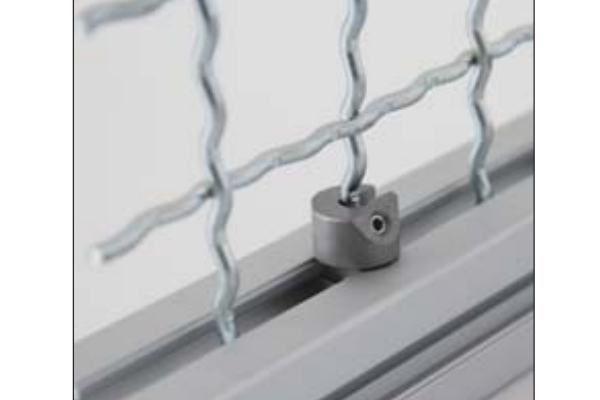
Panel Mounting Nut Block
Block that seats in the profile slot and provides a captive threaded hole at any position, so a panel or fitting bolts to the profile without drilling it.
| Material | Zinc-plated steel, stainless steel or aluminium |
|---|---|
| Alloy Grade | 6063-T5 on aluminium blocks |
| Temper | custom |
| Section Size | Fits 6, 8 and 10 mm slot profiles |
| Slot | M5 / M6 / M8 / M10 thread |
| Length | Block 15-40 mm depending on thread and variant |
| Tolerance | ±0.15 mm on thread position |
| Surface | Zinc plated, stainless or anodised |
| MOQ | 500 |
| Lead Time | 15-25 days after deposit |
| Loading Port | Shanghai / Ningbo |
| Supply Ability | 400,000 pcs per month |
| Payment Terms | T/T 30% deposit + 70% before shipment | L/C at sight |
| Trade Terms | FOB | CIF | EXW |
| Certifications | ISO 9001:2015 | ISO 14001 | RoHS | REACH |
Panel installation · Captive thread
A panel mounting nut block seats in the profile slot and provides a threaded hole at any position along it. A bolt through a panel or a fitting screws into that hole and clamps the panel to the profile face. The block is the reason the profile does not have to be drilled: the thread lives in the block, which can be slid to wherever it is needed.
This is the same principle as a T-nut, but as a block rather than a nut. The block has more thread depth, so it takes a higher bolt torque and a higher load, and it locates square in the slot rather than relying on the nut rotating into position. Where a panel or a fitting has to be bolted to a profile with a real load on it, the block is the stronger choice.
The block, the nut and the bolt
Three parts make the joint: the block, which sits in the slot and carries the thread; the bolt, which passes through the panel or fitting; and the panel or fitting itself, which is clamped between the bolt head and the profile face. Tightening the bolt draws the block against the inside of the slot and clamps the panel to the profile.
The block’s advantage over a plain T-nut is thread depth and squareness. A T-nut is thin, so its thread engagement is limited and it can tilt as the bolt is tightened. A block is a solid piece with a full-depth thread, so it takes more torque and it stays square in the slot, which keeps the panel aligned.
| Block size | Slot | Thread | Max torque | Load per point |
|---|---|---|---|---|
| M5 block | 6 mm | M5 | 4 Nm | Light panel |
| M6 block | 8 mm | M6 | 8 Nm | General panel |
| M8 block | 8 mm | M8 | 20 Nm | Heavy panel or fitting |
| M8 block long | 8 mm | M8 | 20 Nm | Panel with a gasket |
| M10 block | 10 mm | M10 | 35 Nm | Heavy fitting |
- The thread lives in the block. Nothing is tapped into the profile, so the member can be re-used and the slot stays intact along its whole length.
- The position is adjustable. The block slides in the slot, so a panel can be positioned, removed and re-positioned without new holes.
- It is square in the slot. The block has flats that engage the slot walls, so it cannot rotate as the bolt is tightened — a plain T-nut can.
- Thread depth gives torque capacity. The block takes a higher torque than a T-nut of the same thread, which matters where the panel is thick or a gasket has to be compressed.
Practical point: count the fixings before you order. A panel with four corner fixings and no mid-edge support will rattle in the middle, so the block count for a panel is usually two per edge rather than one per corner. We will count the fixings from your panel drawing on request.
- Confirm the slot and the thread The block is sized to the slot and the thread is chosen for the load. A 6 mm slot takes an M5 block; an 8 mm slot takes M6 or M8.
- Slide the block into the slot Insert the block from the end of the profile, or through a slot opening, and slide it to the fixing position.
- Offer up the panel Offer the panel to the profile and align the fixing holes with the block threads. Slide the blocks to suit if the holes are not exactly where expected.
- Fit the bolts and tighten Start the bolts by hand, then tighten to the torque for the thread size. Do not over-torque — the block thread is the limit.
- Check the panel is seated Look along the panel edge. A gap means a block has not drawn up square, which usually means a bolt is cross-threaded.
Frequently asked questions
How is this different from a T-nut?
A block has a full-depth thread and flats that engage the slot, so it takes more torque and stays square. A T-nut is thinner, engages less thread and can rotate as the bolt is tightened.
Can the block be fitted after the frame is built?
Yes, it slides in from the end of the profile or through a slot opening, and it can be positioned anywhere along the slot.
What torque can the block take?
Around 8 Nm for an M6 block, 20 Nm for M8 and 35 Nm for M10. The block thread is the limit, so do not over-torque.
How many blocks does a panel need?
Two per edge is the usual figure, including the mid-edge positions. A panel with only corner fixings will rattle in the middle.
Are the blocks available in stainless?
Yes, for wash-down and outdoor panels, with stainless bolts to match so the fixing does not corrode.
Send the panel drawing and the fixing points
Tell us the panel, the fixing pattern and the load at each point. We will recommend the block, the thread size and the count, and return FOB pricing within one working day.
Request a QuoteRelated Products
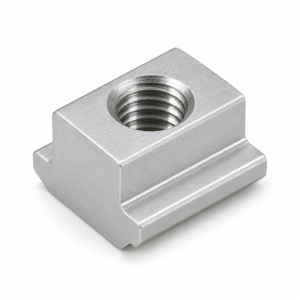 T-Slot Nut 20 Series M5 Hammer Nut for 20×20 Aluminium Extrusion
M5 hammer-head T-slot nut for the 6 mm groove of 20 x 20 mm…
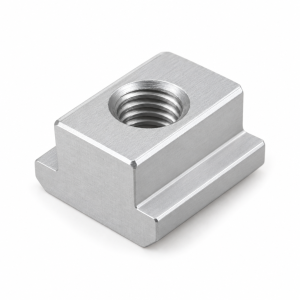 T-Slot Nut 30 Series M6 Hammer Nut for 30×30 Aluminium Extrusion
M6 hammer-head T-slot nut for the 8 mm groove of 30 x 30 mm…
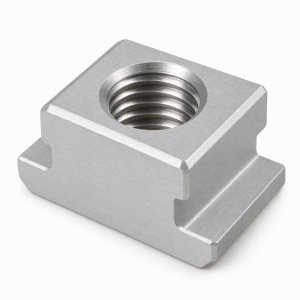 T-Slot Nut 40 Series M8 Hammer Nut for 40×40 Aluminium Extrusion
M8 hammer-head T-slot nut for the 8 mm groove of 40 x 40 mm…
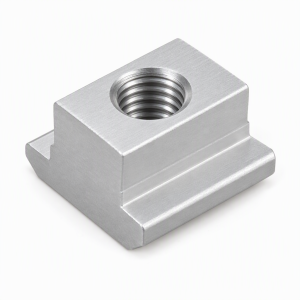 T-Slot Nut 45 Series M8 Hammer Nut for 45×45 Aluminium Extrusion
M8 hammer-head T-slot nut for the 10 mm slot of 45 x 45 mm…
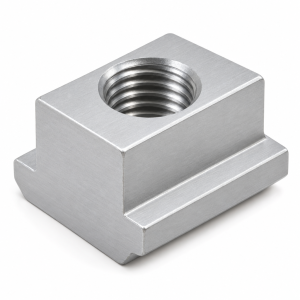 T-Slot Nut 50 Series M10 Hammer Nut for 50×50 Aluminium Extrusion
M10 hammer-head T-slot nut for the 10 mm groove of 50 x 50 mm…
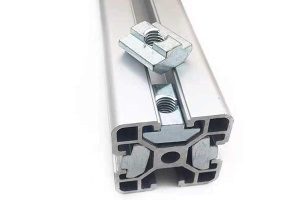 T-Nut and Bolt Set Aluminium Profile Fastener Kit M5 M6 M8 20-40 mm T-Slot Hardware
Matched T-nut, bolt and washer set for aluminium profile frames in M5, M6 and…
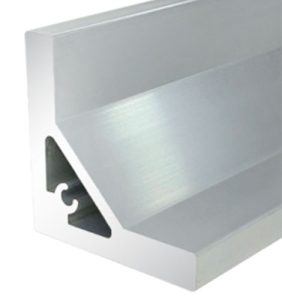 Aluminium Angle Profile 35 x 35 x 4 mm Panel Edge Trim for Guarding
35 x 35 x 4 mm aluminium angle profile with an inner corner slot,…
 Aluminium Profile Sliding Door 40 Series 8 mm Slot for Machine Enclosures
Sliding door leaves framed in 40 series aluminium profile for machine enclosures. Top hung…
