Strut Aluminium Profile 45×45 mm 4-Slot Standard T-Slot Extrusion
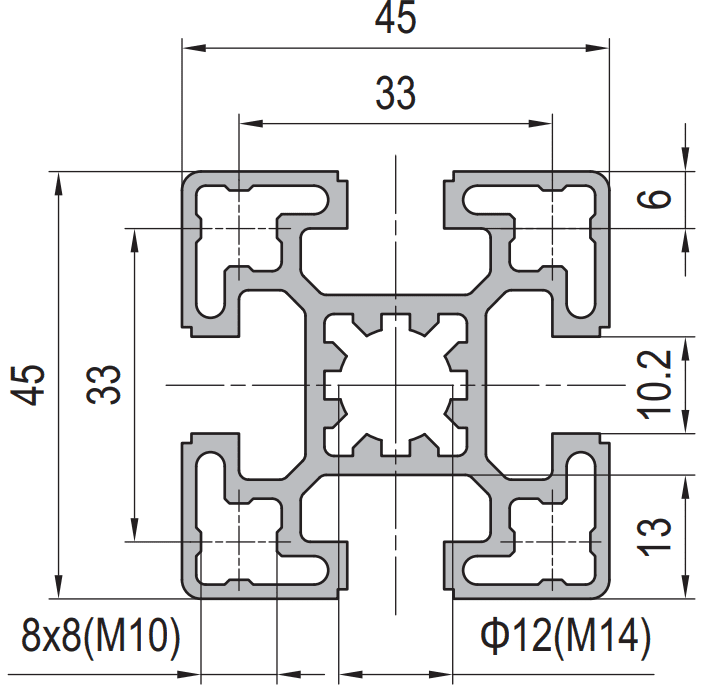
45 x 45 mm four-slot standard T-slot strut aluminium profile in 6063-T5 with walls about 2.0 mm and a weight of about 2.55 kg/m. A 33 mm slot pitch, M10 slot nuts and a O 12 mm centre bore tapped M14 make it the default member of the 45-series module for equipment retrofit and maintenance.
| Material | Aluminium |
|---|---|
| Alloy Grade | 6063-T5 |
| Temper | T5 |
| Section Size | 45 x 45 mm |
| Slot | 8 x 8 mm groove, M10 slot nuts, 4 faces, 33 mm pitch |
| Length | 6 m stock, cut to drawing to plus or minus 0.5 mm |
| Tolerance | EN 755-9 / GB/T 6892, wall plus or minus 0.15 mm |
| Surface | Mill finish / clear anodised / black anodised |
| MOQ | 500 |
| Lead Time | 20-30 days after deposit for mill finish |
| Loading Port | Shanghai / Qingdao |
| Supply Ability | 650 t per month |
| Payment Terms | T/T 30% deposit + 70% before shipment | L/C at sight |
| Trade Terms | FOB | CIF | EXW |
| Certifications | ISO 9001:2015 | EN 755-9 | RoHS | REACH |
Standard wall · 45 series
A 45 x 45 four-slot standard strut profile is an extruded aluminium T-slot section with a 45 mm square envelope, four slots on a 33 mm pitch, M10 slot nuts, a O 12 mm centre bore tapped M14, a wall of about 2.0 mm and a weight of about 2.55 kg/m. Its second moment of area is about 15.5 cm4. It is the default member of the 45-series module, and it is used wherever a frame has to match equipment that was designed on that module.
The point that matters commercially is that 45 series is a separate system, not a larger version of 40 series. The two envelopes are only 5 mm apart, which is why they are constantly confused, but the slot pitch is 33 mm against 30 mm and the slot class is M10 against M6. Nothing in the accessory range crosses over: nuts, cover strip, butt connectors, joining plates and panel fixings are all made to one module. A frame that mixes the two will assemble with a spanner and fail in service.
Why a 45 mm module exists at all
If 40 x 40 is the most widely used framing section in the world, a 45 x 45 looks like an unnecessary neighbour. It is not. The 45 mm module came out of European machine building practice, where equipment envelopes, guard heights and panel thicknesses were already set in millimetres on a 45 mm grid. A machine builder who has designed ten generations of machines around a 45 mm module does not change the module to suit a supplier’s catalogue; the catalogue is expected to have the module.
That is the whole commercial case. When you buy a European machine, extend it, repair it or rebuild its guarding, you inherit its framing module. The question is never “which section is cheaper”, it is “which section fits the brackets, covers and panel cut-outs that are already on the machine”.
How to tell which system you are holding
Two sections five millimetres apart are hard to separate by eye, and a tape measure across the outside is not reliable enough because the extrusion is rarely exactly on nominal after anodising. The decisive measurement is the slot pitch: the centre-to-centre distance between two opposite slot mouths. It is 33 mm on the 45 series and 30 mm on the 40 series, and a caliper settles it in seconds.
| What to check | 40 series | 45 series | Why it decides the question |
|---|---|---|---|
| Envelope | 40 x 40 mm | 45 x 45 mm | Only 5 mm apart, not reliable by eye |
| Slot pitch | 30 mm | 33 mm | The decisive measurement |
| Slot nut class | M6 | M10 | Decides which nuts and bolts you can buy |
| Slot mouth | 8 mm | 8 mm | Looks identical, which is the trap |
| Slot cover strip | 40-series width | 45-series width | Will not clip into the other |
| Butt connector | 40-series body | 45-series body | Sized to the envelope, not the slot |
Measure the pitch, not the width. A slot mouth that looks the same on both sections is exactly why so many people buy the wrong nuts. Take the centre-to-centre distance across two opposite slots: 33 mm means 45 series, 30 mm means 40 series.
Where mixing the two actually fails
Mixing 40 and 45 in one frame is not a cosmetic problem, and it does not fail at the moment of assembly. It fails later, in four specific places.
The three neighbouring modules, side by side
It is worth knowing that 45 is not the only “almost 40” module. The three modules that sit next to each other in European practice each have their own pitch and their own accessory range, so a mixed machine can carry all three at once.
| 40 series | 30 mm pitch, M6 slot nuts, 40 x 40 mm envelope |
| 45 series | 33 mm pitch, M10 slot nuts, 45 x 45 mm envelope |
| 50 series | 35 mm pitch, M8 slot nuts, 50 x 50 mm envelope |
| Shared between them | Nothing. Not nuts, not strip, not connectors |
Inheriting a machine: what to do first
- Measure the pitch on three members Measure on three different members, not one. Machines are often extended over their life, and a machine that started on one module frequently carries a second module added by a later contractor.
- Identify the nut from a sample Take one nut out of the frame and check the thread. M6 points to 40 series, M10 to 45 series, M8 to 50 series. The nut is a more reliable identifier than the section because it cannot be confused by anodising thickness.
- Match the existing module for new members Order new members on the module already on the machine, even if a neighbouring module is cheaper per metre. A 5 mm module mismatch costs more in one adapter plate than the frame saves in a year.
- Ask for the die drawing before the first order Even inside one module, groove depth and lip geometry vary between suppliers. Send the section drawing or a sample nut and we will confirm retention in our groove before the material is cut.
- Keep one module per sub-assembly If a machine genuinely has to carry two modules, keep each module inside its own sub-assembly and join the sub-assemblies with a drilled plate. That confines the mismatch to one interface instead of spreading it through the frame.
Frequently asked questions
Can I use 40-series accessories on a 45 x 45 profile?
No. The slot pitch is 33 mm against 30 mm and the slot class is M10 against M6, so nuts do not retain, cover strip does not clip and butt connectors are sized to a different envelope. Keep one module per sub-assembly.
How do I tell a 45 x 45 from a 40 x 40 quickly?
Measure the centre-to-centre distance between two opposite slot mouths. It is 33 mm on the 45 series and 30 mm on the 40 series. The envelope is only 5 mm different, so the outside measurement is not reliable.
What nuts does this profile take?
M10 slot nuts in the 8 x 8 mm groove, and an M12 through-bolt or an M14 thread in the O 12 mm centre bore. M10 nuts are the quickest way to confirm that a frame is 45 series rather than 40 series.
Do you supply the matching 45-series accessories?
We supply slot nuts, cover strip, angle brackets, joining plates, butt connectors, feet and panel fixings made to the 45-series module, so a frame can be built or extended without an adapter plate.
Can you match the geometry of an existing supplier’s 45 series?
Send the section drawing, or a short sample and one of the nuts, and we will check the groove depth and lip geometry against our die. Where the geometry differs we will say so before quoting rather than after delivery.
Send the section drawing or a sample, we will confirm the module
Tell us the slot pitch you measured, or send a short sample with one of the nuts, and we will confirm whether the frame is 40, 45 or 50 series and check the groove against our die. We then quote the members and the matching accessories as one package, cut, deburred and bagged by assembly.
Request a QuoteRelated Products
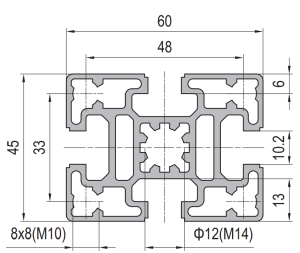 Strut Aluminium Profile 45×60 mm 4-Slot Column T-Slot Extrusion
45 x 60 mm four-slot rectangular T-slot strut aluminium profile in 6063-T5, about 3.3…
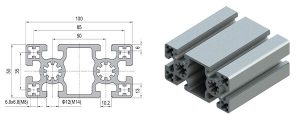 Strut Aluminium Profile 50×100 mm 2-Slot Heavy T-Slot Beam Extrusion
50 x 100 mm heavy two-slot T-slot strut aluminium beam in 6063-T5, about 6.2…
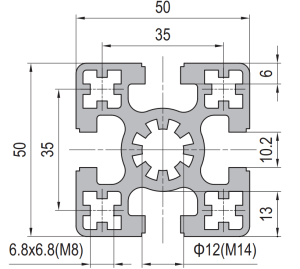 50 x 50 mm Four Slot Aluminium Strut Profile Heavy Frame Cross Member
50 x 50 mm four slot T-slot strut aluminium profile in 6063-T5, about 3.1…
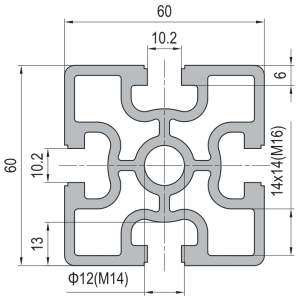 60 x 60 mm Four Slot Aluminium Strut Profile Main Machine Frame Column
60 x 60 mm four-slot T-slot strut aluminium profile in 6063-T5, about 4.3 kg/m…
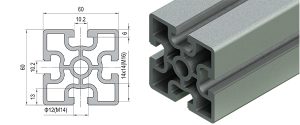 Strut Aluminium Profile 60×60 mm Heavy Duty T-Slot Extrusion M16 Bore
60 x 60 mm heavy duty four-slot T-slot strut aluminium profile in 6063-T5 with…
 PG15 Strut Aluminium Profile 15×15 mm Light T-Slot Extrusion
PG15 15 x 15 mm single-slot T-slot strut aluminium profile in 6063-T5, about 0.48…
 Aluminium Conduit Profile 40×40 mm Cable Duct T-Slot Enclosure
40 x 40 mm aluminium conduit profile in 6063-T5 with a 32 x 8.2…
 Aluminium Conduit Profile 40×80 mm Large Cable Duct Enclosure
40 x 80 mm aluminium conduit profile in 6063-T5 with a 66 x 11…
