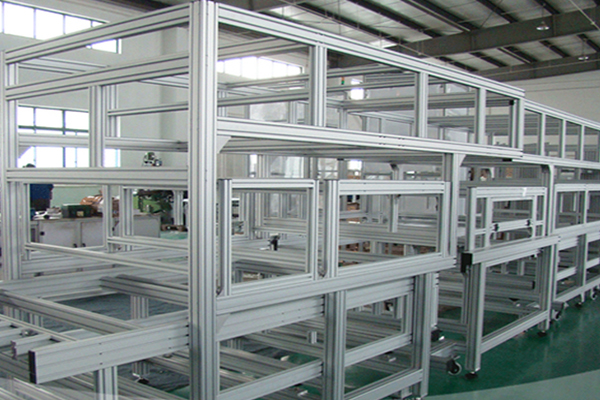
Aluminium Framing Extrusion Kit 40×40 mm 40 Series Cut List for Machine Frames
A cut-to-length aluminium framing extrusion kit in the 40 series: profile cut to a list, corner brackets, T-slot hardware, feet, end caps, a cutting list and an assembly drawing, bagged by joint.
| Material | Aluminium |
|---|---|
| Alloy Grade | 6063-T5 |
| Temper | T5 |
| Section Size | 40 series, 40 x 40 mm and 40 x 80 mm |
| Slot | 8 mm groove, M6 and M8 slot nuts, 40 mm module |
| Length | Cut from 6 m stock to the cutting list, +/-0.5 mm |
| Tolerance | EN 755-9 / GB/T 6892, wall +/-0.10 mm, cut +/-0.5 mm |
| Surface | Mill finish / clear anodised / black anodised |
| MOQ | 20 |
| Lead Time | 18-28 days after deposit and released drawing |
| Loading Port | Shanghai / Ningbo |
| Supply Ability | 450 t per month |
| Payment Terms | T/T 30% deposit + 70% before shipment | L/C at sight |
| Trade Terms | FOB | CIF | EXW |
| Certifications | ISO 9001:2015 | EN 755-9 | RoHS | REACH |
Turnkey kit · 40 series machine frame
An aluminium framing extrusion kit is a machine frame delivered as a set of parts rather than as a pile of stock lengths. You send a drawing; we send the profile cut to length, the corner brackets, the T-slot nuts and bolts, the end caps and slot covers, the feet, a cutting list and an assembly drawing, all bagged by joint. A frame 1,500 mm wide, 1,000 mm deep and 2,000 mm tall is about 15.5 m of 40 x 40 mm profile, 4.7 m of 40 x 80 mm profile, 20 corner brackets and 64 T-slot fixings, and it weighs about 38 kg of aluminium.
What you are buying with a kit is not the profile. Profile is a commodity and the price per metre barely moves between suppliers. What you are buying is that the parts fit together on the first attempt: one cutting tolerance instead of three, one hardware range that is guaranteed to match the groove, one shipment instead of four, and one place to go when something is 3 mm out. The trade is that a kit only pays once the design is frozen, because after the cutting list is issued a change costs the whole bar rather than the difference.
What is actually in the box
A kit is defined by the list of things that arrive with the profile, and the difference between a good kit and a box of extrusion is how complete that list is. The profile is the easy part. The parts that decide whether the frame goes together on the first attempt are the small ones, and they are the ones that get left out when a kit is quoted on a price per metre.
A worked bill of materials
Take a machine frame 1,500 mm wide, 1,000 mm deep and 2,000 mm tall, with 40 x 40 mm posts and 40 x 80 mm rails on edge at the top. The rails sit between the posts, so the clear span is the frame width minus two post widths: 1,500 minus 80 gives 1,420 mm on the long sides and 1,000 minus 80 gives 920 mm on the short sides.
| Member | Section | Cut length | Qty | Total length |
|---|---|---|---|---|
| Post | 40 x 40 | 2,000 mm | 4 | 8.00 m |
| Top rail, long side | 40 x 80 on edge | 1,420 mm | 2 | 2.84 m |
| Top rail, short side | 40 x 80 on edge | 920 mm | 2 | 1.84 m |
| Mid rail | 40 x 40 | 1,420 mm | 2 | 2.84 m |
| Bottom rail, long side | 40 x 40 | 1,420 mm | 2 | 2.84 m |
| Bottom rail, short side | 40 x 40 | 920 mm | 2 | 1.84 m |
| Total 40 x 40 | 15.52 m | |||
| Total 40 x 80 | 4.68 m |
At about 1.6 kg/m for standard wall 40 x 40 and about 2.9 kg/m for 40 x 80 on edge, that is roughly 25 kg plus 14 kg, so about 38 kg of aluminium in the frame. The hardware is 20 corner brackets, about 64 T-slot fixings counted by joint, four levelling feet, end caps for every exposed profile end, and slot covers for the grooves that will be walked past by a machine operator.
The bill of materials is the quote. A price per metre for profile tells you almost nothing about what a finished frame costs, because the hardware, the brackets, the cutting, the kitting and the drawing are all real cost and none of them appear in a per metre figure. Send a drawing and we will quote the frame, not the profile.
The nesting table is where the price comes from
Profile is bought in 6 m bars and cut down. How well the members nest into a bar is the single biggest variable in a kit price, and it is why two frames of the same weight can quote very differently. A 2,000 mm post nests three to a bar with no offcut at all. A 1,420 mm rail nests four to a bar and leaves 320 mm. A 920 mm rail nests six to a bar and leaves 480 mm.
| Member | Cut length | Pieces per 6 m bar | Offcut per bar | Nesting |
|---|---|---|---|---|
| Post | 2,000 mm | 3 | 0 mm | Exact |
| Long rail | 1,420 mm | 4 | 320 mm | Good |
| Short rail | 920 mm | 6 | 480 mm | Good |
| A member at 1,550 mm | 1,550 mm | 3 | 1,350 mm | Poor |
| A member at 2,900 mm | 2,900 mm | 2 | 200 mm | Good |
Look at the fourth row. A member 1,550 mm long nests three to a bar and throws away 1,350 mm every time, which is a quarter of the bar straight into scrap. Changing that member to 1,500 mm does not help much, but changing it to 1,450 mm still nests four to a bar with 200 mm left, and the material cost drops by a quarter for that member. That is the sort of thing we check before quoting, and it is worth knowing before you fix the last few millimetres of a design.
What a design change costs
The instinct is that changing a member from 1,420 mm to 1,450 mm costs 30 mm of profile. It does not. Once the bar has been cut, the 1,420 mm members are scrap and the bar has to be re-cut, so the change costs the whole bar, plus the saw time, plus the re-kitting, plus a second shipment if the first one has already left. On a twenty metre frame that is a change worth several percent of the total.
This is the real argument for freezing the design before the cutting list is issued, and it is also the argument against ordering a kit too early. If the design is still moving, order stock lengths and cut locally, accept the looser tolerance and the extra hardware sourcing, and come back for a kit when the drawing stops changing. A kit ordered at the right moment saves money. A kit ordered while the drawing is still live is the most expensive way to buy profile there is.
- Freeze the drawing, then release the cutting list. Every dimension on the drawing has to be final before the first cut. Changes after that are charged at the bar, not at the difference.
- Check the nesting before the final fix. Send the cut list and we will tell you which member lengths are costing you a quarter of a bar. Moving a length by 50 mm is free at the drawing stage and expensive afterwards.
- Decide flat pack or pre-assembled bay. Flat pack is cheaper to ship and to store, and it lets the frame go through a doorway. A pre-assembled bay arrives square and is faster on site, and costs more in freight because it takes volume.
- Decide what gets a panel before the kit ships. Panel retainers, gaskets and glazing beads are kitted with the frame. Adding them later means a second shipment for parts that cost very little.
What we need to quote a kit
- A drawing, or a sketch with the overall size, the section sizes and the node positions. DWG, DXF, STEP, IGES and PDF all work.
- What the frame has to carry, and whether any member spans between supports rather than between posts.
- The environment: indoor, wash-down, coolant mist, outdoor. It decides the finish and whether the fasteners need to be stainless.
- Quantity, and whether the frames repeat. A repeat frame is worth setting up once.
- The finish: mill, clear anodised or black anodised, and any colour match.
- Delivery terms, so the freight is quoted with the frame rather than discovered afterwards.
The mistakes that cost a day on site
| Mistake | What happens | How the kit prevents it |
|---|---|---|
| Bolt length not matched to the bracket | The bolt bottoms out in the groove and strips the slot on tightening | Fixings bagged by joint with the bolt length already matched |
| Brackets from a different series | The bracket does not sit in the groove, so the joint never closes | Brackets supplied with the same profile order, from the same range |
| Members not labelled | Assembly stops while someone measures every part against the drawing | Every member labelled with its position reference from the cut list |
| No end caps or slot covers | Open profile ends and open grooves fill with swarf and coolant | Caps and covers kitted with the frame, not sold separately |
| Cut list released before the design froze | The whole bar is re-cut and the first shipment is wasted | Cutting starts only against a released, frozen drawing |
Flat pack, pre-assembled or somewhere between
Kits are normally supplied flat packed, which means profile, hardware and drawing in bundles with everything labelled. That is the cheapest way to move a frame and the only way to get a large frame through a standard doorway. At the other end, we can supply the frame assembled and squared, which costs more in freight but removes the assembly labour and the risk of an out-of-square frame.
The middle option is usually the right one for a machine frame. Supply the four sides as pre-assembled rectangles, squared on a jig, and let the customer bolt the four rectangles together and drop the top rails in. That gets the squareness controlled at the factory, where the jig is, while keeping the shipment flat.
Send the drawing and we will quote the frame
Send the frame drawing or a sketch with the overall size, the sections and the node positions. We will return a cutting list, a hardware list, an assembly drawing and a nesting check, and we will not start cutting until the drawing is released as final.
Request a QuoteRelated Products
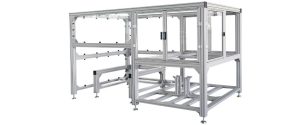 Aluminium Profile Machine Guard Frame 40 x 40 mm Safety Enclosure
40 x 40 mm T-slot aluminium machine guard frame for safety fences and enclosures,…
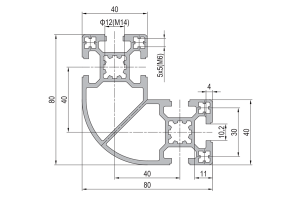 PG40 80×80 mm R90 Six Slot Aluminium Strut Profile Rounded Corner Column
80 x 80 mm L section aluminium corner column with a swept R90 outer…
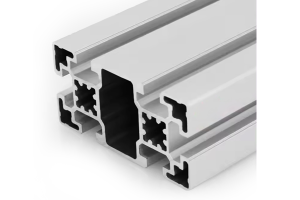 PG40 40 x 40 mm Eight Slot Aluminium Strut Profile High Density Frame
40 x 40 mm eight-slot aluminium strut profile with two T-slots on each face…
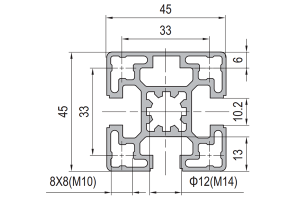 PG45 45 x 45 mm Three Slot Aluminium Strut Profile Asymmetric Rail
45 x 45 mm three-slot aluminium strut profile with one solid flat face for…
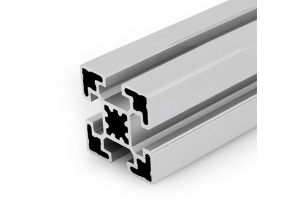 PG45 45 x 45 mm Four Slot Aluminium Strut Profile Standard Frame
45 x 45 mm four-slot aluminium strut profile with 10.2 mm grooves, M8 slot…
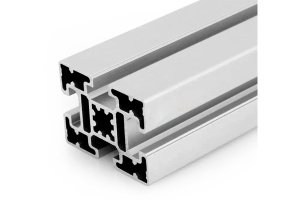 PG45 45 x 60 mm Four Slot Aluminium Strut Profile Rectangular Beam
45 x 60 mm four-slot rectangular aluminium strut profile with directional bending stiffness. Strong…
 Aluminium Pipe 28 mm OD Round Tube Profile for Lean Pipe Systems
28 mm OD round aluminium tube for lean pipe systems, conveyor rollers and rotating…
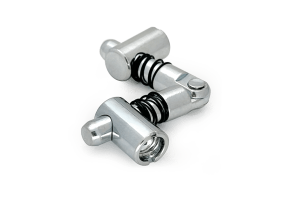 Miter Connector Model C 90 Degree Corner Joint for 40 mm Aluminium Profiles
Miter connector Model C for 90-degree corner joints on aluminium T-slot profiles. Internal tie…
