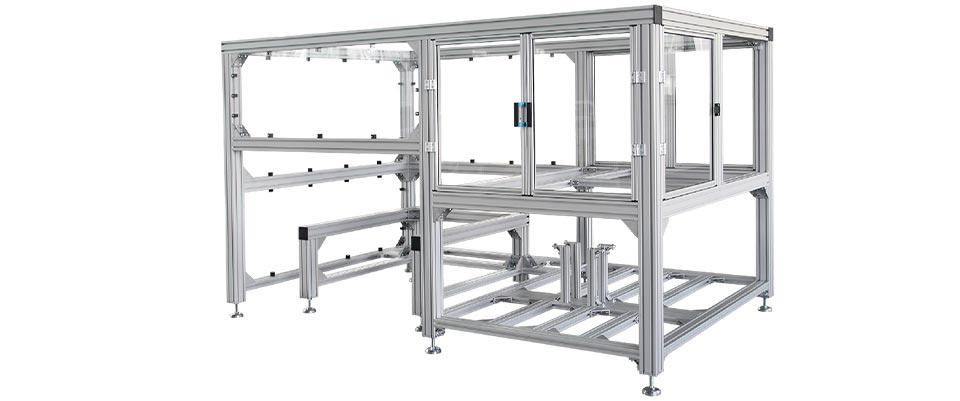
Aluminium Profile Machine Guard Frame 40 x 40 mm Safety Enclosure
40 x 40 mm T-slot aluminium machine guard frame for safety fences and enclosures, built to ISO 14120 principles with mesh or polycarbonate infill.
| Material | Aluminium |
|---|---|
| Alloy Grade | 6063-T5 |
| Temper | T5 |
| Section Size | 40 x 40 mm post and rail |
| Slot | 8 mm groove, M6 and M8 slot nuts, 30 mm slot centres across the corner |
| Length | Cut to drawing, post and rail to +/-0.5 mm |
| Tolerance | EN 755-9, wall +/-0.15 mm |
| Surface | Mill finish / clear anodised / black anodised |
| MOQ | Made to order; single frames from stock components |
| Lead Time | Typically 2 to 3 weeks for the cut and machined frame, plus a week for anodising |
| Loading Port | Shanghai, Ningbo, Qingdao |
| Supply Ability | In-house cutting, machining and assembly capacity for guard frames |
| Payment Terms | T/T 30 per cent deposit, balance against copy of bill of lading |
| Trade Terms | FOB, CIF, CFR, EXW |
| Certifications | Mill certificate to EN 10204 3.1 on request, RoHS and REACH declarations |
01What is an aluminium machine guard frame?
Is a guard frame just a fence?
No. A guard is a safety device, not a fence. It must keep an operator’s hand or body part from reaching a hazard, which is a dimensional requirement set out in ISO 14120. The aluminium frame is the structural part; the mesh or panel infill and the door interlocks are what actually make it a guard.
What is ISO 14120?
It is the standard for the design of machine guards. The key principle is that the guard must prevent access to the hazard, which means the openings must be small enough, and the distance between the guard and the hazard large enough, that a hand or finger cannot reach through. Section 04 gives the opening sizes.
Why aluminium T-slot rather than welded steel?
Aluminium T-slot goes together without welding and without heat, so it is faster to build and easy to modify when the machine changes. It is lighter than steel, does not rust, and the slots carry the mesh or panels directly. The trade is that aluminium is softer than steel, so the frame must be sized for the expected impact.
02Frame data
| Item | Value | Note |
|---|---|---|
| Post and rail | 40 x 40 mm | 40 series T-slot |
| Groove | 8 mm | 30 mm slot centres across the corner |
| Fixings | M6 and M8 slot nuts | mesh clips and panel retainers |
| Wall | light / standard / heavy | weight 1.30 to 2.35 kg/m |
| Infill | mesh or polycarbonate | in the slot or a panel retainer |
| Doors | hinged, with interlock | switch wired to the safety circuit |
| Alloy | 6063-T5 | EN AW-6063 |
| Standard | ISO 14120 | guard design principles |
03The four jobs a guard does
A machine guard does four things at once, and each one drives part of the design.
- Contain the hazard: the infill and frame keep fingers, hands and tools away from moving parts.
- Absorb a light impact: if a part is ejected or an operator leans on the guard, the frame and infill must hold.
- Allow visibility: the mesh or clear panel lets the operator see the process, so the guard does not have to be opened to watch it.
- Control access: the hinged door with an interlock stops the machine when the guard is opened.
The frame is sized for the first two jobs; the infill and door are specified for the second two.
04ISO 14120 opening sizes and distances
The guard works by making the openings small enough that a hand cannot reach through to the hazard. ISO 14120 links the opening size to the minimum distance between the guard and the hazard.
| Opening size (mm) | Min distance to hazard (mm) | Typical infill |
|---|---|---|
| up to 4 | 0 | solid panel |
| 4 to 8 | 15 | fine mesh |
| 8 to 25 | 120 | standard mesh |
| 25 to 40 | 200 | coarse mesh |
| over 40 | 850 or more | not suitable for direct guarding |
The distances are indicative and depend on the specific hazard. For a safety-critical guard, an engineer should verify the opening size and distance against the current ISO 14120 edition for the machine in question. This page is a design guide, not a certification.
05Impact and load the frame can take
The 40 x 40 mm frame is sized for light to medium impact. It will hold a mesh or polycarbonate panel and resist an operator leaning on it, but it is not a crash barrier.
| Wall | Weight (kg/m) | Typical use |
|---|---|---|
| light | 1.30 | static guards, no impact expected |
| standard | 1.8 | guards with occasional contact or lean |
| heavy | 2.35 | guards near ejecting parts or moving loads |
If the hazard can eject a part at high speed, the infill and frame must be engineered for that energy. In that case, a welded steel guard or a polycarbonate panel rated for the impact is usually the right answer.
06Aluminium T-slot vs welded steel guard
Choose aluminium T-slot
- The guard must be built and modified quickly
- No welding is available or wanted
- The machine changes often and the guard must follow
- Corrosion resistance matters (food, clean room)
- Light weight matters for access and transport
Choose welded steel
- The hazard can eject parts at speed
- The guard must resist high impact
- Fire resistance is required
- The guard is permanent and rarely modified
- Cost at scale favours welded steel for large enclosures
07Failure modes to design out
| What goes wrong | Why it happens | Design it out by |
|---|---|---|
| Hand reaches through the opening | opening size or distance to hazard is wrong | verify opening and distance against ISO 14120 for the hazard |
| Door bypasses the interlock | the switch is not wired into the safety circuit | wire the interlock into the machine’s safety-rated stop circuit |
| Frame deforms on impact | the wall is too light for the expected impact | use the heavy wall near ejecting parts, or a welded steel guard |
| Mesh pulls out of the slot | the mesh clip is too light for the tension | use mesh retainers rated for the panel tension |
| Guard is removed and not replaced | the guard is awkward to open and operators bypass it | make the door hinged and counterbalanced so it is easy to use |
08What to check before you order
Procurement checklist for the machine guard frame
- Confirm the hazard: what the guard protects against, and the required opening size and distance per ISO 14120.
- Confirm the frame wall: light, standard or heavy, based on the expected impact.
- Confirm the infill: mesh or polycarbonate, and its panel size and rating.
- Confirm the door: hinged or sliding, and whether an interlock switch is needed.
- Confirm the fixings: M6 or M8 slot nuts for the mesh and panel retainers.
- Confirm the dimensions and cut list for the post and rail frame.
09Terms used on this page
- ISO 14120
- The international standard for the design of machine guards, including the prevention of access to hazards.
- Infill
- The mesh or panel that fills the openings of the guard frame and blocks access.
- Interlock
- A switch on the guard door that stops the machine when the door opens.
- Hazard
- The moving part or energy source the guard protects against.
- Opening size
- The largest gap in the infill, which determines whether a hand or finger can reach through.
10Questions buyers ask
Does the guard frame meet ISO 14120?
The frame is designed to the principles of ISO 14120, but compliance is machine-specific. An engineer must verify the opening size, distance and interlock for the hazard in question. We build to your specification.
Can the frame carry a polycarbonate panel?
Yes. The panel sits in the slot or in a panel retainer, fixed with M6 or M8 slot nuts. Polycarbonate gives full visibility and better containment than mesh.
Is aluminium strong enough for a machine guard?
For light to medium impact, yes, when sized correctly. For hazards that can eject parts at speed, use the heavy wall or a welded steel guard.
Can I add a door later?
Yes. The T-slot system lets you add a hinged door and an interlock without rebuilding the frame.
What is the frame weight?
1.30 to 2.35 kg/m depending on the wall you select.
Can it be anodised?
Yes. Anodising is common for clean room and food environments, where the frame must be easy to clean.
What we need to quote the guard frame
- The hazard description and the required opening size and distance.
- The frame dimensions and the wall (light, standard or heavy).
- The infill: mesh or polycarbonate, and its panel size and rating.
- The door details: hinged or sliding, with or without interlock.
- The finish: mill or anodised.
- The quantity and any certification requirement.
Send those six items and the quotation comes back with the frame, infill, door hardware and finish broken out separately. Browse the full aluminium profile catalogue and the 40 series aluminium profiles range.
Need a machine guard frame quoted to your safety spec?
Send the hazard, dimensions, infill and door details. We quote the frame, infill and hardware as separate lines.
Request a quotationRelated Products
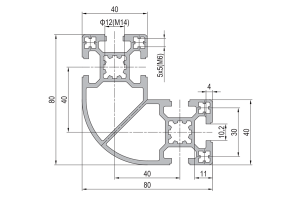 PG40 80×80 mm R90 Six Slot Aluminium Strut Profile Rounded Corner Column
80 x 80 mm L section aluminium corner column with a swept R90 outer…
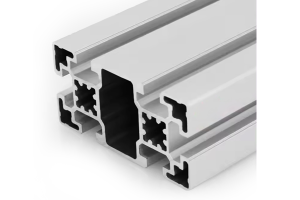 PG40 40 x 40 mm Eight Slot Aluminium Strut Profile High Density Frame
40 x 40 mm eight-slot aluminium strut profile with two T-slots on each face…
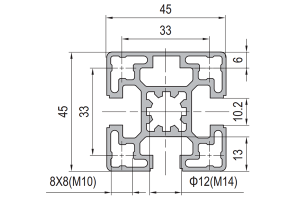 PG45 45 x 45 mm Three Slot Aluminium Strut Profile Asymmetric Rail
45 x 45 mm three-slot aluminium strut profile with one solid flat face for…
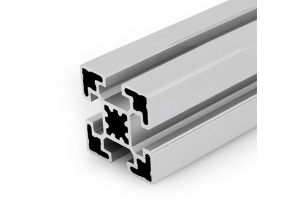 PG45 45 x 45 mm Four Slot Aluminium Strut Profile Standard Frame
45 x 45 mm four-slot aluminium strut profile with 10.2 mm grooves, M8 slot…
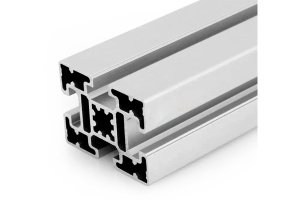 PG45 45 x 60 mm Four Slot Aluminium Strut Profile Rectangular Beam
45 x 60 mm four-slot rectangular aluminium strut profile with directional bending stiffness. Strong…
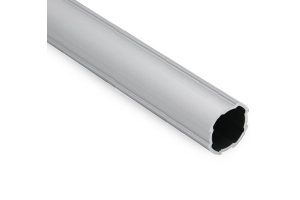 Aluminium Pipe 28 mm OD Round Tube Profile for Lean Pipe Systems
28 mm OD round aluminium tube for lean pipe systems, conveyor rollers and rotating…
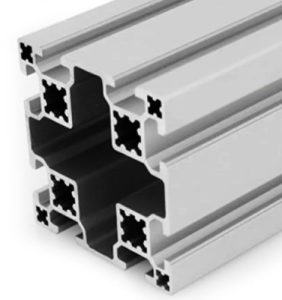 Aluminium I-Beam Profile 40 x 40 mm Structural H-Section Extrusion
Aluminium I-beam (H-section) 40 x 40 mm in 6063-T5. Concentrates material in the flanges…
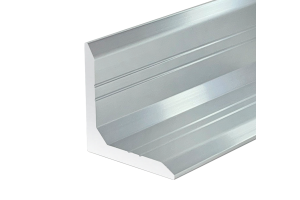 Extruded Aluminium Angle Profile 20 to 100 mm 6061 T6 Equal Leg
Extruded aluminium equal leg angle from 20 x 20 x 3 mm to 100…
