PG40 80×80 mm R90 Six Slot Aluminium Strut Profile Rounded Corner Column
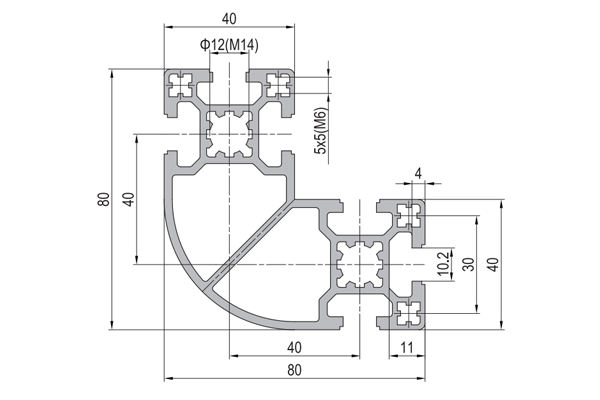
80 x 80 mm L section aluminium corner column with a swept R90 outer corner and six 10.2 mm T-slots on a 30 mm pitch. Used as an exposed corner post on machine guards, enclosures and display frames.
| Material | Aluminium |
|---|---|
| Alloy Grade | 6063-T5 |
| Temper | T5 |
| Section Size | 80 x 80 mm L, arms 40 mm, swept R90 outer corner |
| Slot | 6 x 10.2 mm groove, 8 mm mouth, 30 mm between centres on the 40 mm faces, M8 |
| Length | 6 m stock, cut to drawing to +/-0.5 mm |
| Tolerance | EN 755-9 / GB/T 6892, wall +/-0.15 mm |
| Surface | Mill finish / clear anodised / black anodised |
| MOQ | Made to order; small trial lengths available from stock offcuts |
| Lead Time | Typically 2 to 3 weeks for mill finish, about a week longer for anodising |
| Loading Port | Shanghai, Ningbo, Qingdao |
| Supply Ability | Extrusion capacity for standard and custom dies, with in-house cutting, machining and anodising |
| Payment Terms | T/T 30 per cent deposit, balance against copy of bill of lading; L/C at sight for larger orders |
| Trade Terms | FOB, CIF, CFR, EXW |
| Certifications | Mill certificate to EN 10204 3.1 on request, RoHS and REACH declarations |
01What is the 80 x 80 mm R90 six slot profile?
Is this the same as the square 80 x 80 mm eight slot profile?
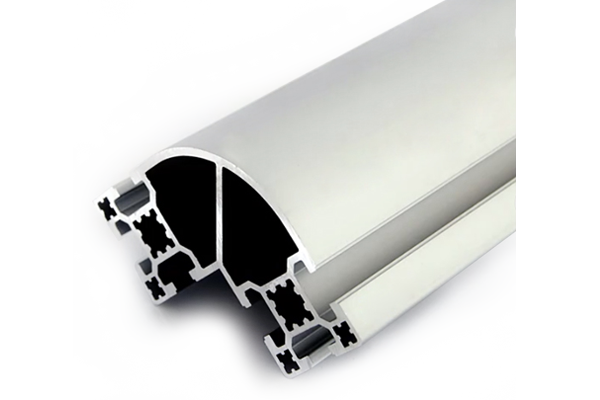
No. The square section is a closed box with slots on all four faces. This one is an L section: two 40 mm arms at 90 degrees, six slots in total, and a swept R90 outer corner instead of a sharp edge. It carries roughly half the material of the square section, so it is used as a corner column or a perimeter post, not as a beam that spans between supports.
What does the R90 corner actually do?
It replaces the sharp arris on the outside of the corner with a continuous arc. On a machine guard, an enclosure or a display frame that is touched or cleaned, that removes a catch point and an injury point at the same time. It also changes the section itself: the centroid moves inboard, the principal axes are no longer at 45 degrees, and the second moment of area about each axis changes. Section 03 works through the numbers.
Where is it normally used?
Exposed corner posts on machine guards and safety fencing; perimeter uprights on enclosures and cleanroom walls; display and exhibition frames where the corner is visible; and handrails or trolley frames where a sharp aluminium edge is unacceptable. It is a frame edge product, not a spanning member.
02Section data
| Item | Value | Note |
|---|---|---|
| Envelope | 80 x 80 mm L | two 40 mm arms at 90 degrees |
| Slots | 6 | 10.2 mm groove, 8 mm mouth |
| Slot spacing | 30 mm | between centres on the 40 mm faces |
| Outer corner | swept, R90 nominal | continuous arc, no arris |
| Inner corner | open, with a rib | the rib ties the two arms together |
| Centre bores | Phi12 mm | tapped M14 through the corner |
| Corner holes | 5 x 5 mm | tapped M6 |
| Wall | 2.2 to 3.0 mm | varies by face |
| Weight | approx. 3.0 kg/m | scaled from the 80 x 80 L eight slot section |
| Alloy | 6063-T5 | EN AW-6063, T5 temper |
| Standard | EN 755-9 / GB/T 6892 | wall tolerance +/-0.15 mm |
| Length | 6 m stock | cut to drawing to +/-0.5 mm |
The weight figure is an estimate scaled from the published 80 x 80 mm L eight slot section in the same 40 series, adjusted for the swept corner and the two fewer slots. Treat it as approximate until a certified weighing is required; ask for one on the quotation if the figure feeds into a lifting or transport calculation.
03Why a swept corner changes the section, not just the look
It is tempting to treat R90 as a cosmetic option: same 80 x 80 envelope, same 40 mm arms, so the same strength. That is wrong, and the error shows up as soon as you bolt a plate across the corner.
Start with the geometry. A plain L section with two 40 mm arms inside an 80 x 80 envelope has its centroid at roughly 25 mm / 25 mm from the outer corner, because the material is concentrated along the two legs. Sweeping the outer corner to R90 moves material away from that corner and out along the arc. The centroid shifts inboard, towards roughly 30 mm / 30 mm on each axis, and the principal axes rotate away from 45 degrees. In a sharp L, the strong axis sits on the 45 degree diagonal; in the swept section it does not.
The practical consequence is in the fixing pattern. On a sharp L, the natural move is to drill a diagonal line of holes straight through the corner. On the swept section the material at the corner is thin and curved, and the same diagonal line will land partly on the arc where there is no flat face to counterbore against. The correct pattern follows the two arms, not the diagonal.
| If you are doing this | Use this pattern | Why |
|---|---|---|
| Bolting a plate to one arm | slots along that arm only | the swept corner has no flat bearing face |
| Joining two R90 sections end to end | the Phi12 / M14 centre bore | the bore is coaxial with the corner, the arc is not |
| Hanging a panel across the corner | two separate fixings, one per arm | a single diagonal fixing lands on the arc |
| Fixing a levelling foot | the 5 x 5 mm M6 corner hole | sized for a foot stud, not a structural load |
| Running a cable around the corner | keep to the arm slots | the swept face has no slot to clip into |
There is a second effect that matters on long runs. Because the centroid has moved, the torsional behaviour of the corner also changes. An open L section is already weak in torsion; a swept corner concentrates the wall into a single curved shell over part of the length, which is stiffer locally but gives a less uniform load path. For a post carrying a panel, this is irrelevant. For anything that spans more than about a metre between supports, use the square 80 x 80 mm section instead and keep the R90 profile for the visible edges.
04How the six slots are laid out
Six slots sounds like a lot for a section with only two arms. The layout is deliberate: each arm is slotted on both of its outer faces, so every exposed face of the finished frame can take a nut without a machining operation.
| Slot group | Count | Face | Typical duty |
|---|---|---|---|
| Top of the vertical arm | 2 | 80 mm end face | top cap, lid, upper rail |
| Outer face of the vertical arm | 1 | left hand 80 mm face | panel or infill fixing |
| Top of the horizontal arm | 1 | top of the 80 mm foot | base plate, floor fixing |
| Outer face of the horizontal arm | 2 | right hand 40 mm face | side rail, guard panel |
Note what is missing. There is no slot on the inner faces. The inner corner is open and carries a rib, so the inside of the frame is a clean continuous surface. That is the point of an L section: the inside of the corner is where panels, cables and moving parts pass, and a slot there would be a snag.
All six slots use the same 10.2 mm groove and 8 mm mouth, so the whole 40 series range of slot nuts, hammer head bolts, cover strips and hinges fits without an adapter. That is the main reason to stay inside one series: the accessory inventory does not fragment.
05Choosing between the R90 corner column and the square sections
Choose the R90 six slot column
- The corner is visible or touched in service
- The frame is a perimeter, not a spanning structure
- You want a rounded edge without adding a separate trim strip
- Panel fixings sit flat against each arm, not across the corner
- Weight matters: roughly half the material of the square section
Choose the square 80 x 80 mm section
- The member spans between supports and carries bending
- You need slots on all four faces including the inside
- The corner is hidden inside a cladding or behind a panel
- You are building a column carrying axial load with a bolted cap
- You want the highest torsional stiffness per metre of frame
The two are not competitors; they are usually used together. A typical machine guard uses square 80 x 80 columns at the load-bearing positions and the R90 section at the corners and along the top rail where hands and cleaning cloths actually go. Specify them as one frame rather than two separate orders so the cut list is optimised across both sections.
06Failure modes to design out
| What goes wrong | Why it happens | Design it out by |
|---|---|---|
| Corner fixing pulls out | the swept corner has less flat bearing area than a square corner | put the load on the arm slots, keep the corner hole for M6 trim duty only |
| Frame racks out of square | an open L section twists easily before the panels are fitted | fit the panels or a diagonal brace before moving the frame |
| Panel sits proud on one arm | the two arms are measured from different datums after the sweep | datum off the slot centres, not off the outer arc |
| Anodised colour looks patchy on the arc | the arc reflects light across a continuous curve | specify a matte etch, or accept a brighter highlight on the sweep |
| Foot stud bottoms out | the 5 x 5 mm M6 hole is shallow | use a stud with a shoulder, or a levelling foot with a separate base plate |
07What to check before you order
Procurement checklist for the R90 six slot column
- Confirm the arm orientation in the finished frame: which arm is vertical, and which faces are exposed.
- Confirm the cut length and the cut ends. A mitred end on a swept section is not the same as a square cut; state the angle and the datum.
- Confirm the finish: mill finish is fine for a frame that will be clad, anodised for anything exposed.
- Confirm whether the corner holes are needed. If the M6 corner holes are not used, they can be omitted from the drawing and the tooling cost drops.
- Confirm the quantity in metres, not in pieces, and add the offcut allowance. A 6 m bar yields four 1,400 mm members with 400 mm of waste.
- Ask for a weight per metre figure on the quotation if the frame feeds into a lifting or shipping calculation.
08Terms used on this page
- Arris
- The sharp edge where two faces of a section meet. The R90 sweep replaces the arris on the outer corner with an arc.
- Centroid
- The geometric centre of the cross section. For a plain L it sits near the inner corner; the sweep pulls it inboard.
- Principal axes
- The two perpendicular directions about which the section has its maximum and minimum stiffness. In a plain L they sit at 45 degrees; the sweep rotates them.
- Second moment of area
- A measure of how the material is distributed about an axis, in cm4. It drives deflection, not strength.
- Slot nut
- A nut that slides into the 10.2 mm groove and locks against the groove lips when the bolt is tightened.
- Mouth
- The 8 mm gap at the surface of the slot, through which the bolt shank passes. It is narrower than the groove behind it.
09Questions buyers ask
Can you supply this section cut to length and mitred?
Yes. State the cut length, the end angle and the datum face on the drawing. Mitred ends on a swept section are cut from the same bar, so the arc runs continuously through the corner of the finished frame.
Is the R90 corner available in a different radius?
The tooling is set for this radius. A different radius means a new die and a new tooling charge, which is only economic above a container-scale order. For smaller quantities, keep the standard section and radius.
Does the section take standard 40 series accessories?
Yes. The groove is 10.2 mm and the mouth is 8 mm, identical to the rest of the 40 series, so slot nuts, hammer head bolts, cover strips and hinges all fit.
What is the minimum order quantity?
Extrusion is made to order. Small trial lengths are possible from stock offcuts; production runs are quoted by the tonne or by the metre depending on the finish. Send the drawing and the annual quantity and we will quote both.
Can it be supplied in 6061 instead of 6063?
For a corner post, 6063-T5 is normally the right answer: better surface finish and adequate strength. If the member carries load rather than trim, say so and we will quote 6061-T6, which machines and anodises differently.
What we need to quote this section
- The section drawing or the profile reference, with the R90 corner called out.
- The cut length for each member and the number of members.
- The end preparation: square cut, mitre angle, or tapped ends.
- The finish: mill, clear anodised, black anodised, or a specified colour.
- The annual or per-order quantity, in metres or in pieces.
- Any certification requirement: mill certificate, dimensional report, or a first article inspection.
Send those six items and the quotation comes back with the extrusion price, the cutting and machining charge, the finish surcharge and the lead time broken out separately, so you can see what each step costs. Browse the full aluminium profile catalogue and the 40 series aluminium profiles range for related sections.
Need this section quoted against your own drawing?
Send the section, the cut list and the finish. We quote extrusion, cutting, machining and anodising as separate lines so the cost of each step is visible.
Request a quotationRelated Products
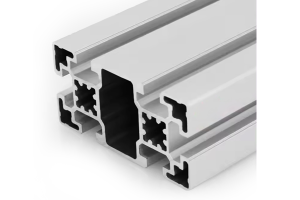 PG40 40 x 40 mm Eight Slot Aluminium Strut Profile High Density Frame
40 x 40 mm eight-slot aluminium strut profile with two T-slots on each face…
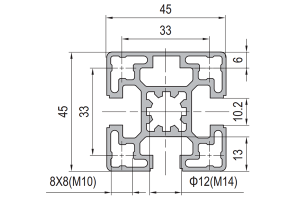 PG45 45 x 45 mm Three Slot Aluminium Strut Profile Asymmetric Rail
45 x 45 mm three-slot aluminium strut profile with one solid flat face for…
 PG45 45 x 45 mm Four Slot Aluminium Strut Profile Standard Frame
45 x 45 mm four-slot aluminium strut profile with 10.2 mm grooves, M8 slot…
 PG45 45 x 60 mm Four Slot Aluminium Strut Profile Rectangular Beam
45 x 60 mm four-slot rectangular aluminium strut profile with directional bending stiffness. Strong…
 Aluminium Pipe 28 mm OD Round Tube Profile for Lean Pipe Systems
28 mm OD round aluminium tube for lean pipe systems, conveyor rollers and rotating…
 Aluminium I-Beam Profile 40 x 40 mm Structural H-Section Extrusion
Aluminium I-beam (H-section) 40 x 40 mm in 6063-T5. Concentrates material in the flanges…
 Extruded Aluminium Angle Profile 20 to 100 mm 6061 T6 Equal Leg
Extruded aluminium equal leg angle from 20 x 20 x 3 mm to 100…
 Aluminium Angle Extrusion 40x40x5 mm for Frame Assembly and Bracing
40 x 40 x 5 mm aluminium angle extrusion in 6061-T6 for frame assembly…
