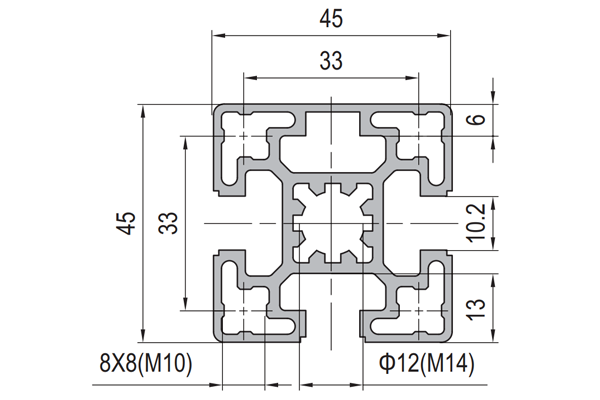
PG45 45 x 45 mm Three Slot Aluminium Strut Profile Asymmetric Rail
45 x 45 mm three-slot aluminium strut profile with one solid flat face for linear guides, machining datums or cleanroom surfaces. Three 10.2 mm T-slots on the other three faces, Phi12 mm bore.
| Material | Aluminium |
|---|---|
| Alloy Grade | 6063-T5 |
| Temper | T5 |
| Section Size | 45 x 45 mm square, three slot with one solid face |
| Slot | 3 x 10.2 mm groove, 10 mm mouth, one per face on three faces, M8 |
| Length | 6 m stock, cut to drawing to +/-0.5 mm |
| Tolerance | EN 755-9 / GB/T 6892, wall +/-0.15 mm |
| Surface | Mill finish / clear anodised / black anodised / hard anodised |
| MOQ | Made to order; small trial lengths available from stock offcuts |
| Lead Time | Typically 2 to 3 weeks for mill finish, about a week longer for anodising; machined solid faces add time |
| Loading Port | Shanghai, Ningbo, Qingdao |
| Supply Ability | Extrusion capacity for standard and custom dies, with in-house cutting, face milling and anodising |
| Payment Terms | T/T 30 per cent deposit, balance against copy of bill of lading; L/C at sight for larger orders |
| Trade Terms | FOB, CIF, CFR, EXW |
| Certifications | Mill certificate to EN 10204 3.1 on request, RoHS and REACH declarations |
01What is a three-slot 45 x 45 profile?
Why only three slots on a square section?
Because the fourth face is intentionally left solid. On a standard four-slot, every face has a groove that interrupts the surface. On this section, three faces carry the normal 10.2 mm T-slot and the fourth is a continuous flat surface with no interruption. That face is used as a sliding guide, a machining datum, or a mounting reference where a slot groove would be a nuisance or a contamination trap.
Is it the same as a four-slot with one slot left empty?
No. If you simply do not use one slot on a four-slot, the face still has the groove recess, the mouth gap, and the two lip edges. On this section, the fourth face is extruded solid — there is no groove at all. The wall is thicker on that face (about 6 mm instead of the 3 mm between the groove and the surface), and the surface is flat enough to use as a linear guide without a separate rail.
What is it used for?
Linear motion frames where one face carries a sliding carriage or a linear guide; precision fixture plates where one face is a machining datum; and cleanroom or hygienic frames where one face must be wipe-clean with no groove to trap dust. The solid face gives a functionally asymmetric section: three faces for assembly, one face for precision.
02Section data
| Item | Value | Note |
|---|---|---|
| Envelope | 45 x 45 mm | same as the standard 45 series four-slot |
| Slots | 3 | 10.2 mm groove, 10 mm mouth on three faces |
| Solid face | fourth face, no groove | flat continuous surface, approx. 6 mm thick |
| Slot pitch | 22.5 mm from centre to face edge | single slot per slotted face |
| Centre bore | Phi12 mm | tapped M14, same as the four-slot |
| Corner holes | 8 x 8 mm | tapped M10, same as 45 series |
| Wall on slotted faces | approx. 3.5 mm | between groove and surface |
| Weight | approx. 2.1 kg/m | slightly less than the four-slot at 2.35 kg/m |
| Alloy | 6063-T5 | EN AW-6063 |
| Standard | EN 755-9 / GB/T 6892 | wall tolerance +/-0.15 mm |
| Length | 6 m stock | cut to drawing to +/-0.5 mm |
The weight is an estimate derived from the published 45 x 45 four-slot section in the same series, reduced by the material of one groove. Treat it as approximate until a certified weighing is arranged. The solid face thickness is a nominal figure from the die; a precision-machined datum face can be specified to a tighter flatness on request.
03The solid face: what it does that a fourth slot cannot
The solid face is the whole point of this section. It is not a cost-reduced version of the four-slot; it is a different product that does something the four-slot cannot.
On a four-slot, the groove on every face means that anything mounted on that face has to bridge the groove or sit in it. A linear guide rail bolted across a grooved face has its mounting bolts going into slot nuts, which can slide, and the rail sits on two narrow lip edges instead of a flat surface. The result is a rail that is less stiff, less repeatable, and more prone to creep under load.
On this section, the solid face gives a continuous flat mounting surface. A linear guide rail bolts directly into tapped holes in the solid face, with the full face area as bearing surface. The bolts go into blind threaded holes in the 6 mm wall, not into sliding slot nuts. The rail is stiffer, more repeatable, and does not creep.
| If you need this | Use the solid face for | Why it works better than a slot |
|---|---|---|
| Linear guide rail mounting | tapped holes in the solid face | full bearing area, no slot nut creep, tighter positional repeatability |
| Machining datum | the flat surface as a reference | no groove interruption, a continuous surface to indicate from |
| Sliding carriage track | the flat surface as a sliding plane | lower friction than a grooved face, no debris trap in the groove |
| Cleanroom frame surface | the wipe-clean face | no groove to trap dust or hold cleaning fluid |
| Adhesive mounting | the flat face for bonding panels or tape | no slot mouth to bridge, full contact area for adhesive |
04Slot layout on the three slotted faces
The three slotted faces carry the standard 45 series groove: 10.2 mm wide, 10 mm mouth, taking M8 slot nuts and accessories. The slot is centred on each face with about 22.5 mm from the slot centre to each edge. The Phi12 mm centre bore runs through the section as on the four-slot, so through-bolting with an M14 tie rod works the same way.
| Face | Slot | Mouth | Typical use |
|---|---|---|---|
| Face A (top) | 1 x 10.2 mm | 10 mm | top rail, sensor mounting, cable clip |
| Face B (left) | 1 x 10.2 mm | 10 mm | side bracket, hinge, panel fixing |
| Face C (right) | 1 x 10.2 mm | 10 mm | side bracket, handle, latch |
| Face D (bottom) | solid, no slot | flat | linear guide, datum, or clean face |
The orientation matters. Because one face is different from the other three, the section is not rotationally symmetric the way a four-slot is. The drawing has to call out which face is the solid one, and the extrusion comes with a orientation mark so the assembler does not put the solid face where a slot was expected.
05Asymmetry and what it means for the frame
A standard four-slot is symmetric about both axes, so it does not matter which way it is rotated when it goes into the frame. This section is symmetric about only one axis. The solid face has more material than a slotted face, so the centroid shifts slightly towards the solid face, and the second moment of area is not the same about both axes.
The effect is small but measurable. The bending stiffness about an axis parallel to the solid face is roughly 8 per cent higher than about the axis perpendicular to it, because the solid face adds material where it is furthest from the neutral axis. For a frame carrying a bending load, orient the solid face away from the load so that the extra material is in the tension or compression fibre.
| Property | About axis parallel to solid face | About axis perpendicular | Difference |
|---|---|---|---|
| I (cm4) | approx. 8.3 | approx. 7.7 | approx. +8 per cent |
| Deflection at 100 N, 1 m span | 0.31 mm | 0.34 mm | approx. -9 per cent |
| Weight | approx. 2.1 kg/m | same | — |
06Choosing between the three-slot and the four-slot
Choose the three-slot with solid face
- One face needs to be a linear guide or sliding surface
- One face is a machining datum and must be uninterrupted
- The frame is in a cleanroom or hygienic environment
- You want to bolt a rail directly to the face without slot nuts
- The frame carries bending in a known direction and the solid face helps
Choose the standard four-slot
- All four faces need fixing positions
- The frame is symmetric and the load direction is unknown
- You want the widest accessory range (every face takes a slot nut)
- Cost per metre matters (four-slot is cheaper in volume)
- You need to rotate the member during assembly without thinking about orientation
07Failure modes to design out
| What goes wrong | Why it happens | Design it out by |
|---|---|---|
| Solid face is on the wrong side | the section is asymmetric and was rotated during cutting or assembly | call out the solid face orientation on the drawing; use the orientation mark |
| Tapped holes in the solid face strip | the 6 mm wall gives limited thread engagement for M6 or M8 | use M5 or M6 with sufficient thread depth, or specify a self-clinching insert |
| Frame deflects unevenly | the two axes have different second moments of area | orient the solid face to carry the bending load; do not treat it as symmetric |
| Cable routing is limited | only three faces have slots, not four | plan cable routes before assembly; or use a four-slot where cables run on all faces |
| Assembler puts a bracket on the solid face expecting a slot | the solid face looks like it should have a slot | mark the solid face orientation on the cut list and the drawing |
08What to check before you order
Procurement checklist for the three-slot profile
- Confirm the orientation of the solid face relative to the frame. Which face is the guide or datum, and which three are slotted? Put it on the drawing.
- Confirm the tapped hole pattern on the solid face if you are mounting a linear guide rail. Specify hole positions, sizes and thread depth.
- Confirm the flatness tolerance of the solid face if it is a datum. Standard extruded flatness is about 0.2 mm over 300 mm; a machined face can be tighter.
- Confirm the cut length and tolerance: standard +/-0.5 mm, tighter on CNC.
- Confirm the finish: mill for clad frames, clear or black anodised for exposed service. Anodising on the solid face is important if it is a sliding surface.
- Confirm the quantity in metres and add offcut allowance.
09Terms used on this page
- Solid face
- The fourth face of the three-slot section that is extruded without a groove, leaving a continuous flat surface.
- Datum face
- A surface used as a reference for measurement or machining. The solid face is suitable because it has no groove interruption.
- Linear guide
- A rail and carriage system for linear motion. The solid face provides a flat mounting surface for the rail.
- Asymmetric section
- A cross section that is not the same in all directions. The three-slot has a solid face on one side, making its bending stiffness different about each axis.
- Slot nut
- A nut that slides into the 10.2 mm groove and locks against the groove lips when the bolt is tightened. Used on the three slotted faces, not on the solid face.
- Through-bolt
- A long bolt through the Phi12 mm centre bore, independent of the slots. Same as on the standard four-slot.
10Questions buyers ask
Can I get this section with the solid face on a different side?
The extrusion die sets which face is solid. The standard section has the solid face on one specific side, and the section is supplied with an orientation mark. If you need a different orientation, rotate the member in the frame rather than ordering a different die.
Does it take standard 45 series accessories?
Yes, on the three slotted faces. The groove is 10.2 mm with a 10 mm mouth, the same as the standard 45 series, so M8 slot nuts, hammer head bolts and hinges all fit. The solid face does not take slot nuts — use tapped holes instead.
What is the difference between this and the 45 x 45 four-slot?
Same envelope, same groove, same bore. The three-slot replaces one grooved face with a solid flat face for guiding, machining or cleanroom use. It is slightly lighter and has asymmetric bending stiffness.
Can the solid face be machined flat after extrusion?
Yes. Standard extruded flatness is about 0.2 mm over 300 mm. A CNC face mill can bring that to 0.05 mm or better. Specify the required flatness on the drawing if the face is a precision datum.
What is the minimum order quantity?
Extrusion is made to order. Small trial lengths are available from stock offcuts. Production runs are quoted by the metre or by the tonne depending on finish and quantity.
Can it be supplied anodised?
Yes. Clear, black, champagne and bronze are standard. If the solid face is a sliding surface, specify a hard anodise (25 to 30 micron) for wear resistance.
What we need to quote this section
- The section drawing or profile reference, with the solid face orientation called out.
- The cut length for each member and the number of members.
- The tapped hole pattern on the solid face if a linear guide is being mounted.
- The flatness tolerance on the solid face if it is a precision datum.
- The finish: mill, clear anodised, black anodised, or hard anodised on the solid face.
- The annual or per-order quantity, in metres or in pieces.
Send those six items and the quotation comes back with the extrusion price, the cutting and machining charge, the finish surcharge and the lead time broken out separately. Browse the full aluminium profile catalogue and the 45 series aluminium profiles range for related sections.
Need this section quoted against your own drawing?
Send the section, the cut list, the solid face orientation and the finish. We quote extrusion, cutting, machining and anodising as separate lines.
Request a quotationRelated Products
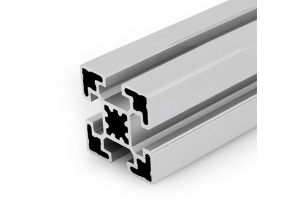 PG45 45 x 45 mm Four Slot Aluminium Strut Profile Standard Frame
45 x 45 mm four-slot aluminium strut profile with 10.2 mm grooves, M8 slot…
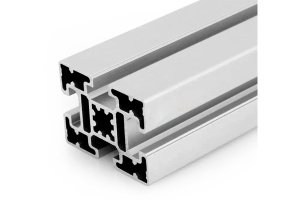 PG45 45 x 60 mm Four Slot Aluminium Strut Profile Rectangular Beam
45 x 60 mm four-slot rectangular aluminium strut profile with directional bending stiffness. Strong…
 Aluminium Pipe 28 mm OD Round Tube Profile for Lean Pipe Systems
28 mm OD round aluminium tube for lean pipe systems, conveyor rollers and rotating…
 Aluminium I-Beam Profile 40 x 40 mm Structural H-Section Extrusion
Aluminium I-beam (H-section) 40 x 40 mm in 6063-T5. Concentrates material in the flanges…
 Extruded Aluminium Angle Profile 20 to 100 mm 6061 T6 Equal Leg
Extruded aluminium equal leg angle from 20 x 20 x 3 mm to 100…
 Aluminium Angle Extrusion 40x40x5 mm for Frame Assembly and Bracing
40 x 40 x 5 mm aluminium angle extrusion in 6061-T6 for frame assembly…
 Custom Aluminium Extrusion Profile 20 to 100 mm, 6063-T5
Aluminium extrusion profiles supplied to Canada in 6063-T5 and 6061-T6, mill or anodised, with…
 Aluminium Extrusion for Sale 20 to 100 mm Stock Lengths Cut to Size 6063 T5
Aluminium extrusion for sale in three routes: stock lengths, cut to size or a…
