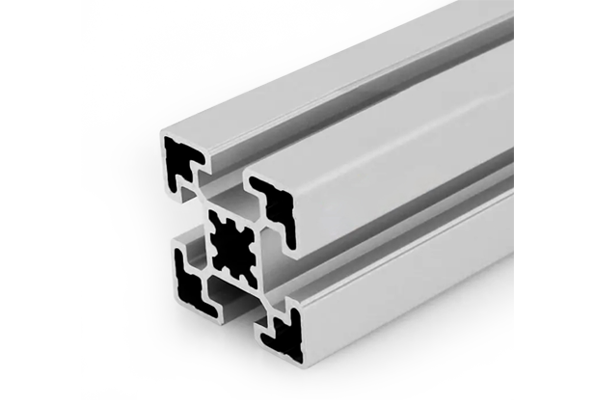
PG45 45 x 45 mm Four Slot Aluminium Strut Profile Standard Frame
45 x 45 mm four-slot aluminium strut profile with 10.2 mm grooves, M8 slot nuts, Phi12 mm bore and M10 corner holes. The standard section of the 45 series for M8-based machine frames.
| Material | Aluminium |
|---|---|
| Alloy Grade | 6063-T5 |
| Temper | T5 |
| Section Size | 45 x 45 mm square, four slot |
| Slot | 4 x 10.2 mm groove, 10 mm mouth, one per face, M8 |
| Length | 6 m stock, cut to drawing to +/-0.5 mm |
| Tolerance | EN 755-9 / GB/T 6892, wall +/-0.15 mm |
| Surface | Mill finish / clear anodised / black anodised |
| MOQ | Made to order; small trial lengths available from stock offcuts |
| Lead Time | Typically 2 to 3 weeks for mill finish, about a week longer for anodising |
| Loading Port | Shanghai, Ningbo, Qingdao |
| Supply Ability | Extrusion capacity for standard and custom dies, with in-house cutting, machining and anodising |
| Payment Terms | T/T 30 per cent deposit, balance against copy of bill of lading; L/C at sight for larger orders |
| Trade Terms | FOB, CIF, CFR, EXW |
| Certifications | Mill certificate to EN 10204 3.1 on request, RoHS and REACH declarations |
01What is the 45 x 45 mm four-slot profile?
How is it different from the 40 x 40 mm four-slot?
The 45 series is one step up from the 40 series in every dimension. The envelope goes from 40 to 45 mm, the groove stays at 10.2 mm but the mouth widens from 8 to 10 mm, the slot nut goes from M6 to M8, the corner hole goes from M6 to M10, and the weight goes from about 1.49 kg/m to about 2.35 kg/m. The centre bore is the same Phi12 mm tapped M14 on both.
Why would you move up from 40 to 45?
Three reasons. First, M8 fasteners: if the frame carries vibration, shock or a heavy panel, M8 slot nuts have about 56 per cent more engagement area than M6 and the pull-out force rises from about 1.5 kN to about 2.5 kN. Second, longer spans: the 45 x 45 has a second moment of area of about 7.7 cm4 vs 5.8 cm4 for the 40 x 40, so a 1 m span deflects about 25 per cent less at the same load. Third, corner hole capacity: the 8 x 8 mm M10 corner hole is sized for a levelling foot or a structural anchor, not just a trim fixing.
Is it interchangeable with the 40 series?
No. The groove is the same 10.2 mm width, but the mouth is wider (10 mm vs 8 mm), so a 40 series slot nut will sit loosely in a 45 series groove. The slot pitch, corner hole size and accessory dimensions are all different. The two series are not designed to share accessories; pick one series per frame and stay in it.
02Section data
| Item | Value | Note |
|---|---|---|
| Envelope | 45 x 45 mm | one step up from the 40 x 40 |
| Slots | 4 | 10.2 mm groove, 10 mm mouth, one per face |
| Slot pitch | 22.5 mm | from slot centre to face edge |
| Centre bore | Phi12 mm | tapped M14, same as the 40 series |
| Corner holes | 8 x 8 mm | tapped M10, larger than the 40 series M6 |
| Wall | approx. 3.5 mm | on the outer faces |
| Weight | approx. 2.35 kg/m | vs 1.49 kg/m for the 40 x 40 standard |
| Alloy | 6063-T5 | EN AW-6063 |
| Standard | EN 755-9 / GB/T 6892 | wall tolerance +/-0.15 mm |
| Length | 6 m stock | cut to drawing to +/-0.5 mm |
The weight figure is the standard-wall value from the 45 series die. Heavy-wall and light-wall variants exist for some sections in the 45 series; ask for the variant if your application needs more or less material than the standard wall.
03When to move up from 40 series to 45 series
The 40 series is the default for industrial framing, and most machine frames are built in it. The decision to move up to 45 is a decision about the fastener size and the span, not about the strength of the aluminium itself (both are 6063-T5). Three thresholds tend to trigger the move:
| Threshold | 40 series value | 45 series value | Why it matters |
|---|---|---|---|
| Slot nut size | M6 | M8 | vibration and heavy panels need more than M6 |
| Slot pull-out | approx. 1.5 kN | approx. 2.5 kN | +56 per cent per nut |
| Span before intermediate support | approx. 800 mm | approx. 1000 mm | 25 per cent less deflection at the same span |
| Corner hole | M6 | M10 | levelling feet and structural anchors |
| Weight | 1.49 kg/m | 2.35 kg/m | +58 per cent; weight is the trade-off |
The weight penalty is the main reason to stay in 40 if you can. A frame built in 45 series weighs about 58 per cent more per metre, and for a portable or hand-moved frame that matters. The decision is not ’45 is better’ — it is ’40 is enough unless you hit one of the thresholds above’.
04The M8 accessory ecosystem
The 45 series carries an M8-based accessory range: M8 slot nuts, M8 hammer head bolts, M8 T-bolts and M8 hinges. The slot groove is 10.2 mm — the same physical width as the 40 series — but the mouth is 10 mm instead of 8 mm, so the M8 bolt shank (8 mm diameter) passes through with clearance. An M6 bolt would also pass through, but an M6 slot nut would be loose in the groove because it is narrower than the mouth.
This means the 45 series accessory range is M8-first: the standard fasteners, brackets and hinges are M8. If you need to use an M6 fastener in a 45 series groove, use a reducing sleeve or an M6-to-M8 adapter nut. It is usually simpler to stay in the M8 range.
| Accessory | 40 series (M6) | 45 series (M8) | Difference |
|---|---|---|---|
| Slot nut thread | M6 | M8 | +one size |
| Bolt shank diameter | 6 mm | 8 mm | +33 per cent |
| Pull-out per nut | approx. 1.5 kN | approx. 2.5 kN | +56 per cent |
| Hinge pin | M6 | M8 | +one size |
| Corner hole | M6 | M10 | +two sizes |
05Bending and deflection: 45 vs 40 at the same span
The 45 x 45 has a second moment of area of about 7.7 cm4 about each principal axis, compared to about 5.8 cm4 for the 40 x 40 standard wall. That is a 33 per cent increase in stiffness, which translates to about 25 per cent less deflection at the same span and load.
For a simply supported 1 m beam under a 100 N centre load:
| Property | 40 x 40 four-slot | 45 x 45 four-slot | Change |
|---|---|---|---|
| I (cm4) | approx. 5.8 | approx. 7.7 | +33 per cent |
| Deflection at 100 N, 1 m span | 0.37 mm | 0.28 mm | -24 per cent |
| Weight (kg/m) | 1.49 | 2.35 | +58 per cent |
| Max span before 0.5 mm deflection | approx. 800 mm | approx. 1000 mm | +25 per cent |
The comparison uses the standard-wall 40 x 40 four-slot as the baseline. The 40 series also comes in a heavy-wall variant with an I of about 7.2 cm4, which is close to the 45 series standard wall — so if stiffness is the only reason to move up, a 40 heavy-wall may be a lighter alternative. See the 40 series profiles page.
06Choosing between the 45 series and the 40 series
Choose the 45 series four-slot
- You need M8 fasteners for vibration or heavy panels
- Spans exceed 800 mm and deflection matters
- The frame carries levelling feet or structural anchors in the corner holes
- You want higher per-slot pull-out without going to a heavy-wall 40
- The frame is semi-permanent or fixed and weight is not critical
Choose the 40 series four-slot
- M6 fasteners are adequate for the load
- Weight matters: the frame is portable or hand-moved
- Spans are under 800 mm or deflection is not critical
- You want the widest accessory range (40 series has the largest ecosystem)
- Cost per metre matters (40 series is cheaper)
07Failure modes to design out
| What goes wrong | Why it happens | Design it out by |
|---|---|---|
| M6 slot nut used in a 45 series groove | the 10 mm mouth is wider than an M6 nut body | use M8 slot nuts; if M6 is needed, use an adapter sleeve or an M6 reducing nut |
| Frame is heavier than expected | 45 series is 58 per cent heavier than 40 series per metre | check the weight budget before specifying 45; consider 40 heavy-wall instead |
| Corner hole too large for the fixing | the 8 x 8 mm M10 hole is larger than many standard feet | use a reducing bush, or specify a custom corner hole on the drawing |
| Deflection still too high at long span | even 45 series has limits; 1 m is not 2 m | add an intermediate support or move to 60 series for spans over 1.2 m |
| 40 and 45 series accessories mixed in one frame | they look similar but are not interchangeable | specify one series per frame on the BOM; do not let the assembler mix |
08What to check before you order
Procurement checklist for the 45 x 45 four-slot
- Confirm the accessory range: the frame uses M8 slot nuts, M8 bolts and M10 corner hole fittings. Do not mix with 40 series M6 accessories.
- Confirm the span: if any member exceeds 1 m between supports, check the deflection against the 7.7 cm4 second moment of area.
- Confirm the weight budget: 45 series weighs 2.35 kg/m. For a frame with 20 m of profile, that is 47 kg before any brackets or panels.
- Confirm the finish: mill for clad frames, clear or black anodised for exposed service.
- Confirm the corner hole requirement: M10 corner holes are standard. If they are not needed, omit them from the drawing to save tooling cost.
- Confirm the quantity in metres and add offcut allowance.
09Terms used on this page
- 45 series
- A family of aluminium extrusion profiles with a 45 mm envelope, 10.2 mm groove, 10 mm mouth and M8-based accessories.
- Second moment of area
- A measure of how material is distributed about the neutral axis, in cm4. It drives bending deflection.
- Slot pull-out
- The force required to pull a slot nut out of the groove, in kN. Driven by the wall thickness and the nut engagement.
- Corner hole
- The 8 x 8 mm tapped hole in the corner of the section, sized for M10. Used for levelling feet and structural anchors.
- Through-bolt
- A long bolt through the Phi12 mm centre bore, tying two members in tension. Same as on the 40 series.
- Slot pitch
- The distance from the slot centre to the face edge. On the 45 series it is about 22.5 mm per side.
10Questions buyers ask
Can I use 40 series slot nuts in a 45 series groove?
No. The groove is the same 10.2 mm width, but the mouth is 10 mm instead of 8 mm, so a 40 series M6 slot nut will sit loosely. Use 45 series M8 slot nuts, or an M6-to-M8 reducing adapter if you must use M6 fasteners.
What is the difference between 45 x 45 and 40 x 40?
Same shape, one step up in every dimension: 45 mm envelope vs 40 mm, 10 mm mouth vs 8 mm, M8 nuts vs M6, M10 corner holes vs M6, 2.35 kg/m vs 1.49 kg/m. The centre bore is the same Phi12 mm M14 on both.
Is it available in different wall thicknesses?
Yes, the 45 series comes in light, standard and heavy wall variants for some sections. The standard wall is the most common; ask for the variant if your application needs more or less material.
What is the maximum span between supports?
About 1000 mm for a 100 N centre load with deflection under 0.5 mm. Beyond that, add an intermediate support or move to the 60 series for larger sections.
What is the minimum order quantity?
Extrusion is made to order. Small trial lengths are available from stock offcuts. Production runs are quoted by the metre or by the tonne.
Can it be supplied in 6061 instead of 6063?
Yes. 6063-T5 is standard for its surface finish and extrudability. 6061-T6 is available for members that carry structural load; it machines and anodises differently.
What we need to quote this section
- The section drawing or profile reference.
- The cut length for each member and the number of members.
- The end preparation: square cut, mitre angle, or tapped ends.
- The finish: mill, clear anodised, black anodised, or a specified colour.
- The wall variant: standard, light, or heavy, if applicable.
- The annual or per-order quantity, in metres or in pieces.
Send those six items and the quotation comes back with the extrusion price, the cutting and machining charge, the finish surcharge and the lead time broken out separately. Browse the full aluminium profile catalogue and the 45 series aluminium profiles range for related sections.
Need this section quoted against your own drawing?
Send the section, the cut list and the finish. We quote extrusion, cutting, machining and anodising as separate lines.
Request a quotationRelated Products
 PG45 45 x 60 mm Four Slot Aluminium Strut Profile Rectangular Beam
45 x 60 mm four-slot rectangular aluminium strut profile with directional bending stiffness. Strong…
 Aluminium Pipe 28 mm OD Round Tube Profile for Lean Pipe Systems
28 mm OD round aluminium tube for lean pipe systems, conveyor rollers and rotating…
 Aluminium I-Beam Profile 40 x 40 mm Structural H-Section Extrusion
Aluminium I-beam (H-section) 40 x 40 mm in 6063-T5. Concentrates material in the flanges…
 Extruded Aluminium Angle Profile 20 to 100 mm 6061 T6 Equal Leg
Extruded aluminium equal leg angle from 20 x 20 x 3 mm to 100…
 Aluminium Angle Extrusion 40x40x5 mm for Frame Assembly and Bracing
40 x 40 x 5 mm aluminium angle extrusion in 6061-T6 for frame assembly…
 Custom Aluminium Extrusion Profile 20 to 100 mm, 6063-T5
Aluminium extrusion profiles supplied to Canada in 6063-T5 and 6061-T6, mill or anodised, with…
 Aluminium Extrusion for Sale 20 to 100 mm Stock Lengths Cut to Size 6063 T5
Aluminium extrusion for sale in three routes: stock lengths, cut to size or a…
 Aluminium Extruders 600 to 4000 Ton Press Capacity 40 to 160 mm Profile
Aluminium extrusion capacity across 600 to 4000 tonne presses, covering profiles up to about…
