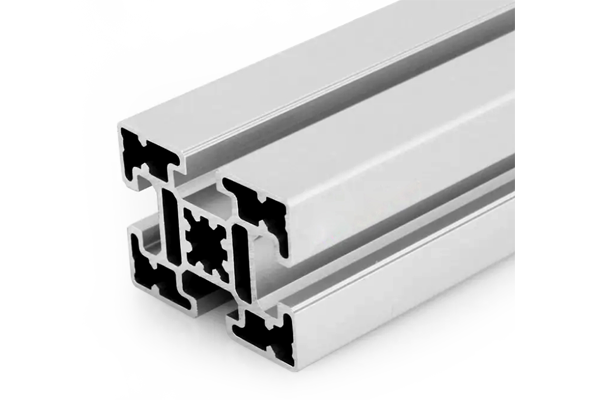
PG45 45 x 60 mm Four Slot Aluminium Strut Profile Rectangular Beam
45 x 60 mm four-slot rectangular aluminium strut profile with directional bending stiffness. Strong axis I approx. 10.5 cm4, weak axis I approx. 5.9 cm4. M8 slot nuts, Phi12 mm bore.
| Material | Aluminium |
|---|---|
| Alloy Grade | 6063-T5 |
| Temper | T5 |
| Section Size | 45 x 60 mm rectangular, four slot |
| Slot | 4 x 10.2 mm groove, 10 mm mouth, one per face, M8 |
| Length | 6 m stock, cut to drawing to +/-0.5 mm |
| Tolerance | EN 755-9 / GB/T 6892, wall +/-0.15 mm |
| Surface | Mill finish / clear anodised / black anodised |
| MOQ | Made to order; small trial lengths available from stock offcuts |
| Lead Time | Typically 2 to 3 weeks for mill finish, about a week longer for anodising |
| Loading Port | Shanghai, Ningbo, Qingdao |
| Supply Ability | Extrusion capacity for standard and custom dies, with in-house cutting, machining and anodising |
| Payment Terms | T/T 30 per cent deposit, balance against copy of bill of lading; L/C at sight for larger orders |
| Trade Terms | FOB, CIF, CFR, EXW |
| Certifications | Mill certificate to EN 10204 3.1 on request, RoHS and REACH declarations |
01What is a 45 x 60 rectangular strut profile?
Why use a rectangular section instead of a square one?
A rectangular section puts more material further from the neutral axis on one direction, giving higher bending stiffness in that direction and lower in the perpendicular direction. The 45 x 60 has its strong axis along the 60 mm depth: a second moment of area of about 10.5 cm4, which is about 1.8 times the 5.9 cm4 about the weak axis (the 45 mm depth). A square 45 x 45 has 7.7 cm4 about both axes. So the rectangular section is stronger in one direction and weaker in the other, and the frame designer uses that asymmetry to put material where the load is.
How is it oriented in a frame?
The rule is simple: orient the 60 mm depth in the direction of the load. For a horizontal beam carrying a downward load, the 60 mm dimension is vertical (depth). For a vertical column carrying a side load, the 60 mm dimension faces the load direction. Getting this wrong is the most common error with rectangular sections — it reduces the effective stiffness by 44 per cent.
Is it the same as the 45 x 45 with extra material?
No. The 45 x 60 is a different die, not a 45 x 45 with a bigger wall. The slot layout is one slot per face (four total), but the two 60 mm faces have the slot centred with more material on either side, while the two 45 mm faces are tighter. The centre bore runs through the 60 mm dimension.
02Section data
| Item | Value | Note |
|---|---|---|
| Envelope | 45 x 60 mm | rectangular, not square |
| Slots | 4 | 10.2 mm groove, 10 mm mouth, one per face |
| Strong axis I | approx. 10.5 cm4 | about the 60 mm depth |
| Weak axis I | approx. 5.9 cm4 | about the 45 mm depth |
| Ratio strong/weak | approx. 1.8 | directional stiffness |
| Centre bore | Phi12 mm | tapped M14, through the 60 mm dimension |
| Corner holes | 8 x 8 mm | tapped M10 |
| Weight | approx. 2.8 kg/m | between the 45×45 (2.35) and 60×60 (3.6) |
| Alloy | 6063-T5 | EN AW-6063 |
| Standard | EN 755-9 / GB/T 6892 | wall tolerance +/-0.15 mm |
| Length | 6 m stock | cut to drawing to +/-0.5 mm |
The second moment of area figures are derived from the published 45 and 60 series sections, scaled to the 45 x 60 envelope. Treat them as approximate; a certified calculation can be provided if the figure feeds into a structural verification.
03Directional stiffness: what the 1.8 ratio means
The 1.8 ratio between the strong and weak axes is the whole reason the rectangular section exists. On a square section, the stiffness is the same in both directions, so there is no saving from orientation — you pay for material in both directions whether you need it or not. On the rectangular section, you put the material where the load is and save it where it is not.
For a horizontal beam of 1 m span carrying 100 N at the centre:
| Orientation | I (cm4) | Deflection at 100 N | vs 45×45 square |
|---|---|---|---|
| 60 mm depth vertical (strong) | 10.5 | 0.20 mm | -46 per cent |
| 45 mm depth vertical (weak) | 5.9 | 0.36 mm | -3 per cent |
| 45 x 45 square (for reference) | 7.7 | 0.28 mm | baseline |
Oriented correctly, the 45 x 60 deflects 46 per cent less than the 45 x 45 square at the same span and load. Oriented incorrectly (60 mm horizontal), it deflects only 3 per cent less than the square, which is a waste of the extra 0.45 kg/m of material.
04Where it goes in a frame: columns and beams
The 45 x 60 is most commonly used in two positions in a machine frame:
| Frame position | Orientation | Why 45 x 60 |
|---|---|---|
| Horizontal beam carrying downward load | 60 mm depth vertical | strong axis resists gravity load, 46 per cent less deflection than square |
| Vertical column carrying side load | 60 mm depth facing the load | strong axis resists the lateral force |
| Base rail on the floor | 60 mm depth horizontal | wide footprint for stability; weak axis carries the frame weight (axial) |
| Top rail (light load) | either orientation | if the load is small, orientation does not matter much |
The key insight is that every member in the frame has a known load direction. Gravity is always downward. Side loads come from a known direction (the cutting force, the robot reach, the conveyor feed). A rectangular section lets you match the member to the load, and the 1.8 ratio means that match is worth about 46 per cent in deflection for a correctly oriented beam.
05The slot layout and what fits where
All four slots are the standard 45 series 10.2 mm groove with 10 mm mouth, taking M8 slot nuts. The two 60 mm faces have the slot centred with about 25 mm of material on either side, giving plenty of room for brackets and panel fixings. The two 45 mm faces have the slot centred with about 17.5 mm on either side, which is tighter but still takes standard accessories.
The Phi12 mm centre bore runs through the 60 mm dimension, so through-bolting with an M14 tie rod works along the strong axis — the bolt is in tension along the direction of highest stiffness.
06Choosing between rectangular and square
Choose the 45 x 60 rectangular
- The load direction is known and is primarily in one direction
- You want higher stiffness in one direction without a heavier square section
- The frame has beams carrying gravity or columns carrying side loads
- You can control the orientation during assembly
- The weight saving vs a 60 x 60 square matters (2.8 vs 3.6 kg/m)
Choose the 45 x 45 square
- The load direction is unknown or multi-directional
- The frame may be reconfigured and the load direction could change
- Simpler assembly is more important than the stiffness gain
- You cannot guarantee correct orientation by the assembler
- The accessory ecosystem is simpler (square sections are the standard)
07Failure modes to design out
| What goes wrong | Why it happens | Design it out by |
|---|---|---|
| Member oriented the wrong way | the rectangular section looks similar from both ends and can be rotated 90 degrees by mistake | mark the strong axis on the cut list and the drawing; use an orientation stamp |
| Deflection is higher than expected | the member was oriented on the weak axis instead of the strong axis | recalculate using the 5.9 cm4 weak-axis value, not the 10.5 cm4 strong-axis |
| Bracket does not fit on the 45 mm face | the 45 mm face is tighter than the 60 mm face | use the 60 mm faces for wide brackets; reserve the 45 mm faces for standard slot nuts and small fittings |
| Joint rotates under torque | the rectangular section has lower torsional stiffness than a square of the same perimeter | add a diagonal brace or a corner gusset; do not rely on the section alone for torsion |
| Frame is assembled as a parallelogram | rectangular members can twist into a non-square frame more easily than square | square the frame with a diagonal measurement before tightening the joints |
08What to check before you order
Procurement checklist for the 45 x 60 four-slot
- Confirm the orientation of every member in the frame: which dimension is vertical, which is horizontal. Put it on the drawing for each member.
- Confirm the cut length and tolerance: standard +/-0.5 mm, tighter on CNC.
- Confirm the end preparation: square cut, mitre (state the angle), or pre-tapped M14 ends for through-bolting.
- Confirm the finish: mill for clad frames, clear or black anodised for exposed service.
- If the frame carries multi-directional loads, add diagonal bracing or consider a square section instead.
- Confirm the quantity in metres and add offcut allowance. A 6 m bar yields six 950 mm members with 300 mm of waste.
09Terms used on this page
- Strong axis
- The direction about which the section has its highest second moment of area. On the 45 x 60 it is along the 60 mm depth.
- Weak axis
- The direction about which the section has its lowest second moment of area. On the 45 x 60 it is along the 45 mm depth.
- Directional stiffness
- The ratio of strong-axis to weak-axis stiffness. On the 45 x 60 it is about 1.8.
- Rectangular section
- A profile with different widths in two perpendicular directions, giving different bending stiffness about each axis.
- Through-bolt
- A long bolt through the Phi12 mm centre bore, running along the 60 mm dimension (the strong axis).
- Orientation
- The rotational position of a rectangular member in the frame, determining which axis carries the load.
10Questions buyers ask
Can I use this section in either orientation?
Physically yes, but structurally no. The 60 mm depth gives 1.8 times the stiffness of the 45 mm depth. Orienting it the wrong way wastes the extra material and gives only 3 per cent less deflection than a 45 x 45 square.
What is the difference between this and a 45 x 45 square?
The 45 x 60 is rectangular, with 10.5 cm4 about the strong axis and 5.9 cm4 about the weak axis. The 45 x 45 square has 7.7 cm4 about both. The rectangular is stronger in one direction and weaker in the other.
Does it take the same accessories as the 45 x 45?
Yes. All four slots are the standard 45 series 10.2 mm groove with 10 mm mouth, taking M8 slot nuts, hammer head bolts and hinges.
What is the maximum span?
About 1.2 m on the strong axis for 100 N centre load with deflection under 0.5 mm. On the weak axis, about 900 mm. Always orient the strong axis to the load.
Can I get it in 6061?
Yes. 6063-T5 is standard; 6061-T6 is available for structural members. Specify on the drawing if 6061 is needed.
What is the minimum order quantity?
Extrusion is made to order. Small trial lengths from stock offcuts; production runs quoted by the metre or by the tonne.
What we need to quote this section
- The section drawing or profile reference, with the rectangular orientation called out.
- The cut length for each member and the number of members, with the orientation of each.
- The end preparation: square cut, mitre, or pre-tapped M14 ends.
- The finish: mill, clear anodised, black anodised, or a specified colour.
- The annual or per-order quantity, in metres or in pieces.
- Any certification requirement: mill certificate, dimensional report, or first article inspection.
Send those six items and the quotation comes back with the extrusion price, the cutting and machining charge, the finish surcharge and the lead time broken out separately. Browse the full aluminium profile catalogue and the 45 series aluminium profiles range for related sections.
Need this section quoted against your own drawing?
Send the section, the cut list, the member orientations and the finish. We quote extrusion, cutting, machining and anodising as separate lines.
Request a quotationRelated Products
 Aluminium Pipe 28 mm OD Round Tube Profile for Lean Pipe Systems
28 mm OD round aluminium tube for lean pipe systems, conveyor rollers and rotating…
 Aluminium I-Beam Profile 40 x 40 mm Structural H-Section Extrusion
Aluminium I-beam (H-section) 40 x 40 mm in 6063-T5. Concentrates material in the flanges…
 Extruded Aluminium Angle Profile 20 to 100 mm 6061 T6 Equal Leg
Extruded aluminium equal leg angle from 20 x 20 x 3 mm to 100…
 Aluminium Angle Extrusion 40x40x5 mm for Frame Assembly and Bracing
40 x 40 x 5 mm aluminium angle extrusion in 6061-T6 for frame assembly…
 Custom Aluminium Extrusion Profile 20 to 100 mm, 6063-T5
Aluminium extrusion profiles supplied to Canada in 6063-T5 and 6061-T6, mill or anodised, with…
 Aluminium Extrusion for Sale 20 to 100 mm Stock Lengths Cut to Size 6063 T5
Aluminium extrusion for sale in three routes: stock lengths, cut to size or a…
 Aluminium Extruders 600 to 4000 Ton Press Capacity 40 to 160 mm Profile
Aluminium extrusion capacity across 600 to 4000 tonne presses, covering profiles up to about…
 Aluminium Extrusion Manufacturing Factory: 20 to 100 mm Profiles
Aluminium extrusion profiles for Gujarat, India, in 6063-T5 and 6061-T6, with anodising film selected…
