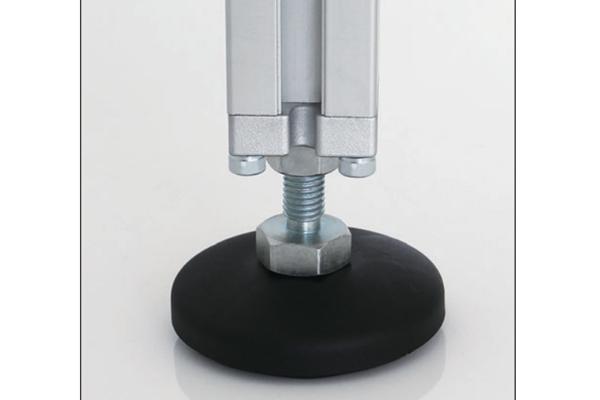
Nylon Pivot Foot
Levelling foot with a moulded PA6 nylon pivot joint and base, selected for vibration damping, electrical insulation, corrosion resistance and a non-marking pad.
| Material | PA6 nylon joint and base; zinc-plated steel stem |
|---|---|
| Alloy Grade | Not applicable |
| Temper | custom |
| Section Size | Fits profile ends with M8-M16 thread insert |
| Slot | M8 / M10 / M12 / M16 stem thread |
| Length | Stem 40-80 mm; overall height 55-140 mm |
| Tolerance | ±0.3 mm on thread pitch diameter |
| Surface | Moulded nylon; zinc-plated stem |
| MOQ | 500 |
| Lead Time | 15-25 days after deposit |
| Loading Port | Shanghai / Ningbo |
| Supply Ability | 250,000 pcs per month |
| Payment Terms | T/T 30% deposit + 70% before shipment | L/C at sight |
| Trade Terms | FOB | CIF | EXW |
| Certifications | ISO 9001:2015 | RoHS | REACH |
Levelling feet · Polymer joint
A nylon pivot foot uses a moulded PA6 nylon joint and base in place of the steel shell of a conventional levelling foot. The joint still allows the pad to sit flat on an uneven floor, but the material changes what the foot does beyond levelling: it damps vibration, it insulates the frame electrically, it does not corrode, and it will not mark a finished floor.
That combination makes it the standard foot on equipment frames rather than machine frames. A bench that carries a precision instrument, a frame that has to be isolated from a static discharge, a frame standing on a new epoxy floor, or a frame in a damp or mildly corrosive environment all get more from a nylon foot than from a steel one.
What the polymer actually contributes
| Stem | Pad Ø | Static load | Typical frame |
|---|---|---|---|
| M8 × 40 mm | 40 mm | 400 kg | Instrument benches and light stands |
| M10 × 50 mm | 50 mm | 600 kg | Workbenches and equipment frames |
| M12 × 60 mm | 60 mm | 1,000 kg | Machine frames and test rigs |
| M16 × 80 mm | 80 mm | 1,600 kg | Heavier frames in stainless-free areas |
Where a nylon foot is the wrong choice
The same properties that make nylon useful also limit it. It is softer than steel, so it creeps under a sustained high load and it deforms under a side load. It has a lower continuous temperature limit — around 90 °C for PA6 — so a foot close to a heat source or a weld operation is a problem. And because it insulates, it cannot be relied on to earth a frame that has to be bonded.
On a frame that is pushed sideways, or one carrying a very heavy static load, a steel or stainless foot is the right answer. Nylon is the default for equipment frames and the wrong choice for heavy machine bases.
- Creep. Under a sustained load the polymer relaxes slowly. Keep a margin between the working load and the rated load, and re-check the level after the frame has been loaded for a few weeks.
- Temperature. PA6 is rated to about 90 °C continuous. A foot adjacent to a hot process, a weld return or an oven needs a metal foot.
- Side load. A frame that is moved or pushed puts a shear load through the pad. Where that is normal, use a steel shell foot with a nylon insert.
Practical point: if the frame has to be both insulated and anchored, we can supply a nylon foot with a steel base plate that is drilled and bolted down through an insulating bush, so the anchor does not bridge the insulation.
Fitting
- Tap or insert the profile end A thread insert pressed into the core hole of the profile takes the M8 to M16 stem. Standard inserts match the standard stems, so no adaptor is needed.
- Screw the foot in Screw the foot into the insert by hand until it seats, then adjust with the spanner flats on the stem.
- Level the frame under load Adjust the feet with the equipment already on the frame, because the polymer settles slightly as the load comes on.
- Fit the locking nut Lock the stem against the profile end. Without it, vibration walks the setting out over time.
- Re-check after a few weeks Because of creep, re-check the level once the frame has been in service for a short period. A quarter-turn is usually all that is needed.
Frequently asked questions
Is a nylon foot strong enough for a machine frame?
For a machine frame up to around 1,000 kg per foot with a static load, yes. For heavier or vibrating machinery a steel or stainless foot is the better choice, because the polymer creeps under sustained high load.
Does the nylon foot insulate the frame?
Yes. It breaks the conductive path between the frame and the floor, which is the usual way to isolate a frame electrically. Where the frame also has to be bonded to earth, that has to be done separately.
Will the pad mark a new epoxy floor?
No. PA6 is softer than epoxy and does not scuff or mark it, and it does not leave a rust stain if the area is washed down.
What is the temperature limit?
About 90 °C continuous for PA6. A foot adjacent to a heat source or a weld return should be a metal foot instead.
Can a nylon foot be anchored to the floor?
Yes, with a steel base plate bolted through an insulating bush so the anchor does not bridge the insulation.
Send the frame and the floor finish
Tell us what the frame carries, the floor finish and whether the frame has to be electrically isolated. We will return the foot, the stem size and FOB pricing within one working day.
Request a QuoteRelated Products
 Metal Pivot Foot
Heavy-duty levelling foot with a steel or stainless pivot joint and base, for frames…
 Cup Pivot Foot
Levelling foot moulded as a shallow cup that the profile end seats into, giving…
 Fixed Foot with Profile Base
Non-adjustable foot that bolts to the profile end at a fixed height, giving higher…
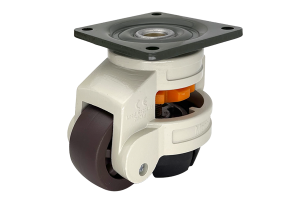 Levelling Castor
Combined castor and levelling foot: move the frame on the wheel, then wind the…
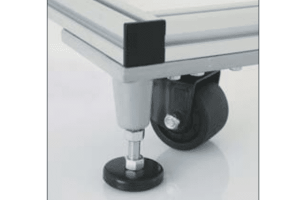 Foot and Castor Components
Spare and replacement components for foot and castor installations — pads, stems, locking nuts,…
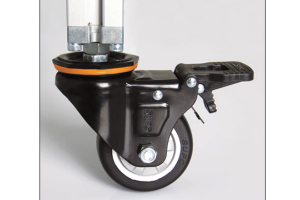 Aluminium Profile Castors
Castors for aluminium profile frames in seven configurations — plate fixed, swivel, braked and…
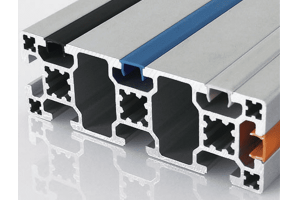 T-Slot Cover Profile
Snap-in T-slot cover strip that closes the open slot on aluminium framing profiles, giving…
 Aluminium Conduit End Cap
Snap-fit or screw-fixed end caps for aluminium conduit profiles from 40x40 to 80x200 mm,…
