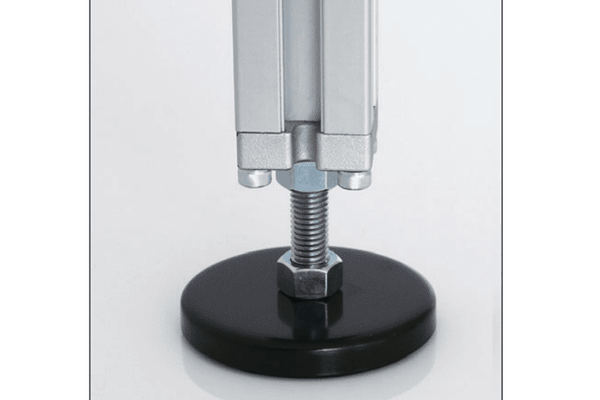
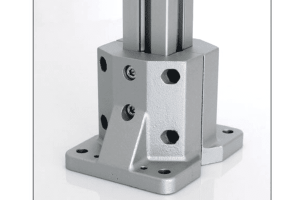
Fixed Foot with Profile Base
Non-adjustable foot that bolts to the profile end at a fixed height, giving higher stiffness, lower cost and a repeatable frame height for jig-built and volume frames.
| Material | Die-cast or machined aluminium foot block; steel base option |
|---|---|
| Alloy Grade | ADC12 die-cast or 6063-T5 machined |
| Temper | custom |
| Section Size | 30x30 to 60x60 mm and 40x80 mm sections |
| Slot | 4 x M6 to M10 bolts plus slot engagement |
| Length | Foot height 20-60 mm depending on section |
| Tolerance | ±0.2 mm on foot height |
| Surface | Anodised or powder coated; zinc-plated steel base |
| MOQ | 200 |
| Lead Time | 20-30 days after deposit |
| Loading Port | Shanghai / Ningbo |
| Supply Ability | 80,000 pcs per month |
| Payment Terms | T/T 30% deposit + 70% before shipment | L/C at sight |
| Trade Terms | FOB | CIF | EXW |
| Certifications | ISO 9001:2015 | ISO 14001 | RoHS | REACH |
Levelling feet · Fixed height
A fixed foot bolts to the end of a profile at a set height. It has no thread and no adjustment: the frame height is set by the length the members are cut to, and the foot simply gives that cut end a stable base and a floor interface.
It sounds like a downgrade from an adjustable foot, and on a one-off frame it often is. But on a frame built to a jig, or on a product made in volume, the fixed foot is the better engineering answer. It is stiffer because there is no thread to flex, it is cheaper because there is no machined thread or locking nut, and it is repeatable because every frame comes out at exactly the same height without anyone adjusting it.
The case for not adjusting
- Stiffness. A threaded stem is the most flexible part of a levelling foot. Remove it and the foot becomes a rigid block bolted to the profile end, which raises the frame’s natural frequency and reduces deflection at the corners.
- Repeatability. A frame that is assembled, not adjusted, comes out at the same height every time. On a production line where frames have to mate with conveyors or with each other, that matters more than the ability to compensate for a floor that is not level.
- Cost. No thread rolling, no locking nut, no spanner flats. On a volume product the saving is real, and it also removes an operation from the assembly line.
- Tamper resistance. A fixed foot cannot be walked out of adjustment by vibration, and it cannot be changed by an operator who should not be changing it.
What the frame has to guarantee instead
The trade-off is that the frame now has to be accurate. If the floor is not level, the frame cannot compensate for it, so either the floor has to be good enough, or the frame has to be shimmed at installation. The usual practice is to set the frame on shims under the feet, level it, then bolt the feet down — which gives the rigidity of a fixed foot with the levelling done once, at installation, rather than at every corner for the life of the machine.
The members also have to be cut accurately. A fixed foot magnifies a cutting error: if one leg is 2 mm long, the frame rocks by 2 mm with no way to take it out. That is why fixed feet belong with cut-to-length members from a single supplier rather than with members cut on site.
| Profile | Foot base | Fixing | Height range | Static load |
|---|---|---|---|---|
| 30 × 30 mm | 60 × 60 mm | 4 × M6 | 20-40 mm | 700 kg |
| 40 × 40 mm | 80 × 80 mm | 4 × M8 | 25-50 mm | 1,200 kg |
| 45 × 45 mm | 90 × 90 mm | 4 × M8 | 25-55 mm | 1,500 kg |
| 60 × 60 mm | 100 × 100 mm | 4 × M10 | 30-60 mm | 2,200 kg |
| 40 × 80 mm | 80 × 120 mm | 6 × M8 | 25-50 mm | 1,800 kg |
Three ways a fixed foot is built
Practical point: if the frame has to sit on a floor that is not level, a fixed foot plus a shim pack is still usually cheaper and stiffer than an adjustable foot on every leg — the shims are set once at installation and never touched again.
Frequently asked questions
How do I level a frame with fixed feet?
With shims under the feet, set once at installation. Level the frame on shims, then bolt the feet down. The shims are not touched again, which is why the frame stays in adjustment.
Are fixed feet strong enough for a heavy frame?
They are stronger than an adjustable foot of the same base size, because there is no thread to flex. The load path is a solid block from the profile end to the floor.
Can the foot be made in a custom height?
Yes. The height is set by the foot block or by the length the profile is cut to, so a custom height is a drawing change rather than a special part.
Do fixed feet need a locking nut?
No. There is nothing to lock — the height is fixed by the frame geometry.
Can the fixed foot be anchored to the floor?
Yes. The profile-base block version can be drilled for anchor bolts, which gives a rigid, anchored foot with no adjustment to drift.
Send the frame height and the cut list
Tell us the frame height, the profile sections and how the frame is built. We will return the foot block, the cut-length tolerance that holds the height and FOB pricing within one working day.
Request a QuoteRelated Products
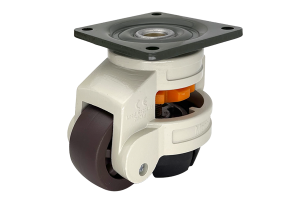 Levelling Castor
Combined castor and levelling foot: move the frame on the wheel, then wind the…
 Foot and Castor Components
Spare and replacement components for foot and castor installations — pads, stems, locking nuts,…
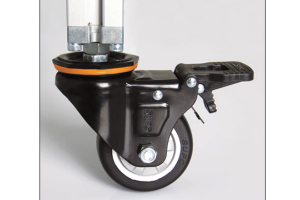 Aluminium Profile Castors
Castors for aluminium profile frames in seven configurations — plate fixed, swivel, braked and…
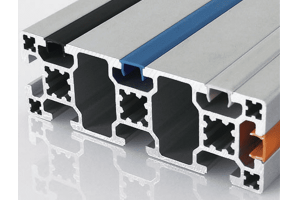 T-Slot Cover Profile
Snap-in T-slot cover strip that closes the open slot on aluminium framing profiles, giving…
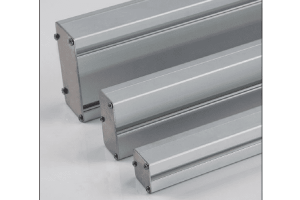 Aluminium Conduit End Cap
Snap-fit or screw-fixed end caps for aluminium conduit profiles from 40x40 to 80x200 mm,…
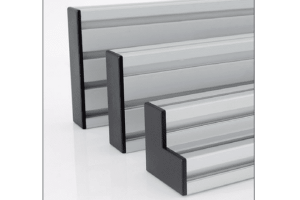 Aluminium Profile End Cap
Push-fit end caps for T-slot framing profiles from 15 to 60 series, sized to…
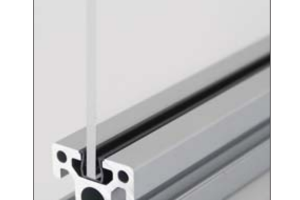 T-Slot Reducing Profile
Reducing insert that narrows a wide T-slot to accept standard nuts and accessories from…
 Aluminium Profile Base Plate
Drilled base plate bolted to the end of an aluminium profile leg to spread…
