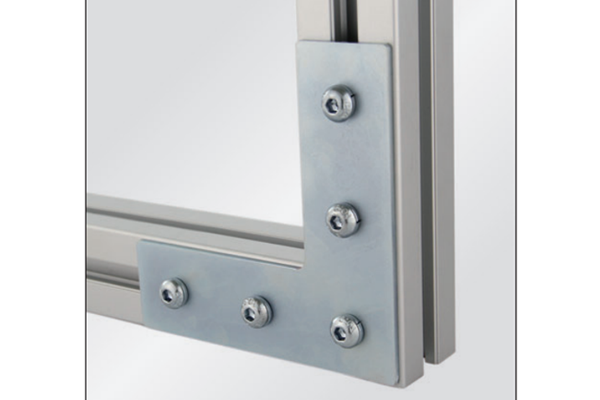
Joining Plate PG45-4545
Joining plate for two 45 × 45 mm profiles at 90°, sized to the 10 mm slot of the 45 series for heavier frames and larger accessories.
| Material | Die-cast aluminium ADC12 or machined 6063-T5 |
|---|---|
| Alloy Grade | ADC12 die-cast or 6063-T5 |
| Temper | custom |
| Section Size | 45 x 45 mm profiles at 90 degrees |
| Slot | 10 mm slot; 2 + 2 M8 or M10 T-nuts |
| Length | Plate 90 x 90 x 45 mm |
| Tolerance | ±0.25 mm on bolt slot positions |
| Surface | Anodised or powder coated |
| MOQ | 500 |
| Lead Time | 15-25 days after deposit |
| Loading Port | Shanghai / Ningbo |
| Supply Ability | 200,000 pcs per month |
| Payment Terms | T/T 30% deposit + 70% before shipment | L/C at sight |
| Trade Terms | FOB | CIF | EXW |
| Certifications | ISO 9001:2015 | ISO 14001 | RoHS | REACH |
Joining plates · 45 series
This plate joins two 45 × 45 mm profiles at 90°. The 45 series is a separate range from the 40 series: its members are larger, its slot is 10 mm rather than 8 mm, and it takes M8 or M10 fixings rather than M8 alone. The plate is sized for that slot and that member, so it is not interchangeable with the PG40 plates.
The reason the 45 series exists is that on some frames an 8 mm slot is too small. A heavy accessory, a long bolt, a cable gland or a large T-nut needs the room that a 10 mm slot provides, and the 45 series gives it while keeping the frame within a size that still looks like a machine frame rather than a structure. Where a designer would otherwise step up to 50 series and pay for the extra size and weight, 45 series is the economical middle.
40 series or 45 series: the real differences
- Slot width. 40 series uses an 8 mm slot; 45 series uses 10 mm. The wider slot takes larger T-nuts, longer bolts and bigger accessories, and it gives more room for cable.
- Member size. A 45 × 45 member is about a quarter larger in section than a 40 × 40, so it is stiffer for the same span — but not dramatically so. The step in stiffness is not the main reason to choose it.
- Fixing size. 45 series accepts M8 and M10 fixings; 40 series is M8. The larger bolt gives more clamping force and more shear capacity at the joint.
- Ecosystem. The two ranges have different plates, feet, castors and accessories. Mixing them in one frame is possible but adds parts and complexity, so a frame is normally built in one series.
| Characteristic | 40 series | 45 series |
|---|---|---|
| Slot width | 8 mm | 10 mm |
| Member size | 40 × 40 mm | 45 × 45 mm |
| Standard fixing | M8 | M8 / M10 |
| Second moment of area | Lower | About 1.6× higher |
| Plate size (corner) | 80 × 80 mm | 90 × 90 mm |
| Best for | General machine frames | Heavier frames, larger accessories |
When the 45 series is worth choosing
The counter-argument is weight and cost. A 45 series frame is heavier and its accessories are larger and more expensive than the equivalent 40 series. Where the frame does not need the extra slot width or the larger fixing, the 40 series is the better value, and the two are not far apart in stiffness. The honest answer is that most frames are 40 series and the 45 series is chosen for a specific reason rather than as a general upgrade.
Practical point: do not mix 40 and 45 series in one frame unless there is a reason. The plates, feet and castors do not interchange, so a mixed frame needs two of everything and the assembler has to keep them apart. Where a frame has to span from a 40 series sub-frame to a 45 series structure, a transition plate is the clean way to do it.
- Confirm the slot is 10 mm Measure the slot mouth of the profile. A 45 series profile has a 10 mm slot and the plate is sized for it; an 8 mm plate will not fit.
- Choose the fixing size M8 or M10 T-nuts. The larger fixing gives more clamping force; confirm the torque figure against the profile supplier’s data.
- Set the T-nuts and fit the plate Drop the T-nuts into the 10 mm slot, slide them to position, and lay the plate over them.
- Square and torque Hold the corner square, tighten finger-tight, then torque in two diagonal passes to around 30 Nm for an M8 or 45 Nm for an M10 T-nut.
- Check the joint Push the corner sideways. Any movement means the joint needs a second plate or a brace, as it would in the 40 series.
Frequently asked questions
Will a PG40 plate fit a 45 series profile?
No. The plate is sized for the 8 mm slot and the 40 mm member. A 45 series profile needs the PG45 plate, which is sized for the 10 mm slot.
Can I mix 40 and 45 series in one frame?
It is possible but not recommended, because the plates, feet and castors do not interchange. Where a mix is unavoidable, use a transition plate and keep the two series’ parts separate on the build.
Is the 45 series much stiffer than the 40 series?
About 1.6 times the second moment of area, so noticeably stiffer for the same span, but not dramatically so. The main reasons to choose it are the 10 mm slot and the larger fixing, not the stiffness.
What torque should the bolts be?
Around 30 Nm for an M8 T-nut and 45 Nm for an M10 T-nut in a 45 series slot, subject to the profile supplier’s data.
Is the 45 series available in stainless?
The plates are, for wash-down and outdoor frames. Match the T-nuts and bolts to the plate material so the joint does not develop galvanic corrosion.
Send the accessory that will not fit an 8 mm slot
Tell us the accessory and the fixing it needs. We will confirm whether the 45 series is required or whether a 40 series solution exists, and return FOB pricing within one working day.
Request a QuoteRelated Products
 Butt Connector
Connector that joins two profiles end to end in a straight line, transmitting bending…
 Radius Corner Aluminium Profile 45×45 mm Quarter Round Trim Section
45 x 45 mm quarter-round radius corner aluminium trim section in 6063-T5 with an…
 Strut Aluminium Profile 45×45 mm 4-Slot Heavy Duty T-Slot Extrusion
45 x 45 mm heavy duty four-slot T-slot strut aluminium profile in 6063-T5 with…
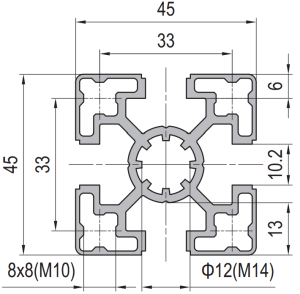 Strut Aluminium Profile 45×45 mm 4-Slot Light T-Slot Extrusion
45 x 45 mm light wall four-slot T-slot strut aluminium profile in 6063-T5 with…
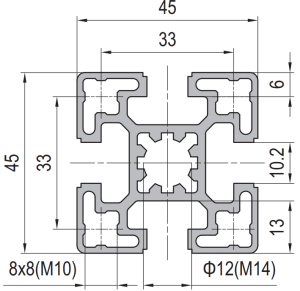 Strut Aluminium Profile 45×45 mm 4-Slot Standard T-Slot Extrusion
45 x 45 mm four-slot standard T-slot strut aluminium profile in 6063-T5 with walls…
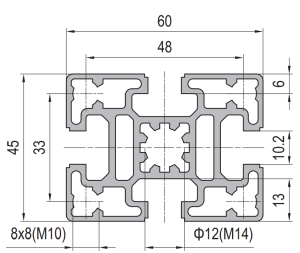 Strut Aluminium Profile 45×60 mm 4-Slot Column T-Slot Extrusion
45 x 60 mm four-slot rectangular T-slot strut aluminium profile in 6063-T5, about 3.3…
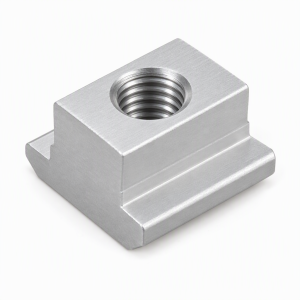 T-Slot Nut 45 Series M8 Hammer Nut for 45×45 Aluminium Extrusion
M8 hammer-head T-slot nut for the 10 mm slot of 45 x 45 mm…
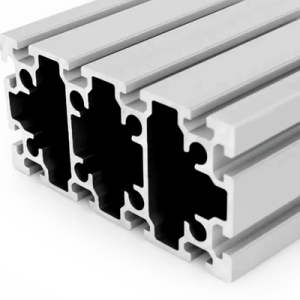 PG45 180 x 90 mm Twelve Slot Aluminium Strut Profile Heavy Duty Column
A 180 x 90 mm twelve slot PG45 aluminium strut profile at about 9.50…
