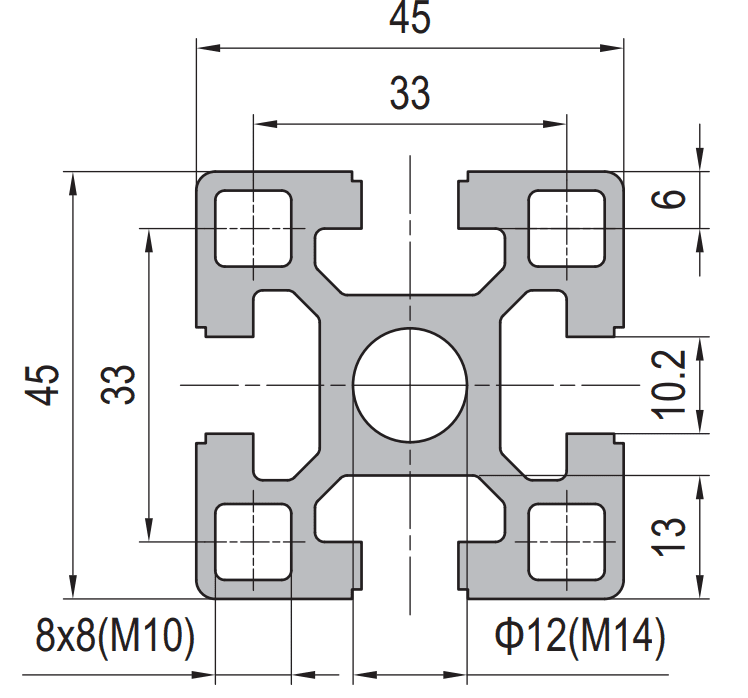
Strut Aluminium Profile 45×45 mm 4-Slot Heavy Duty T-Slot Extrusion
45 x 45 mm heavy duty four-slot T-slot strut aluminium profile in 6063-T5 with walls about 2.6 mm, four 8 x 8 mm slots on a 33 mm pitch and a O 12 mm centre bore tapped M14. About 3.15 kg/m and about 19.5 cm4, for members that have to stay straight under load.
| Material | Aluminium |
|---|---|
| Alloy Grade | 6063-T5 |
| Temper | T5 |
| Section Size | 45 x 45 mm |
| Slot | 8 x 8 mm groove, M10 slot nuts, 4 faces, 33 mm pitch |
| Length | 6 m stock, cut to drawing to plus or minus 0.5 mm |
| Tolerance | EN 755-9 / GB/T 6892, wall plus or minus 0.15 mm |
| Surface | Mill finish / clear anodised / black anodised |
| MOQ | 300 |
| Lead Time | 18-28 days after deposit for mill finish |
| Loading Port | Shanghai / Ningbo |
| Supply Ability | 500 t per month |
| Payment Terms | T/T 30% deposit + 70% before shipment | L/C at sight |
| Trade Terms | FOB | CIF | EXW |
| Certifications | ISO 9001:2015 | EN 755-9 | RoHS | REACH |
Heavy wall · 45 series
A 45 x 45 four-slot heavy duty strut profile is an extruded aluminium T-slot section with a 45 mm square envelope, four 8 x 8 mm slots on a 33 mm pitch, a O 12 mm centre bore tapped M14, and a wall thickness of about 2.6 mm giving roughly 3.15 kg/m and about 19.5 cm4 of second moment of area. It exists for one reason: it occupies the same 45 mm footprint as the standard 45-series member, so brackets, panels, covers and slot accessories do not change, while the extra wall adds roughly 26 per cent to stiffness.
The comparison that decides the purchase is not heavy against standard inside the 45 series, it is heavy against the 40 x 40 heavy member at a similar price. Going from 40 x 40 heavy to 45 x 45 heavy raises the weight from about 2.35 kg/m to about 3.15 kg/m, roughly 34 per cent more material, and raises the second moment of area from about 12.4 cm4 to about 19.5 cm4, roughly 57 per cent. On a 1200 mm span carrying 500 N that is about 2.1 mm of deflection against about 1.3 mm. Below roughly 900 mm of span, or under a few hundred newtons, that difference never appears on site.
What the heavy wall actually buys
Bending stiffness is set by how far the material sits from the neutral axis, so for a section of a given envelope there are only two ways to buy it: add wall, or add depth. Heavy wall is the first, and it is the only one available when the 45 mm footprint is fixed by a guard height, a machine opening or an existing frame being reinforced rather than rebuilt.
Adding wall is a linear purchase. Moving from about 2.0 mm to about 2.6 mm of wall on the same die family raises the weight by about 24 per cent and the second moment of area by about 26 per cent. Adding depth is a cubic purchase: the same material moved outwards into a 45 x 60 section buys far more stiffness per kilogram. Heavy wall is therefore not the efficient way to buy stiffness, it is the way to buy it when the envelope cannot move.
| Property | 40 x 40 heavy | 45 x 45 standard | 45 x 45 heavy |
|---|---|---|---|
| Envelope | 40 x 40 mm | 45 x 45 mm | 45 x 45 mm |
| Wall thickness | approx. 2.6 mm | approx. 2.0 mm | approx. 2.6 mm |
| Slot | M6, 8 mm mouth | M10, 8 x 8 mm groove | M10, 8 x 8 mm groove |
| Slot pitch | 30 mm | 33 mm | 33 mm |
| Second moment of area | approx. 12.4 cm4 | approx. 15.5 cm4 | approx. 19.5 cm4 |
| Weight | approx. 2.35 kg/m | approx. 2.55 kg/m | approx. 3.15 kg/m |
| Deflection, 500 N over 1200 mm | approx. 2.1 mm | approx. 1.7 mm | approx. 1.3 mm |
| Relative material cost | 1.00 | 1.09 | 1.34 |
The two levers are not equivalent. Doubling the wall on the same envelope roughly doubles the stiffness and doubles the price. Doubling the depth roughly multiplies the stiffness by eight for a much smaller weight increase. Heavy wall is the answer when the envelope is fixed, not when the budget is flexible.
When heavy wall is the right purchase
The heavy section earns its premium in three situations, and it is worth naming them plainly because a designer who cannot name them is usually over-specifying.
When heavy wall is the wrong purchase
Short, lightly loaded members are the common over-specification: a guard panel, a cabinet frame or a cover support under about 900 mm carries loads the lightest 45-series wall handles without measurable deflection, and heavy wall adds about 0.6 kg/m of dead weight to a frame that then needs bigger feet.
The more expensive mistake is buying heavy wall when the real problem is span. Above roughly 1.5 m it is the depth of the section, not its wall, that sets deflection, so the fix is a 45 x 60 section on edge or a 50 x 100 heavy beam. A heavier 45 x 45 across 2 m still sags visibly, and now weighs more while doing it.
The O 12 mm centre bore and the joint it makes possible
The heavy section keeps the same O 12 mm centre bore as the standard 45-series member, tapped M14 at the ends. That bore is not a slot accessory, it is the load path for the joint. A slot fixing carries its load through the two lips of the groove, so its capacity is set by the extrusion rather than by the bolt; a through-bolt in the centre bore carries load through the whole section.
On a heavy-wall member this matters more, not less, because a stiffer member attracts a larger share of the load in any redundant frame. Where a 45 x 45 heavy is a machine base rail, the structural joint at the end is normally a plate plus an M12 through-bolt in the centre bore at roughly 85 to 100 Nm in grade 8.8, or a tapped M14 thread in the bore end. The slot then does what it is good at: holding covers, sensors and cable ducts that may need to move later.
- Centre bore: O 12 mm, tapped M14 at the member ends
- Slot: 8 x 8 mm groove taking M10 slot nuts on a 33 mm pitch
- Structural joint: M12 through-bolt in grade 8.8 or 10.9
Ordering heavy wall and actually receiving it
- State the wall on the order line Light, standard and heavy wall are drawn identically in a 2D layout and differ by about 0.6 kg/m. If the order says only 45 x 45 four slot, the factory ships whichever die is running. Put the wall thickness and the target weight per metre on the order.
- Ask for the certified weight on the die The 3.15 kg/m figure is a planning number. Because heavy wall is bought for stiffness, a die that runs two per cent light is stiffness you did not pay for. Ask for the measured weight and the wall check on the first article.
- Mark which ends are tapped A tapped M14 centre bore is a machining operation, not an extrusion feature. Tapping to a stated depth costs very little with the cut, and a great deal when it is discovered on site.
- Fix the finish before the batch Heavy wall is often used in visible machine frames. Anodising adds a lead-time step and a colour-batch risk, so anodise the whole frame order in one batch rather than splitting heavy and standard members across two runs.
Frequently asked questions
How much stiffer is 45 x 45 heavy than 40 x 40 heavy?
About 57 per cent. The second moment of area is roughly 19.5 cm4 against roughly 12.4 cm4, for about 34 per cent more weight. On a 1200 mm span at 500 N that is about 1.3 mm of deflection against about 2.1 mm.
Can I mix 45 x 45 heavy with standard 45 x 45 in one frame?
Yes. Both use the same 8 x 8 mm slot, the same 33 mm pitch and the same O 12 mm centre bore, so nuts, brackets, plates and feet interchange. Only weight and stiffness differ.
What bolt does the centre bore take?
The bore is O 12 mm tapped M14. In practice the structural joint uses an M12 through-bolt in grade 8.8 or 10.9, or an M14 thread tapped into the bore end. Slot nuts in the 8 x 8 mm groove take M10.
Is heavy wall worth it on a 700 mm guard frame?
Usually not. Under about 900 mm and under a few hundred newtons the deflection difference between light, standard and heavy wall is below what can be measured in service.
Can you supply it cut, tapped and anodised to a drawing?
Yes. We cut to plus or minus 0.5 mm, deburr, tap the centre bores, drill and counterbore to drawing, and supply mill finish, clear or black anodised.
Send the span and the load, we will tell you if heavy wall is the answer
Give us the span, the load and the envelope you are locked into. We will check the deflection on standard and heavy wall, tell you honestly which one the design needs, and quote the section, the tapping, the finish and FOB pricing with the members cut, deburred and bagged by assembly.
Request a QuoteRelated Products
 Strut Aluminium Profile 45×45 mm 4-Slot Light T-Slot Extrusion
45 x 45 mm light wall four-slot T-slot strut aluminium profile in 6063-T5 with…
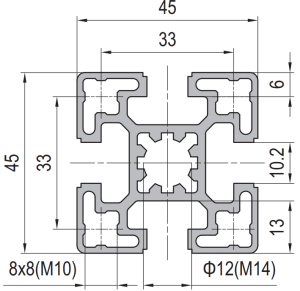 Strut Aluminium Profile 45×45 mm 4-Slot Standard T-Slot Extrusion
45 x 45 mm four-slot standard T-slot strut aluminium profile in 6063-T5 with walls…
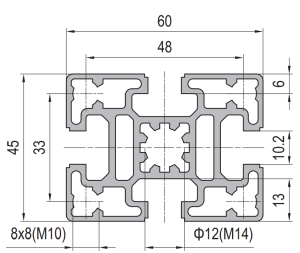 Strut Aluminium Profile 45×60 mm 4-Slot Column T-Slot Extrusion
45 x 60 mm four-slot rectangular T-slot strut aluminium profile in 6063-T5, about 3.3…
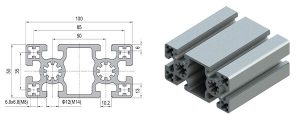 Strut Aluminium Profile 50×100 mm 2-Slot Heavy T-Slot Beam Extrusion
50 x 100 mm heavy two-slot T-slot strut aluminium beam in 6063-T5, about 6.2…
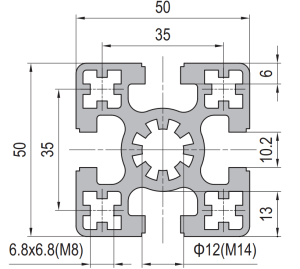 50 x 50 mm Four Slot Aluminium Strut Profile Heavy Frame Cross Member
50 x 50 mm four slot T-slot strut aluminium profile in 6063-T5, about 3.1…
 60 x 60 mm Four Slot Aluminium Strut Profile Main Machine Frame Column
60 x 60 mm four-slot T-slot strut aluminium profile in 6063-T5, about 4.3 kg/m…
 Strut Aluminium Profile 60×60 mm Heavy Duty T-Slot Extrusion M16 Bore
60 x 60 mm heavy duty four-slot T-slot strut aluminium profile in 6063-T5 with…
 PG15 Strut Aluminium Profile 15×15 mm Light T-Slot Extrusion
PG15 15 x 15 mm single-slot T-slot strut aluminium profile in 6063-T5, about 0.48…
