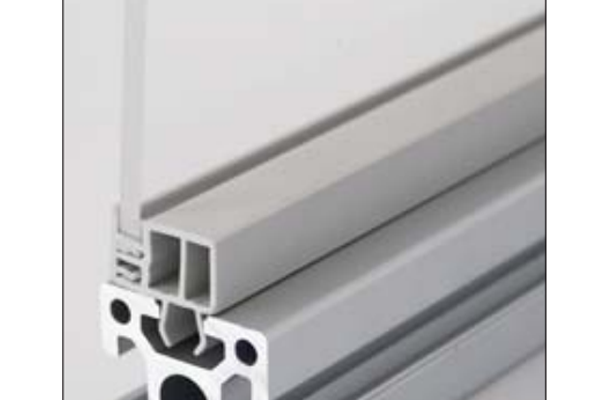
Panel Mounting Strip
Continuous strip that runs the length of a profile and holds a panel along its whole edge, removing the bow that point supports allow between blocks.
| Material | Rigid PVC, aluminium or EPDM |
|---|---|
| Alloy Grade | 6063-T5 on aluminium strips |
| Temper | custom |
| Section Size | Fits 6, 8 and 10 mm slot profiles |
| Slot | Panel thickness 2-12 mm |
| Length | Cut to member length, or 2 m lengths |
| Tolerance | ±0.2 mm on panel throat |
| Surface | Extruded; anodised on aluminium |
| MOQ | 300 |
| Lead Time | 15-25 days after deposit |
| Loading Port | Shanghai / Ningbo |
| Supply Ability | 200,000 m per month |
| Payment Terms | T/T 30% deposit + 70% before shipment | L/C at sight |
| Trade Terms | FOB | CIF | EXW |
| Certifications | ISO 9001:2015 | RoHS | REACH | food-contact grade on request |
Panel installation · Continuous support
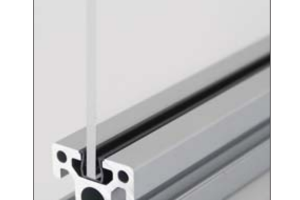
A panel mounting strip runs the whole length of a profile and grips the panel edge along its entire run. Where a block holds the panel at discrete points and lets it bow between them, a strip holds it continuously, so the panel edge is supported everywhere and the bow is eliminated.
That matters wherever the panel has to stay flat or has to resist a load. A glazed guard that bows under a hand pushed against it, a cladding panel that ripples in a cross-draught, a shelf board that sags between supports — all of them are point-support problems, and all of them are solved by replacing the blocks with a continuous strip along the loaded edges.
Point support and continuous support
What the strip changes about the panel
A panel supported continuously along two opposite edges behaves very differently from the same panel on a few blocks. The unsupported span drops from the block spacing to zero along the supported edges, so the bow falls away and the panel carries a much larger load before it deflects visibly.
The strip also changes the failure mode. A point-supported panel cracks at a block under a hard knock, because the load concentrates at a small area. A continuous strip spreads the same load along the edge, so the panel is far more resistant to impact — which is the reason glazing strips are used on machine guards and on any panel a person can lean against.
| Panel | Blocks | Strip |
|---|---|---|
| Bow between supports | Present, set by block spacing | Eliminated along the supported edges |
| Impact resistance | Concentrated load at each block | Load spread along the edge |
| Panel replacement | Lift out between blocks | Slide out of the strip |
| Adjustment | Slide the blocks anywhere | Strip position is set when fitted |
| Appearance | Blocks visible at intervals | Continuous clean line |
- Decide which edges are supported Usually the two long edges, and all four for a large panel. The unsupported edges are where the panel is free to bow.
- Cut the strip to the member length The strip runs the full length of the profile, or between the corner joints. Deburr the cut ends so they sit flush.
- Fit the strip to the profile The strip seats in the slot along the profile. Where it is retained by the slot, slide it in from the end before the frame is closed.
- Slide the panel in On a frame with strips on two opposite edges, the panel slides in from the end. Fit the panel before the last member closes the frame.
- Clamp or seal Tighten the clamping screws, or fit the outer retaining strip. On a glazed strip, check the gasket is compressed evenly along the run.
- Check the panel for flatness Look along the panel edge. A ripple means the strip is not seated, or the profile is not straight.
- The strip has to be fitted before the frame is closed. On a panel held on two opposite edges, the panel slides in from the end, so the last member of the frame has to go on after the panel. That is a build-sequence decision.
- A long strip needs support. On a very long run the strip can be pushed out of the slot by the panel. Where the run is more than about a metre, support the strip at intervals or use a heavier retaining section.
- The strip and the panel expand differently. On an outdoor panel, allow for thermal movement by leaving a small gap at the panel ends, so the panel does not buckle against the strip when it warms up.
Practical point: if the panel is transparent and the frame is visible, a strip with a covering lip gives a much cleaner result than blocks, because it hides the panel edge as well as supporting it. On a glazed guard that is usually the deciding factor.
Frequently asked questions
When should I use a strip instead of blocks?
Wherever the panel has to stay flat, has to resist a load, or is visible. Blocks are for a stiff panel that does not have to be perfectly flat and where speed of fitting matters more.
Can a panel be removed with a strip fitted?
Yes, by sliding it out of the strip, which means the frame has to be open at one end. On a closed frame the panel is fitted before the last member goes on.
Will the strip seal the panel joint?
Only the gasketed glazing version. A plain mounting strip supports the panel but does not seal it, so it is not suitable for a weather-tight enclosure on its own.
Does the strip fit any profile?
It is made to the slot of a specific section. Send the section drawing and we will confirm the fit.
How long can a strip run be?
Up to a few metres, but on a long run the strip needs support or a heavier retaining section so the panel does not push it out of the slot.
Send the panel and tell us if it has to stay flat
Tell us the panel material, thickness and whether it has to be flat under load. We will recommend the strip, the retention and the gasketing, and return FOB pricing within one working day.
Request a QuoteRelated Products
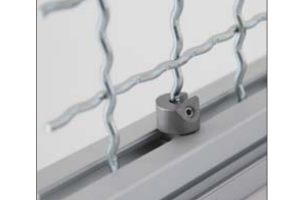 Panel Mounting Nut Block
Block that seats in the profile slot and provides a captive threaded hole at…
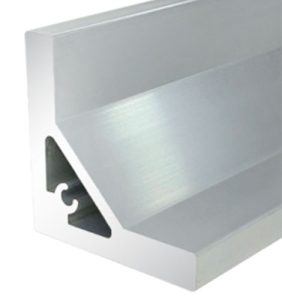 Aluminium Angle Profile 35 x 35 x 4 mm Panel Edge Trim for Guarding
35 x 35 x 4 mm aluminium angle profile with an inner corner slot,…
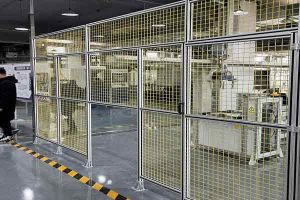 Aluminium Profile Sliding Door 40 Series 8 mm Slot for Machine Enclosures
Sliding door leaves framed in 40 series aluminium profile for machine enclosures. Top hung…
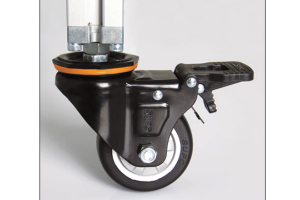 Aluminium Profile Castors
Castors for aluminium profile frames in seven configurations — plate fixed, swivel, braked and…
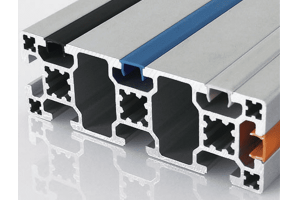 T-Slot Cover Profile
Snap-in T-slot cover strip that closes the open slot on aluminium framing profiles, giving…
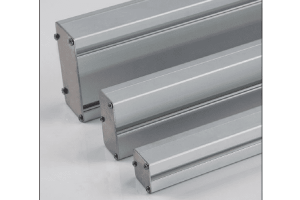 Aluminium Conduit End Cap
Snap-fit or screw-fixed end caps for aluminium conduit profiles from 40x40 to 80x200 mm,…
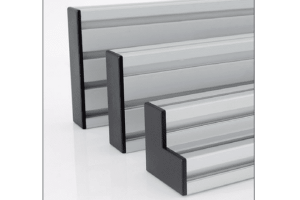 Aluminium Profile End Cap
Push-fit end caps for T-slot framing profiles from 15 to 60 series, sized to…
 T-Slot Reducing Profile
Reducing insert that narrows a wide T-slot to accept standard nuts and accessories from…
