Strut Aluminium Profile 45×45 mm 4-Slot Light T-Slot Extrusion
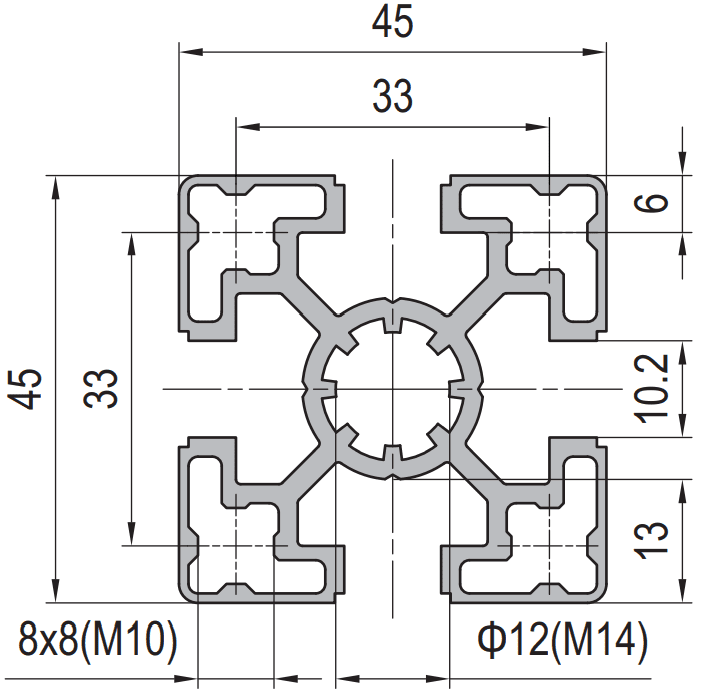
45 x 45 mm light wall four-slot T-slot strut aluminium profile in 6063-T5 with walls about 1.5 mm, about 1.9 kg/m and about 10.5 cm4. M8 slots on a 33 mm pitch and a O 10 mm centre bore tapped M12, for short spans, overhead structures and moving parts.
| Material | Aluminium |
|---|---|
| Alloy Grade | 6063-T5 |
| Temper | T5 |
| Section Size | 45 x 45 mm |
| Slot | M8 slot nuts, 4 faces, 33 mm pitch |
| Length | 6 m stock, cut to drawing to plus or minus 0.5 mm |
| Tolerance | EN 755-9 / GB/T 6892, wall plus or minus 0.15 mm |
| Surface | Mill finish / clear anodised / black anodised |
| MOQ | 800 |
| Lead Time | 15-25 days after deposit for mill finish |
| Loading Port | Ningbo / Shanghai |
| Supply Ability | 700 t per month |
| Payment Terms | T/T 30% deposit + 70% before shipment | L/C at sight |
| Trade Terms | FOB | CIF | EXW |
| Certifications | ISO 9001:2015 | EN 755-9 | RoHS | REACH |
Light wall · 45 series
A 45 x 45 four-slot light wall strut profile is an extruded aluminium T-slot section with a 45 mm square envelope, four slots on a 33 mm pitch, a wall of about 1.5 mm giving about 1.9 kg/m, and a O 10 mm centre bore tapped M12. Its second moment of area is about 10.5 cm4. It is the right member when the envelope has to be 45 mm but the load and the span are modest: guard frames, covers, overhead cable supports, moving gantries and any structure where every kilogram is paid for twice, once in material and once in freight or in the load the structure has to carry.
Choosing between the three wall thicknesses on this die family is not a matter of taste, it is four numbers. Weight per metre decides cost and dead load. Second moment of area decides deflection. The slot and bore class decides which bolts and nuts the member can accept. And the cost per cm4 decides whether the heavier grade is actually poor value or, counter intuitively, slightly better value than the light one. Read those four in order and the selection usually makes itself.
Three wall thicknesses, one 45 mm envelope
The three grades share the same envelope, the same 33 mm slot pitch and the same machining operations. They differ in wall, and the wall difference cascades: less material means less weight, less stiffness, a smaller centre bore and a smaller slot class. That cascade is why the choice is not simply “how strong do I want it”.
The most common mistake on this die family is to treat the three grades as a strength dial and pick the middle one to be safe. The middle grade is a good default, but it is a default for the frame, not for every member in it. A 45 x 45 frame usually wants standard wall on the columns and beams and light wall on the rails that only carry a cover, a guard panel or a cable tray.
| Property | Light wall | Standard | Heavy wall |
|---|---|---|---|
| Wall thickness | approx. 1.5 mm | approx. 2.0 mm | approx. 2.6 mm |
| Weight per metre | approx. 1.9 kg/m | approx. 2.55 kg/m | approx. 3.15 kg/m |
| Second moment of area | approx. 10.5 cm4 | approx. 15.5 cm4 | approx. 19.5 cm4 |
| Slot class | M8 slot nuts | M10 slot nuts | M10 slot nuts |
| Centre bore | O 10 mm, tapped M12 | O 12 mm, tapped M14 | O 12 mm, tapped M14 |
| End bolt | M12, grade 8.8 | M12 to M14, grade 8.8 or 10.9 | M12 to M14, grade 8.8 or 10.9 |
| Relative cost per metre | 1.00 | 1.34 | 1.66 |
| Relative cost per cm4 | 1.00 | 0.91 | 0.89 |
| Comfortable span, light load | about 0.9 m | about 1.2 m | about 1.5 m |
Read the last two rows together. Per metre, light wall is the cheapest and heavy wall is 66 per cent dearer. Per cm4 of stiffness, heavy wall is about 11 per cent cheaper than light wall, because thick walls use material more efficiently in bending. Light wall is not the value choice for stiffness. It is the value choice for absolute weight and for cost per metre.
The four numbers that decide it
How to run the selection in five minutes
- Fix the envelope first All three grades are 45 x 45 mm, so the envelope is not part of the choice. If the design allows a bigger envelope, stop here: a deeper section at the same weight beats any wall change, and a 45 x 60 section on edge is the usual answer.
- Estimate the span and the load Write down the longest unsupported span and the working load on it. If the span is under about 0.9 m and the load is under a few hundred newtons, select light wall and move on. If the span is over about 1.5 m, the answer is a deeper section, not a thicker wall.
- Check the deflection, not the stress Aluminium frames almost never fail in bending stress; they fail by looking bent or by putting a machine out of alignment. Use a limit of span divided by 500 for a machine frame and span divided by 300 for a guard or a cover, and read the required stiffness back off the table.
- Check the fixing scheme before the wall Confirm which bolt size the joint needs. If the joint is specified with M10 slot nuts or an M14 thread, light wall is out of the running regardless of the deflection result, because its slot and bore are one class smaller.
- Add the machining and finish, then compare landed cost Cutting, deburring, tapping and anodising cost roughly the same per piece whatever the wall, so the price gap between grades narrows as machining content rises. Compare the finished member, not the raw metre.
Where the three grades land in service
- Light wall (about 1.9 kg/m): guard panel rails, cover supports, cable tray brackets, overhead runs, moving gantries, display frames, hand-carried fixtures, and any member under about 0.9 m
- Standard wall (about 2.55 kg/m): the default for columns, beams and general frame members up to about 1.2 m of span, and the grade that most accessory drawings are dimensioned around
- Heavy wall (about 3.15 kg/m): machine base rails, conveyor and gantry rails, vibrating and dynamic structures, and reinforcement of existing frames where the envelope cannot change
A mixed frame is normal and usually the cheapest correct answer: heavy or standard wall on the members that carry the load and set the alignment, light wall on everything that only holds a panel. Because all three grades share the slot pitch and the machining operations, mixing them costs nothing in tooling, only in keeping the cut list and the bagging straight. That is the one thing worth insisting on with the supplier: bag by assembly, so the light members do not end up where the heavy ones belong.

Frequently asked questions
Is light wall strong enough for a machine frame?
For a frame under about 0.9 m of span with modest loads, yes. Aluminium frames rarely fail in stress; they deflect. Check the deflection against a limit of span divided by 500 and the answer will be clear.
Can I use the same brackets on light wall as on standard wall?
Not always. Light wall takes M8 slot nuts while standard and heavy take M10, and the centre bore is O 10 tapped M12 against O 12 tapped M14. The bracket can be the same part number, but the nut and the bolt change.
Why is heavy wall cheaper per unit of stiffness?
Because bending stiffness depends on how far the material sits from the neutral axis, and a thick wall places more of its material further out. Per cm4 of stiffness the heavy grade is about 11 per cent cheaper than the light grade, even though it is 66 per cent dearer per metre.
What is the lightest 45 x 45 you supply?
About 1.9 kg/m with walls of about 1.5 mm. If the design needs less weight than that, the correct move is a smaller envelope, a 40 x 40 section or a 30-series member, rather than a thinner wall on a 45 mm die.
Do you cut, tap and anodise light wall to a drawing?
Yes. We cut to plus or minus 0.5 mm, deburr, tap the O 10 mm centre bores to M12, drill and counterbore to drawing, and supply mill finish, clear or black anodised, bagged by assembly.
Send the span and the load per member, we will pick the wall thickness
Give us the frame layout with a span and a load for each member. We will tell you which members can go light wall and which cannot, flag any joint that forces a bigger slot class, and quote the mixed cut list cut, deburred, tapped and bagged by assembly with FOB pricing.
Request a QuoteRelated Products
 Strut Aluminium Profile 45×45 mm 4-Slot Standard T-Slot Extrusion
45 x 45 mm four-slot standard T-slot strut aluminium profile in 6063-T5 with walls…
 Strut Aluminium Profile 45×60 mm 4-Slot Column T-Slot Extrusion
45 x 60 mm four-slot rectangular T-slot strut aluminium profile in 6063-T5, about 3.3…
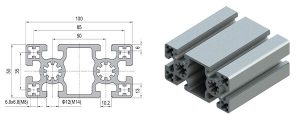 Strut Aluminium Profile 50×100 mm 2-Slot Heavy T-Slot Beam Extrusion
50 x 100 mm heavy two-slot T-slot strut aluminium beam in 6063-T5, about 6.2…
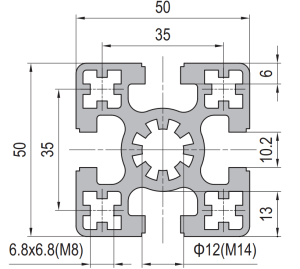 50 x 50 mm Four Slot Aluminium Strut Profile Heavy Frame Cross Member
50 x 50 mm four slot T-slot strut aluminium profile in 6063-T5, about 3.1…
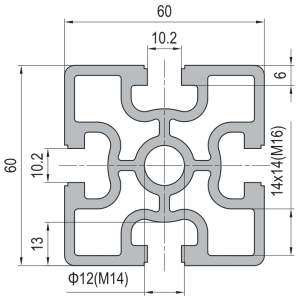 60 x 60 mm Four Slot Aluminium Strut Profile Main Machine Frame Column
60 x 60 mm four-slot T-slot strut aluminium profile in 6063-T5, about 4.3 kg/m…
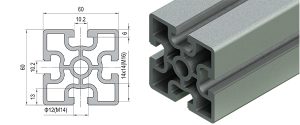 Strut Aluminium Profile 60×60 mm Heavy Duty T-Slot Extrusion M16 Bore
60 x 60 mm heavy duty four-slot T-slot strut aluminium profile in 6063-T5 with…
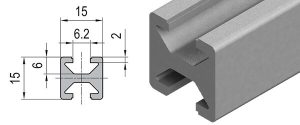 PG15 Strut Aluminium Profile 15×15 mm Light T-Slot Extrusion
PG15 15 x 15 mm single-slot T-slot strut aluminium profile in 6063-T5, about 0.48…
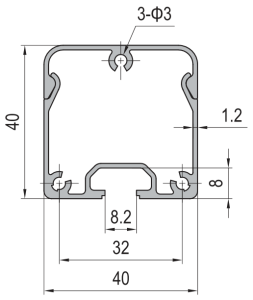 Aluminium Conduit Profile 40×40 mm Cable Duct T-Slot Enclosure
40 x 40 mm aluminium conduit profile in 6063-T5 with a 32 x 8.2…
