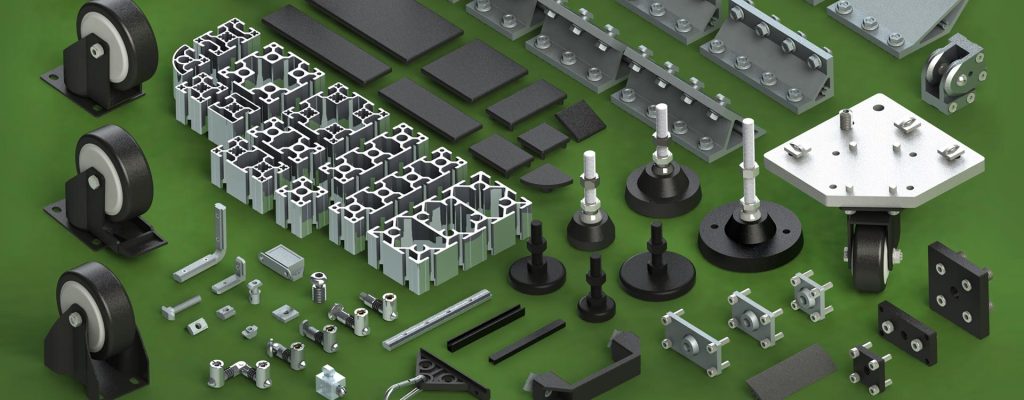
Quick answer
The short version, if you only read one paragraph
Industrial aluminum profiles are almost always 6xxx-series extrusions. What separates them is the alloy recipe and the temper — here is how to tell them apart in under a minute.
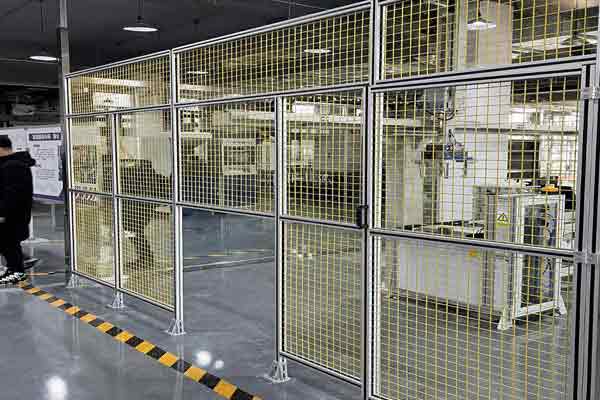
For most T-slot frames and machine guards choose 6063-T5. It extrudes into clean, tight-tolerance sections and is the most economical 6xxx grade.
For load-bearing brackets and machined parts step up to 6061-T6 or 6082-T6. You gain roughly 40–60% more yield strength at the cost of extrudability.
Temper matters as much as alloy T5 is air-quenched and artificially aged; T6 is solution-treated then aged. T6 is stronger but distorts more during quenching, so complex hollow sections are often better in T5.
The real cost drivers are die complexity, extrusion ratio and order volume — not the base metal price. A new die is usually the largest single line item.
Industrial aluminum profiles are the extruded building blocks behind production lines, automation cells, machine guards, workbenches, conveyor frames and the enclosures that house control gear. They are popular for reasons that have little to do with fashion: the material is roughly one third the density of steel, it forms its own protective oxide layer, it can be cut and re-worked on site, and it holds dimensional stability across a wide temperature band.
The catch is that “aluminum profile” is not one product. Two profiles can look identical in a catalogue photograph and behave very differently once a load is applied, a weld is run, or an anodizing bath is entered. That difference comes down to two decisions made long before you order: the alloy and the temper. This guide works through both, then adds the manufacturing and cost realities that catalogues usually leave out.
Definition
What actually makes a profile “industrial”
Any aluminum profile can be decorative. The industrial grade is defined by repeatability: it must hit the same dimensions, the same mechanical properties and the same surface finish on the ten thousandth piece, not just the first one.
In practice, an industrial profile carries four promises. First, a declared alloy and temper — not just “aluminum”. Second, a dimensional tolerance class you can find in a standard, so a drawing dimension is meaningful. Third, verifiable mechanical properties, usually via a mill test certificate. Fourth, a surface treatment with a specified film thickness or coating weight, because that is what determines how the profile survives its environment.
| Requirement | What it means on a drawing | Why it matters in service |
|---|---|---|
| Declared alloy | e.g. EN AW-6063, AA6061 | Determines weldability, anodizing response and strength ceiling |
| Declared temper | T5, T6, T66, O | Sets the actual yield strength you can design against |
| Tolerance class | EN 755-9 / GB/T 6892 / ANSI ADM | Controls whether parts fit together without rework |
| Mechanical certificate | Mill test cert with batch number | Traceability for audits and structural calculations |
| Surface specification | Anodic film µm or coating g/m² | Predicts corrosion life and appearance retention |
A profile that omits any of these five is a semi-finished commodity, not an engineered component.
How to read a quote
Buyers often compare only the per-metre price. Two quotes that differ by 30% on price are frequently quoting different tempers, different tolerance classes, or different anodic film thickness. Normalise those three variables before you compare the number.
Alloys
The 6xxx family: five alloys you will actually encounter
The 6xxx series pairs magnesium with silicon. Together they form magnesium silicide, which can be dissolved and re-precipitated during ageing — that is what makes these alloys both extrudable and heat-treatable. Almost every industrial profile comes from this family.
Alloy selection is a trade. Adding copper raises strength but lowers extrusion speed and corrosion resistance. Adding manganese improves strength and toughness but makes the metal harder to push through a die. Understanding which way each element pushes is more useful than memorising a table.
| Alloy | Alloying additions | Extrudability | Strength band | Where it earns its keep |
|---|---|---|---|---|
| 6063 | Mg, Si | Excellent | Moderate | T-slot framing, enclosures, architectural trims, heat sinks |
| 6060 | Mg, Si (lower) | Excellent | Moderate (lowest of the five) | Decorative and light-duty profiles, bright anodizing |
| 6005A | Mg, Si, Mn, Cr (limited) | Very good | Medium-high | Structural transport frames, modular machine bases |
| 6061 | Mg, Si, Cu | Fair | High | Machined brackets, load-bearing frames, automation fixtures |
| 6082 | Mg, Si, Mn | Good | High with better toughness | Heavy supports, platforms, robotics, European structural work |
Strength band is relative within the 6xxx family. Exact values depend on temper and section thickness — see the next section.
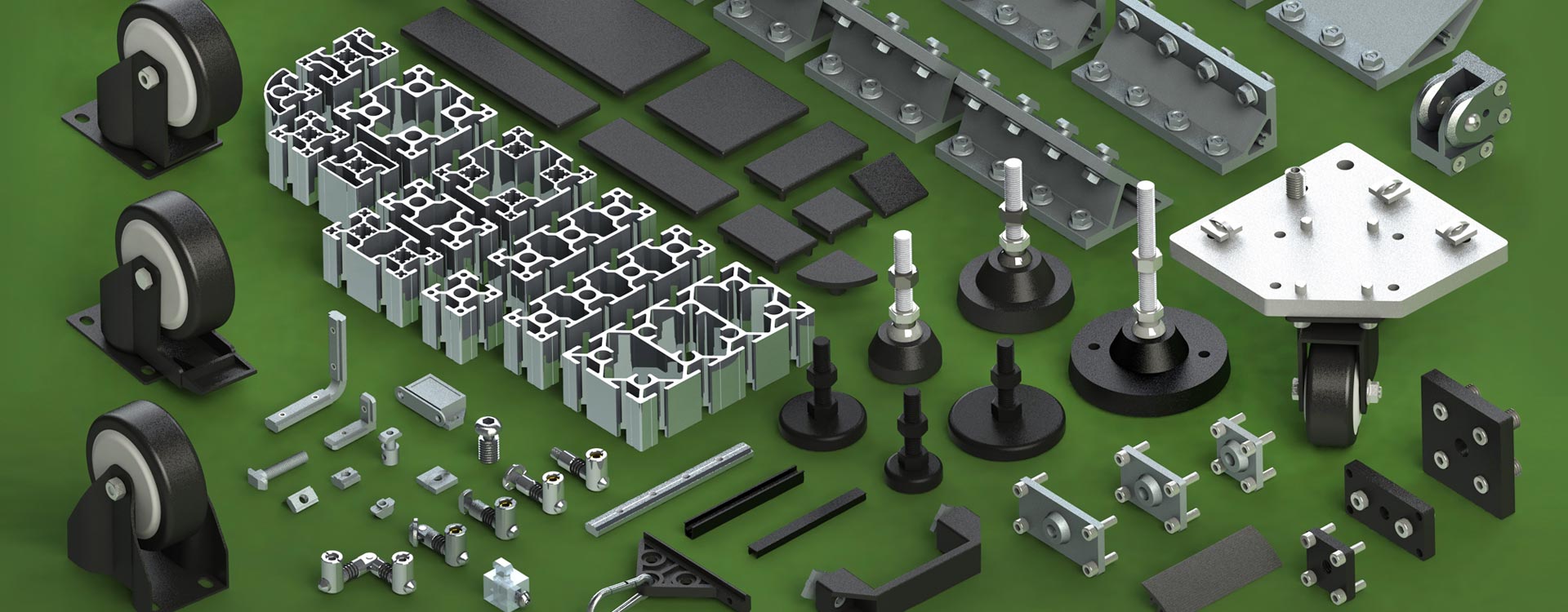
A common misconception worth correcting: 6005 and 6005A are not interchangeable names for one alloy. 6005A limits manganese, chromium and copper to keep weldability predictable, which is why it dominates welded transport structures. If a drawing says 6005A and a supplier delivers 6005, the weld procedure may no longer be valid.
Practical starting point
For a new custom cross-section, 6063 is usually the pragmatic starting point: it extrudes fast, produces a smooth surface and anodizes uniformly. Only move to 6061 or 6082 when the load case demands it, because both are slower to extrude and cost more per metre.
Temper
Temper is the variable most buyers overlook
Two profiles of the same alloy in different tempers can differ in yield strength by more than 100%. Temper describes the thermal treatment applied after extrusion, and it is where a lot of “why did this bend?” problems originate.
| Temper | How it is produced | Typical yield strength | Best for | Watch out for |
|---|---|---|---|---|
| T5 | Cooled at the press (air or mist), then artificially aged | Moderate | Complex hollow sections, visible profiles, tight straightness | Lower strength than T6 in the same alloy |
| T6 | Solution heat-treated, water quenched, then aged | High | Load-bearing brackets, machined parts, heavy supports | Quench distortion and residual stress; more machining allowance |
| T66 | T6 process with tighter property control | High, with a guaranteed floor | Applications with a declared minimum property | Higher cost and longer lead time |
| O | Annealed, fully soft | Low | Sections that must be bent or formed after extrusion | Not a structural condition on its own |
Yield strength is shown qualitatively because the certified figure depends on both alloy and wall thickness. Always design against the certificate for the specific batch.
There is a counter-intuitive point here. T6 is stronger, but it is not automatically the better choice. Water quenching a thin, hollow, multi-cavity section creates thermal gradients that can twist or bow the profile, and the residual stress may release later when you machine it. Many well-designed industrial frames therefore use T5 in 6063 for the visible structure and reserve T6 in 6061 for the small, heavily loaded machined connections.
Design review prompt
If a drawing calls for T6 on a large hollow profile with thin walls, expect to pay for straightening and extra machining stock. Ask your supplier whether T5 would meet the load case — the answer is often yes, at lower cost and better dimensional consistency.
Properties
Strength, hardness and the numbers behind the choice
Once alloy and temper are fixed, three properties drive most design decisions: tensile strength, yield strength and elongation. Hardness is a convenient shop-floor proxy for the first two.
| Property | What it tells you | How it is verified | Why a buyer should care |
|---|---|---|---|
| Tensile strength (Rm) | The stress at which the material breaks | Tensile test to EN ISO 6892 / ASTM E8 | Sets the absolute ceiling; rarely the governing figure |
| Yield strength (Rp0.2) | Stress at 0.2% permanent strain — the design limit | Same tensile test | This is the number your safety factor applies to |
| Elongation (A) | How far it stretches before fracture | Measured during the tensile test | Low elongation means brittle behaviour and cracking risk |
| Hardness | Resistance to local indentation | Webster or Vickers on the section | Fast in-house check that the temper is correct |
| Moment of inertia | Geometric stiffness of the section, not the metal | Calculated from the cross-section drawing | Often a cheaper lever than switching to a stronger alloy |
A frequent insight from design reviews: increasing the section’s moment of inertia is usually cheaper than moving from 6063 to 6082, because it costs no extra metal per unit strength gained.
That last row deserves emphasis. Engineers instinctively reach for a stronger alloy when a frame deflects too much. But deflection in a frame is governed mainly by geometry — the second moment of area — not by yield strength. A deeper profile in 6063-T5 will often outperform a shallower one in 6082-T6 while costing less and extruding more cleanly.
Cost-saving rule of thumb
Before upgrading the alloy, check whether a taller section, a thicker wall, or an added gusset would solve the deflection. Geometry changes cost nothing in material grade; alloy changes ripple through price, lead time and surface finish.
Extrusion
From billet to profile: where tolerances are born
Understanding the extrusion sequence explains why some dimensions are easy to hold and others are not — and why your supplier asks about wall thickness before quoting.
| Stage | What happens | What can go wrong | How it is controlled |
|---|---|---|---|
| Billet heating | Cast billet is heated to its extrusion window | Overheating causes surface tearing | Thermocouple control, spectrum check on incoming billet |
| Extrusion | Metal is forced through a die at controlled speed | Speed too high causes hot cracks and rough surface | Press speed ramping, die pre-heating |
| Quenching | Profile is cooled at the press exit | Uneven cooling distorts thin hollow sections | Air, mist or water quench chosen per section |
| Cutting and stretching | Ends trimmed, profile stretched to straighten | Insufficient stretch leaves bow and twist | Controlled stretch percentage |
| Ageing | Held at temperature to develop properties | Under-ageing misses the strength target | Batch oven logs, hardness verification |
| Finishing | Anodizing, powder coating or machining | Poor pre-treatment causes coating adhesion failure | Process line records, adhesion and film tests |
Each stage is a control point. A supplier who can describe how they control them is a supplier who can hold a tolerance.
Wall thickness uniformity is the single biggest predictor of tolerance difficulty. A profile with a constant 1.5 mm wall is straightforward. A profile mixing a 1.2 mm wall with a 4 mm boss creates differential cooling, and the thin side will pull. This is why experienced extrusion suppliers review the cross-section before quoting, and why the ±0.1 mm tolerances you see on well-made T-slot profiles are a manufacturing achievement rather than a catalogue claim.
Standards
Reading tolerance standards without a headache
Tolerance classes look intimidating, but the underlying question is simple: which dimensions matter for assembly, and which are cosmetic? Standards exist to answer that consistently.
| Standard | Region | Covers | Typical use |
|---|---|---|---|
| EN 755-9 | Europe | Dimensions and tolerances for profiles | European machinery and structural frames |
| GB/T 6892 | China | Extruded aluminium for general engineering | Domestic production and export to Asia |
| ANSI / AA ADM | North America | Aluminum design manual tolerances | US-specified structural and architectural work |
| ISO 6362 | International | Extruded rod, bar, tube and profile tolerances | Where no regional standard is specified |
A competent supplier can quote to any of these. What matters is that the drawing names one, so there is no ambiguity at inspection.
Three practical rules cut most tolerance disputes before they happen. First, separate critical dimensions (those that touch a mating part) from reference dimensions; specify tight tolerances only on the former. Second, be explicit about straightness and twist, which are often the real reason an assembly will not square up. Third, agree the inspection method up front — a dimension measured with calipers and the same dimension measured on a CMM can legitimately differ.
Where the tolerance actually matters
On many projects the most valuable tolerance is not on the cross-section at all, but on the cut length. Frames that must assemble square depend far more on consistent cutting than on sub-millimetre wall control.
Finishing
Surface treatment: choosing by environment, not by looks
Anodizing and powder coating are not just cosmetic options. Each has a specification range, and selecting the wrong end of that range is a common cause of premature corrosion.
| Treatment | Typical specification | Best environment | Limitations |
|---|---|---|---|
| Mill finish | None; natural oxide only | Dry indoor framing, hidden structure | Marks easily; no corrosion barrier in wet or salty air |
| Anodizing, clear | 10–25 µm anodic film | Indoor and sheltered outdoor, where metal appearance is wanted | Film is brittle; deep scratches cannot be blended out |
| Anodizing, coloured | 10–25 µm, dyed or electrolytic | Visible architectural and machine framing | Colour batches can vary; specify a reference sample |
| Powder coating | 60–120 µm, any RAL | Outdoor, chemical and abrasion exposure | Thick film can affect tight-tolerance fits |
| Electrophoretic (E-coat) | 15–25 µm, uniform | Automotive and high-appearance outdoor work | Higher cost; fewer suppliers |
Sealing after anodizing matters as much as film thickness. An unsealed anodic film looks fine for weeks and then stains.
Two specification details separate a durable finish from a disappointing one. The first is film thickness: a 10 µm clear anodic film is adequate for a factory interior but will not survive a coastal site. The second is sealing quality for anodized parts and pre-treatment for coated parts — both are invisible in the finished product and both determine whether the finish stays put.
Coastal installations
If the frame will be installed within 20 km of a coastline, specify a thicker anodic film or a powder coat rather than a thin clear anodize. The premium is small relative to the cost of replacing a corroded frame.
Selection
A selection path you can follow in five steps
Rather than starting from an alloy name, start from the duty the profile has to perform. This sequence resolves most industrial profile specifications without a metallurgist.
1 · Define the load case
Is the profile carrying load, or only locating and protecting? Locating and guarding almost never justifies more than 6063-T5. Load-bearing connections usually do.
2 · Check the environment
Indoor and dry, indoor and humid, outdoor, or coastal and chemical. This drives the surface specification more than the alloy choice.
3 · Choose the section geometry
Select the section that gives the required stiffness first. Geometry is the cheapest lever available to you.
4 · Then pick alloy and temper
Only after steps 1–3 should you choose between 6063-T5, 6061-T6 and 6082-T6. The answer is often the cheapest one that passes.
5 · Specify the finishes and tolerances
Name the standard, the tolerance class, the cut length tolerance and the surface specification. Leave nothing implied.
Following this order matters because it inverts the usual conversation. Buyers often begin by asking “what is the strongest alloy you have?” The better question is “what is the cheapest section and alloy combination that carries this load?” The second question produces a lighter, cheaper and more easily assembled frame almost every time.
Cost
What actually drives the price of an industrial profile
Base metal is a smaller share of the final price than most buyers assume. Understanding the other drivers lets you negotiate on the things that genuinely move the number.
| Cost driver | Impact on price | How to reduce it |
|---|---|---|
| Die cost (new section) | Highest single line item on a first order | Use an existing standard section; amortise the die across volume; ask about tooling refund against tonnage |
| Extrusion ratio and wall thickness | Thin, complex walls slow the press and raise scrap | Relax tight tolerances where they are not functional; avoid mixing very thin and very thick walls |
| Alloy | 6061 and 6082 cost more than 6063 | Use the least strong alloy that passes the load case |
| Temper treatment | T6 adds heat treatment and straightening | Use T5 where the load case permits |
| Surface treatment | Scales with film thickness and coating area | Match finish to actual environment rather than defaulting to premium |
| Order volume and freight | Small orders carry disproportionate setup and shipping | Consolidate lengths and section types into one shipment |
Behaviour of experienced buyers: they negotiate on die amortisation and volume consolidation rather than shaving cents off the metal.
Tooling clause
A new die is typically refundable against a defined future tonnage. If you expect repeat orders, ask for that clause explicitly at quotation stage — it is far harder to obtain later.
Pitfalls
Six failure modes worth designing out early
Most problems with industrial profiles are predictable. These six account for a large share of warranty claims and site rework.
Galvanic corrosion at fixings
Aluminum in contact with stainless or carbon steel in a wet environment will corrode. Use insulating washers or a coated fastener and keep dissimilar metals separated.
Quench distortion on thin hollows
Large thin-walled hollow profiles supplied in T6 may arrive with bow or twist. Specify T5, or allow machining stock and straightening.
Anodic film cracking at bends
Anodized film is brittle. If a profile must be bent after anodizing, expect fine cracking; specify forming before finishing instead.
Over-torquing into hollow sections
Thin walls crush before the fastener reaches its rated torque. Use spreader plates, rivet nuts or thickened bosses at every connection.
Losing weld strength at T6
Welding 6xxx alloys locally reduces strength in the heat-affected zone. If a joint must be welded and stay strong, design it so the weld is not the load path.
Colour mismatch between batches
Coloured anodizing can vary between production runs. Specify a retained reference sample and require batch matching for visible assemblies.
Where the risk really sits
Notice that four of the six are assembly and design issues rather than material defects. Reviewing connection details before ordering removes more risk than upgrading the alloy spec.
Sustainability
Recycled content and the sustainability question
Aluminum is one of the few structural materials with a genuinely strong recycling story, and buyers are increasingly asked to evidence it.
Extrusion lends itself to recycling because process scrap can be returned to the melt without losing its fundamental properties. Recycled aluminum requires a small fraction of the energy needed for primary production, which is why extrusion converters commonly run significant recycled content. The engineering caveat is that recycled feedstock must still meet the alloy specification — the chemistry is what matters, not the origin.
If recycled content is a requirement, ask for it to be stated on the mill certificate alongside the mechanical properties. A supplier who can document both is a supplier who can support your own reporting.
The bigger lever
Specifying a longer service life and a recyclable alloy usually delivers a larger sustainability gain than any single production choice. Design for reuse and refurbishment first.
FAQ
Frequently asked questions
The questions that come up most often when specifying industrial aluminum profiles for a new project.
Where this fits in our range
The sections and tempers discussed above, as we actually supply them
The alloy and temper choices in this guide are the ones behind our own stock range, so you can go straight from the selection logic to the section range we actually hold, with real tolerances, weights and lead times.
Not sure which alloy fits your project?
Send us the cross-section drawing, the load case and the operating environment. We will come back with a recommended alloy, temper and surface specification — plus a quotation with the trade terms you need.
Related reading
Twelve more engineering notes from this blog, picked for this article — plus every category below.
 ApplicationsAluminium Profile for LED Strips: A Heat Sink First, a Housing Second
 Materials and Engineering6063-T5 Aluminium Profile: What the Designation Actually Guarantees
 Engineering Design4040 T-Slot Aluminium Profile for Machine Frames: Choose It by Deflection
 Materials and EngineeringAnodised vs Powder Coated Aluminium Profiles: A Specification Guide for European Buyers
 Engineering Design6061-T5 vs 6063-T5: What the Temper Label Really Decides
 Materials and EngineeringAluminium Corrosion: Why a Salt Spray Number Is a Ranking, Not a Life
- Engineering Design3030 vs 4040 Aluminium Profile: A Decision With Numbers
 Engineering Design6063 vs 6061 vs 6082 and T5 vs T6: What Changes in Practice
 ApplicationsWhere Modular Aluminium Framing Works: A Load-Tier Map Instead of an Industry List
 Applications40×40 Aluminium Profile: Where It Works, Where It Fails, and Why
 Quality and InspectionSampling and First Article Approval for Aluminium Extrusion
 ApplicationsDesigning Machine Guards and Safety Fences in Aluminium Profile: An ISO 14120 Guide
