6063 vs 6061 vs 6082 and T5 vs T6: What Changes in Practice
For catalogue T-slot such as 2020–4040, specify 6063-T5 when finish and slot geometry matter; move to 6061-T6 or 6082-T6 only when the drawing demands higher yield for structural or heavily machined parts. Stiffness barely changes — E stays near 69 GPa — so alloy swaps do not fix a soft span.
Short answer
6063-T5 is the normal supply for industrial T-slot: it extrudes thin walls and sharp slots cleanly and anodises evenly under EN ISO 7599 practice. 6061-T6 raises yield into the ~240 MPa class and machines cleanly, which suits US-spec structural parts and CNC-heavy fixtures, at the cost of harder extrusion and a less uniform anodised look. 6082-T6 is the European structural peer to 6061, typically ~250–260 MPa yield minima depending on thickness per EN 755-2 tables. T5 means cooled from the press then artificially aged; T6 means solution-treated (or equivalent path) and aged for higher strength. Modulus is essentially the same, so deflection problems are solved with I and span, not with a different 6xxx label. Site example still quoted in 6063-T5: 45 × 90 mm six-slot, 4.10 kg/m, I ≈ 68 cm⁴. Dimensional tolerances EN 755-9; chemistry/mechanical often cross-checked to GB/T 6892 on China-origin lots.
What is the difference between 6063 and 6061 for 2020
For a 2020 (and the rest of the catalogue T-slot family) the practical difference is that 6063-T5 is the extrusion- and finish-first choice, while 6061-T6 is a strength- and machining-first upgrade that costs more to run and may need thicker walls on the same envelope.
On a 20 × 20 mm multi-slot section, 6063 fills the lips and core hole more reliably at production speed. 6061’s copper-bearing chemistry raises strength but slows the press and can mark anodising. Buyers who ask for “6061 2020” often want higher proof stress on a fixture rail; confirm whether the real need is yield, hard-coat anodising, or CNC faces — many of those jobs are better as 6063-T5 with a larger series (3030/4040) because I, not alloy, sets deflection.
| Factor | 6063-T5 (typical T-slot) | 6061-T6 | 6082-T6 |
|---|---|---|---|
| Role on 2020–4040 | Default supply | High-load / US print | EU structural print |
| ~Yield (min class) | ~110 MPa | ~240 MPa | ~250–260 MPa |
| ~UTS (min class) | ~150 MPa | ~260 MPa | ~290–310 MPa |
| Extrudability | Excellent | Fair | Fair |
| Anodised appearance | Best uniformity | More variation | More variation |
| Machining | Adequate | Very good | Very good |
| E (stiffness) | ~69 GPa | ~69 GPa | ~69 GPa |
Minima vary with thickness and standard; treat the table as selection guidance and lock values to the mill certificate.
What alloy and temper is a 2020 profile normally supplied in
A catalogue 2020 T-slot is normally supplied in 6063-T5 unless the purchase order explicitly states another alloy-temper pair.
That default holds across 3030, 4040 and most library industrial dies: 6063-T5 balances slot tolerance, surface for clear or colour anodising, and cost. 6063-T6 is available when you need more strength without leaving the 6063 chemistry. 6061-T6 or 6082-T6 are made-to-order on many T-slot tools and may raise MOQ behaviour toward the new-die / special-release path even when the cavity already exists. Finish callouts (mill, anodised per EN ISO 7599, powder) sit beside the temper, not instead of it.
| Section family | Normal supply | Common upgrade | Note |
|---|---|---|---|
| 2020 / 20-series | 6063-T5 | 6063-T6 | Keep 6063 for slot fill |
| 3030 / 30-series | 6063-T5 | 6063-T6 | Same default |
| 4040 / 40-series | 6063-T5 | 6061-T6 / 6082-T6 | Upgrade only if yield required |
| 45 / 50 / 60 industrial | 6063-T5 | 6082-T6 | EU structural preference |
| Custom structural | As drawing | 6082-T6 / 6061-T6 | Often thicker walls |
| Decorative / heat sink | 6063-T5 | 6063-T6 | Finish first |
Can the supplier substitute the alloy grade without telling me
No — alloy and temper on the purchase order are part of the product definition; a silent swap from 6063-T5 to another 6xxx or from T5 to T6 is a nonconformance unless the contract allows an approved alternate.
Substitution changes certified mechanicals, anodising response and sometimes weld procedure qualification. Importers and OEM buyers should state alloy-temper on the drawing and the PO, require a mill certificate with the lot, and reject unmarked bars. If billet availability forces a change, the supplier must propose the alternate in writing before metal runs, with updated mechanical minima and any effect on price or lead time. Die making still adds 7–12 days when a new cavity is needed; alloy change on an existing die is a process change, not a free substitution.
Commercial frame for 2026 releases remains MOQ 150 m on an existing die and 500 m on a new die, T/T 30% deposit + 70% before shipment or L/C at sight, shipped FOB, CIF, DAP or DDP from Shanghai or Ningbo unless agreed otherwise.
What actually differs
What actually differs among 6063, 6061 and 6082 — and between T5 and T6 — is strength, extrudability and surface response; what does not differ enough to matter for most frames is elastic modulus.
6063’s leaner chemistry flows through complex T-slot dies and takes anodising evenly, which is why catalogue framing stays there. 6061 and 6082 trade that flow for higher proof stress and better machining chips, which matters on CNC plates, heavily tapped ends and structural members sized by stress rather than by deflection. T5 is the economical press-cool-and-age route used on most 6063 framing; T6 is the higher-strength heat-treat route buyers name when the print shows elevated minima. Pick alloy for chemistry-sensitive properties (finish, weld, certified yield). Pick section size for stiffness. Mixing those two decisions is how projects order 6061 2020 and still watch the rail sag.
RFQ checklist — alloy and temper
- Alloy-temper on the print — e.g. 6063-T5, not “aluminium.”
- Governing need — finish, yield, or machining.
- Standard — EN 755-2/-9, EN ISO 7599, GB/T 6892 as applicable.
- Mill certificate — required or waived.
- Approved alternates — list any, or write “no substitute.”
- Section / metres — library 150 m or new 500 m.
If the frame fails on deflection, change I or span before you change the alloy letter.
Four alloy mistakes
Related on this site
- how die cost amortises per meter— conversion after alloy is locked
- minimum order with a new die— 150 m / 500 m rules
- die making adds 7–12 days— before special alloy releases
- who owns the die— tooling title
Terms used in this article
- T5
- Cooled from an elevated-temperature shaping process and artificially aged.
- T6
- Solution heat-treated and artificially aged for higher strength.
- Yield (0.2% proof)
- Stress used for strength checks; not a substitute for stiffness design.
- EN 755-9
- Extruded dimensional tolerances referenced on GrownParts industrial sections.
- EN ISO 7599
- Anodising specification framework for appearance and coating control.
Questions buyers ask
Which is cheaper at volume?
6063-T5 is usually the lowest conversion cost on T-slot dies because it runs faster and scrap rates stay low. 6061-T6 and 6082-T6 add billet and press time; at volume the gap is a conversion adder, not a different MOQ rule. Existing-die MOQ stays 150 m; new die 500 m. Compare 2026 FOB Shanghai/Ningbo quotes on the same metres and finish.
Which is stiffer?
None of the three is meaningfully stiffer in bending: E is about 69 GPa for 6063, 6061 and 6082. A 4040 in 6063-T5 and the same 4040 in 6061-T6 deflect almost the same under elastic load. Increase I or shorten span to cut deflection.
Which lasts longer outdoors?
All three 6xxx alloys resist atmospheric corrosion well when anodised or coated correctly. 6063 with a proper anodic film is the usual architectural outdoor choice for appearance. Bare mill finish chalks and spots on any of them; specify coating system and thickness rather than relying on alloy alone.
Can I mix the two?
You can mix alloys in one frame if galvanic and finish differences are accepted, but keep one slot series for hardware. Do not mix unmarked bars of different tempers in the same load path. Prefer one alloy-temper per SKU so certificates and spares stay simple.
Put alloy-temper on the drawing and send it
State 6063-T5, 6061-T6 or 6082-T6, the finish standard, and whether substitutes are forbidden. We will confirm billet, mill certificate and EN 755-9 tolerances before the press run.
Request a quoteRelated reading
Twelve more engineering notes from this blog, picked for this article — plus every category below.
 ApplicationsAluminium Profile Stairs and Platforms: The Geometry and Load Rules Behind Them
 ApplicationsAluminium Pergola Profiles: A Beam Problem With a Water Problem
 ApplicationsLean Pipe vs T-Slot Profile: Two Interface Philosophies, Not Two Generations
 Engineering DesignWhat EN 755-9 Allows: Aluminium Extrusion Tolerances
 Engineering Design4040 T-Slot Aluminium Profile for Machine Frames: Choose It by Deflection
 Engineering DesignAluminium Profile Basics: What the Series Numbers and Slot Codes Mean
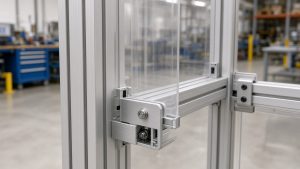 ApplicationsHow to Fix Panels, Guards and Accessories to Aluminium Profiles
 Materials and EngineeringAluminium Corrosion: Why a Salt Spray Number Is a Ranking, Not a Life
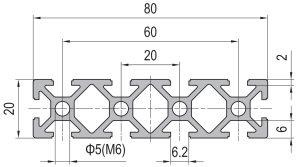 Quality and InspectionGood vs Bad Aluminium Profiles: What Your Receiving Dock Can and Cannot Check
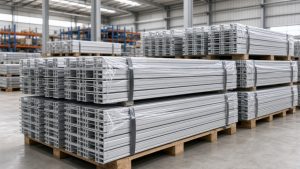 Sourcing and ProcurementAluminium Profile MOQ: 150 m Existing Die, 500 m New
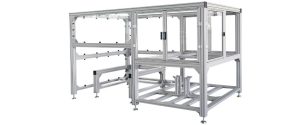 Machine SafetyAluminium Profile Machine Guards: Size the Frame from the Energy, Not from the Mesh
 Sourcing and ProcurementImporting Aluminum Profiles from China: Nine Failures That Quietly Raise Your Landed Cost
