MOQ for Custom Aluminium Profiles
In 2026 a mill-finish 4040 off an existing die typically quotes about US$4.20–5.80 per metre FOB China once you clear the minimum. The minimum order is 150 m off an existing die and 500 m with a new die — the difference is whether the tooling already exists.
Short answer
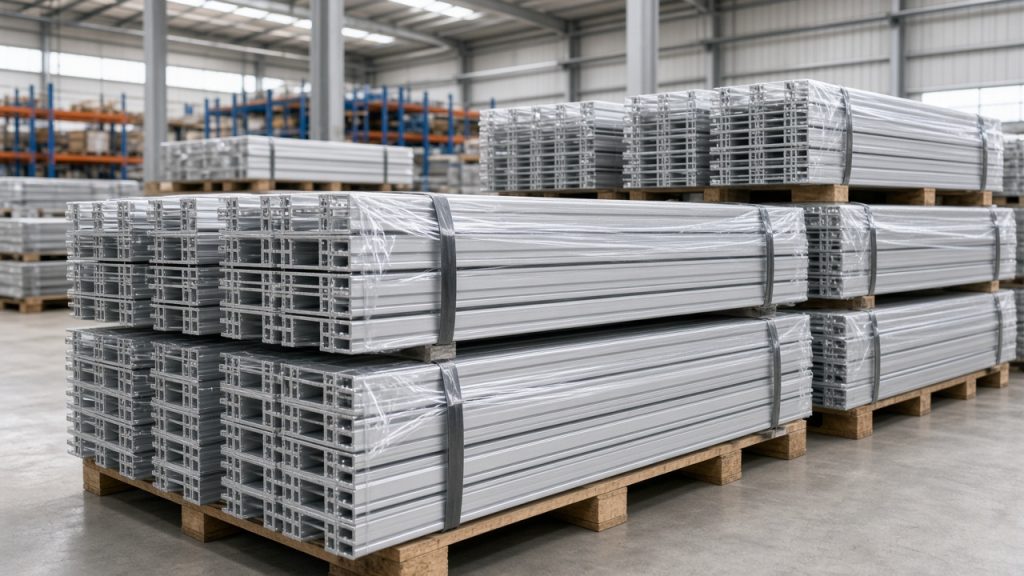
MOQ is set by die changeover and the need to amortise a tool that has no value to anyone else. If the section already sits in our die library, 150 m is the production floor. If the section is new, plan on 500 m plus the die charge, with die making adding 7–12 days before the press run. Price steps at 500 m, 2,000 m, 5,000 m and 10,000 m move the unit rate after you clear the floor. A single bar is a sample or a cut from stock, not a custom production order. Mixed sections can share one container, but each die still has to meet its own metre minimum. Payment is T/T 30% deposit + 70% before shipment, or L/C at sight, on FOB, CIF, DAP or DDP from Shanghai or Ningbo.
What is the MOQ for 2020 profile
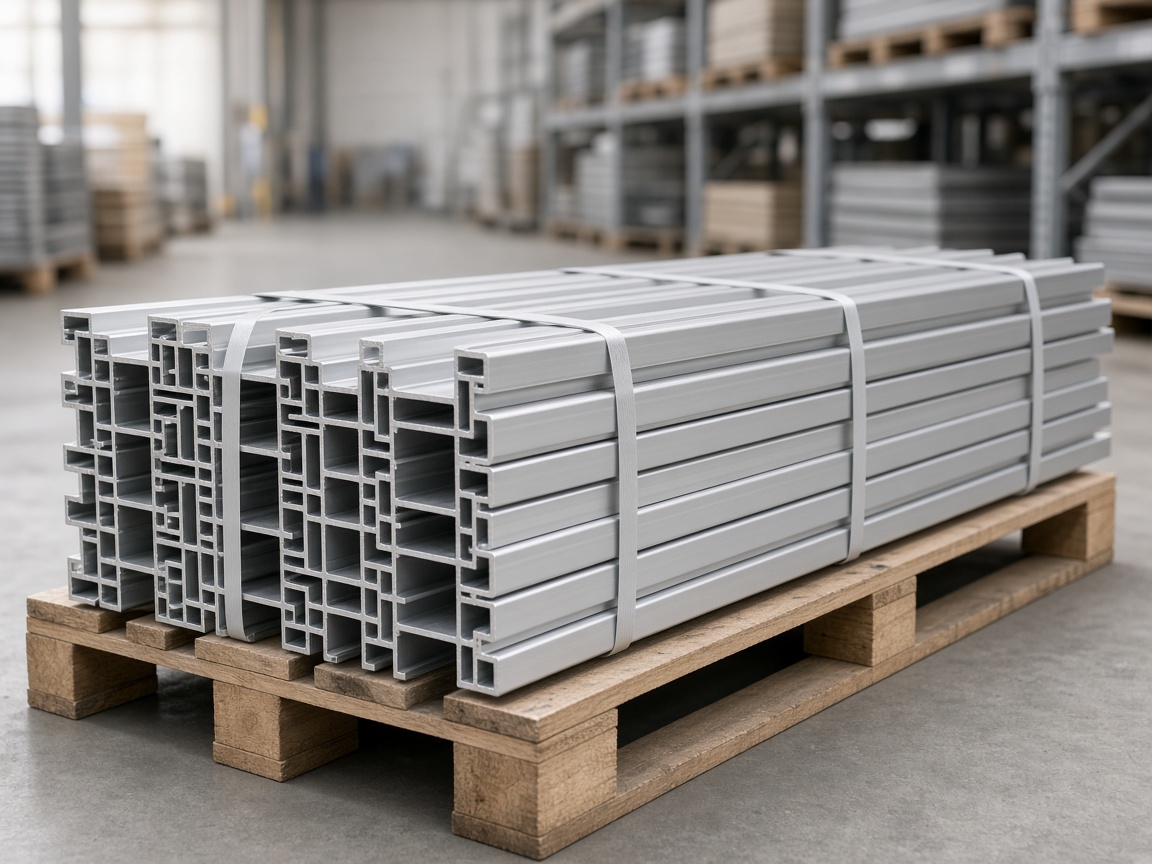
For a standard 2020 (and the other catalogue T-slot sizes in the same family) the MOQ is 150 m when the die already exists, and 500 m when a new die must be cut.
The number does not change just because the envelope is 2020 rather than 4040; what changes is how many kilograms that metre count represents, and therefore how the order sits against finishing-line minima. At ~0.50–0.55 kg/m, 150 m of 2020 is only ~75–85 kg, which is a short press run but a normal existing-die release. 500 m is ~250–275 kg and is the new-die floor. The same metre rules apply across the common industrial sizes; only the weight and the packing length differ.
| Section | Existing-die MOQ | New-die MOQ | ~kg at 150 m | Notes |
|---|---|---|---|---|
| 2020 | 150 m | 500 m | ~75–85 kg | Lightest common T-slot |
| 3030 | 150 m | 500 m | ~130–150 kg | Workbench uprights |
| 4040 | 150 m | 500 m | ~210–240 kg | Default industrial frame |
| 4080 | 150 m | 500 m | ~360–420 kg | Watch finishing bath load |
| 4545 | 150 m | 500 m | ~250–290 kg | 45-series library die |
| 5050 / 8080 | 150 m | 500 m | higher kg/m | Same metre floor, heavier billet |
Can I buy a single piece of 2020 aluminium profile
No — a single piece of a production extrusion is not a production order; it is either a paid sample cut from an existing die or a retail cut from stocked length, and neither rewrites the 150 m / 500 m floors.
If the die exists, we can usually cut one or a few bars for fit check at a short-run metre rate plus express freight. That sample does not create a path to reorder one bar at production pricing. If the die does not exist, a single piece still requires the die; the economic path is a paid pilot length inside the new-die programme, then the 500 m production MOQ. The same answer holds for 3030, 4040, 4080 and the rest of the catalogue: the envelope changes the weight, not the rule.
| Request | Possible? | Commercial path |
|---|---|---|
| 1 pc 2020, existing die | As sample | Short-run rate + express; then 150 m for production |
| 1 pc 3030, existing die | As sample | Same logic |
| 1 pc 4040, new section | Only after die | Die + pilot, then 500 m MOQ |
| 1 pc 4080 from stock | If stocked | Stock cut; not a custom die run |
| Mixed single bars, many sizes | Samples only | Each production die still needs its MOQ |
What is the minimum order for a custom profile
A custom section that needs a new die has a 500 m minimum on the first production release, plus the die charge, because the tool has no alternate customer.
Die making typically adds 7–12 days before metal runs. The die fee is a separate line; how it amortises per metre is covered on the price-per-metre and die-cost pages. Ownership of the die after payment is a contract point — see who owns the extrusion die. A custom profile is not the same as a catalogue T-slot off a library die: the 150 m floor applies only when the tool already exists and is released for your alloy and finish.
Finishing can impose a second minimum. Anodising and powder lines often want a bath or oven load larger than a bare 500 m of a light section. Ask for the extrusion MOQ and the finishing MOQ as two numbers; the order must clear the higher of the two if you need coated metal.
What is the minimum quantity for a stock order
A stock or library-die order clears at 150 m per section, which is the existing-die MOQ, provided the alloy, temper and finish match what the die is set for.
“Stock” here means a die that already exists in the plant, not a promise that cut lengths sit on a shelf in every finish. Mill-finish releases are the simplest. A special anodise colour or a powder shade can reintroduce a finishing minimum even though the extrusion MOQ is 150 m. If you need less than 150 m of a library section for a repair, treat it as a sample or ask whether remnant lengths exist; do not assume production pricing.
Mixed-container path to MOQ. Different sections may ship in one container from Shanghai or Ningbo under one FOB, CIF, DAP or DDP booking. Each section must still meet its own 150 m or 500 m floor. A practical pattern for a frame programme is 150 m of 4040 + 150 m of 4080 + 150 m of 2020 braces on existing dies, rather than forcing one section to absorb the whole freight. New dies cannot borrow metres from a neighbour’s section.
Is there a price break for small orders by size
Yes — once you clear the MOQ, unit price steps down at 500 m, 2,000 m, 5,000 m and 10,000 m; below the MOQ there is no production break, only sample or surcharge pricing.
The table gives 2026 FOB Shanghai/Ningbo reference bands per metre for mill-finish 6063 industrial sections near the first step. Small orders that only just clear 150 m sit at the top of each band; crossing 2,000 m and 5,000 m is where the conversion adder thins. Die amortisation on a new tool is a separate per-metre adder until the die fee is recovered — see how die cost amortises per meter.
| Section | Circumscribed circle | Type | Reference price (USD) | Notes |
|---|---|---|---|---|
| 2020 | ~28 mm | Light T-slot | US$1.80–2.60/m | Breaks after 500 / 2k / 5k / 10k m |
| 3030 | ~42 mm | Light T-slot | US$2.80–3.90/m | 150 m existing-die floor |
| 4040 | ~57 mm | Standard T-slot | US$4.20–5.80/m | Most common step ladder |
| 4080 | ~89 mm | Rectangular | US$7.20–9.80/m | Heavier kg/m, same metre steps |
| 4545 | ~64 mm | 45-series | US$5.40–7.40/m | Library die when available |
| 4590 | ~101 mm | 45-series wide | US$9.50–12.80/m | Confirm finishing MOQ |
| 5050 | ~71 mm | 50-series | US$7.00–9.50/m | Same 150 / 500 m rules |
| 8080 | ~113 mm | Heavy T-slot | US$12.50–17.00/m | Often planned by the tonne |
| 9090 | ~127 mm | Heavy T-slot | US$16.00–22.00/m | Watch press scheduling |
| 100100 | ~141 mm | Heavy structural | US$20.00–28.00/m | New die usually 500 m |
| 16080 | ~179 mm | Wide structural | US$18.00–26.00/m | Large circle, confirm press |
RFQ checklist — MOQ
- Drawing or catalogue section — so we know existing die vs new die.
- Metres per section — not only a total order weight.
- Alloy, temper, finish — finishing may raise the floor.
- Trial vs production — sample pricing is a different line.
- Mix plan — which sections share the container.
- Incoterm — FOB / CIF / DAP / DDP, Shanghai or Ningbo.
State whether each section is library or new. That single word decides 150 m or 500 m before anyone debates price.
Four MOQ mistakes
Related on this site
- how die cost amortises per meter— unit rate after the die fee
- minimum order with a new die— this page’s 500 m rule
- die making adds 7–12 days— before the first 500 m runs
- who owns the die— title after tooling is paid
Terms used in this article
- Existing die
- A tool already cut and released for the section, alloy class and press; unlocks the 150 m MOQ.
- New die
- A tool cut for your section; carries a die charge and a 500 m first-release MOQ.
- Library / stock die
- A catalogue section already tooled; not a guarantee of finished goods on the shelf.
- Price step
- A quantity threshold (500 / 2,000 / 5,000 / 10,000 m) where the unit conversion adder falls.
- Pilot / sample
- A paid short length for validation; commercially separate from production MOQ.
Questions buyers ask
What is included in the quoted price?
At FOB Shanghai or Ningbo the metre price for a MOQ lot covers extrusion, standard packing and export documentation for the stated alloy and finish. Die charges for a new tool are a separate line. Anodising, powder coating, CNC and cut-to-length beyond stock sawing are extra. CIF, DAP and DDP add freight and, for DDP, duty as agreed. Payment is T/T 30/70 or L/C at sight.
Do you charge for samples?
Yes for most short cuts: sample metres are billed at a short-run rate plus freight. On an existing die that is often a few bars. On a new die the sample follows die completion and does not waive the 500 m production MOQ. Say whether the sample cost should credit against the first production release.
How long is the quotation valid?
MOQ unit prices are usually valid 14–30 days in 2026, tied to billet. Die quotes may be held longer because steel and CNC time move slower than metal. If finishing chemicals or powder lots are involved, ask for a separate validity on that line.
Can the price be fixed for a contract?
Annual call-offs can fix the conversion adder and the MOQ rules (150 m / 500 m) while metal follows an agreed billet index. Price steps at 500 / 2,000 / 5,000 / 10,000 m should be written into the schedule. Incoterm and port stay FOB/CIF/DAP/DDP Shanghai or Ningbo unless amended.
Send the section list and the metres
Mark each line as library die or new die, give metres and finish, and say whether you need a paid sample before the 150 m or 500 m release. We will confirm which floor applies before you commit.
Request a quoteRelated reading
Twelve more engineering notes from this blog, picked for this article — plus every category below.
 Engineering DesignCut-to-Length, Drilling and Tapping: What Fabrication Adds
 Quality and InspectionHow to Choose (and Audit) an Aluminium Extrusion Supplier
 Engineering DesignStandard vs Custom Aluminium Extrusion: The Break-Even Calculation
 Engineering DesignT-Slot Cross-Brand Compatibility: Bosch, Item and Generic
 Engineering DesignHow to Choose an Aluminium Extrusion Profile: The Three Decisions That Bind
 Engineering DesignAluminium Extrusion Lead Time: New Die vs Existing Die
 Sourcing and ProcurementDistributor Terms: Territory, Margin and Price Protection
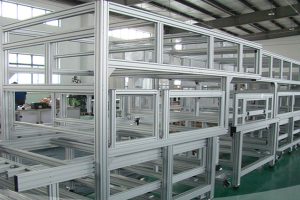 Engineering DesignModular Aluminium Components: Where the System Saves Money and Where It Costs You
 Engineering DesignAluminium Extrusion Tolerances: What to Write, and How to Inspect
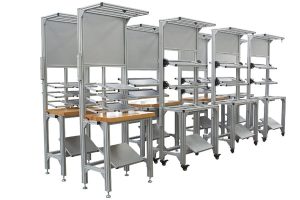 ApplicationsESD-Safe Aluminum Profile Workbenches: Why Anodising Alone Fails the Audit
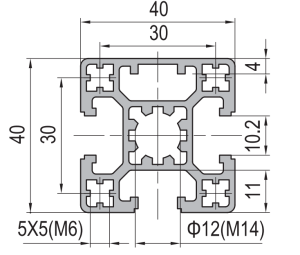 Engineering DesignHow to Choose the Right Aluminium Profile Size for Industrial Frames
 ApplicationsCleanroom and Medical Framing: There Is No Medical-Grade Aluminium Extrusion
