Cleanroom and Medical Framing: There Is No Medical-Grade Aluminium Extrusion
The phrase medical-grade aluminium appears in a lot of marketing and in no alloy standard. What a cleanroom or a medical equipment frame actually has to satisfy is a cleanability requirement, a particulate class, a cleaning-chemical regime and a traceability requirement, and those four things are what should be in the enquiry.
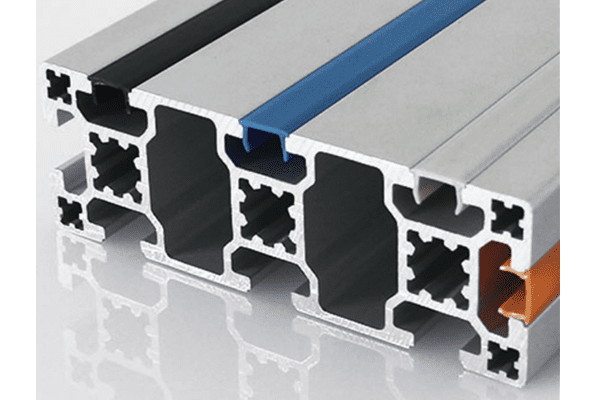
Short answer
There is no alloy called medical-grade aluminium. A profile is designated by its alloy and temper, such as 6061-T6 or 6063-T5, and nothing in those designations carries a medical qualification. Biocompatibility is a property of the finished device, assessed through the ISO 10993 series within a risk management process, and it is not inherited from the metal. What a cleanroom frame has to deliver is cleanability: a surface that can be cleaned to a defined ISO 14644 particulate class, without crevices that hold contamination, and without a coating that the cleaning agent destroys. That makes the T-slot the central problem rather than the solution, because an open slot is a crevice, and a crevice is a reservoir. The honest specification is a cleanable frame with a sealed or covered slot, a defined surface finish, and a documented cleaning regime — plus traceability of the material and the finish.
There is no medical-grade aluminium, and the claim hides the real question
The marketing term medical-grade aluminium usually means one of three things, none of which is a standard. It may mean an alloy that has passed a corrosion test, or an alloy with a low copper content, or simply an alloy that the supplier has supplied to a medical customer before. None of these is a designation, and none of them is transferable to a new application, because the qualification belongs to the device and its risk assessment rather than to the metal.
The reason this matters is that the phrase substitutes for the question that actually decides the specification. That question is: what does the frame have to do that a normal industrial frame does not? The answer is almost always one or more of four things — it has to be cleanable to a class, it has to be compatible with a cleaning agent, it has to be documentable, and it may have to be non-shedding. All four are answerable, and none of them requires a mythical grade.
What aluminium genuinely offers in this setting is a metal that does not rust, can be anodised to a hard, sealed and cleanable surface, is non-magnetic, and is light enough to move. What it does not offer is an implant material: the established implant alloys are titanium, cobalt-chromium and the stainless steels, and a 6061 or 6063 extrusion is not among them.
Biocompatibility is assessed on the device, under ISO 10993
The ISO 10993 series is the framework for the biological evaluation of medical devices. Part 1 sets out the evaluation and testing within a risk management process, and the other parts deal with specific endpoints such as cytotoxicity, sensitisation, irritation and implantation. The evaluation is performed on the device or on materials in their final processed state, because the response depends on the surface, the finish, the sterilisation method and the residues, not on the bulk alloy alone.
The practical consequence for a frame is that a supplier cannot make a profile biocompatible. A supplier can provide a material declaration, a surface finish that has been characterised, and a cleanable geometry, and the device manufacturer then performs the evaluation. A claim that a profile is biocompatible to ISO 10993 is either a shorthand for a material that has been evaluated in a specific finished form, or it is meaningless.
The distinction also sets the boundary of responsibility. The profile supplier owns the alloy, the temper, the surface finish and the traceability. The device manufacturer owns the biological evaluation, the sterilisation validation and the regulatory submission. Writing that boundary down is more useful than arguing about a grade name.
| Requirement | What it actually means | What to specify |
|---|---|---|
| Cleanability | The frame can be cleaned to a defined particulate class | An ISO 14644 class, a cleaning method, and a cleanable geometry |
| Surface finish | A sealed, non-shedding surface that survives the cleaning agent | Anodic thickness with sealing, or a suitable coating, plus a finish standard |
| Absence of crevices | Contamination must not be able to hide and then re-emerge | Covered or sealed slots, gasketed panel joints, no blind holes |
| Chemical compatibility | The cleaner must not attack the frame or its coating | The cleaning agent and its pH, checked against the oxide stability range |
| Traceability | The material and finish can be traced to records | A material certificate and a finish record tied to the order |
What a cleanroom frame actually needs: a class and no crevices
ISO 14644-1 classifies air cleanliness by the concentration of airborne particles, and the classes run from the cleanest upwards. The number that matters to a frame is the class the room must hold and the cleaning regime that maintains it. A frame in a less stringent class with an aggressive daily wipe-down may be a harder requirement than a frame in a cleaner class that is cleaned rarely.
Two properties of the frame follow. The first is that the frame must not shed. A powder coating that chalks, a cut edge that leaves swarf, or a plastic cover strip that becomes brittle, all contribute particles. The second is that the frame must be cleanable in the time available: a geometry with hundreds of small fasteners and open slots cannot be wiped down to a class, because the wipe cannot reach into the slot.
This is why the cleanroom answer is usually a frame with the slot covered. A cover strip turns an open channel into a smooth face that a wipe can cross. The alternative is to avoid the slot altogether and use a smooth or closed section, accepting that the frame is then welded or bonded rather than bolted. Both are legitimate; the point is that the decision is made on cleanability, not on price per metre.
The T-slot is a crevice, and that is the central problem
A T-slot frame is the natural choice for anything that has to be adjustable, and a cleanroom frame often does need adjustment during commissioning. The conflict is that the same slot that makes the frame adjustable is a crevice that traps particles and moisture, and that cannot be reliably cleaned without dismantling the frame.
There are three workable responses. The first is to cover the slot after the frame is set, so the frame is adjustable once and cleanable thereafter. The second is to use the slot only where it is needed and to specify closed faces elsewhere. The third is to accept the crevice and to specify a cleaning method that reaches it, which usually means dismantling, and which is rarely compatible with a production cleanroom.
There is a related detail that is easy to miss: a blind tapped hole is a crevice with no exit. Where a frame is fastened into a tapped hole, the hole should be through-drilled or sealed, because a blind hole holds the residue of every cleaning cycle. The same applies to the hollow interior of a profile: an open profile end is a cavity that collects contamination, so end caps are a cleanability item, not a cosmetic one.
Surface finish, and the cleaning chemicals that attack aluminium
Aluminium’s protective oxide layer is stable over a pH range of roughly 4 to 9, and it is attacked outside that range. Many cleanroom cleaning agents are alkaline, and some are strongly so, because alkalinity is effective against organic soil. An anodised or mill-finish aluminium frame cleaned daily with a high-pH agent will lose its oxide layer, and the loss is not uniform: it starts at edges, at cut ends and at scratches, which is exactly where a cleanroom frame is hardest to inspect.
So the cleaning agent belongs in the specification, alongside the finish. An anodised surface with a sealed film is more resistant than a mill finish, but no anodic layer makes aluminium immune to a strong alkali, and no finish makes a cut end immune. Where an aggressive agent is unavoidable, the frame should be a material that tolerates it, or the agent should be neutralised after use, or the frame should be protected with a coating that is specified for that chemistry.
The other finish question is sterilisation. Where the frame is inside a sterilisation cycle, the agent — steam, hydrogen peroxide vapour, ethylene oxide — has to be checked against the finish, and the cycle count has to be considered, because repeated exposure is what degrades a coating rather than a single event.
Traceability, the EU MDR and change control
A frame that is part of a medical device or of a medical device manufacturing environment sits inside a regulated quality system. In the European Union the Medical Device Regulation sets the requirements for devices, and even where the frame is equipment rather than a device, the manufacturer’s quality system will usually require material traceability and change control.
Two practical requirements follow. The first is a material certificate that ties the profile to a heat or a batch, together with a finish record. The second is change control: if the supplier changes the alloy source, the anodic process or the cover strip material, the customer needs to know, because a change in surface finish can invalidate a cleaning validation that was performed on the previous finish.
This is the part of a cleanroom or medical frame order that is most often left out of the enquiry and most expensive to add later. A supplier who can provide a certificate and who notifies changes is worth more in this application than a supplier who is cheaper per metre.
What to send with a cleanroom or medical frame enquiry
State the class and the cleaning regime. State the cleaning agent and its pH, and the sterilisation method if there is one. State whether the frame is inside the clean zone or outside it. State the traceability and change-control requirements, and the finish standard. State whether the frame will be adjusted after installation, because that decides whether the slot can be covered. Given those, the profile and the finish follow, and the frame can be specified on cleanability rather than on a grade name that does not exist.
RFQ checklist — cleanroom and medical framing
- Cleanliness class — the ISO 14644 class the frame must hold, and whether the frame is inside or outside the clean zone.
- Cleaning agent and pH — the chemistry and frequency, checked against the pH range the oxide layer tolerates.
- Sterilisation method — steam, hydrogen peroxide vapour or ethylene oxide, and the cycle count.
- Geometry — whether slots must be covered, and whether blind holes and open profile ends can be avoided.
- Surface finish — anodic thickness with sealing, or a coating specified for the cleaning chemistry.
- Traceability — the material certificate and finish record required, and the change-notification expectation.
- Adjustability — whether the frame is set once or reworked, which decides whether the slot can be sealed.
- Non-shedding — whether cover strips, gaskets and fasteners must be qualified for low particle shedding.
- Responsibility split — who owns the biological evaluation and the cleaning validation.
Ask one question before quoting: which cleaning agent will be used. It decides the finish more often than the cleanliness class does, and it is the requirement most often discovered after the frame is installed.
Four ways a cleanroom frame fails its purpose
Related on this site
- Choosing a finish by failure mode— how an anodic class or a powder system is selected against the environment
- Quality and inspection protocol for aluminium profiles— the certificates and checks a traceable order should carry
- Anodised aluminium: a documentation preference— what a European finish specification actually contains
- T-slot cover profile— turning an open slot into a cleanable face
Terms used in this article
- Biocompatibility
- The ability of a device or material to perform its function without producing an unacceptable biological response, assessed under the ISO 10993 series.
- ISO 14644-1
- The standard that classifies air cleanliness by the concentration of airborne particles, which sets the class a cleanroom must hold.
- Crevice corrosion
- Localised attack in a narrow gap where the environment becomes different from the bulk, which is why an open slot is a corrosion site as well as a contamination site.
- Sealed anodic film
- An anodised layer that has been sealed so its pores are closed, giving a cleanable surface rather than an absorbent one.
- Change control
- The process of notifying a customer before a material, process or supplier change, so that earlier validations remain valid.
- Non-shedding
- Describing a material or finish that does not release particles in service, which is a requirement inside a clean zone.
Questions buyers ask
Is there such a thing as medical-grade aluminium?
Not as a standard designation. Profiles are specified by alloy and temper, such as 6061-T6, and nothing in those designations carries a medical qualification. Biocompatibility is assessed on the finished device under ISO 10993, not inherited from the metal.
Can I use a standard T-slot frame in a cleanroom?
Yes, if the slots are covered after the frame is set and the interior cavities are closed. An open slot is a crevice that traps contamination and cannot be wiped clean without dismantling the frame, so covering the slot is the usual solution.
Which cleaning agents damage anodised aluminium?
Strongly alkaline ones. Aluminium’s protective oxide is stable over roughly pH 4 to 9, so a high-pH cleaner attacks it, starting at cut ends, edges and scratches. Put the cleaning agent in the specification and check it against the finish.
Does an anodised frame need a certificate?
For a regulated environment, yes: a material certificate tying the profile to a batch, plus a finish record. Change control matters as much, because a new anodic process can invalidate a cleaning validation performed on the previous finish.
Is aluminium suitable for an implant or a surgical instrument?
Not the extrusion alloys. The established implant materials are titanium, cobalt-chromium and the stainless steels. Aluminium is well suited to equipment frames, trolleys, housings and non-implant hardware, where its cleanability and weight are the advantages.
Send the class and the cleaning agent
Give us the ISO 14644 class, the cleaning chemistry and whether the frame will be adjusted, and we will propose a cleanable section with the slot treatment that suits it.
Request a quoteRelated reading
Twelve more engineering notes from this blog, picked for this article — plus every category below.
 Engineering DesignAluminium Profile Anchor Pins: A Preloaded Joint, Not a Pin
 ApplicationsLean Pipe vs T-Slot Profile: Two Interface Philosophies, Not Two Generations
 Quality and InspectionAnodising vs Powder Coating: Thickness, Colour, Salt Spray
 Applications40×40 Aluminium Profile: Where It Works, Where It Fails, and Why
 ApplicationsHow to Choose the Right 4040 T-Slot Aluminium Profile for Industrial Applications
 Quality and InspectionSampling and First Article Approval for Aluminium Extrusion
 Engineering DesignAluminium Extrusion Tolerances: What to Write, and How to Inspect
 Quality and InspectionGood vs Bad Aluminium Profiles: What Your Receiving Dock Can and Cannot Check
 Engineering DesignWhat Your Extrusion Drawing Must Show (and What Costs You Money)
 Engineering DesignRobot Cell Framing in Aluminium: Stiffness, Damping and the 2025 Safety Revision
 Materials and EngineeringAluminium Corrosion: Why a Salt Spray Number Is a Ranking, Not a Life
 Engineering DesignCut-to-Length, Drilling and Tapping: What Fabrication Adds
