Quick answer
Four things to settle before you order a 4040
It is an envelope, not a profile. “4040” fixes 40 × 40 mm and nothing else. The wall, the slot count and the second moment of area are separate choices, and two suppliers quoting “4040” can be 1.3 kg/m apart.
The series ladder is not a smooth curve. Going from 30 to 40 series multiplies stiffness by about 2.6. Going from 40 to 45 series multiplies it by about 1.6 for a similar jump in weight. Depth enters the fourth power, so the same proportional step is worth very different amounts at different sizes.
Stepping up costs more than the profile. A bigger series also brings a bigger nut, a higher torque figure, a different bracket, a wider member and a heavier bundle. The profile is often the smallest part of the increase.
Test the downgrade before you buy the upgrade. Before paying for a 60 series section, check whether a 4040 with one more support does the job. Halving a span gives four times the allowable load at constant deflection limit, and a support rarely costs a quarter of the beam it saves.
Why this one
What a 4040 is actually good at
40 × 40 mm sits at a point where several constraints happen to meet at once, and that is the real reason it dominates industrial framing rather than any structural advantage over its neighbours.
- It is the largest common section with an 8 mm slot. That slot takes an M8 nut with a torque ceiling around 15 N·m — enough for a joint that will not work loose under vibration, and small enough that a standard hex key still fits between the members.
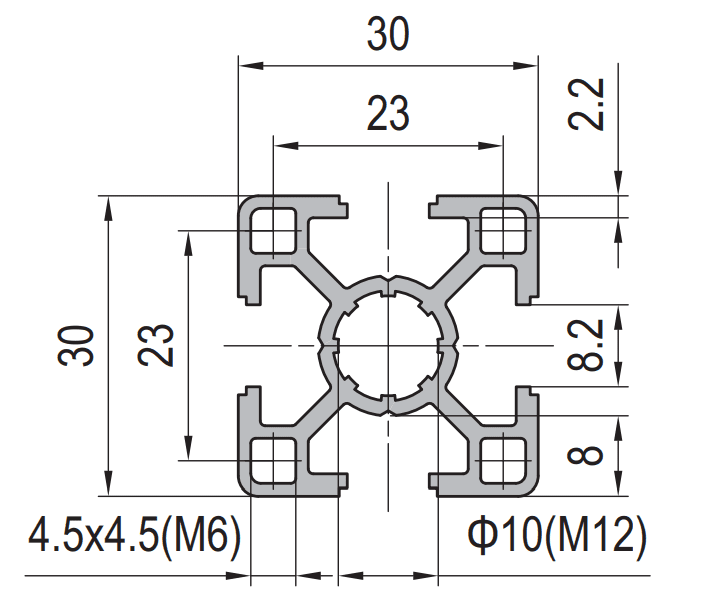
- One slot geometry, three walls. Our 4040 four-slot section keeps the same 8 mm mouth and the same 30 mm pitch in light, standard and heavy wall, so a design can be re-specified for stiffness without changing a single accessory part number.
- A 6 m length is a one-person lift. At about 1.7 kg/m a 6 m bar weighs roughly 10 kg. The equivalent length in 45 series is about 15 kg and in 60 series about 26 kg. Handling is a real constraint on site, and it is the constraint that most often decides the section when two options are structurally equivalent.
- The accessory range is the deepest in the industry. Brackets, joining plates, hinges, panel fixings, feet, castors, covers and end caps all exist in 40 series in every catalogue. Choosing a section with a thin accessory range means designing parts that already exist.
The variant that catches people out
Not every 4040 has four slots, and not every four-slot 4040 has the same wall. A three-slot 40 × 40 section is common for enclosure framing because it leaves one face flat, and its second moment of area is lower than the four-slot version of the same wall. When you compare quotations for “4040”, ask for the slot count and the wall thickness in writing. The section property you are buying is not in the name.
The ladder
4040 against 2020, 3030 and everything above it
This is the comparison that a “4040 versus 2020 versus 3030” question is really asking, extended up the range so you can see the shape of the whole curve. The allowable loads are central point loads on a simply supported span at L/300, using the same method throughout. Every section in the table is one we extrude — the 40 series, 45 series and 60 series pages carry the drawings and full specifications.
| Section | I, cm⁴ | kg/m | 1,000 mm | 1,500 mm | 2,000 mm | cm⁴ per kg/m |
|---|---|---|---|---|---|---|
| 20 × 20 single slot | 0.6 | 0.55 | 7 kg | 3 kg | 2 kg | 1.1 |
| 20 × 40 two slot | 2.0 | 1.05 | 23 kg | 10 kg | 6 kg | 1.9 |
| 30 × 30 light wall | 2.6 | 0.95 | 30 kg | 13 kg | 7 kg | 2.7 |
| 30 × 30 standard | 3.6 | 1.30 | 41 kg | 18 kg | 10 kg | 2.8 |
| 40 × 40 light wall | 7.5 | 1.30 | 86 kg | 38 kg | 21 kg | 5.8 |
| 40 × 40 standard | 9.5 | 1.70 | 108 kg | 48 kg | 27 kg | 5.6 |
| 40 × 40 heavy wall | 13.5 | 2.35 | 154 kg | 69 kg | 39 kg | 5.7 |
| 45 × 45 standard | 15.5 | 2.55 | 177 kg | 79 kg | 44 kg | 6.1 |
| 40 × 60 on edge | 24 | 2.55 | 274 kg | 122 kg | 68 kg | 9.4 |
| 50 × 50 four slot | 25 | 3.10 | 285 kg | 127 kg | 71 kg | 8.1 |
| 60 × 60 standard | 26 | 4.30 | 297 kg | 132 kg | 74 kg | 6.0 |
| 60 × 60 heavy wall | 38 | 6.40 | 434 kg | 193 kg | 108 kg | 5.9 |
| 50 × 100 on edge | 150 | 6.20 | 1,713 kg | 761 kg | 428 kg | 24.2 |
How much each step actually buys
Read the table as ratios rather than as numbers, and the ladder stops looking like a ladder.
The 20 to 30 step looks enormous because a 20 series section is a very small beam. The 40 to 45 step is the one that disappoints: a 12.5 per cent increase in depth gives a 60 per cent increase in stiffness, and you pay roughly a 50 per cent increase in weight and price for it. That asymmetry is the fourth-power rule working against you, and it is why 45 series is a specialist choice rather than a general upgrade from 40.
The last line is the one to remember. Changing the shape of a 40 mm member — keeping the 40 mm envelope but going to 40 × 60 and standing it on edge — gives 2.5 times the stiffness of a 4040 for the same weight per metre as a 45 series section. Depth in the bending direction is cheaper than any amount of section area.
The hidden half of the price
Stepping up a series costs more than the profile
When a designer steps from 40 series to 50 or 60 series, the quotation that comes back is for aluminium by the metre. The cost that shows up six weeks later is the accessory system, and on a frame with a lot of joints it can exceed the profile cost itself.
| What changes | 30 series | 40 series | 50 and 60 series |
|---|---|---|---|
| Standard slot mouth | 8 mm on the standard wall | 8 mm | 10 mm |
| Nut thread | M6 × 1.0 | M8 × 1.25 | M10 × 1.5 |
| Nut torque ceiling | about 6 N·m | about 15 N·m | about 30 N·m |
| Bracket bolt size | M6 | M8 | M8 or M10 |
| Typical panel fixing | M5 to M6 in a 6 mm slot | M6 in an 8 mm slot | M8 in a 10 mm slot |
| Standard wall weight | 1.30 kg/m | 1.70 kg/m | 4.30 kg/m |
| Material index against 4040 | 0.76 | 1.00 | 2.53 |
| Extra width per member | −10 mm | baseline | +10 to +20 mm |
| 6 m length weight | about 7.8 kg | about 10.2 kg | about 25.8 kg |
Three of those rows have nothing to do with strength and everything to do with the cost of the change. A 10 mm slot needs a different nut, which needs a different bracket, which is drilled for a different pitch. If the frame has forty joints, you have just re-specified forty brackets and forty nut part numbers. And the members are 20 mm wider, which changes the envelope of the machine and may not fit where the old one did.
The upgrade that quietly breaks the design
Enlarging a section is not a local change. It moves every slot position, widens the frame in two directions, changes the panel fixing, changes the wrench you need, and may take the frame out of the space it was designed for. If a frame needs to be stiffer and nothing else can change, the cheaper levers are a shorter span, a rectangular member on edge, or better bracing — in that order.
The test
Run the downgrade test before you buy the upgrade
Before accepting a larger section, ask one question: can the smaller section do this job with a shorter span? Work through this table first. Every row in it is a real substitution that saves material without losing performance. The rectangular sections referred to here are the 40 × 60 and the 50 × 100.
| Instead of buying | Check this | The arithmetic |
|---|---|---|
| 60 × 60 standard for a 2 m beam | 40 × 40 standard with one mid-support | 4× the allowable load on the halved span, at 44 per cent of the weight per metre and in a smaller accessory system |
| 45 × 45 standard | 40 × 40 heavy wall | 13.5 cm⁴ against 15.5, at 2.35 against 2.55 kg/m, and it stays in the 40 series accessory range |
| 40 × 40 heavy wall | 40 × 60 used on edge | 24 cm⁴ against 13.5 — 78 per cent more stiffness for 8 per cent more weight |
| 50 × 50 four slot | 40 × 60 used on edge | 24 against 25 cm⁴, at 2.55 against 3.10 kg/m. Practically the same beam, 18 per cent lighter |
| 60 × 60 heavy wall | 50 × 100 used on edge | 150 against 38 cm⁴. Only valid if you have 100 mm of depth available and can brace the weak axis |
| 20 × 40 two slot for a light frame | 30 × 30 light wall | 2.6 against 2.0 cm⁴, at 0.95 against 1.05 kg/m. More stiffness and less weight |
Notice that five of the six rows are not about going smaller at all. They are about changing the shape or the span instead of the series. That is the pattern worth taking away: on a square section, stiffness tracks weight almost exactly, so upsizing a square section is a fair purchase but never a bargain. The bargains are in the shape and in the geometry.
Where the pattern comes from
Divide the second moment of area by the weight per metre and every square section in the table lands between 5.6 and 6.1 cm⁴ per kg/m — 4040, 4545, 5050 and both 6060 walls. The rectangular sections sit at 9.4, and the 50 × 100 on edge at 24.2. Square sections are all on one line; rectangles are off it. That single comparison explains more section-selection decisions than any load table.
Worked example
A 4040 machine base, checked in four lines
A machine base 1,500 × 1,000 mm carries 400 kg distributed across the top. Two long members span the 1,500 mm direction; the load is shared between them, so each carries 200 kg spread along its length.
allowable distributed load = 1.6 × 1.14 × 10⁷ × I / L²The distributed case allows 1.6 times the total load of a central point load at the same maximum deflection. I in cm⁴, L in millimetres, result in kilograms.Check it as it stands
At 1,500 mm with 9.5 cm⁴, the point-load figure is 48 kg, so the distributed figure is about 77 kg per member. Two members give 154 kg against the 200 kg they have to carry. It does not pass.
Halve the span
Add one cross-member at mid-length so each rail now spans 750 mm. The point-load figure rises to 193 kg and the distributed figure to about 308 kg per member — 617 kg in total against 200 kg required. It passes with a margin of three.
Check the yield limit as well
The bending moment on each rail is 200 kg × 9.81 × 750 / 8, or about 184 N·m, against an allowable of about 261 N·m for 6063-T5 at a safety factor of two. That is a factor of 1.4 on top of the deflection check, so the design is deflection-limited, as expected at this span.
Compare against the alternative
Without the cross-member the required section would be about 27 cm⁴ at 1,500 mm — a 60 × 60 standard at 4.3 kg/m, or a 40 × 60 on edge at 2.55 kg/m. The cross-member is about 1 m of 4040, roughly 1.7 kg, plus four brackets.
The cross-member wins on material and on every downstream consequence: no new bracket size, no new nut, no wider frame, no heavier bundle. The only case for the larger section is if the middle of the base has to remain clear, and if it does, the right answer is the 40 × 60 used on edge rather than a larger square.
Ordering
What to write on the 4040 order
Because the name “4040” does not define the section, a purchase order that says “4040 aluminium profile” is an instruction to the supplier to choose for you. Six lines remove the ambiguity, and they take two minutes to write.
- Series, slot count and wall — “40 × 40 mm, four slot, standard wall”. Not “4040”.
- Second moment of area, if the design depends on it — the one number that makes a stiffness-critical order unambiguous.
- Alloy and temper — 6063-T5 for our standard range, with a certified mill certificate if the design is strength-limited.
- Length and tolerance — stock 6 m or cut to a list, with the tolerance stated. Plus or minus 0.5 mm is normal for a framing cut.
- Finish — mill finish, clear anodised or black anodised, and whether the cut ends may be bare.
- Slot geometry, if it must match an existing frame — the mouth, the cavity and the pitch, because those are what the accessories fit, not the envelope.
One more line that saves a batch
Ask for the slot mouth tolerance to be stated, not just the envelope tolerance. The envelope is what the drawing shows; the mouth is what decides whether your nuts enter. On an anodised order, hard anodising builds 20 to 40 µm per surface and there are two lips in a slot, so the effective mouth narrows by up to 80 µm — enough to change a nut that slides in freely into one that needs force.
Questions
Frequently asked questions
Is a 4040 stronger than a 3030?
Yes, substantially — a standard-wall 4040 has about 9.5 cm⁴ of second moment of area against about 3.6 for a standard 3030, so roughly 2.6 times the stiffness at about 1.3 times the weight per metre. It is not a linear relationship. Depth enters the fourth power, so the 33 per cent increase in depth from 30 mm to 40 mm produces a 260 per cent increase in stiffness, while the 12.5 per cent increase from 40 mm to 45 mm produces only 60 per cent.
How much load can a 4040 carry over 1,500 mm?
About 48 kg as a central point load at a deflection limit of L/300, or about 77 kg as a uniformly distributed load, for a standard wall section. Those figures rise to about 69 kg and 110 kg for the heavy wall. The number depends entirely on the span and the deflection limit, which is why a load figure quoted without a span is not usable.
Should I use 4040 or 4545?
Only choose 45 series if you need the larger slot or the slightly higher stiffness and cannot change the frame geometry. A 4040 heavy wall gives 13.5 cm⁴ at 2.35 kg/m against 15.5 cm⁴ at 2.55 kg/m for a 4545 standard, so the difference is small, and the 4040 keeps you in the deeper accessory range with the lower torque figure. A 40 × 60 on edge beats both at 24 cm⁴ for 2.55 kg/m.
Can I mix 40 series and 60 series in one frame?
Yes, and it is often the most efficient layout: 60 series columns with 40 series beams. The two jobs are different. A column resists buckling and carries vertical load, so it is sized on second moment of area and compression area; a beam is sized on deflection. What you should not do is try to bolt a 40 series bracket to a 60 series profile, because the slot mouth, the nut and the pitch all change. Join the two series with a flat plate bolted into each series own slot.
What is the most common 4040 wall thickness?
Standard wall is the common choice, at about 1.7 kg/m and about 9.5 cm⁴ in a four-slot section. Light wall at about 1.3 kg/m is used where the frame is handled more than it is loaded, and heavy wall at about 2.35 kg/m where a joint has to take a large bolt or a reversing moment. Because the slot geometry is identical across all three, the wall can be changed late in a project without changing any accessory part number.
How do I know if the 4040 I am quoted is the same as the one I specified?
Ask for the wall thickness, the slot count and the second moment of area, and weigh one length. Weight per metre is the fastest check available: a standard wall four-slot section is about 1.7 kg/m, so a 6 m bar should be around 10 kg. If it is noticeably lighter or heavier, you have a different wall from the one you specified, whatever the quotation says.
Tell us the span and we will tell you whether to step up
Send the frame dimensions and the load, and we will check the 4040 against the alternatives — including whether a support or a rectangular section is the cheaper answer.
Related reading
Twelve more engineering notes from this blog, picked for this article — plus every category below.
 Engineering DesignAluminium Profile Anchor Pins: A Preloaded Joint, Not a Pin
 ApplicationsLean Pipe vs T-Slot Profile: Two Interface Philosophies, Not Two Generations
 Engineering DesignHow to Join Aluminium Profiles: Joints, Brackets and Torque
 Engineering DesignWhat Is a 4040 Aluminium Profile? (Weight, Slot and Load)
 Engineering DesignESD Anti-Static Workbench Grounding: The Four Joints That Break the Path
 Engineering DesignSlot Dimensions Explained: 6 mm, 8 mm and 10 mm T-Slots
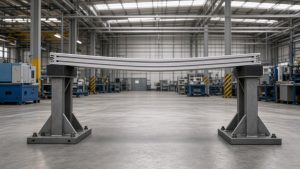 Engineering DesignAluminium Profile Max Span: Deflection Table by Section
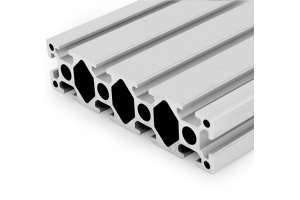 ApplicationsAluminium Partitions: The Three Performance Numbers Behind the Aesthetic
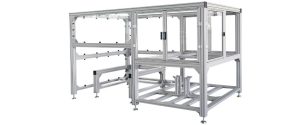 Machine SafetyAluminium Profile Machine Guards: Size the Frame from the Energy, Not from the Mesh
 Quality and InspectionAluminium Extrusion Certificates and Standards Explained (EN 755, EN 12020, ISPM 15)
 Quality and InspectionSampling and First Article Approval for Aluminium Extrusion
 Quality and InspectionHow to Choose (and Audit) an Aluminium Extrusion Supplier
