How to Join and Assemble Aluminium Profiles
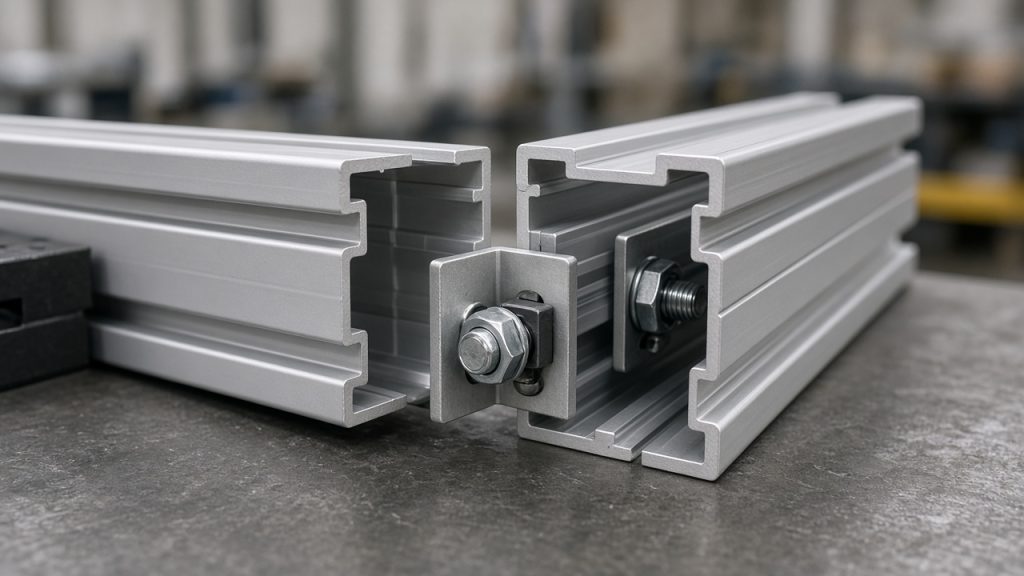
Most 40-series frames fail at the joint, not the profile. The joint decides the stiffness, not the section. The everyday industrial joint is an external corner bracket with M6 or M8 T-nuts: quick to square, serviceable, and strong enough for benches and guards when torqued correctly.
Short answer
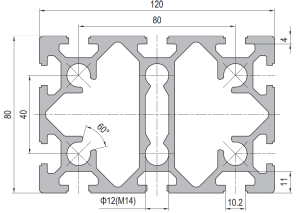
Assemble T-slot by matching the connector to the load path: external corner brackets and gussets for most 90° frames, internal (hidden) connectors where cosmetics matter and loads stay moderate, end tapping through the core for high axial joints, and through-bolts only where you can drill both members. Blind or single-screw aesthetic corners must not carry primary structural load. Typical dry torque bands for clean dry aluminium: M6 T-nut joints 5–8 Nm, M8 T-nut joints 13–20 Nm; end-anchor assemblies on 40-series often sit in a similar 13–29 Nm working band depending on the fastener. Fabrication that supports square frames: cut length ±0.5 mm, hole position ±0.2 mm, end square within 0.3 mm. For stiffness context, a 45 × 90 mm six-slot bar in 6063-T5 at about 4.10 kg/m with I ≈ 68 cm⁰ only delivers that inertia if the joints do not slip first.
How do i level a workbench on an uneven floor
Level a T-slot workbench with adjustable feet in the base slots (or base plates), not by packing shims under raw profile ends — feet take the floor variation while the frame stays square.
Fit M10 or M12 leveling feet into base plates bolted through the bottom slots of the perimeter rails, or into threaded inserts in the upright ends. Set all feet roughly mid-stroke, place the bench, then raise the low corners until a spirit level reads true on both axes of the top. Lock jam nuts so vibration does not wind the feet out. On floors with more than about 10–15 mm of local deviation across a 1.2 m bay, add a lower stretcher so racking does not twist the uprights while you adjust. Casters and leveling feet can share a base plate if the caster offset is short; long offsets turn floor correction into a bending load on light 2020 uprights.
| Floor condition | Fix | Hardware | Do not |
|---|---|---|---|
| ±5 mm over bay | Four leveling feet | M10/M12 feet + base plates | Shims under bare ends |
| 10–15 mm local dip | Feet + lower stretcher | 4040 base preferred | Twist uprights to “force” level |
| Slope along length | Feet at every upright | Shared jam-nut lock | Single long packer |
| Moveable + level | Locking casters + feet | Short-offset plate | Long caster brackets on 2020 |
| Epoxy / cleanroom | Soft pad feet | Non-marking pads | Steel feet that scratch |
| Outdoor / wet | Stainless adjusters | Sealed thread | Bare mild-steel feet |
T-slot vs v-slot for a workbench which is faster to assemble
For a workbench, T-slot with external brackets is usually faster to assemble than V-slot, because drop-in or roll-in T-nuts and standard corner brackets need no linear-rail style alignment.
V-slot (or similar open V geometries) exists to guide wheels for motion systems. That geometry helps gantries and hurts furniture-speed assembly: wheel plates, eccentric nuts and belt hardware add steps a static bench never needs. T-slot accepts a corner bracket, two or four T-nuts and bolts, and a square — dry-fit, torque, done. Choose V-slot only when the same rail must carry linear motion; otherwise the extra geometry slows the kit without buying stiffness. For OEM workbench SKUs, T-slot 3030 or 4040 with a published bracket kit keeps dealer assembly under an hour for a simple four-leg frame.
| Task | T-slot | V-slot | Winner for bench |
|---|---|---|---|
| 90° corner | Bracket + T-nuts | Plate or custom | T-slot |
| Drop-in accessory | Drop-in / roll-in nut | Often slide from end | T-slot |
| Linear motion | Needs separate rail | Native V wheels | V-slot |
| Kit documentation | One fastener family | Wheels + eccentrics | T-slot |
| Dealer rebuild speed | Minutes per joint | More parts per joint | T-slot |
| Structural bench rail | 4040 / 4080 | Possible but odd | T-slot |
Which bracket do i need for a 2020 corner joint
For a 2020 corner joint use a matching 20-series L-bracket or small gusset with M5 (sometimes M4) T-nuts — not a 40-series heavy bracket whose hole pattern and slot mouth will not line up.
2020’s ~6 mm slot and light walls set the limit: a two-hole L-bracket is enough for light shelves and short uprights; a triangular gusset helps when the joint sees racking. Do not expect a single small bracket to turn 2020 into a machine base. If the corner carries a workbench top rail span near 1 m, step the rail to 3030/4040 rather than stacking oversized steel brackets on 2020 lips. Keep hole centres on the slot centreline so the T-nut seats flat.
| 2020 corner use | Bracket | Fastener | Load role |
|---|---|---|---|
| Light shelf / jig | 2-hole L | M5 T-nut | OK |
| Guard frame | 2–3 hole L or small gusset | M5 | OK if braced |
| Workbench primary | Do not rely on 2020 | — | Step up series |
| Hidden look | Internal 20-series connector | System screw | Moderate only |
| Three-way corner | 3-way cube / plates | M5 | Light frames |
| Heavy cast steel bracket | Avoid on 2020 | — | Overloads lip |
Which connector for 2020 at 90 degrees
At 90° on 2020, prefer an external L-bracket for speed and serviceability; use an internal connector only when the face must stay clear and the joint is not the primary load path.
External brackets let you square the frame with a try-square before final torque and allow later reconfiguration. Internal (blind) connectors hide hardware but engage mainly the slot walls, so they carry less than a gusseted external joint — treat them as positioning or light-duty. End tapping the core and using a butt fastener is stronger axially but needs access and accurate end square (within 0.3 mm). Through-bolts across both walls work when you can drill, but they permanently alter the bar.
| Connector | Visibility | Typical strength role | Best for | Must not |
|---|---|---|---|---|
| External L-bracket | Visible | Primary 90° for light frames | Benches, guards, jigs | — |
| Gusset / triangle | Visible | Racking / bending | Taller frames | — |
| Internal / blind | Hidden | ~30–40% of a solid T-nut joint class | Cosmetic corners | Carry primary structural load |
| End tap + butt fastener | Mostly hidden | High axial | Post-to-rail butts | Skip square check |
| Through-bolt | Visible heads | High if both walls engaged | Permanent joints | Use without drill plan |
| Single screw “corner” | Minimal | Furniture only | Display frames | Any loaded rail |
Can i use item fasteners on 2020 profile
Only if the 2020 slot mouth, groove and core match the Item fastener’s series geometry — nominal “20 mm” outline is not a licence to mix brands.
Item system fasteners are cut for Item groove series (commonly groove 5/6/8 depending on the line). A generic Chinese 2020 with a ~6 mm mouth may accept some external T-nuts by feel and still refuse Item-specific anchors or brackets whose undercut or screw length assumes Item’s core and lip. Test the actual nut and bracket in a scrap bar: it must enter, rotate or seat, and clamp without chewing the lip. If the plant standard is Item hardware, buy Item-compatible slot geometry rather than forcing mixed inventory. Cross-brand rules are expanded under slot compatibility pages; on this page the rule is simple — match the fastener to the slot you stock.
| Check | Pass | Fail means |
|---|---|---|
| Slot mouth vs nut | Nut enters and seats | Wrong series / brand mix |
| Undercut / lip | Nut rotates or locks as designed | Pull-through risk |
| Core / anchor | Anchor starts and expands | Do not reuse Item anchors |
| Bracket hole pitch | Holes land on slot centres | Wrong bracket family |
| Torque to band | Preload without stripping | Soft lip or wrong screw |
| Finish friction | Same torque → expected clamp | Anodised vs mill differ |
How do i join two 2020 profiles at a corner
Join two 2020 bars at a corner with square-cut ends, an external 20-series L-bracket (or small gusset), matching T-nuts and bolts torqued in the M5 band — dry-fit and square before final tighten.
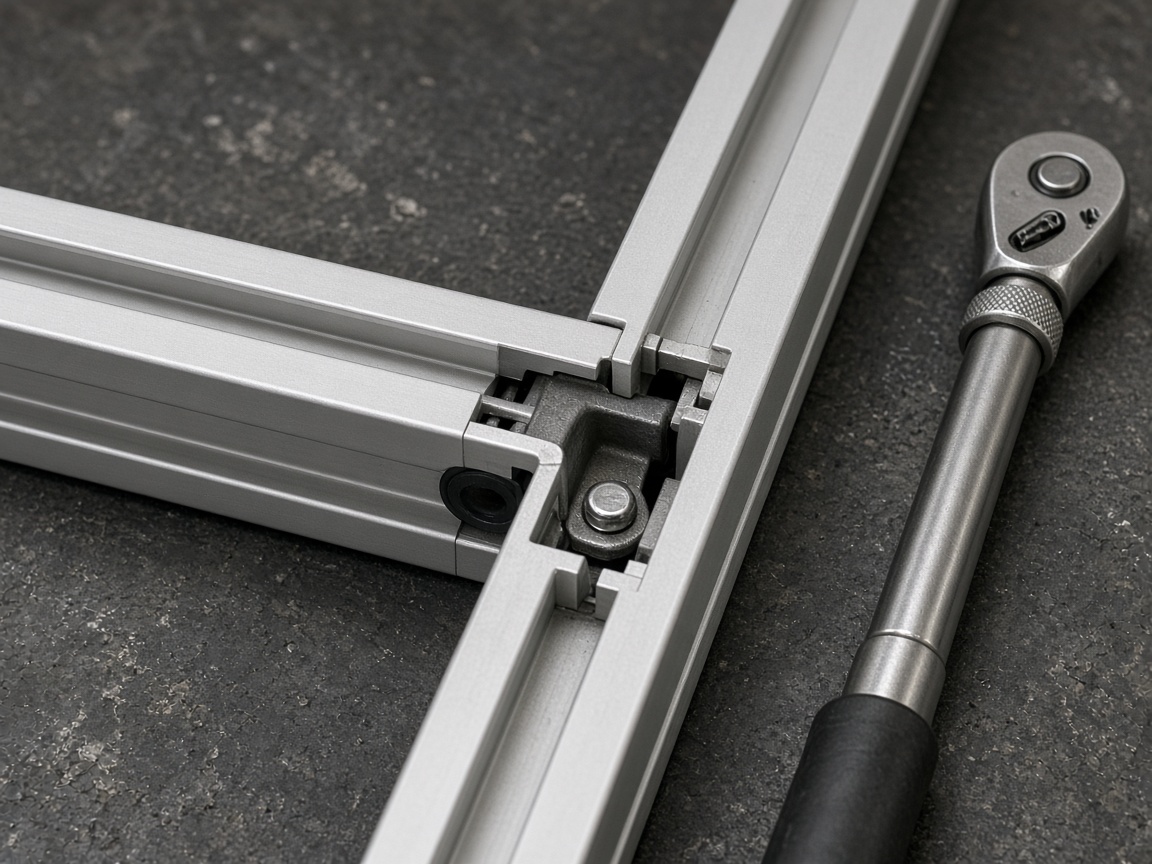
Cut both ends square within 0.3 mm so the faces meet without a wedge gap. Deburr the slot mouth so the T-nut seats fully. Insert T-nuts (or drop-ins), fit the bracket, snug all screws, check square on both planes, then torque evenly — typically about 5–8 Nm for M6-class joints on larger series; for true M5 on 2020 stay toward the lower end of the supplier’s chart (often roughly 3–6 Nm) to avoid crushing the light lip. Add a second bracket or a gusset if the corner sees racking. For a cleaner look, an internal 20-series connector works on light fixtures only; it must not be the sole support of a loaded top rail. Preferred industrial path when the corner is structural: leave 2020 for braces and move the primary rails to 3030/4040.
| Method | Steps (summary) | Torque guide | Structural? |
|---|---|---|---|
| External L-bracket | Square cut → T-nuts → bracket → square → torque | M5 ~3–6 Nm; M6 5–8 Nm | Yes for light 2020 |
| Gusset | Same + multi-hole plate | As above per screw | Better racking |
| Internal connector | Slide/expand per maker | Maker spec | No as primary load |
| End tap + butt | Drill/tap core → butt fastener | Maker / M6–M8 band | Yes axially |
| Through-bolt | Drill both → bolt + nut | Bolt grade chart | Yes if walls engaged |
| 45° mitre + plate | Mitre → plate across joint | As bracket | Only with plate |
RFQ checklist — join and assemble
- Series and slot — 2020 / 3030 / 4040 / 4545 and mouth size.
- Joint type — external bracket, gusset, internal, end tap, through-bolt.
- Load path — which corners carry top load or racking.
- Torque standard — dry M6 5–8 Nm / M8 13–20 Nm unless maker differs.
- Fabrication — cut ±0.5 mm, holes ±0.2 mm, end square 0.3 mm.
- Example heavy rail — 45 × 90 six-slot, 6063-T5, 4.10 kg/m, I ≈ 68 cm⁰ when joints hold.
Ask whether any “hidden” connector is expected to carry primary load. If yes, replace it with a gusset or end fastener before you quote the frame as structural.
Four ways a frame fails at the joint
Related on this site
- how die cost amortises per meter — cost of locking one series
- minimum order with a new die — when a custom joint section needs tooling
- die making adds 7–12 days — calendar if you change the slot
- who owns the die — reuse rights on a custom connector section
Terms used in this article
- T-nut
- A nut that seats in the T-slot and accepts a machine screw to clamp brackets or panels.
- External bracket
- An L-shaped or gusset plate bolted outside the profiles at a corner.
- Internal / blind connector
- A hidden fastener that engages inside the slot or core; lower capacity than a gusseted external joint.
- End tapping
- Drilling and tapping the profile core so a butt fastener can join end-to-face.
- Preload
- Clamping force from correct torque; what actually holds a bolted T-slot frame.
- End square
- How square the cut face is; keep within 0.3 mm for reliable butt and corner joints.
Questions buyers ask
How do i handle a change order after the die is made
Freeze joint-critical geometry — slot mouth, core hole and wall — before steel is cut. After the die exists, a change that alters the slot usually needs die rework or a new tool and restarts the 7–12 day die gate. Cosmetic length or hole pattern changes on fabrication drawings do not touch the die; slot changes do. Issue a written ECO with revised DXF before the next press.
What is the minimum radius for an extruded corner
Outside and inside corner radii on the extrusion are set by the die and alloy flow, typically at least about 0.5–1.0 mm on light walls rather than a sharp knife edge. For mitred frame corners the fabrication mitre radius is separate: keep a clean saw radius and deburr so brackets sit flat. Do not specify a zero inside radius on thin T-slot lips; it cracks and weakens the joint face.
What torque should I use?
On clean dry aluminium T-slot joints, use about 5–8 Nm for M6 T-nut connections and 13–20 Nm for M8 T-nut connections as a working band, unless the fastener maker publishes a different chart. Anodised slots need slightly different torque for the same preload because friction changes. Recheck torque after the first transport or vibration cycle.
Can I drill into the slot?
Yes for clearance or tap holes on the slot centreline when the drawing calls for them — keep hole position within ±0.2 mm. Do not elongate the slot mouth with a drill to force an oversized nut; that destroys clamping geometry. Through-bolts and end taps are planned drills; random holes in the lip for “extra screws” often start cracks under load.
How do I join at 45 degrees?
Cut a true 45° mitre, dry-fit so faces meet without a gap, then bridge the joint with a mitre plate or angle bracket that lands T-nuts in both slots. A mitre alone without a plate is not a structural joint. For adjustable non-90° angles use a hinged or slotted angle bracket rated for the series. Torque each screw in the same M5/M6/M8 bands as square corners.
Send the joint list with series and loads
Share the frame sketch, series (2020/3030/4040), which corners are structural, and whether joints must be hidden. We return a connector bill of materials with torque notes and cut tolerances.
Request a joint BOMRelated reading
Twelve more engineering notes from this blog, picked for this article — plus every category below.
 Engineering DesignAluminium Extrusion Lead Time: New Die vs Existing Die
 Engineering DesignCustom Aluminium Extrusion: From Drawing to Production
 Engineering DesignAluminum Corner Brackets for T-Slot Frames: How to Choose by Load Path, Not by Looks
 ApplicationsWhere Modular Aluminium Framing Works: A Load-Tier Map Instead of an Industry List
 Engineering Design6061-T5 vs 6063-T5: What the Temper Label Really Decides
 Engineering DesignAluminium vs Steel, Extruded vs Cast: What Actually Changes
 Engineering DesignHow to Choose the Right T-Slot Aluminium Profile for Your Project
 Engineering DesignAluminium Extrusion Capacity: What a Factory Can Actually Deliver
 ApplicationsCleanroom and Medical Framing: There Is No Medical-Grade Aluminium Extrusion
 ApplicationsAluminium Profiles in Industry and Construction: One Material, Two Acceptance Logics
 Quality and InspectionAluminium Extrusion Claims: What the Contract Must Say
- Quality and InspectionGlobal Sourcing Excellence: Multi-Category OEM and ODM Manufacturing and Supply Chain Integration
