Custom Aluminium Extrusion: From Drawing to Production
Plan 30–40 days to first load with a new die and anodising, or 12–20 days on an existing die and mill finish — then add fabrication, packing and transit. The calendar is stage-bound: drawing review, die work, trial, finish and cut, not one blurred lead time.
Short answer
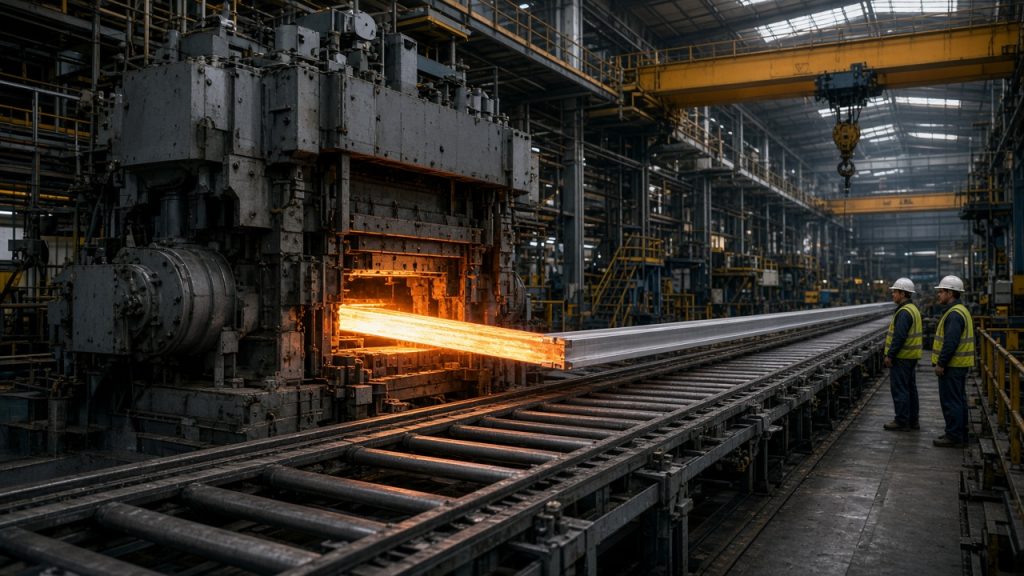
A custom aluminium extrusion programme runs from a revision-controlled drawing package through DFM, die cut (when new), trial bars, finish and fabrication, then packing from Shanghai or Ningbo. With a new die and anodising, plan 30–40 days to load; with an existing die and mill finish, plan 12–20 days. Die making itself typically adds 7–12 days before the press. Production floors are 150 m on an existing die and 500 m with a new die. Fabrication after the press holds cut length ±0.5 mm, hole position ±0.2 mm and end square within 0.3 mm unless the drawing tightens those call-outs. Hollow sections cost more than solids of the same envelope because the die is multi-part and the press window is slower; tooling is usually paid as a separate 2026 USD line and amortised per metre across the release.
Is a hollow section more expensive than a solid one
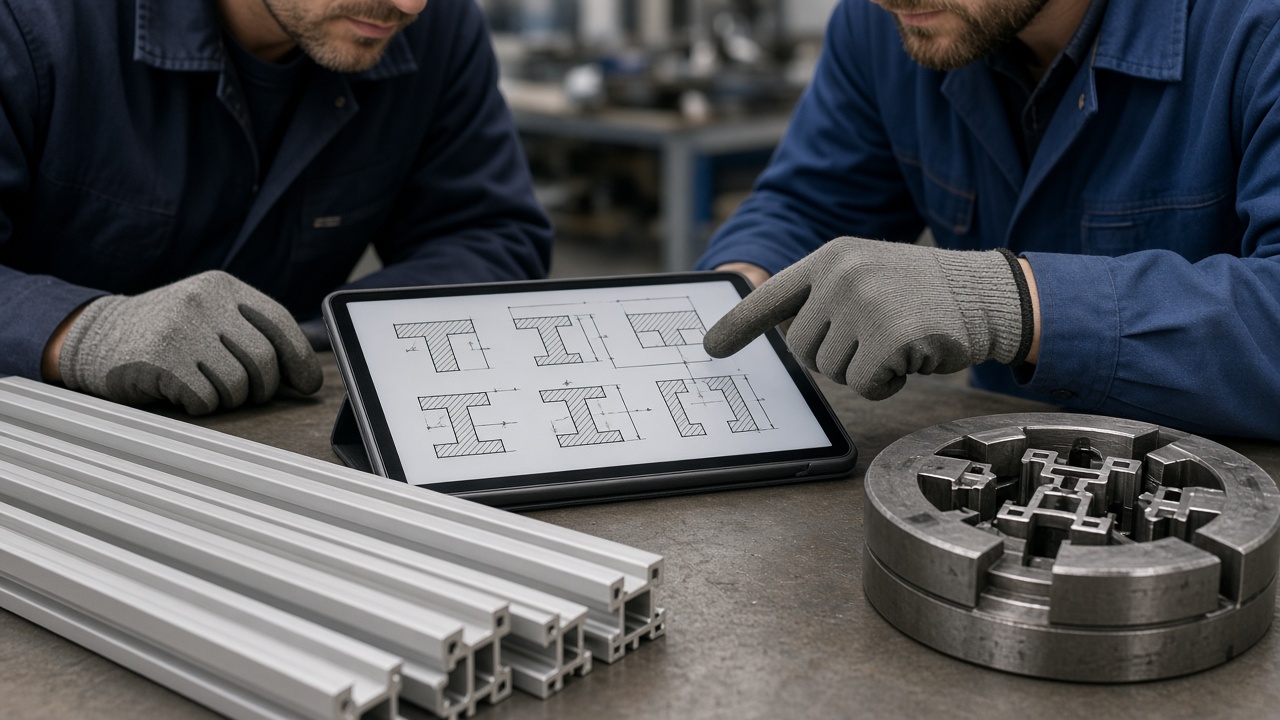
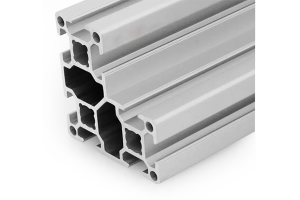
Yes — a hollow (or multi-void) section costs more than a solid of the same circumscribed circle because the die is a porthole or bridge tool, scrap risk is higher and press speed is lower.
A solid die is a single piece of tool steel with an open aperture. A hollow die needs a mandrel and bridges, more EDM and try-out, and longer first-article tuning. In 2026 USD that shows up as a higher die line and a higher conversion adder per kilogram. Thin walls around a void, unbalanced lobes and deep narrow channels push both further. When function allows, converting a deep hollow into a solid with a later CNC pocket can cut tooling and press cost more than it adds in machining. When the hollow is structural, accept the die class and quote it honestly rather than forcing a solid price onto a hollow tool.
| Section class | Die type | Relative die cost | Press behaviour | Buyer note |
|---|---|---|---|---|
| Solid bar / angle | Flat die | Baseline | Fastest fill | Cheapest custom path |
| Semi-hollow | Semi-hollow die | + mid | Moderate | Watch tongue ratio |
| Single hollow | Porthole / bridge | + high | Slower, weld seams | Expect longer try-out |
| Multi-void | Complex porthole | + highest | Slowest | DFM critical before steel |
| Thin-wall hollow | Porthole + care | + high | Fill / mark risk | Thicken non-CTQ webs |
| Same CCD, solid vs hollow | Different tools | Hollow wins cost | Hollow slower | Do not compare on outline alone |
What do i need to send to start a custom extrusion project
Send a revision-controlled 2D section (PDF plus DWG or DXF), alloy or functional needs, cut lengths, quantity, finish and any secondary operations; add STEP or IGES when holes, pockets or assembly features must be machined.
PDF alone starts a conversation; DWG/DXF cuts the die; STEP/IGES programs CNC. Mark critical-to-function dimensions with tolerances. Name the intended alloy/temper (or the strength and finish window if alloy is open), annual volume and whether cosmetic faces are visible after assembly. State whether you need a first-article gate before the bulk run. Missing revision letters, blank tolerances or “make it like the sample” notes burn days inside the 30–40 day new-die window.
Can you help design the section for extrusion
Yes — DFM review is a named gate before a new die is cut, covering wall balance, radii, hollow class, critical dimensions, finish faces and secondary ops.
The review returns a short issue list rather than a silent redraw. Typical fixes are thickening unbalanced webs, adding workable internal radii, relaxing non-mating tolerances to EN 755-9, and moving ultra-tight features into machining after extrusion. We do not invent your product function; we make the section extrudable at the MOQ and calendar you need. After DFM sign-off the quote, die schedule and first-article plan share one revision. Drawing changes after die cut restart cost and calendar.
What is the tooling amortisation model for a custom profile
Tooling is quoted as a separate 2026 USD die line, then recovered as a per-metre adder across the metres you actually release — not as a hidden markup inside the billet price.
A die that looks expensive on a 500 m first release becomes a small adder at 2,000 m or 5,000 m. Existing-library dies skip the die line and clear at the 150 m MOQ; new dies carry the charge and the 500 m floor. Some programmes refund or credit part of the die against later volume; that must be written on the PO. Ownership of the tool after payment is a separate contract point. For the unit-rate math see how die cost amortises per meter; for the metre floors see minimum order with a new die.
| Model | What you pay | When it fits | MOQ floor | Risk |
|---|---|---|---|---|
| Pay die + amortise | Die line + metre rate | Most OEM customs | 500 m new | Low volume = high $/m adder |
| Library / existing die | No new die line | Catalogue T-slot | 150 m | Finish minima may still apply |
| Die credit vs volume | Die now, credit later | Repeat releases | Per contract | Credit rules must be written |
| Mill-owned tool | Higher $/m, no die title | Short trials | Per mill | Harder to move later |
| Shared / multi-buyer | Split die | Rare; NDA conflict | Negotiated | IP leakage risk |
Can you extrude a custom aluminium section for my product
Yes — if the section clears DFM for wall balance, hollow class and press size, we cut or release a die, trial it, finish it and fabricate to the drawing package.
The path is the same for a proprietary enclosure rail, a machine-guard upright or a furniture leg: drawing intake, DFM, quote and PO lock, die work when needed, extrusion, temper, finish, optional CNC, packing. Payment is T/T 30% deposit + 70% before shipment, or L/C at sight, on FOB, CIF, DAP or DDP from Shanghai or Ningbo. Die making adds 7–12 days before first bars when the tool is new — see die making adds 7–12 days. Title to the die after payment should be written before steel is ordered — see who owns the die.
What is the maximum profile length you can extrude
Press and handling set a practical run-out length; cut-to-length for export is then chosen for packing, container fit and your assembly — not as one universal maximum on every PO.
Industrial T-slot programmes commonly ship stock bars in the 5–6 m class and cut-to-length parts much shorter. Very long single bars raise straightness, twist and packing risk and may not fit a 40HQ cleanly. Ask for the press run-out capability and the export packing length as two numbers. Fabrication tolerances on cut parts remain cut length ±0.5 mm, hole position ±0.2 mm and end square within 0.3 mm unless the drawing states otherwise.
| Length use | Typical planning | Driver | Watch | Tolerance note |
|---|---|---|---|---|
| Press run-out | Plant capability | Press / table | Alloy and CCD | As-extruded EN 755-9 |
| Export stock bar | ~5–6 m common | Container / pack | Bow and twist | Straightness over length |
| Cut-to-length part | Per drawing | Assembly | Saw method | ±0.5 mm cut length |
| Machined end | Per drawing | Fixture | Datum choice | End square ≤0.3 mm |
| Drilled / tapped | Per drawing | CNC | Hole stack | Position ±0.2 mm |
RFQ checklist — custom extrusion
- 2D section — PDF + DWG/DXF, revision controlled.
- 3D if machined — STEP or IGES matching the same rev.
- Alloy / temper — or functional strength and finish needs.
- Hollow class — solid, semi-hollow, hollow, multi-void.
- Lengths and qty — cut list + annual volume; 150 m / 500 m floors.
- Finish — mill, anodised colour, powder; cosmetic faces.
- First article — sample qty and approval gate on the PO.
- Incoterms / payment — FOB/CIF/DAP/DDP; T/T 30/70 or L/C at sight.
Freeze CTQs before tool steel is ordered. Everything else can stay on the standard tolerance table.
Four custom-project mistakes
Related on this site
- how die cost amortises per meter — tooling share inside the metre price
- minimum order with a new die — 150 m existing vs 500 m new
- die making adds 7–12 days — calendar before first bars
- who owns the die — tooling title after payment
Terms used in this article
- DFM
- Design for manufacturability review of the section and secondary ops before the die is cut.
- Hollow / porthole die
- Multi-part tooling that forms closed voids; costlier and slower than a solid flat die.
- Amortisation
- Spreading the die fee across the metres released so the adder falls as volume rises.
- EN 755-9
- European standard commonly cited for as-extruded dimensional tolerances on aluminium profiles.
- CTQ
- Critical-to-function dimension that must carry an explicit tolerance on the drawing.
Questions buyers ask
What do you need from me to start?
A revision-controlled 2D section (PDF + DWG/DXF), alloy or functional needs, cut lengths, quantity, finish and any machining features. Add STEP or IGES when holes or pockets exist. With that package we can DFM-review and quote before die steel is ordered.
Can I approve a sample first?
Yes. Write a first-article quantity and an approval gate on the PO. On a new die the sample follows die proving inside the 30–40 day anodised window; on an existing die a short mill-finish cut can precede the bulk run inside 12–20 days. Production metres should not ship until the agreed sample is signed.
What happens if my drawing changes?
Bump the revision and resubmit. Changes before die cut are an engineering update; changes after die cut may need tool rework and a new quote. Fabrication-only changes on an unchanged section usually restart CNC without a new die, but still need a rev-controlled drawing.
How do I track the order?
After PO lock you receive stage dates for DFM, die (if any), press, finish, fabrication and packing. Ask for the current gate on weekly updates and keep the same revision number on every email so status maps to one geometry.
Send the drawing set you want quoted
Attach PDF + DWG/DXF (and STEP if machined), mark CTQs, and state whether the die is new or existing. We will return a DFM note and a stage calendar before tool steel is ordered.
Send drawings for DFM reviewRelated reading
Twelve more engineering notes from this blog, picked for this article — plus every category below.
 Engineering DesignCut-to-Length, Drilling and Tapping: What Fabrication Adds
 Engineering DesignSlot Dimensions Explained: 6 mm, 8 mm and 10 mm T-Slots
 Engineering DesignT-Slot vs V-Slot Aluminium Profiles: The V Is a Raceway, Not a Cheaper T
 ApplicationsLean Pipe vs T-Slot Profile: Two Interface Philosophies, Not Two Generations
 Engineering DesignExtruded vs Cast Aluminium: Stronger in One Direction, Not in All of Them
 Sourcing and ProcurementAluminium Profile Quote: What Changes the Number by Quantity
 Engineering DesignAluminum vs Steel Machine Frames: Choose by Deflection, Not by Strength
 Engineering DesignAluminium Profile Max Span: Deflection Table by Section
 Materials and EngineeringAnodised vs Powder Coated Aluminium Profiles: A Specification Guide for European Buyers
 ApplicationsAluminium Profiles in Solar Mounting: Wind Uplift, Corrosion and a 25-Year Life
 ApplicationsAluminium Profiles Across Industries: What Actually Changes From One Sector to the Next
 Quality and InspectionEuropean Anodised Aluminium Specification: What Should a Purchase Order Contain?
