Ask an engineer whether aluminium or steel is better for an industrial frame and you will get a confident answer about strength. Steel is stronger. Steel is stiffer per unit area. Steel is cheaper per kilogram. All three statements are true, and all three are close to irrelevant for the decision you are actually making.
The reason is that frames do not usually break. They deflect. A conveyor support that sags 4 mm puts the drive out of alignment. A machine base that twists under load makes the tool marks wander. A gantry that flexes 2 mm at the tool centre cannot hold a tolerance no matter how good the servo is. In all three cases the governing limit is a deflection limit, and the governing material property is not yield strength — it is Young’s modulus, multiplied by the second moment of area of the section you chose.
That product, E × I, is where aluminium and steel are genuinely far apart, and where the usual argument immediately goes wrong. This article works through the arithmetic, shows where the 2.9 factor comes from, explains why an aluminium frame can be stiffer than a steel one at the same mass, and then covers the three effects that decide real projects: joint stiffness, thermal movement and fatigue.
Numbers policy
One caveat before the numbers. All section properties below are typical catalogue values for illustration. Before you commit a design, take Ix and mass per metre from the actual supplier datasheet for the actual series you intend to use — T-slot geometry varies between manufacturers, and slot count changes the numbers by 10–15%.
Quick answer
The nine rules that actually decide the material
If you only read one block, read this. Everything below is the arithmetic behind these nine lines.
Check stiffness first, strength second Calculate the deflection limit your process needs, then size the section for E × I. Yield strength only matters once stiffness is satisfied.
The modulus ratio is about 2.9 to 3.0 Aluminium is roughly 70 GPa, steel about 210 GPa. Same geometry, same load, aluminium deflects close to three times as much.
Compensate with section depth, not with a thicker wall For a thin-walled square section, Ix grows roughly with the cube of the outside dimension. Going one series up buys far more stiffness than increasing wall thickness.
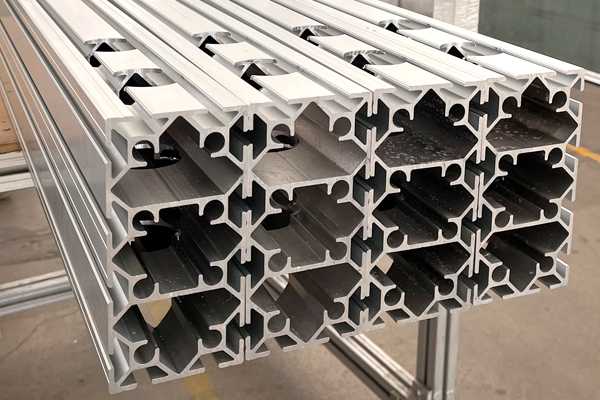
At equal mass, aluminium can win Because extrusion allows deep, complex sections, an aluminium member can be stiffer than a steel member of the same mass per metre. This is the part the usual comparison misses.
Joints usually dominate the deflection A bolted T-slot corner is much softer than a welded steel corner. In many frames, 50–80% of the measured deflection at the load point comes from the connections, not the members.
Buy stiffness with a diagonal before you buy it with a bigger section A single diagonal brace converts bending into axial load and is the cheapest stiffness available in a modular frame.
Check thermal movement if the frame is long or precision Aluminium expands at about 23 µm/m·K against roughly 12 µm/m·K for steel.
Isolate aluminium from steel Direct aluminium-to-steel contact in a wet or chloride environment creates a galvanic couple. Use isolating washers or an intermediate coating.
Do not design aluminium for unlimited fatigue life Aluminium has no true endurance limit. For cyclic loading, design to a finite life with a stress range you can defend.
Framing
Why “steel is stronger” is the wrong starting point
Yield strength describes the stress at which a material stops behaving elastically. For 6063-T5 it is around 145–160 MPa; for S235 structural steel it is 235 MPa. So on paper steel is roughly 1.5 times stronger, and on that basis a designer concludes that aluminium sections must be bigger.
But a frame that deflects 3 mm is nowhere near yielding. In a typical machine frame the working stress is a small fraction of yield — often under 20 MPa — because the deflection limit bites long before the stress limit does. The practical consequence is stark: you can replace a steel frame with an aluminium one that has lower strength and still be completely safe, provided the stiffness works out. Conversely, you can build a frame from a high-strength alloy, feel reassured by the yield number, and still have a machine that cannot hold tolerance.
There is a second reason the strength framing misleads. Stiffness is elastic and geometry-driven; it does not improve when you change alloy or temper. 6063-T5, 6061-T6 and 6082-T6 all have essentially the same Young’s modulus, around 69–70 GPa. Moving from T5 to T6 buys you strength at bolted joints and in machined features. It buys you nothing in deflection. Designers routinely upgrade the alloy hoping to stiffen a frame and are then surprised when the sag does not change.
What strength actually governs
- Bolted joint bearing and thread pull-out
- Local crushing where a bracket bears on a slot
- Overload and impact events
- Machined features with small cross sections
- Anything the customer might reasonably abuse
What stiffness actually governs
- Tool and workpiece position under load
- Drive and rail alignment
- Vibration response and resonance
- Bearing life on belt and screw drives
- Whether the machine holds tolerance at all
The engineering discipline that follows from this is simple: size for stiffness, then verify strength. If the strength check passes with margin — which it usually does by a wide margin in aluminium frames — the only remaining question is whether the connections can carry the load into the members. That is a different calculation, and it comes later in this article.
Calculation
The stiffness arithmetic, and where 2.9 comes from
Deflection in a linear-elastic beam is governed by one relationship: the load and span terms on top, and the product of modulus and second moment of area underneath. For the two most common frame cases:
Cantilever, end load: δ = F·L³ / (3·E·I)
Simply supported, central load: δ = F·L³ / (48·E·I)
Simply supported, uniform load: δ = 5·w·L⁵ / (384·E·I)
δ = deflection (mm), F = load (N), w = load per unit length (N/mm), L = span (mm), E = Young’s modulus (N/mm²), I = second moment of area (mm⁴). For a given load and span, deflection is inversely proportional to E·I — nothing else in the member matters.
Because E is fixed by the material and I is fixed by the section, the whole material comparison reduces to the ratio of moduli. Taking the values used in most European design work:
| Property | Aluminium 6xxx | Structural steel | Ratio (steel / aluminium) |
|---|---|---|---|
| Young’s modulus, E | 69–70 GPa | 200–210 GPa | ≈ 2.9 to 3.0 |
| Density | 2.70 g/cm³ | 7.85 g/cm³ | ≈ 2.9 |
| Yield strength (6063-T5 vs S235) | 145–160 MPa | 235 MPa | ≈ 1.5 |
| Thermal expansion | 23.1 µm/m·K | 12.0 µm/m·K | ≈ 0.5 |
The first two rows are the whole argument. Aluminium is about three times softer per unit area and about three times lighter per unit volume. Those two facts roughly cancel — which is why mass is not the deciding factor, and section geometry is.
So if you take a steel section and swap it for an aluminium section of identical geometry, you lose a factor of about 2.9 in stiffness. To get it back you must increase Ix by the same factor. The question is what that costs you in mass, and the answer is much less than you would expect, because of how Ix scales with depth.
Why section depth is the cheap lever
For a thin-walled square section of outside dimension b and wall thickness t, the second moment of area is approximately I ≈ (2/3)·b³·t. The outside dimension enters cubed; the wall thickness enters linearly. Doubling the wall thickness doubles the stiffness and roughly doubles the mass. Increasing the outside dimension by 40% increases the stiffness by about 2.7 times, and increases the mass by only 40%.
This is the single most useful fact in frame design, and it is the reason the answer to “can aluminium replace steel?” is usually yes. You do not need a three times heavier section. You need a section roughly one series larger, and because aluminium is a third of the density, the result is still lighter than the steel it replaced.
Required Ix in aluminium ≈ 2.9 × Ix of the steel section
Required outside dimension ≈ 2.91/3 × steel dimension ≈ 1.43 ×
Matching a steel member’s stiffness with aluminium of the same wall thickness needs roughly a 40% larger outside dimension. Because aluminium is about one third the density, the resulting member still weighs around half as much as the steel one.
Worked example
A worked example you can check
Take a cantilever bracket, 1,000 mm long, carrying 500 N at the free end — a realistic arrangement for a sensor mount, a guard post or a small tool arm. Deflection is δ = F·L³ / (3·E·I), with F = 500 N, L = 1,000 mm and L³ = 10⁹ mm³. So δ = 5×10¹¹ / (3·E·I).
Now compare six sections: three steel square hollow sections and three aluminium T-slot extrusions, using typical catalogue values. Steel E = 210,000 N/mm², aluminium E = 70,000 N/mm².
| Section | Material | Iₓ (cm⁴) | Mass (kg/m) | Deflection (mm) |
|---|---|---|---|---|
| 40×40×2 SHS | Steel S235 | 7.3 | 2.4 | 10.9 |
| 4040 T-slot, light | 6063-T5 | 10.0 | 1.3 | 23.8 |
| 6060 T-slot | 6063-T5 | 30.0 | 2.5 | 7.9 |
| 60×60×3 SHS | Steel S235 | 37.1 | 5.4 | 2.1 |
| 8080 T-slot, heavy | 6063-T5 | 140 | 5.4 | 1.7 |
| 80×80×5 SHS | Steel S235 | 141 | 11.8 | 1.7 |
Cantilever, L = 1,000 mm, F = 500 N. Steel E = 210,000 N/mm², aluminium E = 70,000 N/mm². Iₓ and mass are typical catalogue values; take the real figures from your supplier’s datasheet before designing.
Read the table in two directions and it tells two different stories.
Row by row: the 4040 light T-slot is more than twice as soft as the 40×40×2 steel tube at just over half the mass. If you simply swap like for like on outside dimension, aluminium looks bad, and that is where most of the folk wisdom comes from.
Column by column: at the same mass of 5.4 kg/m, the 8080 heavy T-slot deflects 1.7 mm and the 60×60×3 steel tube deflects 2.1 mm. Aluminium wins. To match the 8080 aluminium section in steel you need 80×80×5, which weighs 11.8 kg/m — more than twice as much for identical stiffness.
How to use this table honestly
This is not a claim that aluminium is always stiffer. It is a claim that the comparison depends entirely on whether you hold outside dimension constant or mass constant, and that most published comparisons quietly hold the wrong one. A steel tube of a given size is usually stiffer than an aluminium T-slot of the same size. A steel tube is usually not stiffer than an aluminium T-slot of the same mass.
There is a real penalty hidden in the T-slot geometry, and it is worth knowing about. A closed square tube puts its material as far from the neutral axis as possible, which is exactly where it does the most good. A T-slot section removes material to create the slots, and it does so near the surface. Per unit of mass, therefore, a closed tube is a more efficient bending section than a T-slot profile of the same envelope. T-slot profiles compensate by having a thick solid core and by being extruded in deep sections, but if you are chasing the last 10% of stiffness, the closed section is the better shape and you should consider whether the frame genuinely needs the slots.
Joints
Joints decide the answer more often than members do
Everything above assumes a beam with rigid ends. Real frames do not have rigid ends. A welded steel corner is close to rigid; a single T-slot corner bracket is not. And because deflection at the load point is a sum over the whole load path, a soft joint at every corner can easily account for the majority of the total movement.
In practice, when a modular aluminium frame is measured against its calculated deflection, the measured value is usually worse — often substantially. The gap is almost never the members. It is the connections rotating slightly under load, and it grows quickly with the number of joints in series along the load path.
Welded steel frame
- Corner stiffness close to that of the member
- Load transferred by continuous material
- Deflection prediction usually close to measurement
- But: no reconfiguration, and heat distortion from welding
Bolted aluminium T-slot frame
- Corner stiffness a fraction of the member
- Load transferred through a bracket and a small contact area
- Deflection prediction must include joint compliance
- But: fully reconfigurable, and no heat distortion
Four ways to buy joint stiffness
Add a second bracket per corner
Two brackets on adjacent faces change the load path from a single moment connection to a partially restrained one. It is the cheapest and most often skipped improvement.
Use internal anchor connectors instead of external brackets
An anchor connector that pulls the profile ends together keeps the joint in tension rather than relying on friction and bolt shear in a bracket flange. Stiffer, and visually cleaner, at a higher unit cost.
Add a gusset or a corner plate in the plane of the load
A flat plate bolted across the corner and loaded in its own plane is far stiffer than a small bracket. It also distributes the bolt load over more of the slot.
Brace the frame diagonally
A single diagonal turns a rectangle into a pair of triangles and converts bending at the corners into axial load in the diagonal. This is by a wide margin the most stiffness per unit of cost and mass available in a modular frame. If a frame is too flexible, add a diagonal before you change the profile series.
There is also a design rule worth internalising: keep connections in shear and members in bending. A bracket loaded so that it tries to peel off the face of a profile is working in the least efficient mode available, because the bolt is then loading the slot in tension rather than clamping it. Rotating the bracket 90° so the load runs along the profile face often converts a marginal joint into an adequate one at no cost.
Beyond stiffness
The three effects that decide the rest of the project
Thermal movement
Aluminium expands at roughly 23.1 µm per metre per kelvin; steel at roughly 12.0. That is a factor of almost two, and it is usually harmless until the frame is long or the machine is precise. A 6 m aluminium beam moving through a 10 °C shop temperature swing changes length by about 1.4 mm — the equivalent steel beam by about 0.7 mm.
Whether that matters depends on how the frame is constrained. A frame that is free to expand on sliding feet simply changes length and nothing else happens. A frame bolted rigidly at both ends and pinned to a concrete floor develops internal stress and can bow. The design rule is to fix one end and allow the other to slide, and to avoid mixing aluminium and steel members in a statically indeterminate arrangement where they must expand together.
Galvanic corrosion
Aluminium sits well below steel in the galvanic series. Put the two in direct electrical contact in the presence of an electrolyte — condensation, washdown, coastal air, or even a humid workshop — and the aluminium becomes the anode and corrodes preferentially at the joint. The failure is local, ugly and often appears exactly where the structure carries load.
A common and expensive assumption
Stainless steel fasteners are not automatically the safe answer. In chloride-bearing environments a stainless bolt in an aluminium profile is itself a galvanic couple, and the aluminium around the fastener will pit. Use isolating washers, a coated or anodised interface, or a barrier layer — and do not assume that “stainless” means “compatible”.
Fatigue, and the missing endurance limit
Carbon and low-alloy steels exhibit an endurance limit: below a certain stress range, a steel component can be cycled indefinitely without initiating a fatigue crack. Aluminium does not have this property. Its S–N curve keeps falling, which means that for any non-zero cyclic stress range there is a finite number of cycles to failure.
The practical consequence for frames is that cyclic loading must be designed to a target number of cycles rather than checked against a threshold. Vibration tables, indexing conveyors, pick-and-place gantries and anything mounted on a machine that runs continuously all fall into this category. Keep the stress range low, avoid notches and abrupt section changes, and pay attention to bolted joints, where fatigue cracks usually start. A well-detailed aluminium frame has excellent fatigue performance; a badly detailed one will crack at a hole.
And one property that favours steel
Damping. Welded steel frames dissipate vibration energy reasonably well, partly because the welds and the mass help. Extruded aluminium frames are light and elastic, and they ring. For a machine tool, a metrology frame or anything vibration-sensitive, aluminium’s low mass is a genuine disadvantage — not because it is weak, but because low mass means high natural frequency with low damping, and the structure will transmit rather than absorb excitation. Mitigations exist — fill the hollow cores with sand or epoxy granite, add mass deliberately at the base, or mount the machine on damped levelling feet — but they should be part of the design, not an afterthought.
Cost
Costing the decision properly
Aluminium extrusion typically costs more per kilogram than structural steel. That single comparison is why many projects stay with welded steel, and it is an incomplete comparison. The correct metric is cost per unit of stiffness delivered, including fabrication and the cost of change.
| Cost line | Welded steel frame | Modular aluminium frame |
|---|---|---|
| Material per kilogram | Lower | Higher |
| Material per unit stiffness | Depends on section depth available | Often competitive, because deep sections are extrudable |
| Fabrication labour | Cutting, welding, grinding, straightening | Cutting and bolting; no weld distortion |
| Surface protection | Required: blast, prime, paint, or galvanise | Anodising is integral; no repaint after modification |
| Tooling and fixtures | Jigs and weld fixtures per design | Hand tools; jigs largely unnecessary |
| Engineering change | Cut, weld, grind, repaint; often a new frame | Loosen, reposition, add a component |
| Downtime for modification | Days | Hours |
| Shipping and handling | Heavy; needs lifting equipment | Light; often two people |
The last three lines are the ones that decide total cost of ownership. A welded steel frame is cheaper to build once and more expensive to own for every year the process keeps changing.
There is also a reusability argument that shows up in the accounts rather than the engineering drawing. When a production line is reconfigured, a welded steel frame is usually scrapped and a new one fabricated. Profiles are unbolted and reused. Over a five-year horizon with two or three layout changes — which is normal in automation — the modular frame frequently ends up cheaper despite the higher material price, and the saving is concentrated in avoided downtime rather than in the material line.
Honest limits
When steel is still the right answer
An article arguing for aluminium frames that never concedes anything is not useful. There are real cases where steel wins, and they are worth recognising early rather than discovering after the design is frozen.
Very large spans with a depth limit
If the available depth is constrained — under a ceiling, inside a machine envelope — you cannot buy stiffness with a deeper section, and steel’s higher modulus becomes decisive.
High-impact or abusive loading
Forklift contact, dropped loads and shock loading favour a material that yields rather than cracks. Aluminium’s lower ductility in the heat-affected zone makes it less forgiving of gross overload.
Elevated temperature
Above roughly 150 °C aluminium loses strength quickly and irreversibly. Steel holds its properties to far higher temperatures.
Vibration-critical machine tools
Where damping and mass are functional requirements, a heavy welded or cast base is often the better engineering answer.
Pressure-tight or fluid-carrying structures
Welded steel is straightforward; sealing extruded aluminium is not.
One-off, never-modified structures
If the frame will never change, the reconfiguration advantage of modular aluminium has no value, and welded steel is likely cheaper.
For everything else — machine guards, workstations, conveyor supports, automation cells, test rigs, enclosure frames, gantries and production equipment that will be rearranged at least once — the deflection-first method above will usually point to aluminium, and the arithmetic will show that it is not a compromise.
FAQ
Frequently asked questions
Put the numbers on a real section
The profiles this deflection calculation is normally run against
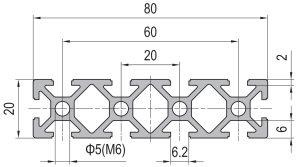
Once you have compared aluminum with steel on stiffness per kilogram, the next step is picking a section with a published moment of inertia. These entries carry their own Ix, weight per metre and tolerance.
Send us the load case and we will size the section
Tell us the span, the load and the deflection limit. We extrude and machine aluminium profiles in-house and will come back with the section, the joint detail and the tolerance we can hold.
Related reading
Twelve more engineering notes from this blog, picked for this article — plus every category below.
 Engineering Design4080 vs 4545 Aluminium Profile: Which for Your Frame
 Engineering Design3030 vs 4040 Aluminium Profile: A Decision With Numbers
 Materials and EngineeringAluminum Extrusion Tolerances: How to Write a Specification Your QC Team Can Actually Inspect
 Engineering Design6061-T5 vs 6063-T5: What the Temper Label Really Decides
 Engineering Design4040 vs 4080 Aluminium Profile: Which for Your Frame
- Engineering DesignAluminium Extrusion Tolerances: What to Write, and How to Inspect
 Engineering Design6063 vs 6061 vs 6082 and T5 vs T6: What Changes in Practice
 Materials and EngineeringRecycled Aluminium Profiles: A Number You Have to Be Able to Evidence
 Sourcing and ProcurementAluminium Profile Quote: What Changes the Number by Quantity
 Sourcing and ProcurementAuditing an Aluminium Profile Supplier: Factory, Trader, or Something in Between
 Quality and InspectionGood vs Bad Aluminium Profiles: What Your Receiving Dock Can and Cannot Check
 Quality and InspectionAluminium Extrusion Claims: What the Contract Must Say
