4040 vs 4080 Aluminium Profile
Choose 4040 when the frame is light and short; move to 4080 the moment span or load starts to govern. The switch is driven by deflection, not strength — 4040 runs 1.05–2.35 kg/m, 4080 runs 1.30–3.60 kg/m.
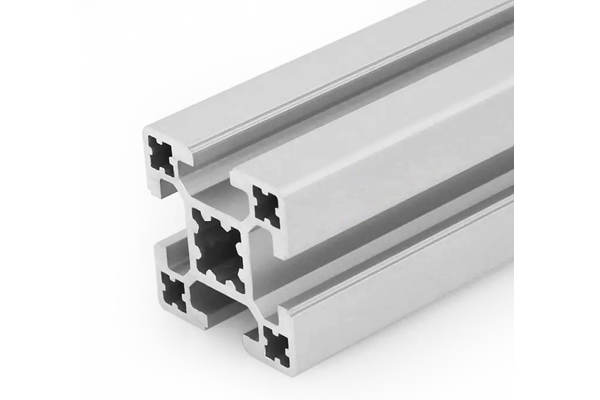
Short answer
Keep 4040 for uprights, guards, short beams and any member that needs equal stiffness and fasteners on four faces. Step to 4080 for long workbench rails, conveyor side members, gantry beams and machine-base laterals — with the 80 mm depth into the principal bending direction. Mid-wall Ix is ~9–11 cm⁴ on 4040 versus ~18 cm⁴ weak / ~65 cm⁴ strong on 4080. Metre prices nearly overlap in 2026 ($2.10–$3.45 vs $2.20–$3.60), so the decision is geometry, not a bargain hunt. Slot class often stays 10.2 mm groove / 8 mm mouth / M8 in the same 40-series family. Hybrid frames are normal: 4080 on long load paths, 4040 elsewhere. See max-span.
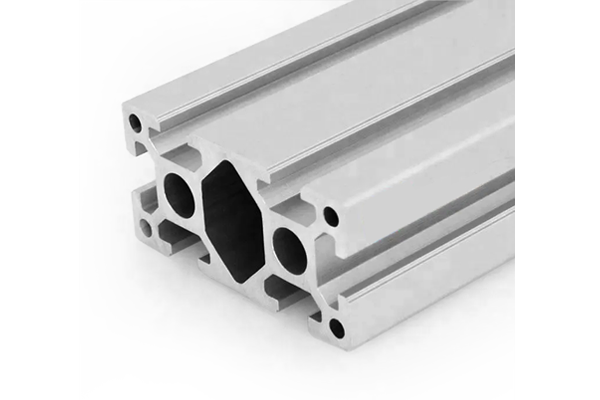
The numbers side by side
4080 is not “twice 4040” in every direction — only the strong axis delivers the big I jump, and only if you orient it correctly.
| Criterion | 4040 | 4080 | Verdict |
|---|---|---|---|
| Envelope | 40 × 40 mm square | 40 × 80 mm rectangle | 4040 isotropic; 4080 directional |
| Weight | 1.05–2.35 kg/m | 1.30–3.60 kg/m | Mass rises; strong-axis I rises much more |
| Slot | Varies — often 10.2 mm groove, 8 mm mouth, M8 | Varies — 10.2 mm groove, 8 mm mouth, 40 mm pitch, M8 both faces class | Often same 40-series hardware family |
| Ix (typical mid-wall) | ≈ 9–11 cm⁴ | ≈ 18 weak / ≈ 65 strong cm⁴ | Orient 80 mm into bending |
| Max span @100 kg (L/500 mid) | ≈ 0.8 m | ≈ 1.1 m weak / ≈ 2.0 m strong | 4080 strong for long rails |
| Price band (2026) | $2.10 – $3.45 / m | $2.20 – $3.60 / m | Nearly overlapping — pick by I |
| MOQ | Made to order; small trial lengths available | 150 m, or one cut list for a single machine | Plan 4080 around a cut list or 150 m |
When 4040 is enough
4040 is enough for uprights, short perimeter rails, guards, doors and multi-face joints where a square envelope is simpler to detail.
Pass cases: workbench legs; enclosure frames; light machine bases with bays near 1 m; cross-braces; panel stiles. If a tall frame sways, check bracing and feet before replacing every upright with 4080 — racking is often a joint problem, not an I problem on the verticals.
When you must move to 4080
Move to 4080 when unsupported horizontal span grows past about 1.2–1.5 m under useful load, or when a guide/actuator needs a deep mounting face.
Triggers: long workbench front/rear rails; conveyor side members; gantry X-beams; openings that cannot take a mid-post; dynamic loads that leave 4040 ringing. Put the 80 mm leg into bending. Laid flat, 4080 is only a modest step over 4040 and wastes the section. Need equal stiffness both ways at long span? Twin rails or a deeper square/rectangle — not a flat 4080.
The cost of choosing wrong
Metre prices almost overlap, so wrong orientation or blanket 4080 hurts more than the USD/m line.
Mid-band ~1.55 vs ~2.5 kg/m: a 60 m frame might add ~55 kg if every member becomes 4080. Freight and handling rise; moving gantries pay inertia forever. The under-size error — 4040 on a 2 m loaded rail — forces mid-posts, sister rails or a re-cut 4080 list. MOQ differs: 4040 trial lengths are easy; 4080 often wants 150 m or one machine cut list. Hybrid: 4080 on long load paths, 4040 on uprights and guards. Price maths: per metre.
RFQ checklist — 4040 vs 4080
- Orientation — which face is vertical on every 4080 length.
- Span and load — L/500 or mm limit.
- Wall / kg/m — inside brief bands.
- MOQ path — trial 4040 vs 150 m / cut-list 4080.
- Slot — confirm M8 family match.
Mark strong-axis arrows on the drawing. Orientation errors are free to write and expensive to fix.
Four ways this pair goes wrong
Related on this site
- What is a 4040 aluminium profile — 4040 on its own
- What is a 4080 aluminium profile — 4080 on its own
- Maximum span and load — strong vs weak axis
- Price per metre — overlapping USD bands explained
Terms used in this article
- Strong axis
- Bending axis where 4080’s 80 mm depth gives Ix ~65 cm⁴ class.
- Weak axis
- Bending about the shallow 40 mm direction (~18 cm⁴ class).
- Hybrid frame
- 4080 on long load paths with 4040 uprights and secondary members.
Questions buyers ask
Is 4040 strong enough for a workbench?
Yes for most industrial benches when bays stay near 1.0–1.2 m and the top is not a precision granite substitute. Move to 4080 (80 mm into bending) for long front rails, heavy plates or when L/500 fails on mid-wall 4040.
Is 4040 strong enough for a conveyor frame?
4040 works on moderate pitches. Long accumulation zones and metre-plus side rails usually want 4080 on the strong axis, with 4040 kept for uprights and short cross-members.
Is 4040 strong enough for a cleanroom equipment frame?
Often yes for metre-class skeletons with good bracing. Upsize long unsupported headers to 4080 if panels, HEPA housings or sliding doors add mid-span load. Pair with sealed anodising.
Is 4040 strong enough for a CNC router gantry?
Borderline as a sole gantry on production machines. Short desktop spans may pass; longer X/Y beams usually need 4080 strong-axis or twin 4040 with proper joining — verify I against acceleration loads.
Is 4040 strong enough for a test rig?
Yes for many static rigs at ~1 m. Long reaction beams and high point loads push you to 4080 oriented correctly, or to a mid support, so frame compliance stays below the measurement budget.
Is 4040 strong enough for a pick-and-place frame?
Static carcasses often stay on 4040. Moving gantries and long axis rails benefit from 4080 so residual vibration settles faster between cycles.
Is 4040 strong enough for a display stand?
Yes for nearly all display and exhibition stands. 4080 is overkill unless you have a long freestanding header or hanging mass mid-span.
Is 4040 strong enough for a greenhouse frame?
Small to medium bays can use 4040. Long purlins and wind/snow runs usually need 4080 (or deeper) on the strong axis; check local load codes and orientation.
Send span and orientation for 4040 vs 4080
Give bay length, load, deflection limit and which face must stay vertical. We return a section and MOQ path against EN 755-9.
Request a quoteRelated reading
Twelve more engineering notes from this blog, picked for this article — plus every category below.
 Engineering DesignHow to Choose the Right T-Slot Aluminium Profile Size
 Engineering DesignCross-Brand T-Slot Compatibility: Interchangeability Is a Hardware Question
 Engineering DesignHow to Choose an Aluminium Extrusion Profile: The Three Decisions That Bind
 Engineering DesignWhat EN 755-9 Allows: Aluminium Extrusion Tolerances
 ApplicationsAluminium Profiles in Solar Mounting: Wind Uplift, Corrosion and a 25-Year Life
 Engineering DesignMetric vs Imperial T-Slot Profiles: How to Test Compatibility Before You Order
 ApplicationsAluminium Profile Applications
 Engineering DesignAluminium Extrusion Die Cost (2026): Price by Section Size
 Sourcing and ProcurementDistributor Terms: Territory, Margin and Price Protection
 Quality and InspectionAluminium Profile Finishes: Choose by Failure Mode, Not by Process Name
 Quality and InspectionAluminium Extrusion Certificates and Standards Explained (EN 755, EN 12020, ISPM 15)
 Sourcing and ProcurementAuditing an Aluminium Profile Supplier: Factory, Trader, or Something in Between
