What Is a 4040 Aluminium Profile?
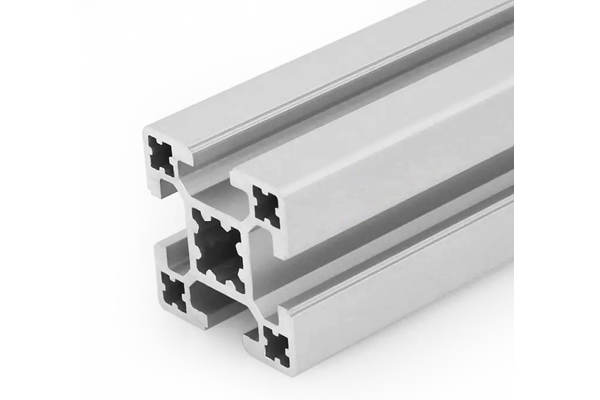
A 4040 aluminium profile is a 40 × 40 mm T-slot section. In the grownparts range it runs 1.05–2.35 kg/m depending on wall thickness, with slot variants across the range (table below).
Short answer
4040 is the 40 × 40 mm square envelope — the industrial default in many 40-series frames. Grownparts mass sits at 1.05–2.35 kg/m by wall class. Slot variants use a 10.2 mm groove with an 8 mm mouth (including one-face-only layouts); hardware is typically M6 on 40 × 40 and M8 on related beams, on a 40 mm pitch. Tolerances: EN 755-9 / GB/T 6892, wall ±0.15 mm; 6 m stock cut to drawing to ±0.5 mm. Made to order; small trial lengths from stock offcuts. Lead time: 18–28 days after deposit for mill finish. Reference price (2026): $2.10–$3.45 per metre. Context: weight per metre, T-slot dimensions.
What the numbers mean
“4040” is geometry only: 40 mm by 40 mm. It is not an alloy designation and it does not freeze the slot to one universal cavity.
On this site, 4040 variants centre on a 10.2 mm groove and 8 mm mouth at 40 mm pitch. Some dies open one face only with three solid faces; others slot all faces. Fastener callouts run M6 on 40 × 40 and M8 on related beams. Another supplier’s “4040” may use an 8 mm European mouth or a different core hole — interchange is a hardware measurement, not a name match. Read slot dimensions before substituting brands.
Specification table (by wall thickness)
Fifteen in-range 4040 products collapse into three wall classes for quoting.
| Variant | Weight (kg/m) | Slot | Wall | Ix (cm⁰) | Typical use |
|---|---|---|---|---|---|
| Light wall | 1.05–1.40 | 10.2 mm groove, 8 mm mouth; M6/M8 | Light | per die drawing | Guards, light frames |
| Standard wall | 1.40–1.90 | 10.2 mm groove, 8 mm mouth; 40 mm pitch | Standard | per die drawing | Machine frames, benches |
| Heavy wall | 1.90–2.35 | 10.2 mm groove; one-face or multi-slot | Heavy | per die drawing | Stiffer uprights, panel bays |
Family mass: 1.05–2.35 kg/m. Mid-wall site reference near 1.55 kg/m pairs with Ix on the order of ~10 cm⁰ — always take Ix from the die drawing and the chart.
What it is typically used for
4040 is the square workhorse for industrial modular frames.
Name the jobs explicitly: machine frames, guards, workbenches, conveyors, light gantries, and panel structures. It is also the usual upright and table member beside a deeper 4080 gantry rail. Catalogue: 40 series aluminium profiles.
Where the limits are
4040 covers many 1 m industrial bays; long, heavily loaded members still want depth or a twin rail.
When spans stretch toward 1.5–2 m under useful load, or when a CNC/plasma gantry beam must stay flat, prefer 4080 on the strong axis, twin 4040, or a mid-post rather than hoping a light 4040 will behave like a beam. Check numbers on max span and load. Weak-axis orientation of any rectangular neighbour is a separate failure mode — 4040 itself is square, so Ix is the same about both axes for a symmetric die.
Supply facts: 6 m stock, cut to drawing ±0.5 mm; wall ±0.15 mm; made to order with small trial offcuts; 18–28 days after deposit for mill finish; reference price $2.10–$3.45 (2026).
RFQ checklist — 4040
- Wall class — inside 1.05–2.35 kg/m.
- Slot layout — 10.2 mm groove / 8 mm mouth; faces open vs solid.
- Hardware — M6 on 40×40, M8 on beams as applicable.
- Cut list — ±0.5 mm.
- Lead — 18–28 days mill after deposit.
Send wall class, slot faces and cut list for the matching 4040 die quote.
Related on this site
- Aluminium profile weight per metre — how this section compares across the range
- T-slot dimensions — what the slot number means
- Maximum span and load — the load limit in numbers
- 40 series aluminium profiles — products in this series
Terms used in this article
- 4040
- Nominal 40 × 40 mm T-slot envelope in the 40-series module.
- kg/m
- Mass per metre; here 1.05–2.35 by wall class.
- 10.2 mm groove
- Groove width on grownparts 4040 variants; mouth typically 8 mm.
- EN 755-9
- Tolerance base with wall ±0.15 mm on this section.
- Ix
- Second moment of area from the die drawing for deflection design.
Questions buyers ask
Should I use 4040 or a deeper section for a workbench?
4040 is the default industrial workbench rail for many 1 m bays. Step to 4080 on the strong axis, or twin 4040, when the top is heavy or spans push past about 1.2–1.5 m under load.
Should I use 4040 or a deeper section for a machine frame?
4040 is the usual primary square for compact machine frames. Use 4080 or twin rails when horizontals are long, payloads are high, or deflection limits are tight (L/500).
Should I use 4040 or a deeper section for a robot cell fence?
4040 posts and rails cover most cell fences with doors and cable trays. Deeper sections help only when bays are unusually wide or the fence carries heavy panels and services.
Should I use 4040 or a deeper section for a conveyor frame?
4040 is a solid main-rail choice for many light-to-mid conveyors. Long unsupported bays or heavy rollers often need 4080 oriented for stiffness — see max span.
Should I use 4040 or a deeper section for a cleanroom equipment frame?
Yes for cleanroom benches, cabinets and equipment frames that need M6/M8 hardware and reconfigurable slots. Jump deeper only for tall, heavily loaded walls.
Should I use 4040 or a deeper section for a machine guard?
4040 is widely used for perimeter guards and panel structures. Local light windows can drop to 3030; the primary guard frame usually stays on 4040.
Should I use 4040 or a deeper section for a CNC router gantry?
Prefer a rectangular 4080 (80 mm in the bending plane) for the gantry beam. 4040 remains correct for uprights, tables and light axis covers on the same machine.
Should I use 4040 or a deeper section for a test rig?
4040 is a strong default for production test rigs and durable lab frames. Use 4080 when long actuator rails must stay flat without mid-posts.
Open the 40 series range or send a 4040 cut list
Select the wall and slot layout in the 40 series category, or send lengths for a quote against 1.05–2.35 kg/m.
Request a quoteRelated reading
Twelve more engineering notes from this blog, picked for this article — plus every category below.
 Engineering DesignHeavy-Duty T-Slot Hinges and Sliding Door Buffers: Sizing Them with Numbers
 ApplicationsAluminium Profile Shelving: It Buckles and Tips Before It Bends
 Materials and Engineering6063-T5 Aluminium Profile: What the Designation Actually Guarantees
 ApplicationsAluminium Profile for LED Strips: A Heat Sink First, a Housing Second
 Engineering DesignAluminium Extrusion Capacity: What a Factory Can Actually Deliver
 ApplicationsAluminium Partitions: The Three Performance Numbers Behind the Aesthetic
 Engineering DesignAluminium Profile Anchor Pins: A Preloaded Joint, Not a Pin
 Engineering DesignPrecision Cutting and Tapping of Aluminium Profiles: The Tolerance That Actually Matters
 Sourcing and ProcurementPayment Terms for Aluminium Profile Orders (T/T, L/C and the Risk)
 Quality and InspectionAnodising vs Powder Coating: Thickness, Colour, Salt Spray
 Quality and InspectionHow to Choose (and Audit) an Aluminium Extrusion Supplier
 Sourcing and ProcurementDistributor Terms: Territory, Margin and Price Protection
