Payment Terms for Aluminium Profile Orders (T/T, L/C and the Risk)
On a first export order the buyer carries deposit risk until goods are produced and released; the supplier carries production and inventory risk until the balance clears. Three practical paths close that gap: T/T 30% deposit and 70% before shipment, L/C at sight, or a staged release after third-party inspection — always paired with a named Incoterm (FOB / CIF / DAP / DDP).
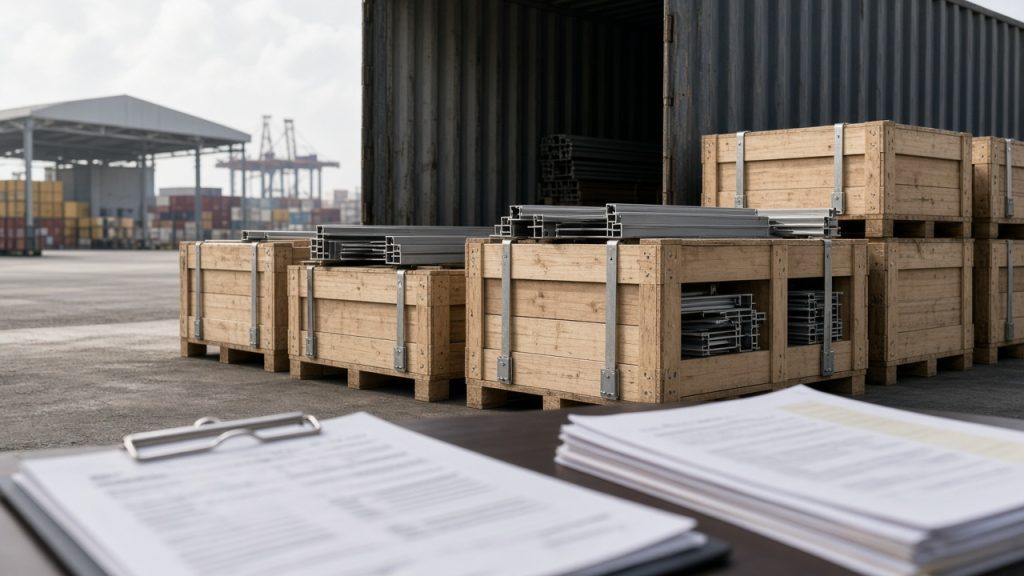
Short answer
For GrownParts export orders the default is T/T 30% deposit to start production and 70% balance before shipment, or an irrevocable L/C at sight. Trade terms are FOB, CIF, DAP or DDP from Shanghai or Ningbo. Quality is called to EN 755-9 for extrusion, EN ISO 7599 for anodising where specified, and GB/T 6892 for alloy. A “first order of 100 m” sits below the 150 m existing-die MOQ, so the commercial path is either raise to MOQ, pay a small-lot premium, or run a paid sample / pilot cut before the production deposit.
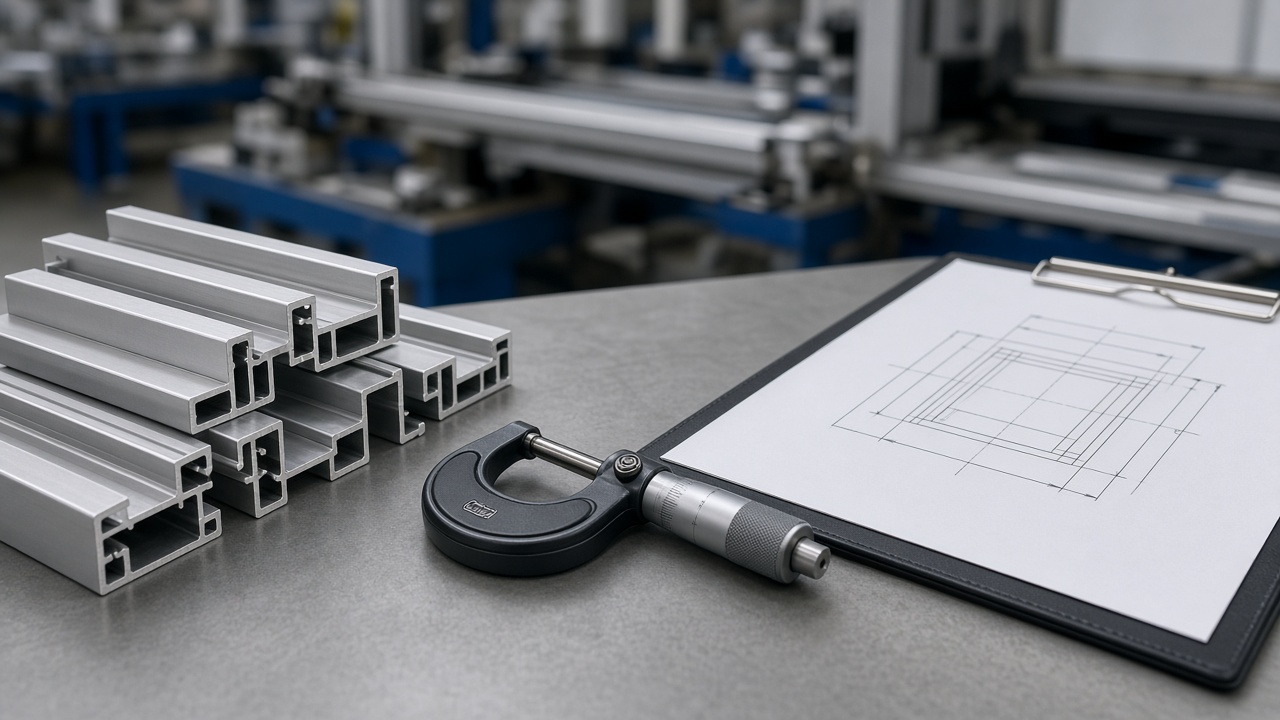
What is the payment term for a first order of 100 m
A first order at 100 m uses the same T/T 30/70 or L/C at sight structure as larger lots; the open issue is MOQ and how risk is staged, not a different payment alphabet.
MOQ is 150 m off an existing die and 500 m with a new die. At 100 m you are under the existing-die floor, so the workable answers are: (1) raise the line to 150 m and pay T/T 30% to start; (2) keep 100 m as a paid pilot / sample-rate cut with courier or small air freight; (3) combine 100 m with other sections to fill a production slot. L/C at sight is available but often uneconomic under a few thousand USD of order value because bank fees are fixed.
| Scenario | Metres | Die | Payment path | Risk note |
|---|---|---|---|---|
| First trial cut | ~100 m or less | Existing | 100% T/T before cut / sample rate | Below MOQ; treat as paid sample or pilot |
| First production lot | 150 m | Existing | T/T 30% + 70% before shipment | Standard MOQ floor |
| New custom section | 500 m | New | T/T 30/70; die fee often with deposit | Die ownership stated in contract |
| Container programme | 2 000–10 000 m | Existing / mixed | T/T 30/70 or L/C at sight | L/C fees make more sense at volume |
| Repeat call-off | Per schedule | Existing | T/T 30/70; net terms by agreement | After track record only |
| Inspection hold | Any | Any | 70% after third-party pass, before B/L release | Buyer names inspector; adds days |
The six common variants (“what is the payment term for a first order of X metres”) differ only in quantity. The answer structure is identical: name T/T 30/70 or L/C at sight, check MOQ, and decide whether inspection or sample staging is required before the balance.
Where the risk actually sits
Deposit risk sits with the buyer; production and finished-goods risk sits with the supplier until the balance is paid and documents release.
Under T/T 30/70 the buyer’s 30% funds billet and press time. If the supplier fails to produce, that deposit is the exposure — which is why company registration, a factory audit and a clear quality clause matter before the wire. The supplier’s exposure is the remaining 70% of cost tied up in finished profiles until the balance clears; that is why balance is due before shipment rather than after arrival on a first order.
Incoterms move a different risk: FOB Shanghai/Ningbo passes ocean risk at the ship’s rail; CIF adds freight and insurance to the destination port but not import duty; DAP and DDP push delivery further inland, with DDP including import clearance. Payment terms and Incoterms are orthogonal — paying by L/C does not make a FOB shipment into DDP. Die risk is separate again: who pays for the die and who owns it must be written down, especially on a 500 m new-die first order.
What the contract should say
The contract should name payment triggers, Incoterm, quality standards, die ownership and the claim window — five lines that prevent most disputes.
State: T/T 30% deposit within N days of PI; 70% before shipment against packing list / draft B/L; or irrevocable L/C at sight advising a named bank. Name FOB or CIF or DAP or DDP and the port. Call EN 755-9 for extruded tolerances, EN ISO 7599 for anodising where relevant, and GB/T 6892 for alloy. Say who owns the extrusion die after the fee is paid, and whether the die stays at the press for exclusive use. Set a claim window (commonly 7–14 days after arrival for visible packing damage; longer for dimensional claims backed by inspection data).
Attach the drawing revision, finish specification and kg/m used for invoicing. If third-party inspection is required, name the agency and that the 70% balance waits on a pass report. Ambiguity on any of those five points is what turns a late container into a legal argument.
How to handle a dispute
Handle disputes with measured evidence against the contract standards, not with withheld balances on unrelated lines.
Photograph packing and seals at unpacking; measure against EN 755-9 and the drawing; keep the mill certificate and packing list. Notify inside the claim window with section, lot, defect rate and proposed remedy (rework, replacement, or credit). Withholding the next order’s deposit without a written finding usually freezes both sides. For transit damage under CIF, open the insurer claim with the survey report; under FOB the ocean risk was already the buyer’s.
Tooling disputes are different: if the die fee was paid and the contract says the buyer owns the die, ask for the die card and storage confirmation rather than a refund of profile goods. Factory audits before a large programme remain the cheapest risk control — visits or third-party social/quality audits are available on request and should be booked before the first large deposit, not after a failure.
RFQ checklist — payment and risk
- Order size — metres vs MOQ 150 m / 500 m.
- Payment — T/T 30/70 or L/C at sight.
- Incoterm + port — FOB / CIF / DAP / DDP; Shanghai or Ningbo.
- Quality callouts — EN 755-9, EN ISO 7599, GB/T 6892 as applicable.
- Die ownership — who pays, who owns, where it is stored.
- Inspection — whether balance waits on third-party pass.
- Claim window — days after arrival for visible and dimensional claims.
Send the PI terms you need on payment, Incoterm and die ownership with the drawing. We mirror them on the order confirmation before any deposit is taken.
Four payment traps on first orders
Related on this site
- how die cost amortises per meter — what the deposit is actually funding
- minimum order with a new die — 150 m vs 500 m before payment staging
- die making adds 7–12 days — when the deposit clock starts
- who owns the die — tooling cash vs title
Terms used in this article
- T/T 30/70
- Telegraphic transfer: 30% deposit to start; 70% balance before shipment.
- L/C at sight
- Irrevocable letter of credit payable when compliant documents are presented.
- FOB / CIF / DAP / DDP
- Incoterms that allocate freight, insurance and import clearance between buyer and seller.
- Claim window
- Contractual period after arrival during which visible or dimensional defects can be notified.
- Die ownership
- Title to the extrusion tooling after the die fee is paid; independent of profile payment terms.
Questions buyers ask
What if the goods arrive out of tolerance?
Notify inside the claim window with photos, measurements against EN 755-9 / the drawing, and the lot identity. Typical remedies are sorted replacement, rework credit, or partial refund for the defective metres. Keep the mill certificate and packing list; do not scrap the lot until the claim path is agreed if you want replacement material.
Who owns the tooling?
Whoever the contract names. If you pay a new-die fee, the agreement should state that you own the die and that it is stored for your exclusive use at the press. Profile payment terms (T/T or L/C) do not by themselves transfer die title — write ownership as its own clause.
What is the claim window?
Set it in the contract. A common pattern is 7–14 days after arrival for visible packing and surface damage, and a longer window for dimensional claims backed by inspection data. Late notice without evidence is why many claims fail; photograph seals at open-box.
Can I audit the factory?
Yes. Schedule a visit or a third-party quality/social audit before a large first deposit. Audits do not replace T/T 30/70 or L/C; they reduce the chance you need them as dispute tools. For repeat programmes, net terms are discussed only after a delivery track record.
Send the PI terms you need before deposit
Tell us metres, Incoterm, T/T or L/C, die ownership and claim window with the drawing. We put them on the order confirmation before any funds move.
Request a quoteRelated reading
Twelve more engineering notes from this blog, picked for this article — plus every category below.
 Sourcing and ProcurementAluminium Profile Quote: What Changes the Number by Quantity
 Engineering DesignModular Aluminium Components: Where the System Saves Money and Where It Costs You
 Engineering DesignAluminium Extrusion Lead Time: New Die vs Existing Die
 Engineering DesignT-Slot Cross-Brand Compatibility: Bosch, Item and Generic
 Sourcing and ProcurementAluminium Extrusion Price per kg in 2026 (China FOB)
 Engineering DesignStandard vs Custom Aluminium Extrusion: The Break-Even Calculation
 Materials and EngineeringRecycled Aluminium Profiles: A Number You Have to Be Able to Evidence
- Quality and InspectionGlobal Sourcing Excellence: Multi-Category OEM and ODM Manufacturing and Supply Chain Integration
 Engineering DesignMoment of Inertia and Section Modulus of T-Slot Profiles
- Engineering Design6061-T5 vs 6063-T5: What the Temper Label Really Decides
 Engineering DesignHow to Choose the Right T-Slot Aluminium Profile Size
 Engineering DesignAluminum Corner Brackets for T-Slot Frames: How to Choose by Load Path, Not by Looks
