Cross-Brand T-Slot Compatibility
Slot width is standardised; slot depth, pitch and fastener geometry are not. A 40-series profile from one brand will not always take another brand’s nut. Decide by load and span first, then lock one slot family so hardware stays interchangeable.
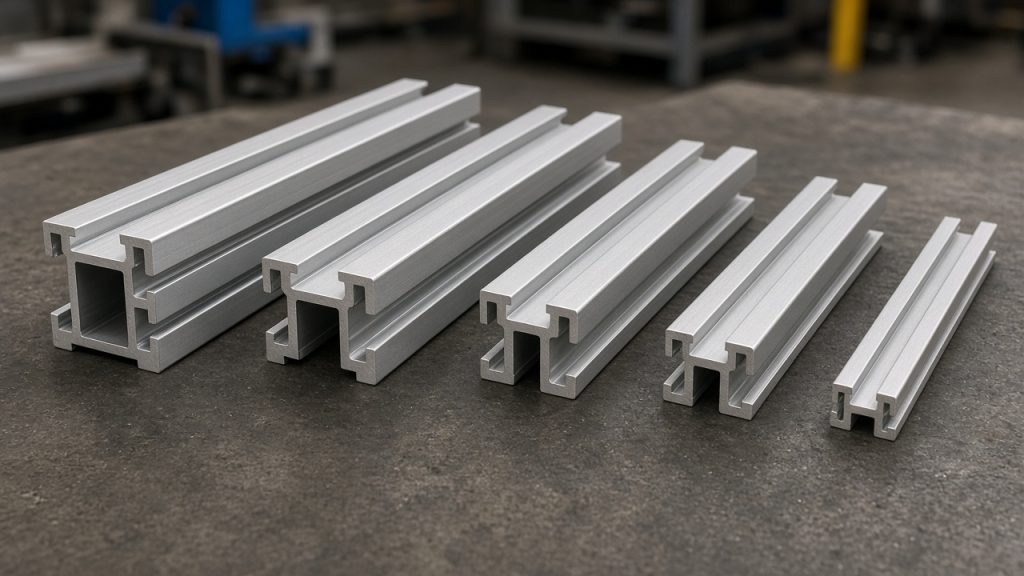
Short answer
Treat cross-brand use as a hardware match, not an outline match. Compare slot mouth width, groove depth, slot pitch and the nut/anchor geometry before you call two 2020 or two 4040 bars interchangeable. Bosch Rexroth lines often centre on 8 mm or 10 mm system grooves depending on series; Item lines use their own groove families; many generic Asian 20/30/40 catalogues target ~6 / ~8 / ~8–10 mm mouths that fit commodity T-nuts but not every branded internal anchor. What usually interchanges: simple external T-nuts and L-brackets when mouth and pitch match within tolerance. What usually does not: brand-specific internal anchors, end connectors cut for one core-hole diameter, and end caps keyed to one outer contour. Extrusion tolerances follow EN 755-9 (wall ±0.15 mm, straightness 1.5 mm/m, twist 2°); fabricated cut length ±0.5 mm, hole position ±0.2 mm, end square within 0.3 mm. 2020 is for short light members — not a 2 m primary bench rail.
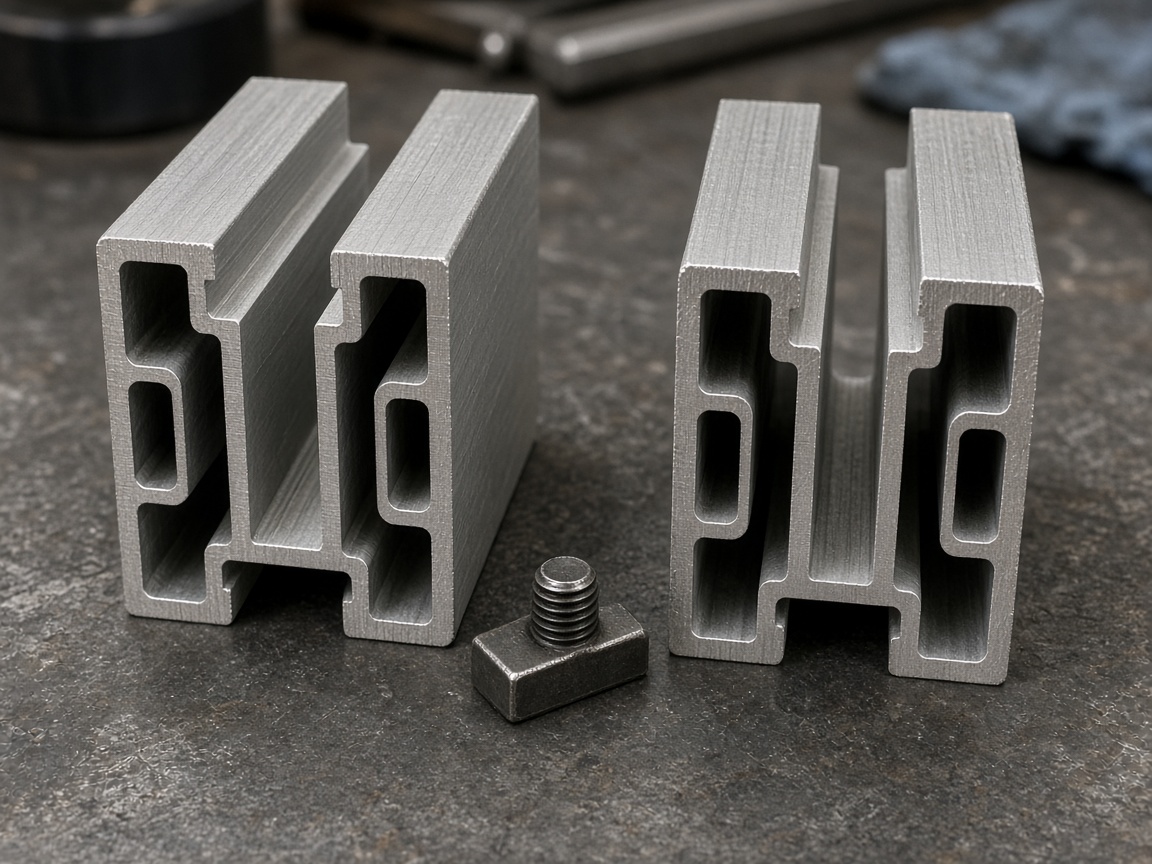
Is 2020 compatible with bosch rexroth profiles
Generic 2020 is not automatically compatible with Bosch Rexroth profiles — only a bar whose slot mouth, depth, pitch and core match the Rexroth series you stock will take Rexroth fasteners reliably.
Bosch Rexroth framing is organised by system groove (commonly 8 or 10 on industrial lines, with smaller grooves on compact series). A commodity 20×20 with a ~6 mm mouth may accept some light M5 T-nuts and still refuse Rexroth brackets, anchors and end connectors sized for a different undercut or core. Outer 20 mm means nothing by itself. If the installed plant standard is Rexroth, either buy Rexroth-compatible geometry or replace hardware with the generic nut family that actually fits the bar you import.
| Check | Compatible if | Not compatible if |
|---|---|---|
| Slot mouth | Matches Rexroth nut for that series | Nut will not enter or rattles |
| Groove depth / undercut | Nut seats and locks | Partial seat / pull-through |
| Pitch / hole centres | Bracket holes land on slots | Misaligned brackets |
| Core hole | Anchor diameter matches | Anchor spins or will not start |
| End cap contour | Cap seats on outer shape | Gaps / no retention |
| Load rating | Maker data covers joint | Fit-only trial on a loaded rail |
What is the replacement for bosch rexroth 2020
Replace a Bosch Rexroth compact ~20 mm rail with a profile that documents the same groove series and accepts the existing Rexroth fasteners — or redesign the joint to a declared generic 20-series slot and new nuts.
There is no universal “Rexroth 2020 clone” part number across Asian catalogues. Ask for a dimensioned slot section (mouth, depth, lip, core) and a fit test with the actual T-nut and anchor from the machine you are maintaining. If fasteners must be reused, geometry is a hard constraint. If fasteners can change, a catalogue 2020 with ~6 mm mouth and M5 hardware is the usual light-duty substitute for jigs and short guards — not for primary 2 m spans.
| Replacement path | When to use | Hardware fate | Risk |
|---|---|---|---|
| Same groove, documented compatible | MRO on running cells | Reuse Rexroth nuts | Lowest if verified |
| Generic 2020 + new nuts | New light fixtures | Replace fasteners | Low if loads stay light |
| Step up to 3030/4040 | Span or load grew | New series BOM | Wrong if you only needed 20 |
| Outline-only “same size” | Never | Unknown | High — joint fails |
| CAD model only | Never as proof | — | Tolerance missing |
| Sample fit test | Always before PO | Confirms path | Mandatory gate |
Is there a cheap equivalent to item 2020 profile
Yes — commodity 20-series bars can substitute on price for light Item 20-class rails when you switch to matching generic fasteners; they are not a drop-in for Item-specific anchors if you keep the Item hardware set.
Item system pricing reflects the kit (connectors, documentation, certified loads). A generic 2020 at a lower 2026 FOB USD/m is rational for high-volume light guards and jigs after you freeze one nut/bracket family. It is a false economy on a line that already owns Item internal connectors and end fasteners: failed fit costs more than the profile delta. Compare mouth, depth, pitch and core on a drawing, then price the full BOM including fasteners.
| Option | Profile cost | Hardware | Use when |
|---|---|---|---|
| Item 20-class rail | Higher | Keep Item kit | Certified joints / existing stock |
| Generic 2020 + generic nuts | Lower FOB | New BOM | New light products |
| Generic + Item nuts forced | Low profile | High risk | Avoid |
| 30/40 series instead | Higher kg/m | New series | Span/load needs it |
| Mixed brands one frame | Mixed | Two inventories | Avoid on OEM SKUs |
| Sample + torque check | Small | Proof | Before volume PO |
Which generic profile matches 2020 from a european brand
Match a European 20-class rail by slot geometry and nut family first — usually a generic 20×20 with ~6 mm mouth for light series, or the brand’s stated groove number if it is groove 5/6 rather than a simple millimetre mouth.
European brands (Item, Bosch Rexroth, MayTec and others) publish groove series that are not a cross-maker standard. A buyer who only orders “2020” from a trading company gets an outline, not a system. Request: mouth width with tolerance, groove depth, lip thickness, core diameter/position, and a list of T-nuts that are declared compatible. Fabrication should hold cut length ±0.5 mm, hole position ±0.2 mm, end square within 0.3 mm so butt joints and brackets behave like the European kit you are leaving.
| European cue | Generic target | Interchanges | Does not |
|---|---|---|---|
| ~20 mm + small groove | 2020 ~6 mm mouth | Simple T-nuts / L-brackets | Brand anchors / keyed caps |
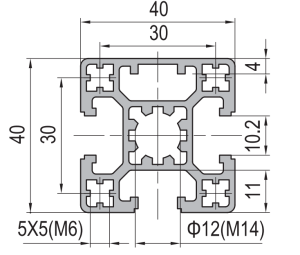
| Groove 8 on 40 outline | 40-series 8 mm class | 8 mm commodity nuts | 10 mm-only hardware |
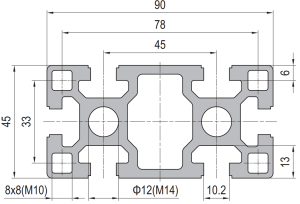
| Groove 10 industrial | 40/45 with 10 mm mouth | 10 mm T-nuts | 8.2 mm-only anchors |
| 8.2 mm + ~12 mm core | Declared compatible only | If core matches | “Almost 8 mm” bars |
| 45 mm grid hardware | 4545 / 4590 family | Same pitch accessories | 40-pitch brackets |
| Unknown brand marking | Measure sample | After fit test | Catalogue guess |
What profile replaces a discontinued 2020 section
Replace a discontinued 2020 by measuring the live sample’s slot and core, then selecting a current 20-series (or stepping up if load/span now exceed 2020 limits) that passes a fastener fit test.
Discontinued dies and private-label sections vanish from catalogues while machines still need spares. Do not order by the old marketing name alone. Calliper the mouth at several points, measure core diameter, note lip thickness, and list the T-nut part numbers still in the storeroom. If the frame now spans near 2 m under real load, the correct replacement is often 3030 or 4040, not another fragile 2020. EN 755-9 wall ±0.15 mm, straightness 1.5 mm/m and twist 2° remain the extrusion acceptance backdrop for the new bar.
| Step | Action | Output |
|---|---|---|
| 1. Measure | Mouth, depth, core, lip on scrap | Geometry sheet |
| 2. List hardware | Nuts, anchors, brackets in use | Reuse vs replace decision |
| 3. Shortlist | Current 2020 or step-up series | 2–3 candidates |
| 4. Fit test | Actual fasteners in sample bar | Pass/fail |
| 5. Check span/load | 2020 vs 3030/4040 need | Series choice |
| 6. Freeze BOM | One slot family for spares | PO + drawing |
Is 2020 compatible with 40 series accessories from other brands
No — 2020 slots and 40-series accessories are different families; a 40-series bracket or 10 mm T-nut will not correctly engage a 20-series ~6 mm slot.
Accessory catalogues are keyed to series: hole pitch, nut width, screw length and lip load all assume one slot. Forcing a 4040 corner bracket onto 2020 either misses the slot centres or overloads the light lip. Keep 20-series accessories on 2020, 40-series accessories on 4040/4080, and only share fasteners across brands when the slot geometry table matches. Mixing series on one OEM product creates two inventories and assembly errors.
| Brand / family (typical) | Slot mouth | Depth / notes | Pitch cue | Nut / fastener | Vs 2020 |
|---|---|---|---|---|---|
| Generic 2020 | ~6 mm | Light lip | 20 mm grid | M4/M5 T-nut | Baseline |
| Generic 3030 | ~8 mm | Deeper groove | 30 mm | M5/M6 | Not 2020 accessories |
| Generic 4040 | ~8 or 10 mm | Industrial | 40 mm | M6/M8 | Not compatible with 2020 |
| Bosch Rexroth (by series) | 8 or 10 mm class | System undercut | Series grid | Rexroth T-nuts/anchors | Only if geometry matches |
| Item (by groove) | Groove 5/6/8… | System-specific | Item grid | Item fasteners | Not by outline alone |
| MayTec-class 8.2 mm | ~8.2 mm | Core ~12 mm often | Brand pitch | System anchors | Fails on plain 8 mm |
| Misumi HFS-class 40 | ~10 mm common | Core/tap variants | 40/45 | Matching end-tap stack | Not 2020 hardware |
RFQ checklist — cross-brand compatibility
- Existing brand / series — Bosch, Item, MayTec, Misumi, generic; groove number if known.
- Slot sheet — mouth, depth, lip, core with tolerances.
- Hardware reuse — yes/no; list nut and anchor part numbers.
- Load and span — especially anything near 2 m (do not keep 2020 as primary).
- Acceptance — EN 755-9; cut ±0.5 mm, holes ±0.2 mm, square 0.3 mm.
- Priority — hard compatibility vs cost-driven redesign.
Ask one question first: must existing branded fasteners be reused? If yes, slot geometry is the constraint and the outer millimetres are almost irrelevant.
Four ways a “compatible” buy fails
Related on this site
- how die cost amortises per meter — cost of locking one compatible series
- minimum order with a new die — when a compatible custom slot needs tooling
- die making adds 7–12 days — calendar for a new compatible tool
- who owns the die — reuse rights on a replacement section
Terms used in this article
- Slot mouth
- The narrow opening at the face of the T-slot that sets whether a nut can enter.
- Groove / undercut
- The wider cavity behind the mouth that seats and retains the nut.
- Pitch
- Centre spacing of slots or mounting holes that brackets must hit.
- Core hole
- Central bore used by internal anchors and some end fasteners.
- Interchangeability
- Documented ability of two systems to share hardware within tolerance — not visual similarity.
- EN 755-9
- Extrusion tolerance framework cited here for wall, straightness and twist.
Questions buyers ask
What is the closest metric equivalent to an imperial profile
Map by slot mouth and series mass, not by converting inches to millimetres. A 1.5 in (about 38 mm) imperial rail is closer to 40-series metric hardware than to 3030 if the slot is 10 mm class; a 1 in rail often sits nearer 20/25-series. Always verify nut fit and core hole before calling it equivalent.
Can i mix brands of t-slot nuts in one frame
Only when every nut matches the same slot mouth, undercut and torque band. Mixing Bosch, Item and generic nuts on one rail invites loose clamps and stripped lips. Prefer one nut family per slot series; if you must mix, fit-test each SKU and keep load-critical joints on one brand.
Which profile for a 2 m span?
Do not use 2020 as a primary 2 m rail under bench or machine load. Prefer 4040/4545 or a rectangular 4080/4590 oriented on the strong axis, with deflection checked to your limit (for example L/500). 2020 suits short members roughly under 0.5–0.7 m.
Do I need a heavier wall?
Yes when joint pull-out, vibration or long spans push light lips past safe preload. Heavier wall or a deeper series raises both stiffness and the load the slot lip can take. EN 755-9 wall tolerance of ±0.15 mm still applies; do not confuse tolerance with intentional light vs heavy series choice.
Which slot size should I pick?
Pick the slot that matches the hardware you will stock for the plant: ~6 mm with 20-series, ~8 mm with 30-series, 8/10 mm with 40-series, ~10 mm with most 45 industrial lines. Slot width is only half the story — depth, pitch and nut geometry must match too.
Send the slot sheet and fasteners you must reuse
Give us brand/series, measured mouth and core, and whether existing nuts stay. We confirm a compatible catalogue section or a step-up series before you commit metres.
Request a compatibility checkRelated reading
Twelve more engineering notes from this blog, picked for this article — plus every category below.
 Engineering DesignWhat Is a 4080 Aluminium Profile? (Weight, Slot and Load)
 Engineering DesignWhat EN 755-9 Allows: Aluminium Extrusion Tolerances
 Materials and EngineeringAluminium Extrusion Section Design: What Each Feature on the Drawing Costs You
 Engineering DesignHow to Choose the Right Aluminium Profile Size for Industrial Frames
 Engineering DesignRobot Cell Framing in Aluminium: Stiffness, Damping and the 2025 Safety Revision
 Sourcing and ProcurementAluminium Profile MOQ: 150 m Existing Die, 500 m New
 Quality and InspectionT-Slot Aluminium Profiles for Industrial Frames and Automation: A Specification Playbook
 Sourcing and ProcurementAluminium Profile Shipping: Packing, Container Loading and ISPM 15
 ApplicationsCleanroom and Medical Framing: There Is No Medical-Grade Aluminium Extrusion
 ApplicationsAluminium Profiles Across Industries: What Actually Changes From One Sector to the Next
 Materials and Engineering6063-T5 Aluminium Profile: What the Designation Actually Guarantees
 Quality and InspectionEuropean Anodised Aluminium Specification: What Should a Purchase Order Contain?
