Aluminium Profiles Across Industries: What Actually Changes From One Sector to the Next
“Aluminium is light, corrosion resistant and recyclable” is true and almost useless for specification. What changes between industries is which requirement dominates, and that changes what you have to ask for, test, and pay for.
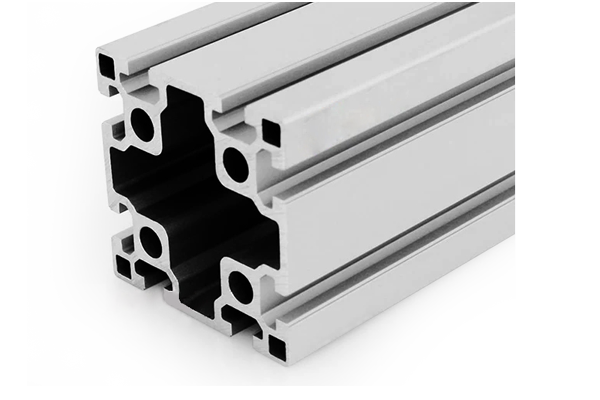
Short answer
The material is the same in every sector; the governing requirement is not. In transport it is mass and fatigue. In food and pharmaceutical plants it is washdown chemistry and cleanability. In electronics it is electrical continuity. Outdoors it is long-term exposure. In construction it is thermal bridging and fire. Once you know which one governs, the specification writes itself, because each constraint points at a specific alloy, temper, coating, joint detail and piece of evidence. Two facts about aluminium do most of the work here and both are usually left out: the oxide layer is attacked at both ends of the pH scale, so “does not rust” is not the same as “immune”; and aluminium has no fatigue limit, so repeated loading has to be designed against a finite life rather than an infinite one.
The industry list is the wrong shape
The standard version of this article lists industries: construction, transport, automation, electronics, furniture, energy, medical. It is accurate and it answers a question no buyer is actually asking. A buyer knows which industry they are in.
The useful question is different: in this sector, which requirement governs, and what does it force me to specify that another sector could ignore? A section that is entirely adequate for a warehouse cart can be rejected in a food plant for reasons that have nothing to do with strength, and a frame that passes a cleanroom audit can be unsuitable outdoors. The material did not change. The governing constraint did.
We have written separately about the split between industrial and construction acceptance logic. This is the wider map, and it exists because most specification mistakes are made by carrying an assumption across a sector boundary.
Fact one: aluminium is attacked at both ends of the pH scale
Aluminium protects itself with a thin natural oxide layer. That layer is stable over roughly neutral conditions and it is attacked at both extremes. Strong alkalis dissolve it, and strong acids dissolve it. This is why “aluminium does not rust” is a true statement that leads buyers to a false conclusion.
The practical consequence is that several sectors routinely expose aluminium to chemistry that is far from neutral, and the exposure is designed into the process rather than being an accident:
Food and dairy plants clean with alkaline detergents and caustic solutions, and they follow with acid rinses. That is a chemical attack on an untreated or thinly anodised surface, repeated daily, for years.
Construction puts aluminium against fresh concrete and mortar, which are strongly alkaline while they cure. Splash and run-off carry that alkalinity onto the surface, and the resulting staining and etching is often blamed on the coating rather than on the chemistry.
Industrial cleaning in general has moved towards stronger, more alkaline products, for reasons of hygiene and cost. A frame that survived a mild detergent for a decade may not survive the replacement.
The controls are to know the cleaning chemistry before choosing the finish, to specify a coating class rather than a process name, and to remember that cut ends and drilled holes have no coating at all and are the first places the attack shows. Where the chemistry is aggressive, a coating system intended for that exposure, or a different material altogether, is the honest answer.
Fact two: aluminium has no fatigue limit
Steel exhibits a stress below which it can be cycled indefinitely without cracking. Aluminium does not. There is no safe stress; there is only a life, and it gets shorter as the stress range rises.
This matters wherever the load repeats. Transport and vehicle structures, vibrating machinery, equipment on moving floors, anything exposed to wind gusting, and anything that is loaded and unloaded many times a day all fall into this group. In those applications the design question is not “is it strong enough” but “how many cycles, at what stress range, and what life do we need”.
Two practical consequences follow. First, the connection matters more than the section, because fatigue cracks almost always start at a geometric discontinuity such as a hole, a thread root or a sharp change of section. Second, a warranty or a design life stated without a cycle count is not a fatigue statement at all. Where repeated loading is significant, the honest specification asks for the load spectrum, not just the peak load.
The constraint map
The table below is the practical version of “applications across industries”. Read the middle column first: it is the requirement that will decide the specification, and it is the one that has to be stated in the enquiry.
| Sector | Dominant requirement | What it changes | Evidence worth asking for |
|---|---|---|---|
| Transport, aerospace | Mass and fatigue | Alloy and temper control; finite-life assessment; no sharp section changes | 3.1 mill certificate; temper verification; fatigue data for the joint |
| Food and beverage | Washdown chemistry | Coating class and sealing; sealed joints; no bare cut faces | Coating thickness report; chemical compatibility statement |
| Medical, cleanroom | Cleanability, particle shedding | Closed sections; sealed joints; smooth finish | Surface finish specification; cleaning agent compatibility |
| Electronics, ESD | Electrical continuity | Deliberate bonding; conductive path across joints | Bonding method and continuity test result |
| Energy, outdoor | Long-term exposure | Thicker coating class; galvanic control; expansion provision | Coating class; salt spray as a comparative result |
| Automation | Reconfigurability | Slot geometry and tolerance; accessory range | Interface tolerance; accessory availability |
| Construction | Thermal bridging, fire, certification | Thermal break; tested assemblies; declared tolerances | System test evidence; declared thermal values |
| Marine and coastal | Chloride attack | Coating class; isolation of dissimilar metals | Coating class; isolation detail on the drawing |
Where the usual answer is simply wrong
Three sectors deserve calling out, because the standard answer fails there in a way that is expensive to discover late.
Food and pharmaceutical plants. The standard advice is that aluminium is hygienic because it does not rust. The actual constraint is that the cleaning regime is chemically aggressive, and that hygiene requirements favour smooth, sealed, easily cleaned surfaces with no crevices. Those requirements can conflict with a slotted section, where the slot is a crevice by design. In these environments the right answer may be a closed profile, or aluminium excluded from the washdown zone altogether.
Construction. The standard advice is that aluminium is light and does not corrode. The actual constraints are thermal bridging and fire. Aluminium conducts heat roughly four times better than steel, so an aluminium frame is a thermal bridge unless it is broken, and it loses strength progressively at temperatures well below melting, so fire performance is a property of a tested assembly rather than of the section. Both constraints are outside the scope of a profile supplier and both have to be owned by the system designer.
Anything outdoors. The standard advice is that aluminium is maintenance free. The actual constraint is that the coating is thin and can be worn or chemically attacked, that chlorides are aggressive, and that dissimilar fasteners create a galvanic couple in rainwater. “Low maintenance” is defensible; “no maintenance” is not.
How to state this in a specification
Once the dominant constraint is identified, the specification becomes short and specific. Three lines do most of the work: the dominant requirement, the acceptance evidence, and the assumptions that were made.
The acceptance evidence line is the one buyers forget. A requirement without a test is a preference. If cleanability matters, the specification should name the cleaning agent and the surface requirement. If continuity matters, it should name the bonding method and how continuity is verified. If long-term exposure matters, it should name the coating class and the thickness test. That is what turns a wish list into something a supplier can be held to, and it is also what makes a quotation comparable between suppliers.
What to send with an enquiry
RFQ checklist — cross-industry profiles
- Sector and the dominant constraint — one line naming what governs: load, fatigue, chemistry, cleanliness, continuity or exposure.
- Environment — indoor, outdoor, coastal, washdown, cleanroom; and the temperature range.
- Cleaning or process chemistry — the agents and their concentration, if the surface will meet them.
- Load spectrum — peak load and, where it repeats, how often.
- Electrical requirement — whether continuity or bonding is needed across joints.
- Finish class — thickness in micrometres and sealing, plus how cut ends are protected.
- Acceptance evidence — the certificate or test that has to accompany the delivery.
- Applicable standard — named, so the acceptance criteria are not invented on both sides.
Ask one question before quoting: which single requirement, if it were not met, would stop the project. Everything else can be traded; that one cannot.
Five assumptions that travel badly between sectors
Related on this site
- Industrial vs construction: two acceptance logics— the split this map extends
- Alloys and tempers: how to select them— the material half of the decision
- Fish tank frames: glass load and salt water— a worked example of a chemistry constraint
- What a 6063-T5 designation guarantees— reading the temper label that sectors depend on
Terms used in this article
- Amphoteric
- Being attacked by both acids and alkalis; aluminium’s oxide layer behaves this way outside roughly neutral conditions.
- Fatigue limit
- A stress below which repeated loading causes no cracking. Steel has one; aluminium does not.
- Load spectrum
- The distribution of load cycles a part experiences, used for finite-life fatigue assessment.
- Thermal bridging
- A path of high thermal conductivity through an insulated construction, bypassing the insulation.
- Galvanic couple
- Two dissimilar metals in electrical contact in an electrolyte; the more anodic one corrodes.
- Acceptance evidence
- The specific certificate or test result that demonstrates a requirement was met on the delivered batch.
Questions buyers ask
Is aluminium suitable in a food plant washdown area?
It can be, but not by default. Alkaline and acid cleaning agents attack the oxide layer, and hygiene requirements favour smooth sealed surfaces rather than slotted ones. State the cleaning chemistry and consider a closed profile.
Why does my aluminium frame stain where it meets concrete?
Fresh concrete and mortar are strongly alkaline while curing, and that chemistry attacks aluminium. Protect the interface, and treat splash and run-off as a design case rather than an accident.
Does aluminium fail in fatigue?
It has no fatigue limit, so any repeated loading has to be assessed against a finite life. Fatigue cracks usually start at a hole, a thread or an abrupt change of section, so the joint detail matters most.
Is aluminium lighter than steel for the same job?
It is lighter for the same section, but its elastic modulus is about one third of steel’s. Where stiffness governs, the section has to grow, and much of the mass advantage is spent.
Which sector needs the most specification detail?
Usually the ones with an aggressive environment or a regulatory duty: food and pharmaceutical washdown, coastal exposure, and construction. In each case the requirement is chemistry or certification, not strength.
Tell us which constraint governs
Name the one requirement your project cannot trade, and we will specify the alloy, temper, coating and joint detail against it and tell you what evidence we can provide.
Request a quoteRelated reading
Twelve more engineering notes from this blog, picked for this article — plus every category below.
 Engineering Design6063 vs 6061 vs 6082 and T5 vs T6: What Changes in Practice
 ApplicationsAluminium Partitions: The Three Performance Numbers Behind the Aesthetic
 Engineering Design3030 vs 4040 Aluminium Profile: Which for Your Frame
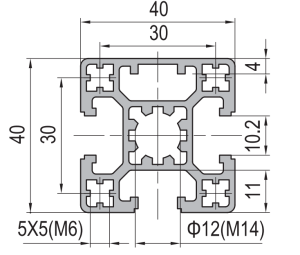 Engineering DesignHow to Choose the Right Aluminium Profile Size for Industrial Frames
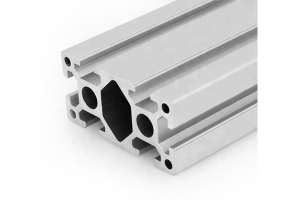 Engineering DesignWhat Is a 4080 Aluminium Profile? (Weight, Slot and Load)
 ApplicationsESD-Safe Aluminum Profile Workbenches: Why Anodising Alone Fails the Audit
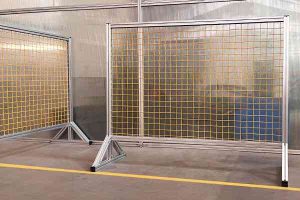 ApplicationsDesigning Machine Guards and Safety Fences in Aluminium Profile: An ISO 14120 Guide
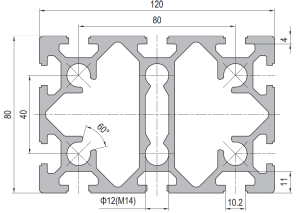 ApplicationsWhere Modular Aluminium Framing Works: A Load-Tier Map Instead of an Industry List
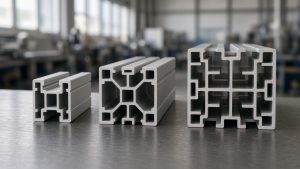 Engineering DesignSlot Dimensions Explained: 6 mm, 8 mm and 10 mm T-Slots
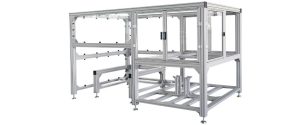 Machine SafetyAluminium Profile Machine Guards: Size the Frame from the Energy, Not from the Mesh
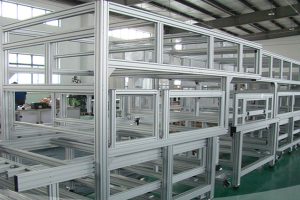 Engineering DesignModular Aluminium Components: Where the System Saves Money and Where It Costs You
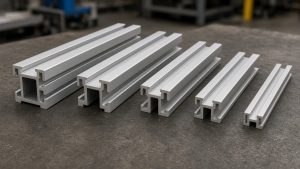 Engineering DesignT-Slot Cross-Brand Compatibility: Bosch, Item and Generic
