Aluminium Profile Fish Tank Frames: Glass Load, Salt Water, and the Alloy Question
A display aquarium is one of the few applications where the frame sees a permanent distributed load, a permanently wet environment and a visible finish requirement at the same time. It is also the application where the wrong alloy choice fails in the least recoverable way.
Short answer
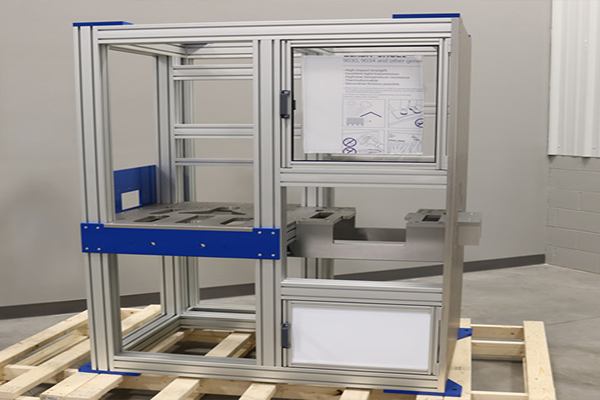
An aquarium frame carries the weight of the water as a permanent distributed load, not a point load, so the base must support the tank continuously along its whole length rather than at the corners. Where salt water is involved, the alloy and the finish matter more than the section size: 6061 is generally preferred over 6063 for chloride exposure, the anodic layer needs to be specified by thickness, and every fastener should be isolated from the aluminium because bare aluminium against stainless in salt water is a galvanic cell.
The load is different from every other framing job
A machine frame carries a load that is known, concentrated and often dynamic. An aquarium carries a load that is spread evenly, never removed, and completely predictable — and that difference changes what the frame has to be.
Water weighs very close to 1 kg per litre, so the arithmetic is simple and the numbers are large. A tank holding 500 litres imposes half a tonne on its base before the glass, the substrate and the cabinet are counted. There is no impact factor and no dynamic allowance, but there is also no relief: the load is present every hour of every day for the life of the installation.
Two consequences follow. The first is that creep and long-term deflection matter more than yield strength, because the frame is loaded continuously rather than intermittently. The second is that the base must be continuous. Point support at four legs puts the glass panel into bending between supports, which is a failure mode the glass was not selected for.
On glass thickness
Glass thickness for an aquarium is determined by water pressure and panel dimensions, and it is a matter for the glazing supplier and the applicable local requirements. This article covers the metal frame only. Do not size glass from a framing guide.
Translating tank volume into a frame load
The conversion is worth doing explicitly because it is where aquarium projects are most often under-specified. Volume in litres gives the water mass almost directly; the glass adds a substantial further amount on larger tanks; substrate, rock and equipment add more.
| Tank volume | Water mass | Plus glass and substrate | Design load to use |
|---|---|---|---|
| 100 L | ~100 kg | ~20–30 kg | ~130 kg |
| 250 L | ~250 kg | ~45–70 kg | ~320 kg |
| 500 L | ~500 kg | ~90–140 kg | ~640 kg |
| 1000 L | ~1000 kg | ~180–280 kg | ~1280 kg |
| 2000 L | ~2000 kg | ~350–550 kg | ~2550 kg |
Those design loads place most display aquaria squarely in the heavy-duty band of structural framing, and the larger ones beyond it. A 1000 litre installation is carrying well over a tonne, continuously, which is not a 20 series or light 40 series job and should not be specified as one.
The other number that matters is the span. A base rail that is supported only at its two ends over a 2 m tank length is a beam under a distributed load of a tonne, and its deflection is the number that determines whether the glass stays flat.
Why the base must be continuous
Glass in an aquarium is loaded in bending by water pressure, and it is supported along its bottom edge. If that edge sits on a continuous surface, the load transfers evenly. If it sits on a frame that touches it only at intervals, the panel spans between the touch points and the bending it was never sized for appears.
This is the single most common framing error in aquarium stands, and it is invisible until the tank is filled. The frame looks correct, the tank sits level, and the base panel is quietly carrying a load case nobody calculated.
The same logic applies to level. A frame that is out of level by a few millimetres puts a torsional load into the tank as the water settles to one side, and glass does not tolerate torsion. Levelling feet are not optional on this application; they are part of the load path.
RULE 1
Continuous base support. The bottom panel must bear along its whole length, not at intervals.
RULE 2
Level before filling. Out-of-level frames torsion the tank as the water settles.
RULE 3
Support under the load, not beside it. Legs belong under the tank footprint, not outboard of it.
RULE 4
Check deflection filled. Measure the base rail before and after filling, and record it.
Salt water: the two corrosion mechanisms
A fresh water display is a demanding environment. A salt water one is a chloride environment, and chlorides attack aluminium in a specific way that section size does nothing to address.
The first mechanism is pitting. Chloride ions penetrate the oxide film locally and start a pit that grows while the surrounding surface stays intact. 6063, the standard extrusion alloy, is more susceptible to this than 6061, which is why marine framing generally starts from 6061 even though it costs more and extrudes less easily.
The second mechanism is galvanic corrosion, and it is entirely a specification problem. Aluminium is anodic to stainless steel. Put a bare stainless bolt into bare aluminium, add an electrolyte — and salt water is an excellent one — and the aluminium corrodes to protect the bolt. The bolt looks pristine and the hole around it disappears.
Both mechanisms are addressed the same way: choose the alloy for the environment, specify the coating by thickness rather than by name, and isolate every dissimilar metal contact.
| Element | Fresh water | Salt water |
|---|---|---|
| Alloy | 6063-T5 usually adequate | 6061 generally preferred |
| Anodic layer | Standard decorative class | Thicker class, specified in micron |
| Fasteners | Stainless acceptable with isolation | Stainless 316, isolated, or non-metallic |
| Dissimilar contact | Isolate | Isolate and seal |
| Cut ends | Cap | Cap and seal |
Four failures specific to aquarium framing
What to send with the enquiry
Aquarium framing is one of the applications where a supplier can be genuinely helpful early, because the load is fully determined by the tank dimensions and the environment is either fresh or salt. Four numbers and one word are enough to start.
RFQ checklist — aquarium framing
- Tank dimensions — length, width and height, inside dimensions.
- Fresh or salt — the single word that changes the alloy, the coating and the fastener plan.
- Filled weight — volume plus glass, substrate and equipment. State the design load, not the water volume.
- Base support arrangement — confirm continuous support, and send the cabinet or stand layout.
- Alloy preference — 6061 for marine; confirm what the supplier stocks.
- Coating class — state the anodic thickness in micron, or specify powder coat over a suitable pre-treatment.
- Fastener plan — material, and whether isolation sleeves or gaskets are included.
- Visibility — which faces are seen. It drives the finish grade and the cut-end treatment.
State clearly that glass thickness is being handled separately. A supplier who starts specifying glass is working outside the frame scope.
Checks before the tank is filled
- Confirm the base panel bears continuously along its full length.
- Level the frame with feet, then re-check after positioning.
- Confirm every dissimilar metal joint is isolated and sealed.
- Measure base rail deflection dry, then filled, and compare against the design limit.
- Check cut ends are capped and sealed, especially on marine installations.
Related on this site
- PG40 80 x 40 six-slot heavy profile— a heavy beam section for long tank spans
- Aluminium I-beam profile— where material is put into the flanges instead of the web
- Angle profiles category— trim and edge sections for cabinetry
- Anodised vs powder coated profiles— the coating decision for a wet environment
Terms used in this article
- Pitting
- Localised corrosion that forms small cavities while the surrounding surface remains intact; chloride-driven in aluminium.
- Galvanic corrosion
- Accelerated corrosion of the more anodic metal when two dissimilar metals are electrically connected in an electrolyte.
- Anodic layer
- The aluminium oxide coating grown by anodising; specified by thickness in micron.
- Continuous support
- Support along the whole length of a panel edge rather than at discrete points.
- Creep
- Slow permanent deformation under a sustained load; relevant because an aquarium load never relaxes.
Questions buyers ask
Can I build an aquarium stand from standard 40 series profile?
For smaller fresh water tanks, often yes, provided the base is continuously supported and the span is short. For large tanks or any marine installation, size the section from the filled weight and the span rather than from a series habit.
Which alloy for a salt water display?
6061 is generally preferred over 6063 in chloride exposure because of its better pitting behaviour. Combine it with a specified anodic thickness and isolated fasteners; the alloy alone is not a complete answer.
Can I use stainless bolts in the frame?
Yes with isolation. Bare stainless against bare aluminium in salt water is a galvanic cell and the aluminium loses. Use sleeves, gaskets or a coating to break the electrical path, and seal the joint.
Do I need to worry about deflection if the tank looks level?
Yes. Level is about torsion, deflection is about bending, and they are independent. A level frame can still sag under the filled load. Measure the base rail dry and filled.
Should the frame be anodised or powder coated?
Anodising is integral to the aluminium and resists underfilm creep better if a scratch occurs; powder coat is thicker and more forgiving of substrate preparation. For a wet application, anodising to a stated thickness is the more common starting point.
Send the tank dimensions and “fresh” or “salt”
We will size the frame from the filled weight and the span, and specify the alloy, coating class and fastener isolation for the environment.
Request a quoteRelated reading
Twelve more engineering notes from this blog, picked for this article — plus every category below.
 ApplicationsAluminium Profile Stairs and Platforms: The Geometry and Load Rules Behind Them
 ApplicationsAluminium Profile Shelving: It Buckles and Tips Before It Bends
 ApplicationsAluminium Profile Workbenches: Design the Top and the Frame as Two Separate Problems
 Materials and EngineeringAluminium Corrosion: Why a Salt Spray Number Is a Ranking, Not a Life
 ApplicationsHow to Choose the Right 4040 T-Slot Aluminium Profile for Industrial Applications
 ApplicationsAluminium Workstations: From Fixed Benches to Reconfigurable Cells
 ApplicationsAluminium Profiles Across Industries: What Actually Changes From One Sector to the Next
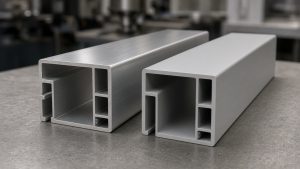 Quality and InspectionAnodising vs Powder Coating: Thickness, Colour, Salt Spray
 Engineering DesignAluminium Extrusion Lead Time: New Die vs Existing Die
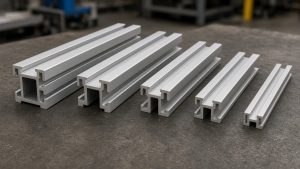 Engineering DesignT-Slot Cross-Brand Compatibility: Bosch, Item and Generic
 Sourcing and ProcurementAluminium Extrusion Price per kg in 2026 (China FOB)
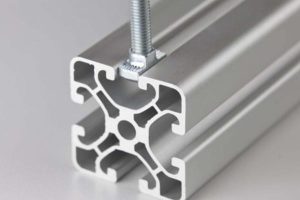 Engineering DesignCross-Brand T-Slot Compatibility: Interchangeability Is a Hardware Question
