Aluminium Workstations: From Fixed Benches to Reconfigurable Cells
The move away from fixed benches is usually described as a modern design trend. It is not. It is a response to a measurable thing: how often the work changes. Once changeover frequency is high enough, the cost of rebuilding a welded bench outweighs everything else in the decision.
Short answer
Reconfigurable aluminium workstations are worth the premium when the layout changes often enough that rebuilding a fixed bench costs more than the difference in purchase price. That crossover is reached sooner than most people expect, because the dominant cost of a rebuild is not new material — it is the downtime and labour to strip and remake the station. A welded bench is stiffer and cheaper to buy; a modular cell costs more upfront and far less to change.
What actually drove the change
Descriptions of this shift usually start with aesthetics or with the idea of a modern workplace. The real driver is operational: product mix and process change became frequent enough that fixed stations were a liability.
A fixed bench is optimised for one task. It is stiffer and often cheaper than a modular equivalent, and if the task never changes it remains the better answer. The trouble starts when the task changes every few months, because then every change is a fabrication job: cut, grind, weld, reposition services, and accept the accumulated damage of doing it repeatedly.
A modular station accepts the same change as a disassembly and reassembly job using the same parts. The performance gap between the two is real, and the reconfiguration gap is much larger. Which one matters depends entirely on how often the second event happens.
The question that settles it
Not “is modular better” but “how many times will this station be changed in its life”. Under two, a fixed bench usually wins. Above four or five, modular wins by a wide margin. The grey zone in between is where the honest calculation has to be done.
Three stages, and what each one bought
The evolution is best understood as three different answers to the same question of how to hold a work surface at the right height.
The first stage was the welded or bolted steel bench: very stiff, cheap per unit, and effectively permanent. It solved the load problem completely and the change problem not at all.
The second was the bolted aluminium frame: lighter, cleaner, and adjustable within limits, but still built around a fixed design intent. It made stations easier to build and slightly easier to alter.
The third is the modular cell, where the frame is a kit of standard parts and the layout is a configuration rather than a design. This is the stage where changeover stops being a project, and it is the stage where the specification has to be managed, because the same flexibility that lets a station be reconfigured also lets it be reconfigured badly.
| Stage | Change cost | Stiffness | Best for |
|---|---|---|---|
| Welded steel bench | High — refabrication | Highest | Frozen tasks, high loads, vibration |
| Bolted aluminium frame | Moderate — partial strip | High | Stable tasks, cleaner environments |
| Modular aluminium cell | Low — strip and rebuild | Adequate if specified | Changing tasks, mixed product, cells |
The rebuild cost nobody writes down
When a fixed station is changed, three costs are incurred and only the first one appears on a purchase order.
The first is new material: the steel or profile, consumables and any new tops or fittings. The second is labour to strip the old station and build the new one, which for a welded bench includes cutting and grinding and usually produces parts that cannot be reused. The third is downtime, which is the one that dominates in any operating plant, because the station is not producing while it is being rebuilt.
Modular framing attacks all three, and attacks the third one hardest. The material is largely reused, the labour is disassembly and reassembly rather than fabrication, and the downtime is measured in hours rather than days. That is why the payback calculation is usually decided by the downtime line rather than by the material line.
Where a rebuild actually costs
- New material (profile, fittings, tops)Smallest of the three
- Labour: strip, cut, refabricate, refitOften 2–4× material
- Downtime while the station is outUsually dominates
- Scrap: parts that cannot be reusedNear zero modular, high welded
The implication for procurement is direct: when comparing quotes, compare the cost of the second and third build, not just the first. A station that is cheaper to buy and three times more expensive to change is the wrong answer in any environment with a changing product mix.
Ergonomics as measurements, not preferences
Ergonomics is usually discussed as comfort. In a specification it has to be numbers, because comfort is not something a supplier can build to.
The two that matter most are working height and reach. Working height depends on the task: fine assembly is done with the work higher and closer to the eyes, heavy work lower so that body weight can be used. A single fixed height across both types of task is the most common ergonomic error in a plant, and it is why adjustable stations exist even where loads are low.
Reach is the second. Anything used frequently should sit within easy reach of the operator’s normal working position rather than at the extremes, and that constraint drives where shelves, bins and tools are mounted. On a modular frame this is easy to get right and easy to get wrong, because everything can be mounted anywhere.
FACTOR 1
Task height. Fine work higher, heavy work lower. One height cannot serve both.
FACTOR 2
Reach envelope. Frequently used items inside easy reach; occasional items outside it.
FACTOR 3
Sitting or standing. It changes the height and the clearance required underneath.
FACTOR 4
Adjustability. Where operators or tasks vary, height adjustment beats a compromise height.
The exact dimensions follow from the task and the workforce, and should be set from a workplace ergonomics assessment rather than from a catalogue. What belongs on the drawing is the resulting height range and the reach arrangement, stated as requirements.
When modular is the wrong answer
The honest version of this article includes the cases where a reconfigurable station is a mistake, and there are three of them.
The first is a genuinely frozen task. If the station will do one thing for a decade, the flexibility is being paid for and never used, and a welded bench is stiffer and cheaper.
The second is severe vibration or impact. Every bolted joint is a potential loosening point under sustained vibration, and a welded structure has none. Where the station carries a press, a hammer or a shaker, the joint count works against modular framing.
The third is very high load or very high precision. Beyond a certain point the joint compliance that makes modular framing pleasant to work with becomes the limiting factor, and a dedicated structure is the correct answer.
- The task changes more than a few times
- Downtime is expensive
- Operators or products vary
- The station may move or be redeployed
- Services and accessories get repositioned
- The task is frozen for years
- Vibration or impact is severe
- Loads or precision are extreme
- Unit cost dominates and volume is high
- There is no rebuild capability on site
What to send with a workstation enquiry
The enquiries that get quoted accurately are the ones that state how often the station will change, because that single fact decides the whole approach.
RFQ checklist — workstations
- How often will the layout change? — the decisive question; state a number per year.
- Task type and working height range — fine or heavy, sitting or standing.
- Load: distributed and any point load — including presses, vices and monitors.
- Accessory list — shelving, bins, power, lighting, tool balancers; each is a load and a mounting.
- Adjustability requirement — fixed height, manually adjustable, or powered.
- Mobility — castors or feet; castors change the base condition and the sway behaviour.
- Environment — ESD, clean room, washdown, or standard industrial.
- Quantity and whether it will be repeated — repeat orders justify standardising the design.
If you are replacing fixed benches, say how many and why. The reason is usually changeover or ergonomics, and naming it changes the recommendation.
Four ways a modular station disappoints
Related on this site
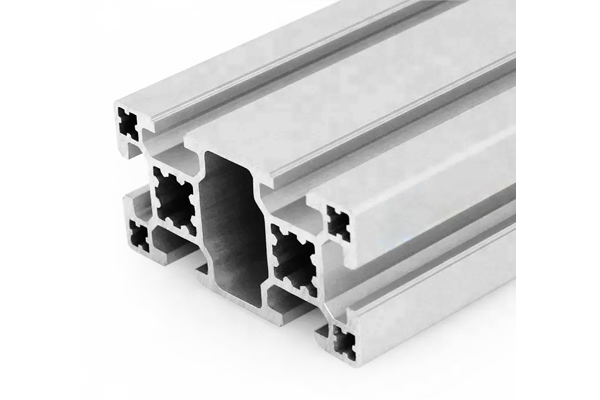
- Aluminium extrusion table frame— a 40 series bench base
- PG40 40 x 40 four-slot heavy profile— the usual leg and frame section
- Connecting elements category— the joints that make reconfiguration possible
- Workbenches: top and frame as two problems— the design detail behind the bench
Terms used in this article
- Changeover
- Reconfiguring a station or line from one product or task to another.
- Cell
- A group of stations arranged so one operator or team can complete a sequence of work.
- Reach envelope
- The volume an operator can comfortably reach from a normal working position.
- Joint compliance
- The small amount of movement in a bolted joint under load; it accumulates across a frame.
- Downtime
- Period when a station is not producing; often the largest cost of a rebuild.
Questions buyers ask
Is a modular workstation as stiff as a welded bench?
No, and it does not need to be for most tasks. A welded bench is stiffer; a modular station is stiff enough when the connector class matches the load. The gap matters under vibration, high load or high precision.
How many rebuilds justify going modular?
As a rough guide, under two changes a fixed bench usually wins; above four or five, modular wins clearly. The exact crossover depends on how expensive your downtime is, which is usually the deciding factor.
What working height should I specify?
It follows from the task: fine assembly higher and closer, heavy work lower. Set it from a workplace ergonomics assessment and state the resulting range on the drawing rather than picking a catalogue height.
Can I reuse parts when I reconfigure?
Extrusions yes, to a high degree. Interface hardware only partially, because nuts and bolts lose holding margin once torqued and removed. Budget for new fasteners even when reusing profile.
Should the station be on castors?
Only if it genuinely needs to move. Castors raise the load application point, remove the friction that resists sway and concentrate load at four small wheels. Fixed feet are stiffer and simpler.
Tell us how often the layout changes
Give us the changeover frequency and the task type, and we will tell you whether modular pays back and specify the frame and connectors for it.
Request a quoteRelated reading
Twelve more engineering notes from this blog, picked for this article — plus every category below.
 ApplicationsAluminium Profile for LED Strips: A Heat Sink First, a Housing Second
 ApplicationsAluminium Profile Workbenches: Design the Top and the Frame as Two Separate Problems
 Engineering DesignMetric vs Imperial T-Slot Profiles: How to Test Compatibility Before You Order
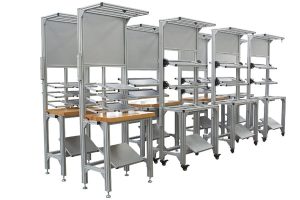 ApplicationsESD-Safe Aluminum Profile Workbenches: Why Anodising Alone Fails the Audit
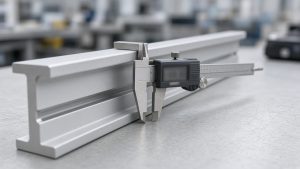 Engineering DesignWhat EN 755-9 Allows: Aluminium Extrusion Tolerances
 Engineering DesignAluminium Extrusion Lead Time: New Die vs Existing Die
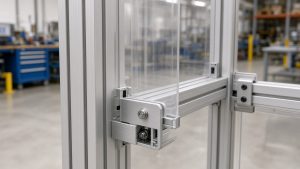 ApplicationsHow to Fix Panels, Guards and Accessories to Aluminium Profiles
 Engineering DesignHow to Choose an Aluminium Extrusion Profile: The Three Decisions That Bind
 Materials and EngineeringIndustrial Aluminium Extrusion: Five Advantages and the Conditions Attached to Each
 Sourcing and ProcurementAluminium Profile Price Breaks: How Volume Changes the Unit Price
 Sourcing and ProcurementAluminium Extrusion Price per kg in 2026 (China FOB)
 Quality and InspectionSampling and First Article Approval for Aluminium Extrusion
