Aluminium Profile Price Breaks: How Volume Changes the Unit Price
In 2026 China-factory FOB metres for silver-anodised T-slot typically sit around USD 1.40–2.20/m on 20 × 20 and USD 4.20–6.50/m on 40 × 40 at mid volume, and the unit price steps again at 500 m, 2 000 m, 5 000 m and 10 000 m as fixed setup is spread thinner.
Short answer
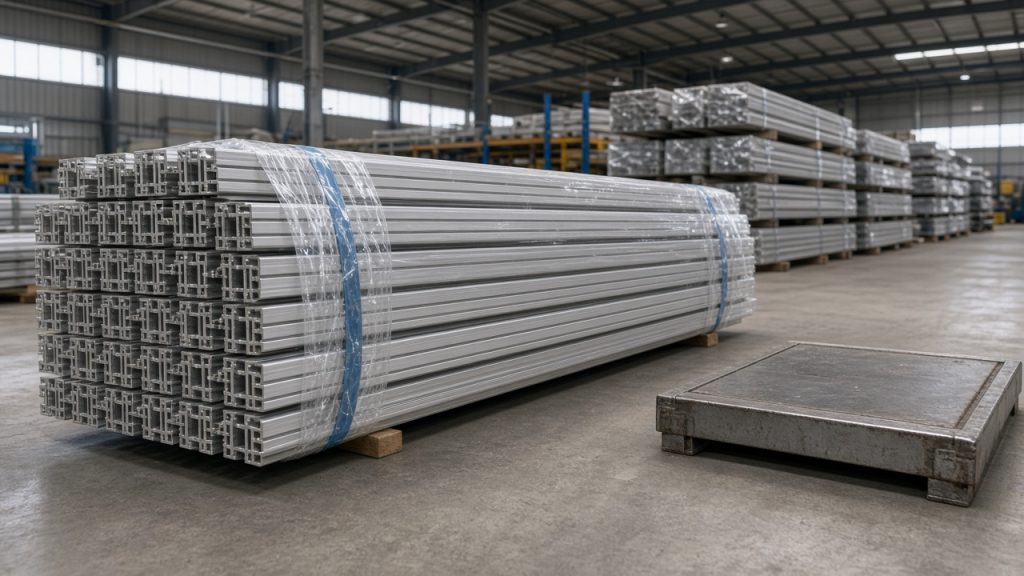
Unit price falls when the order crosses published metre steps because die change, trial scrap, anodising batch and export packing are largely fixed per run. MOQ is 150 m off an existing die and 500 m with a new die. Reference 2026 FOB China bands for silver 6063-T5 T-slot run about USD 1.40–2.20/m on 20 × 20 and USD 4.20–6.50/m on 40 × 40 near the mid steps; heavier sections scale with kilograms. Extruded framing usually beats cast parts at volume once the die is paid. Trade terms available are FOB / CIF / DAP / DDP from Shanghai or Ningbo.
Extruded vs cast aluminium for a workbench which is cheaper at volume
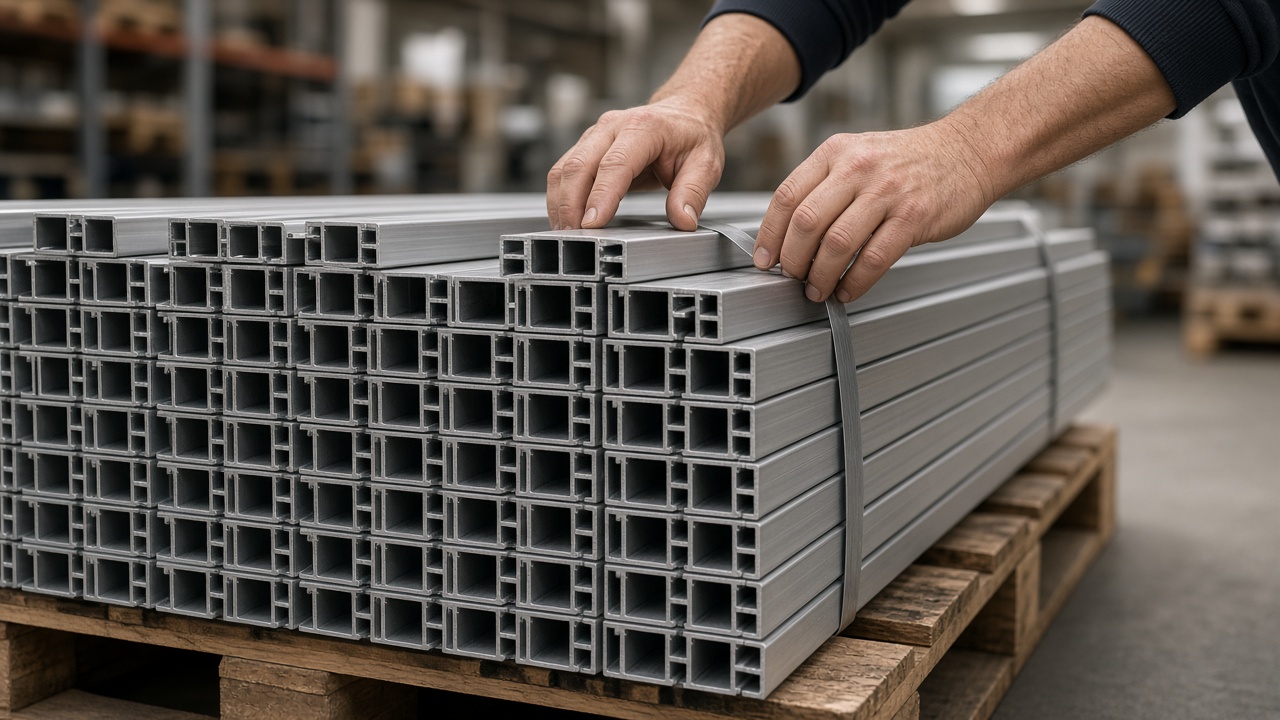
For a modular workbench frame at production volume, extruded T-slot is almost always cheaper per metre of usable structure than casting equivalent members, once the extrusion die is amortised.
Casting wins on complex nodes and one-off shapes with heavy section changes; extrusion wins on long straight members, repeat cuts and hardware reuse. At 500 m and above the extrusion die share per metre is small, anodising is continuous, and cut-to-length yield is high. A cast leg set still carries pattern cost, machining of mounting faces and a finish that rarely matches a clear anodised bar. Use the comparison grid when the variable is workbench, guard frame, conveyor side or similar long members.
| Factor | Extruded T-slot | Cast aluminium | At volume (≥500 m / large lot) | Verdict |
|---|---|---|---|---|
| Tooling | Extrusion die | Pattern / mould | Die share falls fast with metres | Extrusion |
| Unit shape | Constant section | 3D node-friendly | Long members dominate benches | Extrusion |
| Finish | Anodising line | Paint / powder often | Clear anodise stays cheap | Extrusion |
| Hardware | T-nuts, reuse | Machined bosses | Rebuilds stay modular | Extrusion |
| Scrap / yield | Cut-list controlled | Gate and riser scrap | Bar yield usually higher | Extrusion |
| Complex joint | Needs brackets | Integrated boss | Hybrid often best | Cast the node |
Which series profile to use (by series)
Pick the series from slot and load band first; volume discounts apply on top of that choice and do not fix an undersized envelope.
The six common metric families below cover most importer and OEM frames. Slot locks the fastener kit; load band is a planning guide for static benches and light machine bases, not a substitute for a deflection check. Price breaks at 500 m, 2 000 m, 5 000 m and 10 000 m apply inside whichever series you freeze.
| Series | Slot | Typical use | Load band | Verdict |
|---|---|---|---|---|
| 20 series | 6 mm | Guards, jigs, displays | Light | Use for short spans only |
| 30 series | 8 mm | Light workstations | Light–mid | Good when mass budget is tight |
| 40 series | 8 mm | Machine frames, benches | Mid | Default industrial choice |
| 45 series | 10 mm | Heavy frames, Bosch-class | Mid–heavy | When 10 mm hardware is standard |
| 50 series | 10 mm | Heavy bases, long spans | Heavy | Step up when 40/45 deflects |
| 60 series | 10+ mm | Gantries, large cells | Heavy | Structural; verify I and mass |
What the price is actually made of
A metre price is billet metal plus press conversion, finish, packing and a share of fixed order costs — volume only shrinks the fixed share.
Billet usually dominates a China FOB number on commodity 6063. Conversion covers press time, ageing and recovery. Anodising is priced by surface and colour batch; packing for export is an ISPM 15 cradle or a plywood case for short cuts. Die change, first-bar trial and documents do not shrink on a 150 m run, which is why the existing-die MOQ and the 500 m new-die MOQ exist. How that tooling lands per metre is spelled out under how die cost amortises per meter; ownership under who owns the die. Ports are Shanghai or Ningbo; Incoterms FOB / CIF / DAP / DDP decide whether freight sits on the same sheet.
How quantity changes the unit price
Unit price steps down at 500 m, 2 000 m, 5 000 m and 10 000 m because setup, scrap and packing are spread across more metres and the press run is cleaner.
Indicative effect around a mid-2026 FOB band for a common 40 × 40: 150 m (existing-die MOQ) sits roughly 8–15% above the mid band; 500 m is the first formal step; 2 000 m often trims another 3–6%; 5 000 m about 6–10%; 10 000 m about 8–12% plus room for a metal formula. A new die needs the 500 m gate and carries tooling until amortised — see minimum order with a new die. Die making adds 7–12 days before the press on that path (die making adds 7–12 days). Payment on firm orders is T/T 30% deposit and 70% before shipment, or L/C at sight.
| Quantity step | What changes | Indicative unit effect (2026) |
|---|---|---|
| 150 m (existing-die MOQ) | Full setup on a short run | +8% to +15% vs mid band |
| 500 m | First formal price break | Reference band |
| 2 000 m | Better recovery; fewer orphans | −3% to −6% |
| 5 000 m | Near full-press; often FCL freight | −6% to −10% |
| 10 000 m | Contract metal formula useful | −8% to −12% plus hedge |
RFQ checklist — price breaks
- Section / series — freeze envelope and slot before chasing a step.
- Quantity — metres at the step you can actually call off.
- Die status — 150 m vs 500 m MOQ.
- Finish and length — mill/anodised; stock bar or cut list.
- Incoterm / port — FOB Shanghai/Ningbo or CIF/DAP/DDP.
- Payment — T/T 30%+70% or L/C at sight.
Ask for the unit price at two neighbouring steps. The delta tells you whether consolidating call-offs is worth the inventory.
Related on this site
- how die cost amortises per meter — tooling inside each step
- minimum order with a new die — 150 m and 500 m gates
- die making adds 7–12 days — calendar before volume runs
- who owns the die — title when volume repeats
Terms used in this article
- Price break
- A published quantity step where the unit price falls because fixed costs are spread thinner.
- MOQ
- Minimum order quantity: 150 m on an existing die, 500 m with a new die.
- FOB
- Free on board at Shanghai or Ningbo; buyer takes ocean freight after loading.
- Die amortisation
- Spreading one-time tooling across the metres in the order or contract.
- Call-off
- Releasing part of a committed volume against a schedule instead of one shipment.
Questions buyers ask
What is included in the quoted price?
A firm sheet lists metal, process, finish, packing and, if new, die tooling as separate lines under the named Incoterm (FOB Shanghai/Ningbo, CIF, DAP or DDP). Ocean freight only appears when the Incoterm includes it. Payment is T/T 30% deposit and 70% before shipment, or L/C at sight.
Do you charge for samples?
Short sample cuts off an existing die are usually billed at a sample rate plus freight. Off-tool samples on a new die ride with the tooling programme. Approve the sample, then the production metres use the volume price break that matches the released quantity.
How long is the quotation valid?
Spot quotations are typically valid 7–14 days because billet moves with the metal market. Process and finish lines are stabler. For programmes past that window, ask for a metal formula plus firm conversion rather than a frozen all-in metre price.
Can the price be fixed for a contract?
Yes, within a metal formula: conversion, finish and packing can be firm for a call-off period while billet follows an agreed index. State annual metres and release pattern so the price breaks at 500 m, 2 000 m, 5 000 m and 10 000 m can be written into the schedule.
Send the section, the metres and the step you can call off
Name the series, finish, quantity at 500 / 2 000 / 5 000 / 10 000 m, and FOB or landed terms, and we will return unit prices at the neighbouring breaks before you consolidate inventory.
Request a quoteRelated reading
Twelve more engineering notes from this blog, picked for this article — plus every category below.
 Materials and EngineeringAluminium Extrusion Section Design: What Each Feature on the Drawing Costs You
 Sourcing and ProcurementAluminium Extrusion Price per kg in 2026 (China FOB)
 Quality and InspectionGlobal Sourcing Excellence: Multi-Category OEM and ODM Manufacturing and Supply Chain Integration
- Engineering DesignStandard vs Custom Aluminium Extrusion: The Break-Even Calculation
 Sourcing and ProcurementAuditing an Aluminium Profile Supplier: Factory, Trader, or Something in Between
 Sourcing and ProcurementDistributor Terms: Territory, Margin and Price Protection
 Sourcing and ProcurementFOB vs CIF vs DAP vs DDP: Aluminium Profile Landed Cost
 Engineering DesignModular Aluminium Components: Where the System Saves Money and Where It Costs You
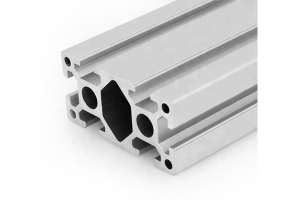 Engineering Design4080 vs 4545 Aluminium Profile: Which for Your Frame
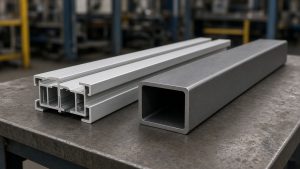 Engineering DesignAluminium vs Steel, Extruded vs Cast: What Actually Changes
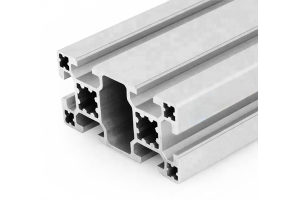 ApplicationsAluminium Workstations: From Fixed Benches to Reconfigurable Cells
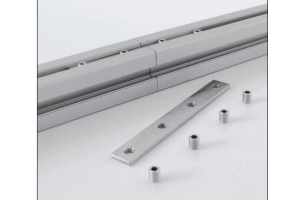 Engineering DesignT-Slot Aluminum Profile Connectors: What Each Type Is Actually Good At
