How to Fix Panels, Guards and Accessories to Aluminium Profiles
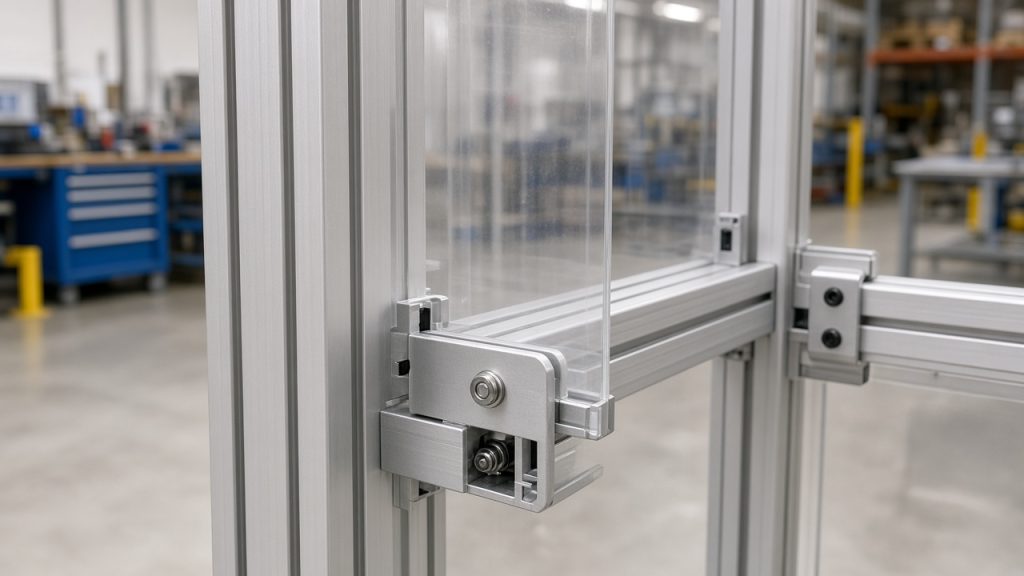
The everyday panel fix on industrial T-slot is a retainer or clamping strip into the slot, backed by T-nuts where the panel must come off for service. That joint holds the panel; it does not replace the frame’s structural brackets — treat the two load paths separately.
Short answer
Fix panels by choosing cover or inset layout first, then matching thickness to a gasket, clamping strip or drilled T-nut pattern for the series you stock. On 2020 (≈6 mm slot) use light retainers and M5 hardware; step to 3030/4040 when PC, mesh or sheet spans grow. Mount safety switches on a plate bolted through T-nuts so the actuator stays aligned after panel removal; hang cable trays from slot-rated hangers, not from screws into the thin lip. Dry torque: M6 5–8 Nm, M8 13–20 Nm. Fabrication that keeps openings true: cut ±0.5 mm, holes ±0.2 mm, end square within 0.3 mm. A 45 × 90 mm six-slot rail in 6063-T5 at 4.10 kg/m with I ≈ 68 cm⁰ is a useful heavy panel rail when the joints that carry the frame remain brackets or end taps — panel screws are not that joint.
How do i fix a panel to a 2020 profile
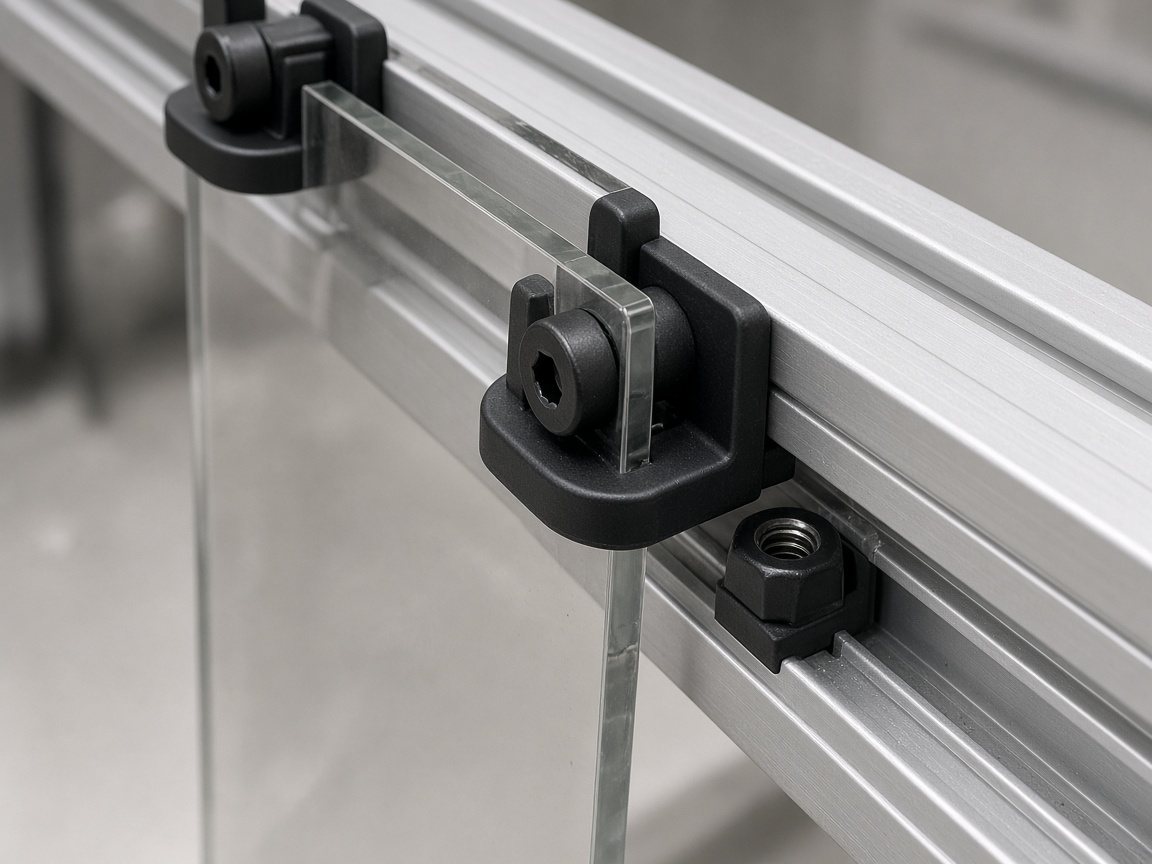
Fix a panel to 2020 with a series-matched retainer, gasket or light clamping strip sized to the panel thickness — or with drilled holes into M5 T-nuts — after you measure the assembled opening, not the CAD clear span.
Decide cover (outside the outline) versus inset (inside the bay). Inset panels need insertion clearance, gasket compression and thermal room; cover panels need underside support so the sheet does not hang from screws alone. Common clamping bands are 2–4, 4–6, 6–8 and 8–10 mm — pick the strip for the actual sheet, not for a nominal “3 mm PC.” Soft plastics need oversized holes or slotted clamps so aluminium expansion does not crack the corner. Never force a panel to pull a racked 2020 bay square; correct diagonals first. Order closing rails slightly short (about 0.5 mm in some strip systems) when the maker requires it for strip insertion.
| Method | Best panel | 2020 hardware | Removable? |
|---|---|---|---|
| Slot gasket / strip | 2–6 mm PC, acrylic, thin sheet | Matching 6 mm strip | Yes if strip levers out |
| External retainer | Guards, side panels | M5 T-nut + retainer | Yes |
| Drilled to T-nuts | Metal sheet, covers | M5 + washers | Yes with access |
| Cover on support rails | Tops, shelves | Underside screws | Yes |
| Adhesive only | Trim / labels | — | No — not structural |
| Screws into lip only | Avoid | — | Damages slot geometry |
How do i mount a safety switch on a 2020 frame
Mount a safety switch on a rigid plate or bracket fixed through T-nuts into the 2020 slot so the actuator stays aligned when the guard panel is removed — do not hang the switch body from a flexible plastic clip alone.
Place the switch on the fixed frame member, not on the removable panel, unless the maker’s interlock kit is designed that way. Keep cable exits clear of hinge arcs and panel extraction paths. Use a flat mounting plate so the switch face is square to the actuator; a twisted 2020 lip will mis-trigger. Torque M5/M6 fasteners into the published band and add thread locker or a second nut where vibration is high. Route the cable in slot covers or ties so a service tech cannot pull the switch out of alignment. Interlocks are a risk-assessment output (ISO 12100 / local rules); the T-slot only provides the mechanical interface.
| Mount detail | Do | Do not |
|---|---|---|
| Location | Fixed upright / header | Only on flimsy mesh |
| Interface | Plate + M5 T-nuts | Self-tappers into lip |
| Alignment | Square to actuator path | Rely on panel bend |
| Cable | Slot channel / ties | Pinched in hinge |
| Torque | Maker chart / M5–M6 band | Hand-snug only |
| Service | Panel off without unwiring switch | Hidden splices behind panel |
How do i hang a cable tray from a 2020 profile
Hang a light cable tray from 2020 with slot-rated hangers or quarter-turn mounts that engage the T-slot — and step the rail to 3030/4040 when tray mass, fill or span exceeds what a light lip can carry.
Match the hanger to the groove width (≈6.2 mm on many 20-series bars; 8 or 10 mm on larger series). Support continuous tray at intervals from the tray maker’s span table; a single mid hanger on a long run invites sag and connector strain. Keep copper and data cables inside the tray radius limits; do not use the aluminium slot as a sharp edge for jacket pull. For vertical drops add strain relief above the first bend. Heavy ladder tray, dense power fill or long unsupported runs belong on 4040 or a dedicated steel hanger off a stronger member — 2020 is an accessory rail in that case, not the primary beam. Never drill random holes through the thin lip to “bolt the tray on”; that starts cracks and ruins future T-nut travel.
| Tray duty | Profile | Hanger | Spacing start |
|---|---|---|---|
| Light data / pneumatics | 2020 OK | Slot clip / M5 hanger | Per tray chart (often ≤1 m) |
| Mixed control cables | 3030 preferred | M6 T-nut hanger | Shorter if filled |
| Power ladder tray | 4040 / 45 × 90 | Heavy bracket | Maker span table |
| Vertical drop | Match horizontal | + strain relief | At each bend |
| Moving cable chain | Dedicated mount | Chain bracket | Not plain tray clip |
| Wash-down | Anodised / sealed | Stainless hardware | Avoid open mill chips |
The joint is the weak point
Panel fasteners and accessory clips are not structural joints — the frame still needs brackets, gussets or end-tapped butts to carry racking and top load.
A polycarbonate guard held by clamping strips can look complete while the corner behind it is a single undersized L-bracket on a light lip. Under fork-truck bump or door slam the panel stays put and the bay lozenges. Keep three load paths separate on the drawing: (1) primary frame joints with stated torque, (2) panel retention sized to thickness and removal, (3) accessories (switches, trays) on T-nuts that may be stripped without weakening (1). Where an upright takes axial load into a rail face, end-tap the core rather than adding more panel screws. Fabrication tolerances matter here too: cut ±0.5 mm, holes ±0.2 mm and end square within 0.3 mm keep the opening the panel was sized for. When spans grow, move the panel rail to a 45 × 90 six-slot class section (4.10 kg/m, I ≈ 68 cm⁰) and keep the same discipline on the corners.
RFQ checklist — panels and accessories
- Layout — cover or inset; removal direction; hinge/door if any.
- Panel stack — material, thickness, tolerance, and retainer band (2–4 / 4–6 / 6–8 / 8–10 mm).
- Series — 2020 / 3030 / 4040 / 45 × 90 and slot mouth for hardware.
- Switches — make/model, plate size, cable exit, interlock requirement.
- Cable tray — type, fill, hanger series, support spacing.
- Structural joints — brackets/gussets/end taps separate from panel fixings; torque M6 5–8 Nm / M8 13–20 Nm.
- Fabrication — cut ±0.5 mm, holes ±0.2 mm, end square 0.3 mm.
Ask whether any panel screw is expected to carry frame racking. If yes, redesign that corner before the panel BOM is released.
Four ways panel work fails
Related on this site
- how die cost amortises per meter — cost of locking one panel-rail series
- minimum order with a new die — when a custom panel groove needs tooling
- die making adds 7–12 days — calendar if you change the slot for retainers
- who owns the die — reuse rights on a custom guard section
Terms used in this article
- Clamping strip
- Aluminium or plastic strip that locks a panel edge into the T-slot groove for a stated thickness band.
- Cover panel
- A panel that follows the outside frame outline rather than the clear opening.
- Inset panel
- A panel sized to the clear opening between profiles, often retained in the slot.
- T-nut
- A nut that seats in the T-slot and accepts a machine screw for brackets, plates or panels.
- End tapping
- Tapping the profile core for a butt fastener used as a structural joint, not a panel fix.
- Interlock
- A safety switch arrangement that prevents hazard access when a guard is open, per risk assessment.
Questions buyers ask
What torque should I use?
For frame brackets and accessory plates on clean dry aluminium use about 5–8 Nm for M6 T-nut joints and 13–20 Nm for M8, unless the fastener or switch maker publishes a lower limit for the device. Panel retainers often need only light snug torque so they do not crush PC or acrylic — follow the strip maker’s note. Recheck after transport on guarded cells.
Can I drill into the slot?
Yes for planned clearance holes on the slot centreline when a drilled panel or switch plate needs them — hold position within ±0.2 mm. Do not drill out the slot mouth to admit an oversized nut, and do not place random holes in the thin lip for tray screws. End taps through the core are planned structural drills, separate from panel work.
How do I join at 45 degrees?
Mitre the frame members, then bridge with a mitre plate or angle bracket on T-nuts; a panel alone does not hold a 45° corner. If a glazed corner must look continuous, mitre the panel too but keep the structural plate behind it. Torque corner fasteners in the same M5/M6/M8 bands as square bays.
What panel thickness fits the slot?
Match thickness to the retainer or gasket range for your series. Widely stocked clamping bands cover 2–4, 4–6, 6–8 and 8–10 mm. Thin sheet can ride in the groove; thicker composite or heavy PC usually needs external retainers or a cover layout on T-nuts. Measure the assembled opening before cutting.
Send the panel stack and accessory list
Share series, panel material and thickness, whether panels are removable, plus switch and tray notes. We return retainer call-outs, T-nut counts and a joint list that keeps structure separate from cladding.
Request a panel BOMRelated reading
Twelve more engineering notes from this blog, picked for this article — plus every category below.
 Engineering DesignAluminium Profile Max Span: Deflection Table by Section
 Engineering DesignHow to Join Aluminium Profiles: Joints, Brackets and Torque
 ApplicationsAluminium Profiles in Industry and Construction: One Material, Two Acceptance Logics
 Engineering DesignT-Slot Aluminum Profile Connectors: What Each Type Is Actually Good At
 Engineering DesignWhat Your Extrusion Drawing Must Show (and What Costs You Money)
 Applications40×40 Aluminium Profile: Where It Works, Where It Fails, and Why
 Engineering DesignAluminium Profile Weight per Meter Chart (20–60 Series)
 ApplicationsAluminium Pergola Profiles: A Beam Problem With a Water Problem
 Materials and Engineering6063-T5 Aluminium Profile: What the Designation Actually Guarantees
 Quality and InspectionEuropean Anodised Aluminium Specification: What Should a Purchase Order Contain?
 Materials and EngineeringAluminium Corrosion: Why a Salt Spray Number Is a Ranking, Not a Life
 Quality and InspectionAnodising vs Powder Coating: Thickness, Colour, Salt Spray
