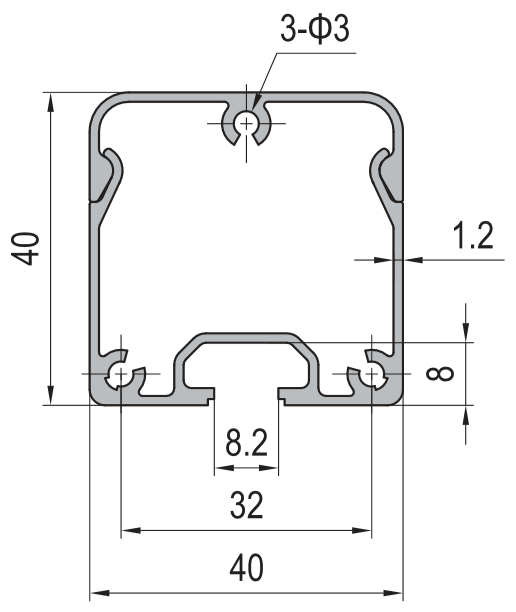
Quick answer
Your project type decides more than your load does
Building one or two? Use a stocked section and a stocked accessory range. Every hour spent optimising the cross-section for a single frame costs more than the aluminium it saves, and a custom die adds weeks to the schedule for no return.
Building five to fifty? The section is now settled — the money is in the cutting list, the pre-machining and the way the parts are kitted. This is the stage where most projects lose hours and never notice.
Building hundreds? A custom die starts to pay, but only if it removes material or removes a machining operation. A die that only makes the frame look neater never pays back.
Extending an existing machine? Nothing in a catalogue applies. Measure the profile you already have, because the same series name from a different source will not match the slot, the finish or the alloy.
The fork in the road
Four project types, four different things to optimise
The question “which profile should I choose” has no answer until you know how many you are making and whether the design is still allowed to change. A frame that will be built once can tolerate a section that is 20 per cent heavier than necessary. A frame that will be built two hundred times cannot, because that 20 per cent is multiplied by the order quantity every month for as long as the product lives.
| Project type | What actually matters | What to ignore | The classic mistake |
|---|---|---|---|
| One-off prototype or tooling frame | Availability, delivery date, ability to modify on site | Weight, material cost, cross-section efficiency | Designing a custom section for a frame that will be rebuilt twice before it works |
| Small batch, 5 to 50 units | Cut accuracy, pre-machined features, kitted hardware, repeatability | Cross-section optimisation — it is already decided | Cutting and drilling in house to save a small per-part charge, then losing a day per batch |
| Production, 100 units and up | Material per unit, number of machining operations, tooling ownership | Stock sizes and stock accessories | Buying a die to change the look instead of to remove a machining step |
| Extending an existing machine | Matching the slot, the finish and the alloy of what is already there | Everything in the current catalogue | Ordering by series name and finding the nuts will not enter the slot |
Read the third column carefully. In three of the four rows, the thing that a general selection guide tells you to focus on is the thing you should ignore. That is the whole point of this article: the profile-selection question is a different question at each scale.
One or two units
If you are building one, buy the standard die and stop
For a single frame, a custom extrusion is almost always the wrong answer, and the reason is not the die cost. It is the sequence. A new die has to be cut, corrected and sampled before it produces a saleable length. The industry typically quotes two to four weeks for die manufacture and first sample, and that is before you have measured the sample, approved it and released the production run. A frame that could have been built from stock next week is now a six-week project, and it will still need a second iteration because nobody gets a slot geometry right the first time on a drawing alone. Our own section range covers the sizes most one-off frames need, cut to order from 6 m stock.
What you should do instead, for a one-off:
- Choose the section from what is on the shelf, then solve the structural problem with span and bracing rather than with geometry. Adding one upright is a same-day change. A new die is not.
- Spend the optimisation budget on the machining, not the extrusion. Accurate cut lengths, tapped ends, a clean hole pattern and deburred edges are what make a one-off frame go together in an afternoon instead of a week.
- Stay inside one accessory system. One nut part number, one bracket part number, one torque figure. On a one-off build the accessories are more than half the assembly time, and mixing systems means you discover the incompatibility with the frame half built.
- Accept the weight. A section that is 20 per cent heavier than the theoretical optimum costs a few dollars on a single frame. Chasing that 20 per cent costs days.
Where one-off projects go wrong
The most expensive habit in one-off framing is specifying a section that is not stocked because it matches a drawing that was drawn for a different purpose. The frame then waits for a minimum production run of that section to be scheduled at the mill, and the schedule is driven by the mill’s other customers, not by your deadline. If a section is not in stock, ask what is in stock and redesign around it.
Five to fifty units
If you are building twenty, the cutting list is the project
Once the section is fixed, the dominant cost in a small batch is not aluminium. It is the time spent turning six-metre bars into the right set of parts, and then finding out that two of them are the wrong length. A 1,200 × 800 × 900 mm workbench contains twelve cut lengths. Twenty of them is two hundred and forty cuts, and at roughly a minute and a half each including measuring, deburring and handling, that is six hours of saw time before anything has been assembled. Measured in loaded labour that is a full day, and it produces a variable amount of scrap.
The alternative is to buy the parts cut, tapped and deburred to a list. It costs a small amount per cut and it removes the measuring, the scrap and the skill requirement from your own floor. The comparison is not “cutting charge against free in-house cutting” — it is “cutting charge against six hours of your own labour plus the cost of the two members you cut 5 mm short”.
What a cutting list has to contain
A list that says “40 × 40, twelve pieces, 1,200 mm” is not a cutting list, it is a wish. A list that can be manufactured without a phone call has one row per distinct part and these columns:
Two of those columns are consistently left off and consistently cause problems. Face features without a datum produce a batch of parts that are correct but mirrored, which is worse than being wrong because they will assemble and then not fit the panel. And no tolerance on the length means the supplier will use whatever is economical, which may be plus or minus 2 mm, and your frame will not be square.
Kit by assembly, not by part number
If you are building twenty identical frames, ask for the parts to be bagged by assembly rather than by part type. Receiving twelve bags that each contain one bench is a completely different operation from receiving twelve piles of one hundred members that have to be sorted on the floor. The supplier cost is nearly identical; the difference on your side is several hours per batch and a large reduction in mis-assembly.
cutting hours = pieces × 1.5 minutes / 60Rough allowance for measuring, cutting, deburring and handling one member on a manual saw, including the setup time amortised across the batch. Compare that against the quoted per-cut charge before deciding to do it in house.Hundreds of units
If you are building production, the die is the cheap part
A custom extrusion die for a modest hollow section is not the expensive item in a production programme. It is a one-time cost, and it is small compared with the recurring cost of machining a feature onto every length for the life of the product. The die pays back when it removes work, not when it changes appearance.
It removes a machining operation
If every length in the frame needs a cable channel milled into it, or a panel groove cut on a router, extruding that feature instead removes a machine, an operator and a scrap rate from the process. This is the strongest case for a new die and the easiest to justify, because the saving is per piece and continues forever.
It removes material
If the section you are buying is heavier than the load requires, a lighter section with the same second moment of area saves aluminium on every metre. The saving is proportional to the weight difference, so a 15 per cent reduction on a 3 kg/m section is 0.45 kg/m, every metre, forever.
It locks in your accessory range
A proprietary slot or panel groove means your own brackets, covers and panel fixings only fit your own profiles. That is a real commercial benefit for a product you sell, and it is the one case where a die pays back through margin rather than through cost.
It only changes the appearance
A new die that reproduces a stocked section with a different external profile adds tooling cost, a new part number, a new accessory range and a stock-keeping burden, and saves nothing per unit. If the business case is “it will look more like our brand”, it is not a business case.
The arithmetic, before you commit
Custom extrusion minimum order quantities are normally quoted in kilograms, commonly in the range of a few hundred kilograms per section and finish combination, because the press has to be set up and run a minimum billet sequence to be economic. That means the tooling decision and the order quantity decision are the same decision, and it should be made with one line of arithmetic rather than with a feeling.
break-even quantity = die cost / saving per unitWork the saving per unit in money, not in kilograms, and include every consequence: the machining operation removed, the material saved, the assembly time removed, and on the other side the cost of a new accessory range and the stock-keeping burden of a second section.Run that calculation honestly and two things usually happen. Either the break-even quantity comes out comfortably below your annual volume, in which case the decision is easy, or it comes out above it, in which case you have just avoided a tooling investment that would have been written off.
Tooling ownership, in writing
Ask three questions before you pay for a die. Who owns it? The answer should be you, and it should say so on the invoice and in the tooling record. Where is it kept? Dies are usually stored at the extruder, which is fine, but you want the die number, the die drawing and the right to collect it. What happens if you move supplier? A die is not always portable between presses, and a die that cannot be moved is not really yours. Get all three answers in writing before the die is cut, not after.
The sample gate nobody should skip
Before releasing a production run, get a sample and measure it. Not look at it — measure it. A first-article sample should arrive with a dimensional report covering the envelope, the slot mouth, the groove cavity, the wall thicknesses and the straightness, and you should check the report against your own measurements of the sample rather than against the drawing alone. Two things are worth checking that are usually omitted: the anodised sample, because coating builds on the slot lips and changes the nut fit, and the end cut, because a section that measures correctly along its length can still be twisted.
Existing machines
If you are extending something already built, measure it first
Extending an existing machine is the one case where no catalogue can help you, because the frame in front of you is the specification. Two things make this harder than it looks. The first is that a series name does not define a slot, so a “40 series” profile from one source may have a different mouth, cavity and pitch from a “40 series” profile from another. The second is that a profile that has been in service for years is not the profile that was delivered: anodising fades and changes colour between production lots, and a frame that has been in a coolant mist environment has a surface that no new extrusion will match exactly.
Record these eight measurements from the frame you are matching, and photograph the cut end of a member next to a ruler. That photograph is worth more than any drawing you will find.
Then decide which of the three mismatches you can live with. A slot mismatch is not negotiable — if the nuts will not enter, the profile is useless to you. A finish mismatch is usually tolerable on a machine frame and usually not tolerable on a visible enclosure. An alloy or temper mismatch is tolerable structurally in most cases, but it matters if the new members will be welded or hard anodised, because those processes behave differently across alloys. For joining two members end to end on the same line, a flat joining plate is usually the part you are looking for.
The honest answer on proprietary systems
If the existing frame uses a branded system, there is no guarantee that a general-purpose profile will join to it. The slot may be a proprietary geometry with a licensed profile only. Before ordering, take one existing nut or bracket and try it in a sample of the new profile. That single test settles in thirty seconds what a drawing comparison cannot settle at all.
Documents
What each stage of a project should produce
Projects that run late usually did not fail at the design stage. They failed because a decision was left implicit and was therefore made twice — once by the designer and once by the supplier. These are the six gates, and the one document that closes each of them.
| Stage | The document that closes it | What it prevents |
|---|---|---|
| Concept | One page: load, span, deflection budget, and the section you intend to use | Designing a frame around a section that is not stocked |
| Design freeze | A section drawing with the slot dimensions and the orientation of every rectangular member marked | Rectangular members installed the wrong way round, at half the stiffness |
| Enquiry | A specification block: section, alloy, temper, tolerance, finish, cutting scope, quantity | Quotes that cannot be compared, because each supplier assumed a different scope |
| Sample approval | A measured first-article report, including an anodised sample | Releasing a production run on a section that fits on paper and not in the hand |
| First delivery | A signed-off incoming inspection record against the specification block | Discovering the tolerance drifted after the batch has been cut and machined |
| Repeat order | The same specification block, with the die number or the previous order reference added | The second order arriving subtly different from the first |
The three questions that move the price most
When you compare quotations for the same frame, the differences are almost never in the section. They are in quantity, finish and how much cutting and machining is included. A quote that looks 15 per cent cheaper is usually a quote for mill finish instead of anodised, or for random lengths instead of a cutting list, or for a smaller batch. Compare the scope first and the number second, and ask every supplier to break the three out separately.
Questions
Frequently asked questions
Should I design a custom profile for a one-off frame?
Almost never. A new die has to be cut, corrected and sampled before it produces a saleable length, and the industry typically quotes two to four weeks for die manufacture and first sample, before your own approval. A one-off frame can be built from stock next week. Redesign around a stocked section and spend the effort on the cutting list and the machining instead.
How many frames do I need to build before a custom die pays back?
Divide the die cost by the saving per unit and compare the result with your realistic annual volume. The saving has to be real: a machining operation removed, material saved, or assembly time removed. If the only benefit is appearance, there is no break-even point at all, because there is no saving per unit to divide into the die cost.
Can I use profiles from two different suppliers in one frame?
Only if the slot geometry matches, and the series name is not evidence of that. Measure the slot mouth, the groove cavity and the pitch on both profiles and try one nut in each. If the slots match, mixing suppliers is a commercial decision rather than an engineering one. If they do not, the joint between the two will be the weakest point in the frame.
Who owns the extrusion die?
You should, if you paid for it, and it should say so on the invoice and in the tooling record. Ask where it is stored, what the die number is, and whether it can be moved to another press. A die that is physically tied to one extruder is not really an asset you own, and this is worth settling in writing before the die is cut rather than afterwards.
What is the minimum order for a custom extrusion?
It is normally quoted in kilograms rather than pieces, commonly a few hundred kilograms per section and finish combination, because the press needs a minimum billet sequence to run economically. That is why the tooling decision and the order quantity decision are the same decision: the die is affordable only if the first order is large enough to absorb it.
How do I match a new profile to a machine I already have?
Measure the envelope, the slot mouth, the groove cavity, the pitch, the centre bore and the wall thickness, and photograph a cut end next to a ruler. Then take one of your existing nuts or brackets and try it in a sample of the new profile before ordering. A slot mismatch is not negotiable, a finish mismatch is usually tolerable on a frame, and an alloy mismatch only matters if the parts will be welded or hard anodised.
Tell us the quantity and we will tell you the route
Send a cutting list, a drawing or a photograph of a section you need to match. We will come back with the section, the cut and machining scope, and an honest view on whether a custom die is worth it at your volume.
Related reading
Twelve more engineering notes from this blog, picked for this article — plus every category below.
 Machine SafetyAluminium Profile Machine Guards: Size the Frame from the Energy, Not from the Mesh
 Engineering DesignT-Slot vs V-Slot Aluminium Profiles: The V Is a Raceway, Not a Cheaper T
 Engineering DesignMoment of Inertia and Section Modulus of T-Slot Profiles
 Sourcing and ProcurementImporting Aluminum Profiles from China: Nine Failures That Quietly Raise Your Landed Cost
 Engineering DesignAluminium vs Steel, Extruded vs Cast: What Actually Changes
 Engineering Design3030 vs 4040 Aluminium Profile: A Decision With Numbers
- Engineering DesignAluminium Profile Standard Sizes: How the Series Matrix Actually Works
 Engineering Design3030 vs 4040 Aluminium Profile: Which for Your Frame
 ApplicationsDesigning Machine Guards and Safety Fences in Aluminium Profile: An ISO 14120 Guide
 ApplicationsAluminium Profiles Across Industries: What Actually Changes From One Sector to the Next
 Materials and EngineeringAluminium Corrosion: Why a Salt Spray Number Is a Ranking, Not a Life
 ApplicationsCleanroom and Medical Framing: There Is No Medical-Grade Aluminium Extrusion
