Aluminium Profile Basics: What the Series Numbers and Slot Codes Mean
A code such as 4040 means a 40 × 40 mm envelope; 2020 is 20 × 20 mm and 4590 is 45 × 90 mm. The series digit locks the slot family that your nuts and brackets must match, not just the outer size.
Short answer
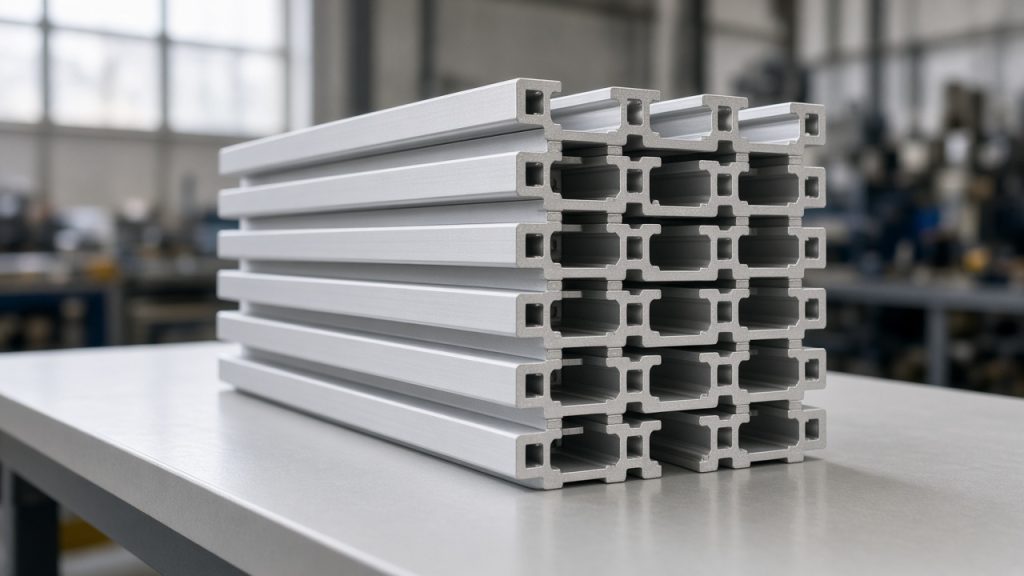
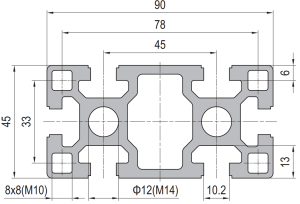
Read a metric T-slot code as millimetres: the first pair is one side of the envelope, the second pair is the other, so 3030 is 30 × 30 mm and 4080 is 40 × 80 mm. The series (20, 30, 40, 45, 50) usually fixes the slot mouth — 6 mm on 20 series, 8 mm on most 30 and 40 series, 10 mm on 45 series and many heavier frames — which is what decides hardware. For a worked mass and stiffness figure, a 45 × 90 mm six-slot 6063-T5 bar is 4.10 kg/m with I ≈ 68 cm⁴ on the strong axis. Pick series by load band and slot first; treat catalogue names such as PG40 as branded 40-series lines until you have a dimensioned section, not as proof of interchange.
What does 2020 mean in aluminium extrusion
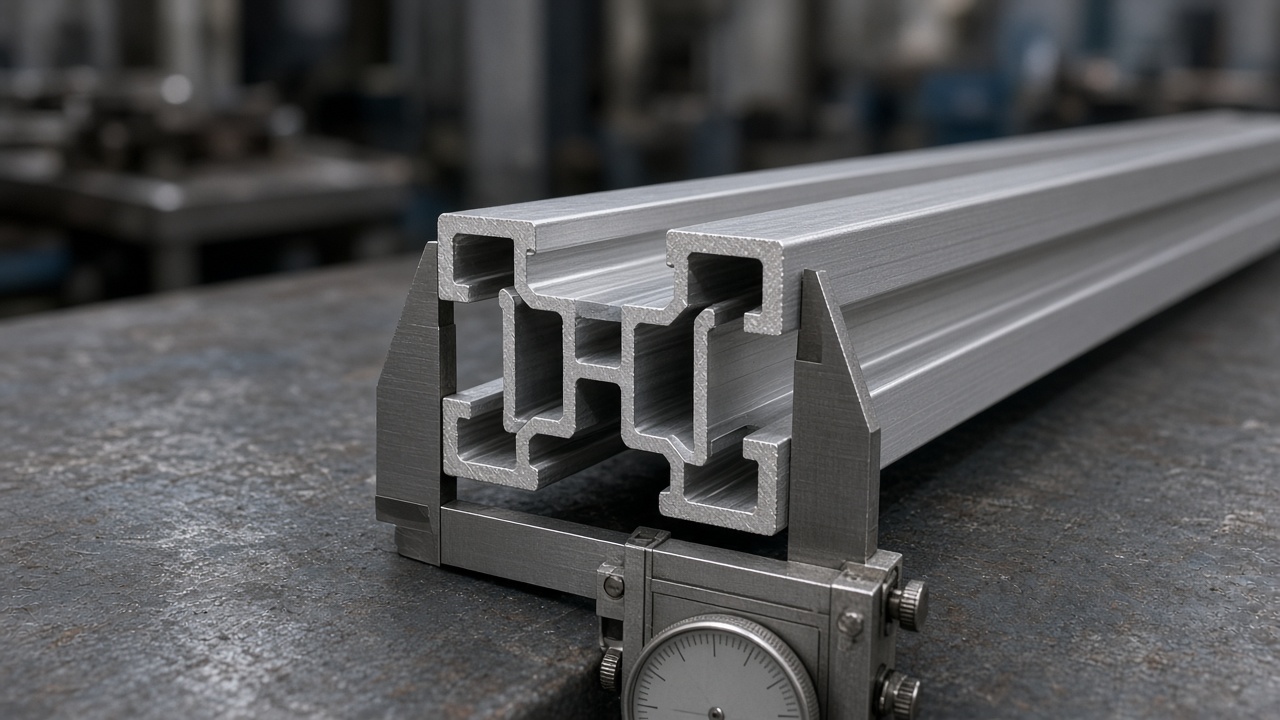
2020 means a 20 × 20 mm square envelope on the metric naming system; the same pattern scales to every common square and rectangular code.
The first two digits are one outer side in millimetres and the second two digits are the other. Rectangular bars keep the series slot: a 2040 uses the same 6 mm mouth as a 2020, and a 4080 usually shares the 8 mm mouth of a 4040. The name is not a wall thickness, not a mass, and not a hardware guarantee — those come from the section drawing and the slot table. Copy the mapping below onto a first RFQ so purchasing and design use one language.
| Code | Envelope | Typical series / slot | What the digits are | What they are not |
|---|---|---|---|---|
| 2020 | 20 × 20 mm | 20 series / 6 mm | Outer width × height | Wall or kg/m |
| 2040 | 20 × 40 mm | 20 series / 6 mm | Same series, deeper rail | A different nut family |
| 3030 | 30 × 30 mm | 30 series / 8 mm | Outer width × height | Interchange with 20-series hardware |
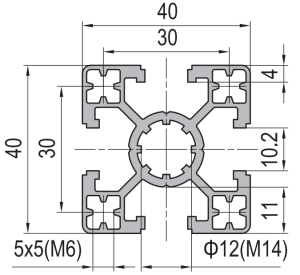
| 4040 | 40 × 40 mm | 40 series / 8 mm (some 10) | Outer width × height | Proof of brand compatibility |
| 4080 | 40 × 80 mm | 40 series / 8 mm | Rectangular envelope | Twice the slot mouth |
| 4545 / 4590 | 45 × 45 / 45 × 90 mm | 45 series / 10 mm | Outer sides in mm | Same nuts as 8 mm systems |
Which series profile to use (by series)
Choose the series by the governing constraint — span, joint load or plant hardware standard — then keep one series across the frame so T-nuts stay interchangeable.
20 series suits short, light members. 30 and 40 series cover most OEM workbenches and machine frames on an 8 mm mouth. 45 series steps the mouth to 10 mm for heavier lips and larger nuts. 50 series is for machine bases and long uprights where mass and I dominate. The table is a selection band, not a substitute for a deflection check: aluminium’s modulus is near 69 GPa, so serviceability usually fails before yield.
| Series | Slot | Typical use | Load band | Verdict |
|---|---|---|---|---|
| 20 series | 6 mm | Fixtures, sensor mounts, light guards, short lab rails | Light; short spans | Use when mass and envelope must stay minimal |
| 30 series | 8 mm | Mid benches, small machine frames, panel posts | Light–medium | Good step up from 2020 without 40-series mass |
| 40 series | 8 mm (some 10) | Industrial workbenches, conveyors, robot fences | Medium; plant default | Default OEM framing series in Europe and export kits |
| 45 series | 10 mm | Heavy benches, welding tables, tall uprights | Medium–heavy | Pick when joint preload and lip thickness matter |
| 50 series | 10 mm class | Machine bases, long gantries, high uprights | Heavy | Use when span and vibration outgrow 40/45 |
A concrete stiffness example: the site’s 45 × 90 mm six-slot 6063-T5 section at 4.10 kg/m with I ≈ 68 cm⁴ sits well above a light 4040 for bending, which is why rectangular 45-series rails appear on long top beams. For metre price and tooling share see how die cost amortises per meter; for order floors see minimum order with a new die.
What is pg40 vs 40 series
PG40 is a catalogue or brand line name for a 40 mm-class profile with a declared accessory set; “40 series” only promises a 40 mm envelope family unless the supplier also states the slot geometry.
Buyers mix the two terms because many Asian catalogues prefix square sections with PG (or similar) and a size digit. That label often implies a matched T-nut, bracket and core-hole anchor kit. A generic 40-series call-out without mouth, undercut and core-hole dimensions does not prove those accessories will fit. Before substituting PG40 hardware onto a generic bar — or the reverse — require a dimensioned section with slot mouth, lip and core hole, then fit-test the actual nut. Envelope, weight and 2026 USD per metre say nothing about interchange. Cross-brand notes live with hardware compatibility; this page only settles the naming confusion.
What is a t-slot aluminium profile used for
T-slot aluminium profiles are used to build reconfigurable industrial frames — workbenches, machine bases, guards, conveyors, test rigs and automation cells — where bolted joints beat welded steel for layout changes.
The continuous slot accepts T-nuts anywhere along the length, so panels, hinges, cable trays and actuators mount without drilling every new hole in the primary members. OEM and integrator buyers specify a series once, then cut and join bars into kits that assemble on site. Typical 6063-T5 framing balances finish quality with adequate strength; move to higher-yield alloys only when the drawing demands it. Secondary work — cut length, holes, taps — turns stock bars into kit members; calendar and die questions sit on die making adds 7–12 days and who owns the die.
RFQ checklist — naming a first profile order
- Envelope code — e.g. 4040 or 45 × 90 mm, written as millimetres.
- Series and slot mouth — 6, 8 or 10 mm, not assumed from the envelope alone.
- Alloy / temper — usually 6063-T5 for framing.
- Mass / I if structural — kg/m and cm⁴ when span governs.
- Hardware set — whether existing nuts/brackets must be reused.
- Finish — mill or anodised, and which faces are cosmetic.
Put both the envelope and the slot mouth on the PO. A “4040” line without “8 mm slot” leaves the fastener ambiguous.
Related on this site
- how die cost amortises per meter — tooling share inside the metre price
- minimum order with a new die — 150 m existing vs 500 m new
- die making adds 7–12 days — calendar before first bars
- who owns the die — tooling title after the trial
Terms used in this article
- Series
- The envelope family (20, 30, 40, 45, 50…) that usually locks the slot mouth and hardware set.
- Envelope
- The outer width × height of the profile in millimetres, as named by codes such as 4040.
- Slot mouth
- The narrow opening at the face of a T-slot; the dimension a nut must pass.
- PG40
- A catalogue or brand line name for a 40 mm-class profile with a declared accessory set, not a universal standard.
- Moment of inertia (I)
- Section property that sets bending stiffness for a given span and load.
Questions buyers ask
What does the first number mean?
On metric codes the first digit pair is one outer side in millimetres and the second pair is the other side. In 4040 both sides are 40 mm; in 4080 one side is 40 mm and the other is 80 mm. The digits never state wall thickness or slot mouth by themselves — those belong on the section drawing.
What is a slot?
A T-slot is the continuous groove along the profile face that accepts a T-nut or panel fastener. The critical width is the mouth at the face (commonly 6, 8 or 10 mm). The undercut behind the lips is what the nut flanges lock into; without that undercut a bolt has nothing to pull against.
What is the difference between series?
Series change the envelope, the usual slot mouth and the load band. 20 series uses a 6 mm mouth for light work; 30 and most 40 series use 8 mm; 45 and many heavy frames use 10 mm. Hardware from one mouth family will not fit another even when the outer sizes look similar in a photograph.
Which series is most common?
For industrial export framing the 40 series with an 8 mm slot is the volume default on workbenches and machine guards. 30 series appears on lighter benches; 45 series appears when joints and spans outgrow 40. Lock one series for the whole cell so nuts and brackets stay interchangeable.
Send the series and slot you intend to standardise
State the envelope code, the slot mouth and whether existing hardware must be reused. We will confirm the section against a dimensioned drawing before you lock the BOM.
Send drawings for reviewRelated reading
Twelve more engineering notes from this blog, picked for this article — plus every category below.
 Engineering DesignAluminium Extrusion Lead Time: New Die vs Existing Die
 ApplicationsHow to Choose the Right 4040 T-Slot Aluminium Profile for Industrial Applications
 Engineering DesignAluminium Profile Sizes: The Four Slot Dimensions That Decide Compatibility
 Engineering DesignAluminium vs Steel, Extruded vs Cast: What Actually Changes
 Engineering DesignSlot Dimensions Explained: 6 mm, 8 mm and 10 mm T-Slots
 ApplicationsAluminium Greenhouse Profiles: A Snow Load Problem With a Condensation Problem
 Materials and EngineeringAluminium Extrusion Section Design: What Each Feature on the Drawing Costs You
 Engineering DesignAluminium Profile Standard Sizes: How the Series Matrix Actually Works
 ApplicationsDesigning Machine Guards and Safety Fences in Aluminium Profile: An ISO 14120 Guide
 ApplicationsESD-Safe Aluminum Profile Workbenches: Why Anodising Alone Fails the Audit
 Quality and InspectionT-Slot Aluminium Profiles for Industrial Frames and Automation: A Specification Playbook
 ApplicationsCleanroom and Medical Framing: There Is No Medical-Grade Aluminium Extrusion
