Aluminium Greenhouse Profiles: A Snow Load Problem With a Condensation Problem
A greenhouse is sold on light, ventilation and yield. It is engineered as a snow-loaded roof on slender posts, with a condensation problem underneath it and a galvanic problem at every place the aluminium touches something else. The profiles are the easy part of that specification.
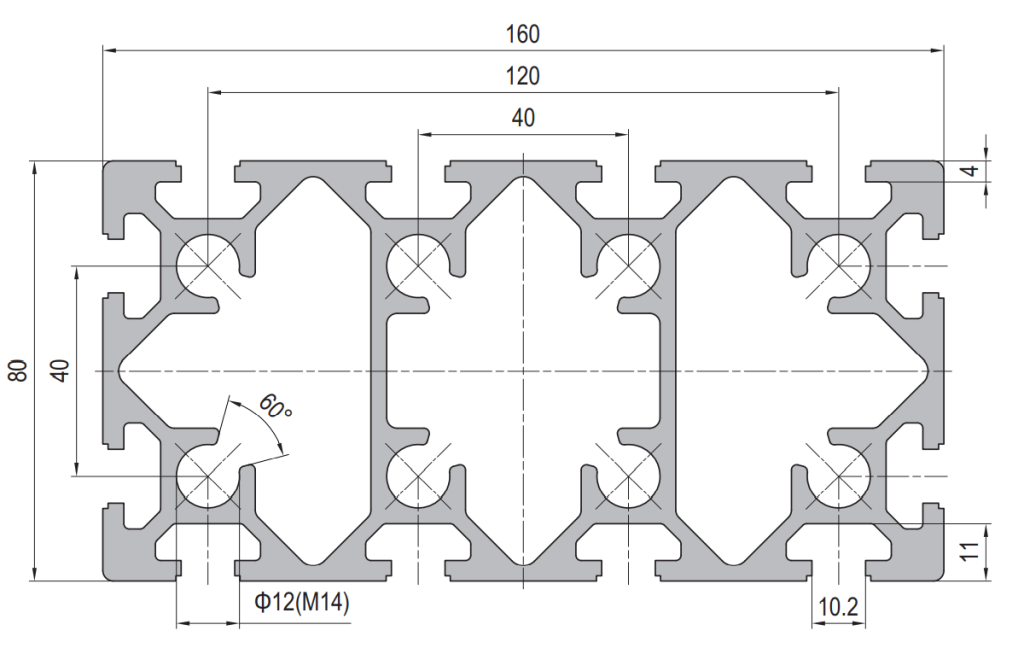
Short answer
A commercial greenhouse is designed as a structure to EN 13031-1, not to the building code used for a warehouse, and the two things that decide the frame are the snow load on the roof and the serviceability limit. Snow does not have to break a rafter to destroy a crop: a few millimetres of extra deflection is enough to pond water at the gutter and pull a glazing bar out of its seal. The aluminium profile itself is rarely the weak element. The weak elements are the glazing bar as a thermal bridge, the gutter as a structural member that is usually treated as a drainage detail, the galvanic couple between aluminium and steel or stainless hardware, and the alkaline attack from concrete and from cleaning chemicals. Since 1 January 2026 aluminium entering the EU also carries a CBAM obligation, so the embedded-emissions data now travels with the order.
A greenhouse is designed to a greenhouse standard, not a building standard
The first thing to settle is which document the structure is designed to. Commercial production greenhouses in Europe are normally designed to EN 13031-1, which sets out principles and requirements for mechanical resistance and stability, serviceability and durability. It is not the same document as the Eurocode route used for an industrial shed, and it does not carry the same partial factors or the same deflection allowances.
The practical difference is that a greenhouse is designed to be light. The structure is deliberately slender because every kilogram of frame is a kilogram of shadow, and because the roof has to transmit light rather than carry a heavy deck. That slenderness is bought back with tight limits on deflection and with a load path that assumes the cladding contributes. A glazed panel is not only a window; in many designs it braces the frame, and once it is removed or replaced with a heavier or lighter sheet, the bracing assumption changes.
So the enquiry has to state the standard the design follows, the design life, and whether the cladding is part of the structural model. A supplier who quotes a profile without knowing those three things is quoting a shape, not a structure.
Snow is the governing load, and it fails progressively
On most European greenhouse sites the roof is designed for snow, and the snow case is not a single event. Snow accumulates, and the way it accumulates matters more than the depth. Drift against a ridge, against a valley gutter, and against a wall all produce local loads well above the uniform blanket case, and a valley between two spans collects from both sides.
The failure mode is what makes this a serviceability problem rather than a strength problem. A rafter that is loaded past its deflection limit sags. Once it sags, the roof plane is no longer a plane, water no longer runs off, and the sag becomes a pond. The pond is a load, and the load increases the sag. In a heated greenhouse the same snow sits on a roof that is melting it from underneath, so the snow load is delivered as water and the roof carries water where it was designed to carry snow. This is why a snow assessment that only checks stress and not deflection is not an assessment.
Two controls follow. The first is to fix a deflection limit before the section is chosen, and to check the ponded case, not only the uniform case. The second is to check the connections: a greenhouse rafter is lightly loaded and its joints are lightly made, and the joint that carries the drift case is often a pair of small brackets in a slot.
| What governs the greenhouse frame | Why it governs | What to do |
|---|---|---|
| Snow, including drift | Local drift loads exceed the uniform blanket, and valley gutters collect from both spans | Check the drift case at ridges, valleys and walls, not only the uniform case |
| Serviceability, not strength | A sag becomes a pond, and the pond becomes more sag | Set a deflection limit and check the ponded condition |
| Gutter as a structure | The gutter collects the roof and spans between posts | Design it as a beam with a drainage function, not as trim |
| Condensation | An aluminium bar is a thermal bridge, so water forms on the coldest face | Specify a thermal break or a drip channel that leads water away from the crop |
| Dissimilar metals | Aluminium against steel or stainless in a wet, chloride-bearing environment | Isolate the joint, or accept a shorter inspection interval |
The glazing bar is a thermal bridge, so the frame drips on the crop
Aluminium conducts heat roughly three orders of magnitude better than glass or polycarbonate. A single-skin glazing bar therefore has a cold inner face in winter, and any moist air that reaches it condenses there. The water then runs down the bar and lands on the crop, which is exactly where it does the most damage: leaf disease, local cold spots and uneven growth.
This is why the glazing bar in a serious greenhouse is not a plain extrusion. It is either thermally broken, with a non-metallic separation between the outer and inner faces, or it is shaped to collect the condensate in a channel and lead it to a gutter instead of letting it drip. Both are profile features, and both have to be specified. A buyer who orders a bar on the basis of its slot and its price has not specified the part that determines whether the house works.
The same logic sets the eave height and the ventilation ratio. Taller eaves give more air volume and a higher condensation point, and a well-designed ridge vent removes the humid air before it reaches the cold bar. Ventilation is a structural requirement as well as an agronomic one, because an open vent is a wind-loaded opening and the mechanism that drives it has to be mounted on something.
The gutter is a structural member that happens to carry water
In a multi-span greenhouse the gutter is the most highly loaded member in the structure. It carries the snow and water from two roof slopes, it spans between the posts, and it also has to be watertight over a length that is measured in tens of metres. Treating it as a drainage accessory is the single most common structural mistake in a greenhouse specification.
Two consequences. First, the gutter section is chosen by bending over the post spacing, and its capacity to carry water is a second, separate calculation. A gutter that is deep enough for the flow and not deep enough for the snow is a winter failure. Second, the joints between gutter lengths are a movement and a sealing problem. Aluminium expands and contracts with temperature, and over a long run the movement is several millimetres; a joint that is rigidly bolted will either leak or crack the seal. The run needs a joint that accommodates movement, and the detail has to say which end is fixed and which end slides.
A question worth settling at enquiry stage
Who owns the structural design? On a greenhouse the frame, the cladding, the gutter and the ventilation mechanism are usually bought from different suppliers, and each one assumes the other has checked the load path. The snow case crosses all four. Ask for the load path in writing before the profiles are ordered, because a profile quotation cannot resolve it later.
Aluminium against steel, concrete and cleaning chemicals
Aluminium does not rust, but it corrodes, and a greenhouse is an unusually good place for it to happen. The environment is permanently wet, often warm, and frequently carries fertiliser salts, which are chlorides and nitrates. Three mechanisms matter.
The first is the galvanic couple. Where aluminium is in electrical contact with steel or stainless steel in the presence of an electrolyte, the aluminium is the anodic member and it corrodes. The rate depends strongly on the area ratio: a small aluminium part against a large steel part corrodes fast, because all of the corrosion current is concentrated into a small area. A galvanised steel gutter bolted to an aluminium post is a classic version of this detail, and so is a stainless bolt in an aluminium slot. The control is to break the electrical contact with an isolating washer or a coated interface, or to accept the couple and shorten the inspection interval.
The second is alkalinity. Aluminium’s protective oxide layer is stable over a pH range of roughly 4 to 9, and it is attacked outside it. Wet concrete, cement dust and many alkaline cleaning agents sit above that range. A profile that is set into a concrete kerb without a separation layer, or washed with an alkaline foam cleaner, loses its oxide layer and then its section.
The third is the cut end. An anodised profile has a protective layer on its faces, but a cut end or a drilled hole exposes bare metal. In a wet greenhouse, that is where corrosion starts, and it is where water enters a hollow section. Sealing cut ends is part of the finish specification, not a workshop preference.
Ventilation, screens and the parts that move
Every moving element in a greenhouse — ridge vents, roll-up screens, shade curtains, sliding doors — is mounted on the frame and loads it. These loads are small individually and they are repeated many thousands of times, which makes them a fatigue question rather than a static one.
Aluminium has no fatigue limit. Unlike steel, there is no stress below which an aluminium detail can be cycled indefinitely without accumulating damage; the S-N curve keeps falling. In practice this means that the design of a vent mechanism has to be judged on the stress range at the joint, not on the peak stress, and that a sharp change of section or a thread in a lightly engaged slot is a fatigue initiation site. The controls are ordinary ones: generous radii, bolts that are preloaded so the joint does not fret, and brackets that spread the load into the profile rather than point-loading a slot lip.
The other moving-part problem is wear at the slot. A slot that carries a sliding shoe will wear, and the wear opens the mouth and reduces the grip of everything else mounted in it. Where a slot is a running track, it should be a dedicated track profile or it should carry a hardened insert, not the same slot that holds the frame together.
What CBAM changed for aluminium bought into the EU
Since 1 January 2026 the EU carbon border adjustment mechanism has been in its definitive period, and aluminium is one of the covered sectors. A European greenhouse builder importing aluminium profiles or finished frame sections is now inside a regime where the embedded emissions of the goods matter, with the first annual declaration and certificate surrender due on 30 September 2027 and certificate sales starting on 1 February 2027.
Two details decide whether this affects a given order. The first is the de minimis threshold: an importer whose annual net mass of the relevant iron and steel, aluminium, fertiliser and cement imports stays under 50 tonnes is outside the obligation. The threshold is annual and per importer, and it aggregates across those sectors, so it is not a free allowance on every shipment. The second is the emissions route. Aluminium sits in the group that currently accounts for direct emissions, and the choice between verified actual values and published default values changes the certificate requirement. A default value is not automatically the cheaper or the more expensive option; it depends on the plant.
For the supplier, the practical consequence is that the emissions data has to be available with the product, tied to the correct production installation and the correct CN code, and reconciled with the invoice net weight. That is a documentation capability as much as a manufacturing one, and it is worth asking about before the first order rather than after it.
How to write the greenhouse enquiry so it can be answered
An aluminium supplier cannot size a greenhouse from a span and a photograph. The information that makes a quotation usable is the same list that makes the design checkable, and it is short. State the design standard and the design life. State the snow and wind loads, or the site, and say whether drift has been considered. State the cladding and whether it is structural. State the post spacing and the gutter run, because those two numbers set the gutter section. State the finish and the environment, including whether fertiliser salts and alkaline cleaning are present. State who owns the structural design.
Everything else — the slot, the alloy, the temper, the cut lengths — follows from those answers. A profile quotation that arrives before them is a price for a shape.
RFQ checklist — greenhouse profiles
- Design standard and life — state EN 13031-1 or the alternative, and the design life in years.
- Snow and wind loads — or the site location; and confirm whether drift at ridges, valleys and walls is included.
- Post spacing and gutter run — these two numbers set the gutter section, which is the most loaded member.
- Cladding type and structural role — glass, twin-wall sheet or film; and whether it braces the frame.
- Thermal break — whether the glazing bar must be thermally broken or drip-channelled.
- Finish and environment — anodic class or powder system; fertiliser salts, coastal chloride, alkaline cleaning.
- Dissimilar-metal details — what the aluminium is bolted to, and whether isolation is required.
- Moving elements — vents, screens and doors, with their loads and cycle counts.
- CBAM data — whether the EU importer needs installation-level emissions data, and in what format.
Ask one question before quoting: has the snow drift case been checked at the valley gutter. It is the member that fails first and the one most often left out of the load path.
Four ways a greenhouse frame fails early
Related on this site
- Solar mounting: uplift, corrosion and a 25-year life— the same wind, galvanic and exposure problem on a light roof
- Choosing a finish by failure mode— how to pick an anodic class or a powder system for a wet environment
- Agricultural framework profile system— the framing range used for protected cropping structures
- Strut profiles category— the structural section range and its load data
Terms used in this article
- Serviceability limit
- The limit on deflection or movement at which a structure stops being acceptable in use, before any question of strength arises.
- Snow drift
- Local accumulation of snow against a ridge, wall or valley, producing loads well above the uniform roof case.
- Thermal break
- A non-metallic separation inside a profile that interrupts the heat path between the cold outer face and the warm inner face.
- Galvanic couple
- Two dissimilar metals in electrical contact in an electrolyte; the more anodic one corrodes, and the rate depends on the area ratio.
- Amphoteric
- A material that is attacked by both acids and alkalis; aluminium’s protective oxide is stable only over roughly pH 4 to 9.
- Embedded emissions
- The greenhouse gases released in producing a good, which the CBAM regime requires to be declared and verified.
Questions buyers ask
Why does my greenhouse drip from the frame in winter?
Condensation on a thermal bridge. Aluminium conducts heat far better than the cladding, so the inner face of a single-skin glazing bar is the coldest surface in the house and moisture condenses there. The fix is a thermally broken or drip-channelled bar, plus enough ventilation to keep the humidity down.
Is snow or wind the governing load on a greenhouse?
On most European sites snow governs the roof, with drift at ridges and valleys producing the highest local loads. Wind governs the cladding, the open vents and the anchorage. The design should state which case governs and confirm both have been checked.
Can I use the same aluminium profiles as an industrial shed?
The profiles may look similar but the design basis is different. A commercial greenhouse is normally designed to EN 13031-1 with tight deflection limits and slender members, because the structure competes with the crop for light. Reusing a shed section usually means an unnecessarily heavy and expensive frame.
How do I stop the aluminium corroding against a steel gutter?
Break the electrical contact with an isolating washer or a coated interface, and keep the aluminium area large relative to the steel where you cannot isolate. In a wet, fertiliser-bearing house, plan an inspection interval rather than assuming no maintenance.
Does CBAM apply to my greenhouse frame order?
Aluminium is a covered sector in the CBAM definitive period that began on 1 January 2026. The obligation sits with the EU importer or their representative, and importers below the 50-tonne annual threshold are outside it. If your importer is above the threshold, expect to be asked for installation-level emissions data.
Send the site and the post spacing
Give us the location or the snow and wind loads, the post spacing and the cladding, and we will propose a frame section with a thermal break and a gutter sized as a beam.
Request a quoteRelated reading
Twelve more engineering notes from this blog, picked for this article — plus every category below.
 ApplicationsCleanroom and Medical Framing: There Is No Medical-Grade Aluminium Extrusion
 Applications20 Series T-Slot Profiles: Where the Limits Actually Are
 Engineering DesignSlot Dimensions Explained: 6 mm, 8 mm and 10 mm T-Slots
 ApplicationsAluminium Profile Applications
 ApplicationsHow Strong Is an Aluminium Profile? It Depends on How You Fix It
 Engineering Design6063 vs 6061 vs 6082 and T5 vs T6: What Changes in Practice
 Engineering DesignCustom Aluminium Extrusion: From Drawing to Production
 Engineering DesignAluminium Extrusion Price per Meter: How the Number Is Built
 Quality and InspectionGood vs Bad Aluminium Profiles: What Your Receiving Dock Can and Cannot Check
 Machine SafetyAluminium Profile Machine Guards: Size the Frame from the Energy, Not from the Mesh
 Materials and EngineeringAluminum Extrusion Tolerances: How to Write a Specification Your QC Team Can Actually Inspect
 Quality and InspectionHow to Choose (and Audit) an Aluminium Extrusion Supplier
