20 Series T-Slot Profiles: Where the Limits Actually Are
The 20 series is the smallest common framing system, and the usual mistake is to treat it as a scaled-down 40 series. It is not. On a 20 series frame the fastener and the slot lip normally govern, and the profile itself is rarely the part that fails.
Short answer
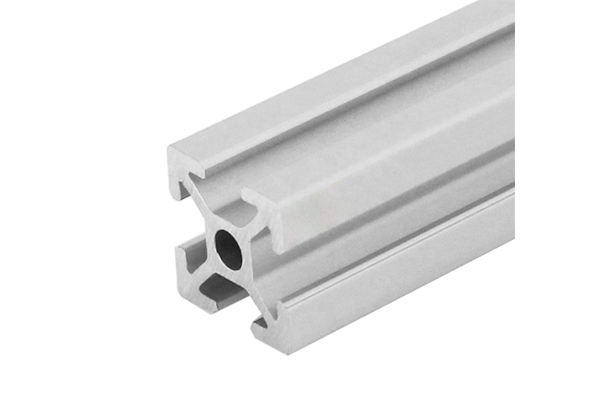
A 20 series profile is defined by its slot interface, not by its outside size. In this system the slot is a 6.2 mm groove with a 6 mm mouth and takes an M6 fastener, and that single fact sets most of the limits. The wall at the slot lip is around 1.5 mm, so a bracket loaded on the lip will deform the slot before the beam yields. The joint, not the beam, is usually the weakest element, because an M6 nut in a 6 mm slot has a finite pull-out and because every connection consumes slot length. And on a section this shallow, deflection over any real span is the number that decides the design. The 20 series is excellent for sensor mounts, small guards, light enclosures, prototypes and 3D printer frames. It is the wrong choice for anything a person leans on.
What “20 series” actually fixes
Series numbers describe a slot family, not a size. A 20 series profile is one whose slot takes 20 series nuts and fasteners. In this range that means a 6.2 mm groove with a 6 mm mouth, and an M6 fastener; the 20 x 20 four-slot section carries about 0.62 kg/m, and a 20 x 40 six-slot section about 0.80 kg/m.
That distinction matters because the same nominal envelope can be built with different slot counts, different slot widths and different wall thicknesses. Published mass for a “2020” varies noticeably between suppliers, and the reason is almost always that the section is not the same section. A lighter quoted weight usually means fewer slots, thinner walls, or both, and the place that shows up first is the slot lip.
So the first question about any 20 series quotation is not the size. It is which slot, which fastener, and what the wall is at the lip.
The slot lip is the thinnest structural element you have
On a four-slot 20 x 20 section the wall at the slot lip is approximately 1.5 mm. That is the material that has to carry any load applied through the slot, and it is doing so as a cantilever off the section body.
The failure mode is not dramatic. A bracket bolted into a slot and loaded outward or sideways puts a bending moment into the lip, and the lip deforms. The visible symptom is a joint that will not stay tight, or a slot that has spread so that a nut no longer seats properly. Nothing has yielded in the beam; the interface has simply been overloaded.
Three details control this. Keep the load close to the section body rather than out at the end of a long bracket. Use a nut that engages as much of the groove as possible, so the load is spread over a longer length. And check the bearing area: a small nut in a shallow groove concentrates the load, which is why the load rating of a 20 series joint is not simply the load rating of the bolt.
The most common 20 series mistake
Sizing the profile for the load and then ignoring the joint. On a small section, the joint is where the capacity actually is, and it is typically the last thing to be checked.
The joint sets the limit, not the beam
Three effects combine at every 20 series connection.
Fastener pull-out. An M6 nut held in a 6 mm slot resists being pulled out by the strength of the lip that retains it, which is a function of groove geometry and wall thickness, not of the bolt’s own strength. This is usually well below the bolt’s tensile capacity.
Preload and how it is achieved. A bolted joint carries load by clamping, and the clamping force depends on the torque applied and on friction. In a small section, the material under the nut is thin, so over-torquing crushes the lip instead of increasing preload. A torque figure chosen for the fastener rather than for the section is a reliable way to damage a frame during assembly.
Slot consumption. Every joint occupies slot length. On a small frame the members are short and the slot is finite, so the number of joints and accessories a member can carry is genuinely limited. This is a design constraint that only appears on a 20 series frame; on a larger section there is usually enough slot to spare.
Where the load is significant, the reliable arrangement is to take it out of the slot entirely: through-bolt with a nut on the far side, or a bracket that bears on the outside face rather than on the lip.
20 x 20, 20 x 40 and a 40 x 40 with 20 series slots
There are three sensible ways to use this slot family, and they are not interchangeable.
| Section | Mass (approx.) | What the extra material buys | Right for |
|---|---|---|---|
| 20 x 20, four slot | 0.62 kg/m | Nothing extra: smallest practical square | Sensor mounts, small guards, brackets, prototypes |
| 20 x 40, six slot | 0.80 kg/m | Depth in one plane only | Rails and beams where bending is in a known direction |
| 40 x 40 with 20 series slots | 1.05 kg/m | Depth in both planes, thicker flange, M6 corner taps | Frames that must stay square and carry a real panel |
The 20 x 40 point deserves emphasis. A rectangular section is only stiff in the direction of its greater depth. Loaded the other way it behaves like the narrow dimension, and it will surprise anyone who assumed the larger number applied in all directions. Rotating the section is free; getting it wrong is not, because the frame has to be taken apart to fix it.
The third row is the useful discovery for many projects. Staying inside the 20 series slot family while moving to a 40 x 40 envelope keeps one accessory system, one fastener size and one set of spares, and adds roughly 70 per cent more mass for a much larger gain in stiffness in both axes. It is often cheaper overall than a 20 x 20 frame that needs extra bracing to become stiff enough.
Deflection at this scale is not a detail
Deflection depends on the depth of the section cubed, so a small change in depth produces a large change in stiffness. That works in your favour when you go up a size, and against you when you stay small over a long span.
The practical test is simple: divide the span by the depth. A member whose span is many times its own depth will look and behave like a flexible member, however strong it is. On a 20 series frame, a span of a metre on a 20 mm deep section is already a long span by that measure, and it will sag visibly under even modest load.
The consequence is that 20 series frames usually need support points closer together than people expect, or a change to a deeper section. Adding intermediate supports is often the cheapest fix, and it is worth checking before moving to a heavier profile, because it reduces the span rather than increasing the section.
Where it belongs, and where it does not
The 20 series earns its place in light, precise, frequently changed assemblies: sensor and camera mounts, small safety guards, enclosures for electronics, laboratory fixtures, prototypes and 3D printer frames. In these applications its low mass is a genuine benefit and the loads are small and known.
It does not belong where a person leans or sits, where a machine vibrates, where a load is applied at the end of a lever, or where the frame carries a heavy panel. In those cases the failure is not a clean break; it is a joint that loosens, a slot that spreads, and a frame that slowly loses its squareness. Moving to a 30 or 40 series section is the honest answer, and the cost difference is small compared with the cost of a rebuild.
One more point about the ladder: going up a series does not automatically buy a bigger fastener. In this system the 20 series and the 30 series both take M6; the step to M8 comes with the 40 series. So if the reason for moving up is a stronger bolt, the move has to be two steps, not one.
What to send with a 20 series enquiry
RFQ checklist — 20 series frames
- Load and where it is applied — at the joint, at the end of a lever, or distributed; the location matters as much as the magnitude.
- Longest unsupported span — and whether intermediate supports are acceptable.
- Bending direction — decide it before choosing a rectangular section.
- Joint type — slot nut, through-bolt or external bracket, and the torque you intend to apply.
- Slot budget — how many accessories each member has to carry, so slot length can be checked.
- Accessory system — whether you are staying inside one slot family or mixing.
- Environment and finish — the 20 series is often used indoors; say so if it is not.
- Tolerance on cut lengths — on a small frame, a millimetre of cut error shows as a racked rectangle.
Ask one question before quoting: what is the longest span with no support in the middle. It sets the section far more often than the total load does.
Five ways a 20 series frame disappoints
Related on this site
- Sizes from 20 x 20 to 100 x 100: what fails first— the same question across the whole range
- How the series matrix actually works— why series numbers describe slots, not sizes
- PG20 20 x 20 four-slot profile— the section used as the example here
- The slot mouth is the interface standard— why the mouth, not the groove, decides compatibility
Terms used in this article
- Series
- A slot family: the 20 series is defined by its slot and fastener size, not by the outside dimensions of the profile.
- Slot mouth
- The narrow opening of the T-slot at the profile surface, which sets the largest fastener that can pass through.
- Slot lip
- The thin wall between the slot mouth and the internal groove; it carries loads applied through the slot.
- Pull-out
- The load at which a nut or fastener is drawn out of a slot, governed by the groove geometry and lip thickness.
- Preload
- The clamping force induced in a bolted joint by tightening; it is what actually carries the load.
- Span-to-depth ratio
- The unsupported span divided by the section depth; a quick indicator of whether a member will behave flexibly.
Questions buyers ask
Is 2020 strong enough for a machine frame?
For a small enclosure or a guard, usually yes. For a frame that carries a machine, vibrates, or has unsupported spans of a metre or more, no. The failure is not a break but a joint that loosens and a frame that loses squareness.
Why do two suppliers quote different weights for 2020?
Because the sections differ. Slot count, slot width and wall thickness all vary within the same nominal envelope. A lighter section usually has less material at the slot lip, which is exactly where the load goes.
Can I use M8 bolts in a 20 series slot?
No. The mouth is 6 mm, so an M8 bolt will not pass through it. The 20 series takes M6 in this system, and so does the 30 series; M8 arrives with the 40 series.
Which way round should a 20 x 40 go?
With its 40 mm depth in the direction of bending. It is only stiff across the deep axis, and loaded the other way it behaves like a 20 mm section. Decide before assembly, not after.
How much load can a 20 series joint take?
It depends on the groove, the lip thickness and the nut, not on the bolt alone. Treat the nut pull-out as the governing number and check it against your load, including any lever arm.
Send the span and the load point
Tell us the longest unsupported span, where the load lands and which way the section bends, and we will tell you whether the 20 series is right or whether one step up is the cheaper answer.
Request a quoteRelated reading
Twelve more engineering notes from this blog, picked for this article — plus every category below.
 ApplicationsAluminium Workstations: From Fixed Benches to Reconfigurable Cells
 Engineering DesignT-Slot Aluminium: The Slot Mouth Is the Interface Standard, Not the Series Name
 ApplicationsESD-Safe Aluminum Profile Workbenches: Why Anodising Alone Fails the Audit
 Engineering DesignHow to Request a Quote for Custom Aluminium Extrusion (RFQ Checklist)
 Engineering DesignExtruded vs Cast Aluminium: Stronger in One Direction, Not in All of Them
 ApplicationsAluminium Profiles in Solar Mounting: Wind Uplift, Corrosion and a 25-Year Life
 ApplicationsCleanroom and Medical Framing: There Is No Medical-Grade Aluminium Extrusion
 Engineering DesignStandard vs Custom Aluminium Extrusion: The Break-Even Calculation
 Sourcing and ProcurementAluminium Profile MOQ: 150 m Existing Die, 500 m New
 Quality and InspectionEuropean Anodised Aluminium Specification: What Should a Purchase Order Contain?
 Quality and InspectionGood vs Bad Aluminium Profiles: What Your Receiving Dock Can and Cannot Check
 Sourcing and ProcurementDistributor Terms: Territory, Margin and Price Protection
