How to Request a Quote for Custom Aluminium Extrusion (RFQ Checklist)
A complete custom extrusion programme typically runs 30–40 days to first load with a new die and anodising, or 12–20 days on an existing die and mill finish — drawing review, tooling, press, finish and packing in that order.
Short answer
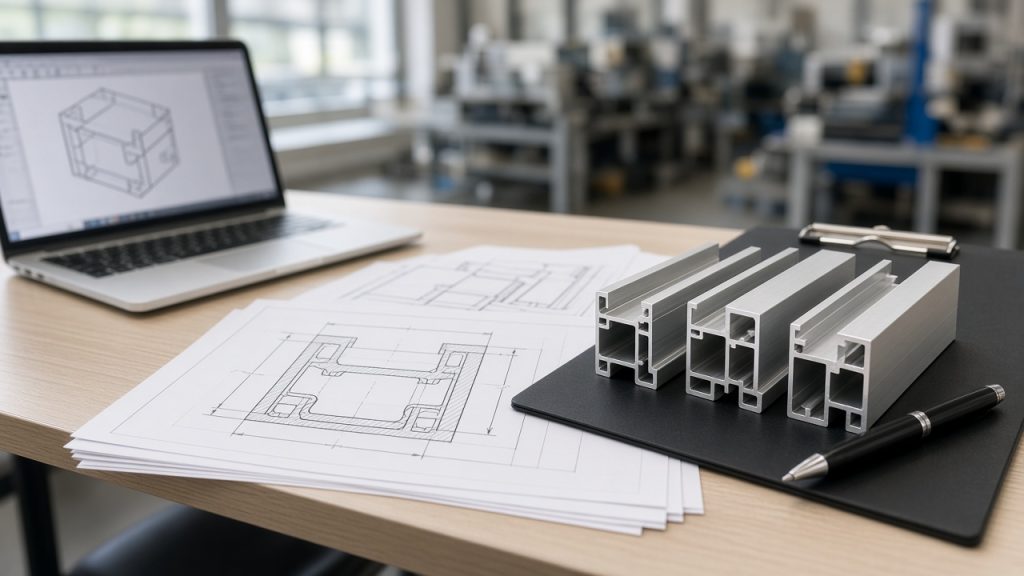
Send a dimensioned section in PDF, DWG, DXF, STEP or IGES, name alloy and temper, finish, cut lengths, quantity, die status and Incoterm. That pack lets a factory quote metal, process, finish, packing and tooling as separate lines. Compare two quotations on those lines plus validity dates and lead stages, not on a single “per metre” cell. Price validity on aluminium extrusion quotations is usually 7–14 days because billet tracks the metal market; lock metal or reconfirm before the window closes. Machining after extrusion holds cut length ±0.5 mm, hole position ±0.2 mm and end square within 0.3 mm when those call-outs are on the drawing.
What information do you need to quote a 2020 profile
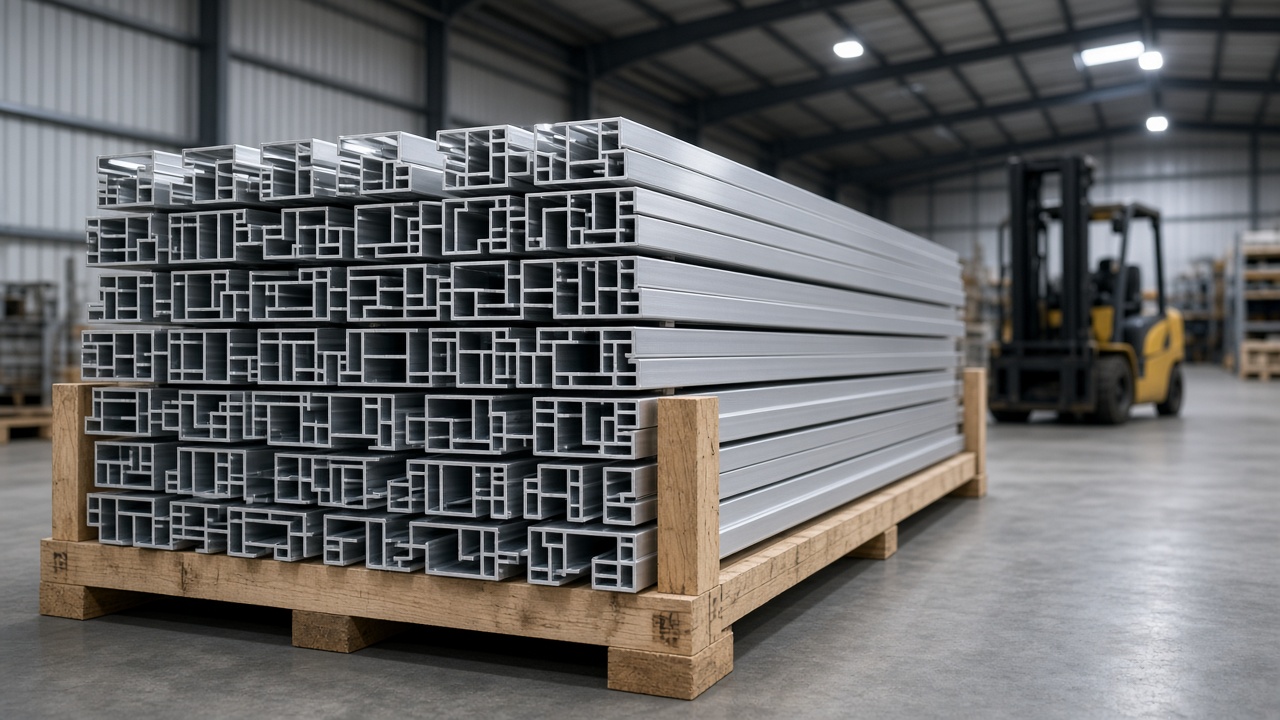
To quote a 2020 (or any catalogue T-slot) we need the section code or DXF, alloy/temper, finish, cut length and tolerance, quantity, and whether the die already exists.
A bare “quote 2020” email forces assumptions on finish and length that reverse rankings later. The same checklist applies when the variable is 3030, 4040 or a custom envelope: swap the section, keep the fields. Drawing review comes first; we will not cut a new die from a sketch without a dimensioned section and revision letter.
| Field | What to send | Why it moves the quote | If missing |
|---|---|---|---|
| Section | 2020 code or DXF/PDF | Locks kg/m and press size | Quote delayed |
| Alloy / temper | Usually 6063-T5 | Billet and ageing cost | Defaulted, then reworked |
| Finish | Mill / silver / black / powder | Bath and rack time | Mill assumed wrongly |
| Cut length | Stock bar or cut list ±0.5 mm | Yield and packing | 6.02 m bar assumed |
| Quantity | Metres or tonnes | Price step and MOQ gate | Spot sample economics |
| Die status | Existing or new | Tooling + 7–12 days die time | Existing-die price misapplied |
| Incoterm / port | FOB / CIF / DAP / DDP | Freight and risk split | FOB-only comparison trap |
How do i compare two quotations for 2020 profile
Compare quotations line by line on metal, process, finish, packing, tooling, validity and lead stages — never on one blended metre price alone.
Two sheets that look USD 0.15/m apart can reverse once anodising, cut-list yield and FOB versus DAP are aligned. Use the matrix below for any catalogue section; only the section row changes when you swap 2020 for 4040. Ask whether the die charge is amortised into the metre or shown once, and whether the validity clock has already started.
| Line to compare | What “equal” means | Common mismatch | Buyer check |
|---|---|---|---|
| Metal / kg | Same alloy and billet basis date | One quote hedges, one spots | Ask the metal date |
| Process / kg | Same press recovery assumption | Scrap buried in process | Ask recovery % |
| Finish | Same colour and film build | Mill vs silver mixed | Match the call-out |
| Packing | Same export cradle / case | Domestic pack vs ISPM 15 | Ask pack photo |
| Tooling | Shown once or amortised clearly | Hidden in metre rate | See die ownership note |
| Lead stages | Die / press / finish split | Single “4 weeks” blob | Demand stage dates |
| Validity | Same calendar window | 7 vs 30 days | Reconfirm before PO |
What is the price validity period on an aluminium extrusion quotation
Most factory extrusion quotations stay valid for 7–14 days in 2026 because billet follows the metal market; beyond that window reconfirm metal before you issue a PO.
Process, finish and packing lines move more slowly than metal, but a sheet that bundles everything into one metre price hides which part expired. Contract programmes can fix a metal formula (LME/SHFE plus conversion) for months while leaving process firm. If your internal approval cycle is longer than two weeks, say so in the RFQ so the quote can carry a formula instead of a spot number. Die charges, once paid, are not subject to the metal validity clock.
How do i request a quotation for custom aluminium extrusion
Request a custom extrusion quote by sending the drawing pack, commercial quantities and Incoterm in one message, then expect drawing review before tooling or press time is booked.
Sequence that works: (1) controlled 2D section plus 3D if useful; (2) alloy, finish, lengths, tolerances; (3) prototype and annual quantities; (4) die new or existing; (5) FOB Shanghai/Ningbo or CIF/DAP/DDP with named place. Drawing review catches thin walls, impossible hollows and missing datums before steel is cut. New-die programmes land in the 30–40 day band to load with anodising; existing-die mill-finish repeats sit in 12–20 days. Die making itself adds 7–12 days inside the new-die path — see die making adds 7–12 days. Amortisation of that tool is covered under how die cost amortises per meter; MOQ gates under minimum order with a new die; title under who owns the die.
RFQ checklist — custom aluminium extrusion
- Drawings — PDF/DWG/DXF plus STEP/IGES; revision letter; critical dims marked.
- Material — alloy and temper, or performance targets if open.
- Finish — mill, anodising colour, or powder RAL; cosmetic faces.
- Secondary ops — cut ±0.5 mm, holes ±0.2 mm, end square 0.3 mm, CNC notes.
- Quantity — sample, first lot, annual metres or tonnes.
- Die — new or existing; who pays; who owns.
- Commercial — Incoterm, port, target load week, certificates needed.
Send one complete pack. Partial emails produce partial quotes that cannot be compared.
Four ways an RFQ stalls
Related on this site
- how die cost amortises per meter — tooling inside the metre number
- minimum order with a new die — 150 m vs 500 m gates
- die making adds 7–12 days — calendar inside the 30–40 day path
- who owns the die — title after the trial bar
Terms used in this article
- RFQ
- Request for quotation: the drawing and commercial pack a factory needs to price a job.
- Drawing review
- Engineering check of walls, hollows, tolerances and finish before die steel is cut.
- Price validity
- Calendar window during which quoted metal and process numbers still hold.
- Incoterm
- Rule that splits freight, insurance and risk (FOB, CIF, DAP, DDP).
- First article
- Sample bars from the production die used to approve fit and finish before the bulk lot.
Questions buyers ask
What do you need from me to start?
A dimensioned section (PDF, DWG, DXF, STEP or IGES), alloy and temper, finish, cut lengths, quantity in metres or tonnes, and the Incoterm with destination. Mark critical dimensions. With that package we return a line-item quote and a manufacturability note; missing finish or quantity is what usually stalls the first reply.
Can I approve a sample first?
Yes. Off-tool or first-article bars can ship before the production lot. Approve slot fit, finish colour and cut length on the sample, then release the balance. Sample lead time sits inside the new-die or existing-die window quoted for the order.
What happens if my drawing changes?
A revision after die trial usually means a die rework or a new tool, plus a fresh sample. Small machining-only changes on an existing die are cheaper. Freeze the section before the die is cut whenever possible; call out revision letters on every file you send.
How do I track the order?
After deposit we share the stage dates: die (if new), press, finish, packing and ETAs against the Incoterm. You get the booking once the 70% balance clears before shipment, or against L/C at sight terms on the order confirmation.
Send the drawing pack and quantity in one file set
Attach PDF/DWG/DXF (and STEP if you have it), name finish, metres, die status and Incoterm, and we will return a staged quote with validity dates before any die steel is cut.
Request a quoteRelated reading
Twelve more engineering notes from this blog, picked for this article — plus every category below.
 Engineering DesignAluminum Corner Brackets for T-Slot Frames: How to Choose by Load Path, Not by Looks
 Engineering DesignHow to Choose the Right T-Slot Aluminium Profile Size
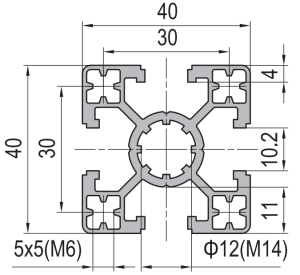 Engineering Design4040 T-Slot Aluminium Profile for Machine Frames: Choose It by Deflection
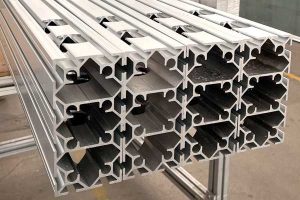 Engineering DesignAluminum vs Steel Machine Frames: Choose by Deflection, Not by Strength
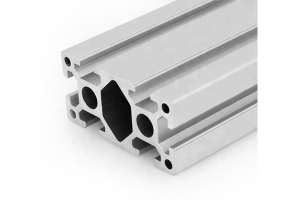 Engineering Design4080 vs 4545 Aluminium Profile: Which for Your Frame
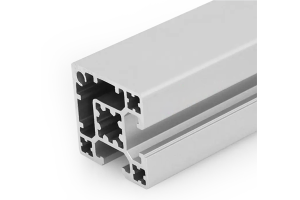 ApplicationsAluminium Workbench Fit-Out: When the Accessories and the Joints Compete for the Same Slot
 Engineering DesignAluminium Profile Sizes: The Four Slot Dimensions That Decide Compatibility
 ApplicationsAluminium Profile Stairs and Platforms: The Geometry and Load Rules Behind Them
 Quality and InspectionEuropean Anodised Aluminium Specification: What Should a Purchase Order Contain?
 ApplicationsAluminium Profiles in Solar Mounting: Wind Uplift, Corrosion and a 25-Year Life
 ApplicationsCleanroom and Medical Framing: There Is No Medical-Grade Aluminium Extrusion
 ApplicationsESD-Safe Aluminum Profile Workbenches: Why Anodising Alone Fails the Audit
