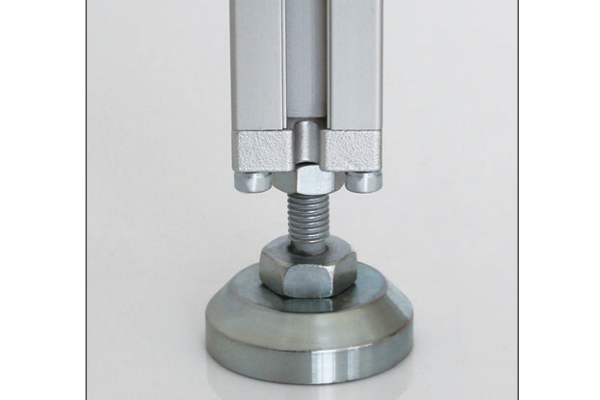
Metal Pivot Foot
Heavy-duty levelling foot with a steel or stainless pivot joint and base, for frames that have to carry a high static load, resist a side load or work close to heat.
| Material | Zinc-plated steel or stainless steel base and joint |
|---|---|
| Alloy Grade | Not applicable |
| Temper | custom |
| Section Size | Fits profile ends with M12-M24 thread insert |
| Slot | M12 / M16 / M20 / M24 stem thread |
| Length | Stem 60-120 mm; overall height 85-230 mm |
| Tolerance | ±0.4 mm on thread pitch diameter |
| Surface | Zinc plated 8-12 µm; stainless 304 / 316 |
| MOQ | 100 |
| Lead Time | 20-30 days after deposit |
| Loading Port | Shanghai / Ningbo |
| Supply Ability | 40,000 pcs per month |
| Payment Terms | T/T 30% deposit + 70% before shipment | L/C at sight |
| Trade Terms | FOB | CIF | EXW |
| Certifications | ISO 9001:2015 | ISO 14001 | RoHS | REACH |
Levelling feet · Heavy duty
A metal pivot foot uses a steel or stainless steel joint and base rather than a polymer one. It does the same levelling job — the joint lets the pad sit flat on an uneven floor — but it carries a far higher load, it does not creep, it takes a side load without deforming, and it works close to heat.
The foot is the last component in the load path between the frame and the floor, so on a heavy installation it is the part that decides whether the load reaches the slab evenly or concentrates on one edge. Where a frame weighs several tonnes, or where the equipment on it vibrates, the metal foot is the only sensible choice.
Where the metal foot earns its cost
On a light bench the difference between a polymer and a metal foot is small and the polymer foot is cheaper. On a heavy frame the difference becomes structural. Three load cases separate them.
| Load case | What happens to a polymer foot | What the metal foot does |
|---|---|---|
| Sustained heavy static load | Creeps — the frame slowly sinks on one corner | Holds the setting indefinitely |
| Side load from a moving frame | Pad deforms and the joint opens up | Takes the shear through the steel base |
| Vibration from machinery | Damps well, but the joint wears at the pivot | Resists wear; damping handled by a separate pad |
| Heat near a process | Softens above about 90 °C | Unaffected well beyond 200 °C |
| Point load on a hard floor | Pad flattens over time | Spreads the load without deforming |
The joint: ball, pivot or plain
- Ball joint — the stem ends in a ball that seats in a socket in the base. It absorbs angle in any direction and is the most forgiving on a frame that is out of square.
- Single-axis pivot — a pin joint that tilts in one plane. It is stronger than a ball joint for a given base size and is used where the frame geometry is known and the angle is small.
- Plain (fixed) — no joint at all. The pad is machined flat and the frame has to be square. This is the strongest and cheapest option and the right one for a frame built on a jig.
Base options and the floor
Practical point: on a frame over about two tonnes, the foot is no longer a catalogue item — it is a load path that should be checked. Send us the frame weight, the number of legs and the centre of gravity, and we will return the stem size, the base diameter and the floor bearing pressure.
Material and finish
- Choose the base material Zinc-plated steel is standard. Stainless 304 is used for wash-down and outdoor installations; 316 where chlorides or cleaning chemicals are present.
- Choose the stem thread M12 to M24 are standard for heavy feet. A longer stem gives more adjustment range but less stiffness, so the stem should be no longer than the adjustment actually needed.
- Decide the joint Ball for a frame that is out of square, pin for a known geometry, plain for a frame built on a jig.
- Specify the floor interface A steel pad on a concrete slab is fine. On a coated floor or a raised deck, add an elastomer pad or a load-spreading plate so the point load is spread.
- Add the anchoring if required Drilled base plus anchor bolts where the frame must be secured. The bolt type follows the floor build-up.
Frequently asked questions
How much load can a metal pivot foot take?
Up to about 5,000 kg per foot on the largest M24 size, static. A dynamic or vibrating installation should be derated to about half that, and the three-foot rule still applies for a four-leg frame.
Will the steel pad damage a concrete floor?
Not under normal load, but a very high point load can spall a weak screed. Where the floor is a thin screed or a coated finish, add a load-spreading plate or an elastomer pad under the foot.
Is a metal foot noisier than a nylon one?
Yes. A metal foot transmits more vibration between frame and floor. Where that matters, use an anti-vibration base with a bonded elastomer pad rather than a plain metal pad.
Can the foot be supplied in stainless?
Yes, in 304 or 316. Use 316 where chlorides or aggressive cleaning chemicals are present, and match the anchor bolts to avoid galvanic corrosion.
Do I need a locking nut?
Yes, on any frame that vibrates. The nut locks the stem against the profile end so the levelling setting cannot walk.
Send the frame weight and the centre of gravity
Tell us the frame weight, the number of legs and where the mass sits. We will return the stem size, base diameter, joint type and floor bearing pressure, with FOB pricing within one working day.
Request a QuoteRelated Products
 Cup Pivot Foot
Levelling foot moulded as a shallow cup that the profile end seats into, giving…
 Fixed Foot with Profile Base
Non-adjustable foot that bolts to the profile end at a fixed height, giving higher…
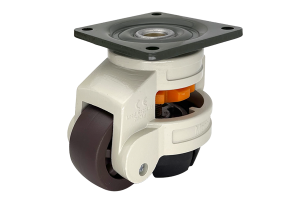 Levelling Castor
Combined castor and levelling foot: move the frame on the wheel, then wind the…
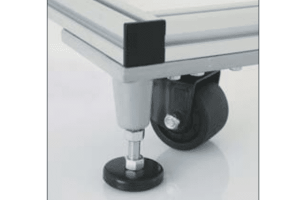 Foot and Castor Components
Spare and replacement components for foot and castor installations — pads, stems, locking nuts,…
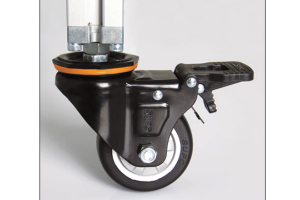 Aluminium Profile Castors
Castors for aluminium profile frames in seven configurations — plate fixed, swivel, braked and…
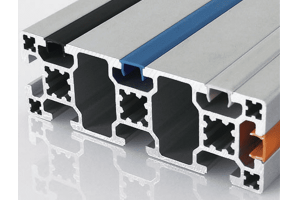 T-Slot Cover Profile
Snap-in T-slot cover strip that closes the open slot on aluminium framing profiles, giving…
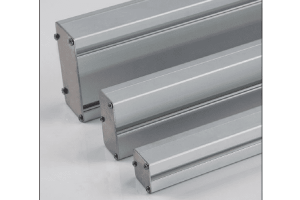 Aluminium Conduit End Cap
Snap-fit or screw-fixed end caps for aluminium conduit profiles from 40x40 to 80x200 mm,…
 Aluminium Profile End Cap
Push-fit end caps for T-slot framing profiles from 15 to 60 series, sized to…
