Radius Corner Aluminium Profile 45×45 mm Quarter Round Trim Section
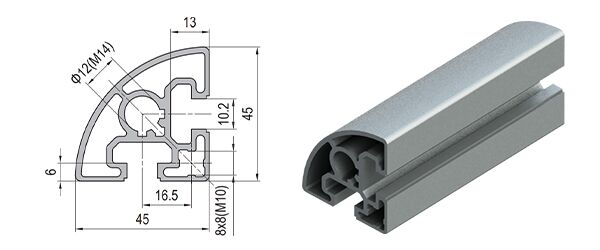
45 x 45 mm quarter-round radius corner aluminium trim section in 6063-T5 with an outer radius, two 90 degree seating faces, an 8 x 8 mm M10 groove and a O 12 mm bore tapped M14. A non-structural trim for enclosure, stand and railing corners.
| Material | Aluminium |
|---|---|
| Alloy Grade | 6063-T5 |
| Temper | T5 |
| Section Size | 45 x 45 mm quarter round |
| Slot | 8 x 8 mm fixing groove taking M10 T-slot nuts |
| Length | 6 m stock, cut and mitred to drawing to plus or minus 0.5 mm |
| Tolerance | EN 755-9 / GB/T 6892, wall plus or minus 0.12 mm |
| Surface | Mill finish / clear anodised / black anodised / powder coated |
| MOQ | 600 |
| Lead Time | 18-28 days after deposit for mill finish |
| Loading Port | Shanghai / Ningbo |
| Supply Ability | 350 t per month |
| Payment Terms | T/T 30% deposit + 70% before shipment | L/C at sight |
| Trade Terms | FOB | CIF | EXW |
| Certifications | ISO 9001:2015 | EN 755-9 | RoHS | REACH |
Radius trim · 45 series
A radius corner profile is a quarter-round aluminium trim section measuring 45 x 45 mm, with an outer radius, two flat seating faces set at 90 degrees to each other and a wall of about 1.6 mm. It weighs about 1.15 kg/m. It is not a structural member: it carries no load, it is never used as a frame member and it is not part of the stiffness calculation. Its job is to close the outside corner where two flat surfaces of an enclosure, a display stand, a railing or a machine cover meet, so that the corner is a smooth radius instead of a sharp edge.
There are two reasons to do that. The first is appearance and safety: a 45 mm radius reads as a designed corner rather than a cut one, and it removes the sharp edge that otherwise sits at hand or hip height. The second, and in food, pharmaceutical and laboratory equipment the decisive one, is cleaning: a 90 degree corner cannot be wiped or washed properly, while a radius can. The section is supplied mill finish or anodised, cut to length, and fixed to the structure with M10 T-slot nuts in its own groove or a through-bolt in its M14 bore.
It is a trim section, not a structural member
This distinction matters because the section looks like a profile and is bought from the same catalogue as a profile, and it is easy to treat it as one. It has no slots for connectors, no centre bore for through-bolting a frame and a 1.6 mm wall that dents under a hammer. It should never appear in a load path, and it should never be the member that holds two panels apart.
The correct arrangement is that the structure does the work and the trim does the finish. Where a corner needs both, put the stiffness inside the joint with an angle bracket or a joining plate on the structural profiles, and fit the radius trim on the outside afterwards to cover the joint. The trim then hides the fasteners as well as the corner, which is usually why it is specified in the first place.
The hygiene argument, in one table
In hygienic equipment design the question is not whether a surface can be reached but whether it can be cleaned. Corners are where that is decided, because a sharp corner holds residue and wash water and a radius does not.
| Corner treatment | Corner geometry | Cleanable | Typical use |
|---|---|---|---|
| Butt joint, square cut | sharp 90 degrees | No, residue collects | Machine bases, non-hygienic frames |
| Machined chamfer | small flat, hard corner | Partly, still a dirt trap | General industrial frames |
| Radius corner trim, this section | 45 mm radius, joint enclosed | Yes, wipeable in one pass | Enclosures, stands, railings, covers |
| Fabricated radius, filled and painted | varies with the workmanship | Depends on the finish | Architectural and exhibition work |
Practical point: the trim encloses the joint line between the two structural members rather than sealing it. If the enclosure has to be washdown-rated, the seal still has to be made inside, behind the trim, with a gasket on the structural profiles. The trim improves the cleanability of the outside surface; it is not a seal.
How it fixes to a structural profile
- Seat the two flat faces on the frame The two seating faces are set at 90 degrees and are intended to sit flat against the two outer faces of the structural profile or against a profile and a panel. Any gap here shows as a shadow line along the whole length, so check the frame faces are flat and clean before fitting.
- Load the T-slot nuts before assembly The 8 x 8 mm groove in the seating face takes M10 T-slot nuts, and they have to be slid in from the end of the trim. Fit them as the trim is offered up, not afterwards, because once the trim is against the frame there is no access to the groove.
- Pull it up at sensible centres Fixings at 300 to 400 mm centres hold the trim evenly without bowing it. At 1.6 mm wall thickness the trim will follow a curved frame if it is pulled hard at the ends only, and it will not recover.
- Use the M14 bore for the heavy fixing The O 12 mm bore tapped M14 takes a through-bolt or a threaded rod where the trim has to be pulled hard against the frame, for example at the ends of a long run or where a bracket sits behind it. It is also the fixing to use where the groove is obstructed.
- Bolt it, do not bond it Adhesive gives a cleaner visible face but makes the trim permanent. On a machine cover or an exhibition stand the trim is the part most likely to be damaged, and a bolted trim can be replaced in minutes without dismantling the frame. Reserve bonding for trims that will never be struck.
Cutting, mitring and finishing
The trim is normally supplied cut to length with mitred ends so that two runs meet at a corner. Mitres are cut on the CNC machining centres we use for the rest of the frame, and the cut edges are deburred and, where the frame is anodised, touched in so the raw aluminium is not exposed at the joint.
Finish is where most of the value of a trim section sits. Because it is the most visible part of the assembly, it is usually anodised to match the frame: clear anodising for a natural silver frame, black for a dark one. Anodising is a batch process, so a trim order placed separately from the frame order can arrive in a slightly different shade. Order the trim and the frame together and specify that they are anodised in the same batch. Where a colour match to a painted housing is needed, powder coating is the alternative, and it covers the mitre joints more forgivingly than anodising does.
Frequently asked questions
Is a radius corner profile strong enough to use as a frame member?
No. It is a trim section with a 1.6 mm wall, no connector slots and no frame geometry, and it should never be part of a load path. Build the frame from structural profiles, put the stiffness in the joint with a bracket or a plate, and fit the trim on the outside to finish the corner.
What is the radius corner trim used for?
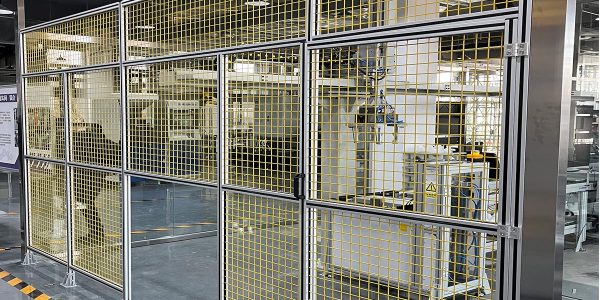
Closing the outside corners of machine covers, enclosures, control cabinets, display stands, exhibition counters and railings. It gives the corner a 45 mm radius instead of a sharp edge, which improves appearance and safety and makes the surface wipeable.
How does it attach to the frame?
The 8 x 8 mm groove in the seating face takes M10 T-slot nuts, which are slid in from the end of the trim and tightened at 300 to 400 mm centres. A O 12 mm bore tapped M14 gives a heavier through-bolt fixing where the trim has to be pulled hard against the frame.
Does the trim seal the corner?
No. It encloses the joint line but does not seal it. If the enclosure has to be washdown-rated, the seal is made behind the trim with a gasket on the structural profiles. The trim improves the cleanability of the outside surface.
Can you supply it cut, mitred and anodised to match the frame?
Yes. We cut to plus or minus 0.5 mm, mitre the ends on CNC centres, deburr and touch in the cut edges, and supply mill finish, clear anodised, black anodised or powder coated. Send DWG, DXF, STEP or PDF and we will quote the trim and the frame together so they can be finished in one batch.
Send the corner detail, get a trim and finish quotation
Tell us the outer radius you want, how the trim will be fixed and which finish the frame carries. We will confirm the section and the fixing groove, quote the mitred cut list, and supply the trim anodised in the same batch as the frame so the shade matches.
Request a QuoteRelated Products
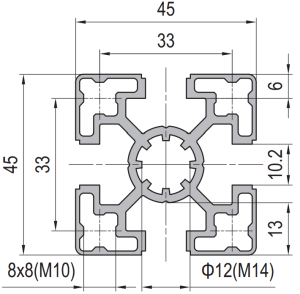
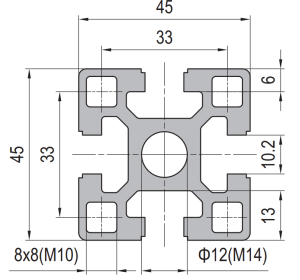 Strut Aluminium Profile 45×45 mm 4-Slot Heavy Duty T-Slot Extrusion
45 x 45 mm heavy duty four-slot T-slot strut aluminium profile in 6063-T5 with…
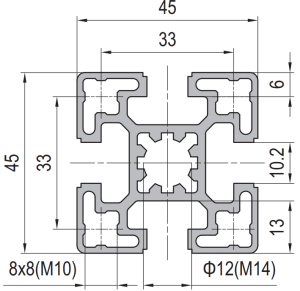
 Strut Aluminium Profile 45×45 mm 4-Slot Light T-Slot Extrusion
45 x 45 mm light wall four-slot T-slot strut aluminium profile in 6063-T5 with…
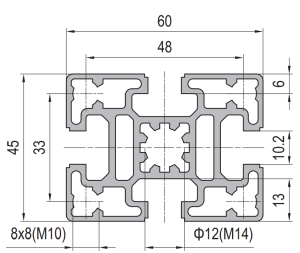
 Strut Aluminium Profile 45×45 mm 4-Slot Standard T-Slot Extrusion
45 x 45 mm four-slot standard T-slot strut aluminium profile in 6063-T5 with walls…
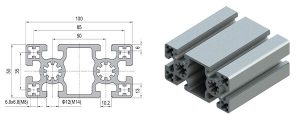
 Strut Aluminium Profile 45×60 mm 4-Slot Column T-Slot Extrusion
45 x 60 mm four-slot rectangular T-slot strut aluminium profile in 6063-T5, about 3.3…
 Strut Aluminium Profile 50×100 mm 2-Slot Heavy T-Slot Beam Extrusion
50 x 100 mm heavy two-slot T-slot strut aluminium beam in 6063-T5, about 6.2…
 50 x 50 mm Four Slot Aluminium Strut Profile Heavy Frame Cross Member
50 x 50 mm four slot T-slot strut aluminium profile in 6063-T5, about 3.1…
 60 x 60 mm Four Slot Aluminium Strut Profile Main Machine Frame Column
60 x 60 mm four-slot T-slot strut aluminium profile in 6063-T5, about 4.3 kg/m…
 Strut Aluminium Profile 60×60 mm Heavy Duty T-Slot Extrusion M16 Bore
60 x 60 mm heavy duty four-slot T-slot strut aluminium profile in 6063-T5 with…
