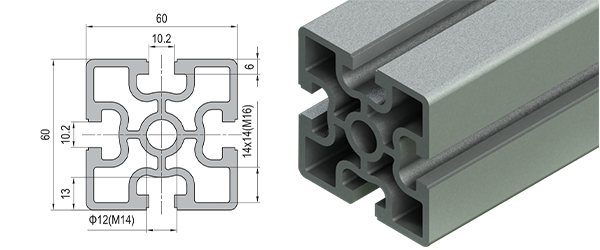
Strut Aluminium Profile 60×60 mm Heavy Duty T-Slot Extrusion M16 Bore
60 x 60 mm heavy duty four-slot T-slot strut aluminium profile in 6063-T5 with walls about 3.6 mm, a 14 x 14 mm groove taking M16 slot fixings and a O 12 mm centre bore tapped M14. About 6.4 kg/m and about 38 cm4, for joints that have to hold a large bolt without yielding.
| Material | Aluminium |
|---|---|
| Alloy Grade | 6063-T5 |
| Temper | T5 |
| Section Size | 60 x 60 mm |
| Slot | 10.2 mm mouth, 14 x 14 mm groove, M16 slot fixings, 4 faces, 48 mm pitch |
| Length | 6 m stock, cut to drawing to +/-0.5 mm |
| Tolerance | EN 755-9 / GB/T 6892, wall +/-0.15 mm |
| Surface | Mill finish / clear anodised / black anodised |
| MOQ | 300 |
| Lead Time | 25-35 days after deposit for mill finish |
| Loading Port | Qingdao / Shanghai |
| Supply Ability | 300 t per month |
| Payment Terms | T/T 30% deposit + 70% before shipment | L/C at sight |
| Trade Terms | FOB | CIF | EXW |
| Certifications | ISO 9001:2015 | EN 755-9 | RoHS | REACH |
Heavy wall · 60 series
A 60 x 60 heavy duty four-slot strut profile is the same 60 mm square envelope as the standard 60 x 60, extruded with walls of about 3.6 mm instead of about 2.4 mm. That raises the weight from about 4.3 kg/m to about 6.4 kg/m and the second moment of area from about 26 cm4 to about 38 cm4. The slot geometry is unchanged: a 10.2 mm mouth over a 14 x 14 mm groove, on a 48 mm pitch, with a O 12 mm centre bore tapped M14.
It exists for joints that carry more load than a standard wall can hold. The 14 x 14 mm groove takes a slot fixing with an M16 thread, the largest in the range, and an M16 bolt tightened to about 210 Nm develops roughly 83 kN of clamp against about 12 kN for an M8 at 25 Nm. The wall is what stops the slot lips yielding under that clamp, so the heavy section is bought for the joint rather than for the span. Where the load is dynamic, where a joint has to resist an overturning moment, or where a single fixing must carry the whole connection, it is the correct starting point.
What the extra wall actually changes
On the same envelope, wall thickness is the least efficient way to buy stiffness and the only way to buy joint strength. Both effects are present here and it is worth separating them. Adding 1.2 mm of wall raises the second moment of area by about 45 per cent, which matters over a long column or a loaded span but is not transformative. What it does transformatively is the local stiffness of the slot lips and the wall around the bore, and that is what sets how much clamp load a joint can hold before the aluminium deforms and the fixing goes loose.
The two are related but not the same purchase. A designer who needs stiffness should compare this section against a deeper one, because depth buys far more stiffness per kilogram. A designer who needs a joint that will not work loose under a big bolt, a vibrating load or a reversing moment has no cheaper option than more wall around the fixing.
| Property | 60 x 60 standard | 60 x 60 heavy |
|---|---|---|
| Envelope | 60 x 60 mm | 60 x 60 mm |
| Wall thickness | approx. 2.4 mm | approx. 3.6 mm |
| Slot mouth and groove | 10.2 mm / 14 x 14 mm | 10.2 mm / 14 x 14 mm |
| Slot pitch | 48 mm | 48 mm |
| Centre bore | O 12 mm, tapped M14 | O 12 mm, tapped M14 |
| Second moment of area | approx. 26 cm4 | approx. 38 cm4 |
| Compression area | approx. 15.9 cm2 | approx. 23.7 cm2 |
| Euler buckling load, 2 m pinned | approx. 44 kN | approx. 65 kN |
| Weight | approx. 4.3 kg/m | approx. 6.4 kg/m |
| Weight of a 6 m bar | approx. 25.8 kg | approx. 38.4 kg |
| Slot fixing class | M8 – M10 | up to M16, loaded from the member end |
Roughly 45 per cent more stiffness, 49 per cent more weight. That ratio is why the heavy section is not sold as a general upgrade. If the frame needs to be stiffer, a deeper section wins on weight every time. If the joint needs to hold a large bolt without the aluminium yielding around it, nothing else in the 60 mm envelope will do it.
When a large bolt is the right answer
A joint fails for one of three reasons, and a bigger bolt addresses only the first two. Working through which one applies is faster than arguing about section size.
What swaps with the standard 60 x 60, and what does not
The two sections share a die family and an accessory range, and almost everything above the surface is interchangeable. Both use the 10.2 mm mouth, the 48 mm pitch, the 14 x 14 mm groove and the O 12 mm centre bore tapped M14, so slot nuts, brackets, joining plates, feet, panel blocks and cover strip are the same parts. A bolt length worked out for a standard 60 x 60 is correct for the heavy section, because groove depth is unchanged.
What does not swap is anything the wall thickness touches.
- Same: 60 mm envelope, 48 mm slot pitch, 10.2 mm mouth, 14 x 14 mm groove, O 12 mm bore tapped M14, and the entire 60-series accessory range.
- Different: wall thickness, weight, second moment of area and compression area. A 6 m heavy bar weighs about 38.4 kg against about 25.8 kg, so handling, bundle size and freight weight all change with the order.
- Different: the maximum slot fixing. The groove takes M16 fixings in the heavy section because the wall can hold their preload. In the standard section the same groove is normally limited to M8 and M10 in practice.
- Not interchangeable in a calculation: substituting a heavy member for a standard one makes it stiffer, which in a redundant frame makes it attract more load. Substituting a standard member for a heavy one reduces the capacity of the joint it was bought for. Neither substitution is a like-for-like change.
- Not interchangeable on site: the two look identical once assembled and anodised. They are distinguished by weight and by a caliper on the wall, not by eye, so mixed deliveries must be labelled by assembly and by wall.
Keep one wall thickness per frame. Mixing heavy and standard columns in the same frame changes the load path: the stiffer column takes a larger share of the load, and a calculation that assumed equal sharing no longer describes what is standing on the floor. If one column needs heavy wall, the safest answer is heavy wall for all of them.
Specifying and receiving the heavy section
- Put the wall thickness and the weight on the order line Standard and heavy 60 x 60 are drawn identically in a 2D layout and differ by about 2.1 kg/m. An order that says only 60 x 60 four slot will be supplied from whichever die is running, so state the wall and the target weight per metre.
- Ask for the measured weight on the first article About 6.4 kg/m is a planning number. Because the section is bought for local strength around the fixings, a die that runs light is strength that was not delivered. Ask for the measured weight and the wall check on the first article.
- Say which fixings will be used If the joint will use M16 slot fixings, tell us at the enquiry stage. It changes the groove gauge check and, where the fixing is loaded from the member end, it may change which ends are deburred and chamfered.
- Decide the bore detail early The O 12 mm centre bore takes an M12 through-bolt or an M14 thread tapped into the end. Both are machining operations, so put the thread callout and the depth on the drawing rather than discovering the requirement at assembly.
- Plan the handling A 6 m heavy bar at about 38.4 kg is a two-person lift and a bundle of fourteen is a trolley job. If the frame is assembled on a mezzanine or in a clean room, ask for the members cut and bagged by assembly so nothing heavy is handled twice.
Frequently asked questions
Do heavy and standard 60 x 60 use the same accessories?
Yes. Both use the 10.2 mm slot mouth, the 48 mm slot pitch, the 14 x 14 mm groove and the O 12 mm centre bore tapped M14, so slot nuts, brackets, joining plates, feet and panel blocks are the same parts and bolt lengths are the same.
Can I mix heavy and standard 60 x 60 in one frame?
Mechanically yes, and it is sometimes done to strengthen one overloaded column. Structurally it is a design decision rather than a free upgrade, because the stiffer column takes a larger share of the load. Where one column needs heavy wall, specify heavy wall for the frame.
What is the difference in stiffness?
About 38 cm4 against about 26 cm4, roughly 45 per cent, for about 49 per cent more weight. Over a 2 m column with pinned ends the elastic buckling load is roughly 65 kN against roughly 44 kN.
How much heavier is it to handle?
About 6.4 kg/m against about 4.3 kg/m, so a 6 m bar is about 38.4 kg against about 25.8 kg. Bundles and freight weights change accordingly, and cut lengths are normally bagged by assembly to avoid double handling.
Can you supply it cut, tapped and anodised to a drawing?
Yes. We cut to plus or minus 0.5 mm, deburr, face the ends square, tap the O 12 mm centre bores M14, drill and counterbore to drawing, and supply mill finish, clear anodised or black anodised.
Tell us the joint, not just the section
Send the joint detail with the bolt size, the preload or the torque you intend to use, and the loads the connection has to carry. We will tell you whether the heavy wall is needed for the joint or whether the standard 60 x 60 will hold it, then quote the section, the tapping, the finish and FOB pricing with the members cut, end faced and bagged by assembly.
Request a QuoteRelated Products
 PG15 Strut Aluminium Profile 15×15 mm Light T-Slot Extrusion
PG15 15 x 15 mm single-slot T-slot strut aluminium profile in 6063-T5, about 0.48…
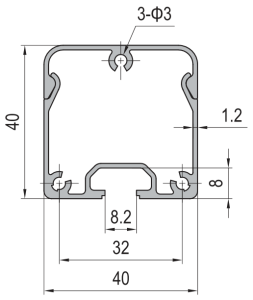 Aluminium Conduit Profile 40×40 mm Cable Duct T-Slot Enclosure
40 x 40 mm aluminium conduit profile in 6063-T5 with a 32 x 8.2…
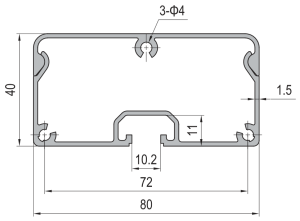 Aluminium Conduit Profile 40×80 mm Large Cable Duct Enclosure
40 x 80 mm aluminium conduit profile in 6063-T5 with a 66 x 11…
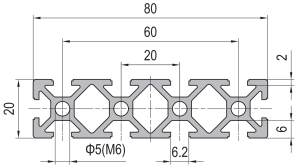 PG20 80×20 mm Ten Slot Aluminium Strut Profile Wide Flat Beam for Cable Tray and Panel Support
80 x 20 mm ten slot PG20 aluminium strut profile in 6063-T5 with a…
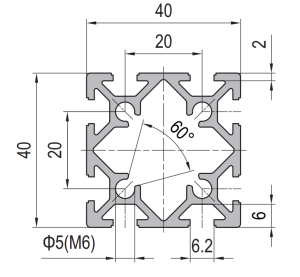 PG20 40×40 mm Eight Slot Aluminium Strut Profile 20 mm Pitch T-Slot Extrusion for Dense Fixtures
40 x 40 mm eight slot PG20 aluminium strut profile in 6063-T5 with two…
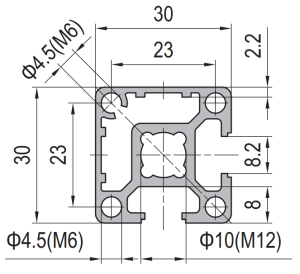 PG30 30×30 mm Two Slot Type A Aluminium Strut Profile Closed Face T-Slot Extrusion
30 x 30 mm Type A two slot PG30 aluminium strut profile in 6063-T5…
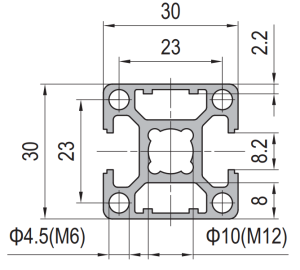 PG30 30×30 mm Two Slot Type B Aluminium Strut Profile Symmetric T-Slot Extrusion for Corner Posts
30 x 30 mm Type B two slot PG30 aluminium strut profile in 6063-T5…
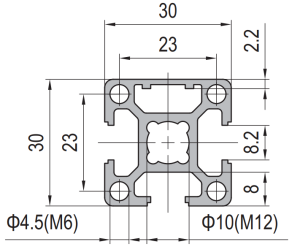 PG30 30×30 mm Three Slot Aluminium Strut Profile Light Frame Column
30 x 30 mm aluminium strut profile with three 8.2 mm T-slots and one…
