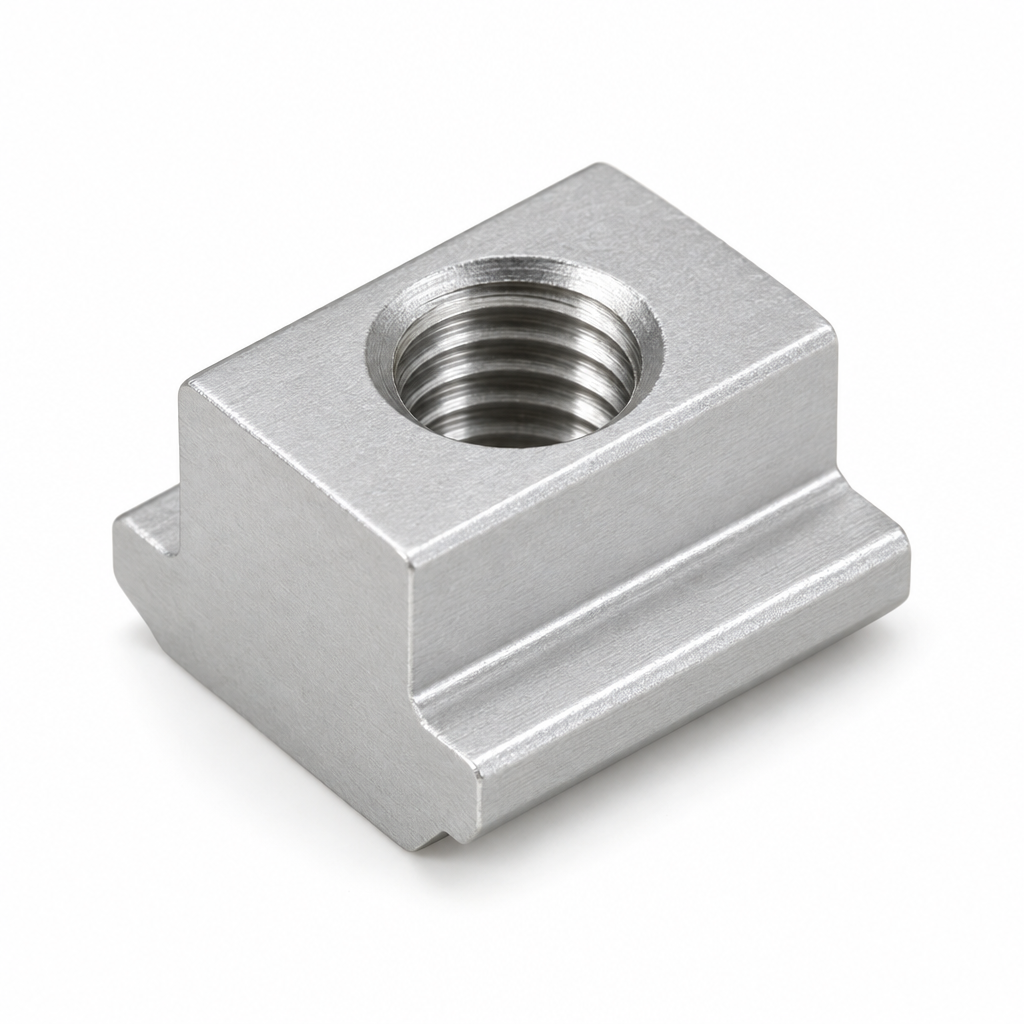
T-Slot Nut 20 Series M5 Hammer Nut for 20×20 Aluminium Extrusion
M5 hammer-head T-slot nut for the 6 mm groove of 20 x 20 mm aluminium extrusion, in slide-in and post-install quarter-turn form, carbon steel zinc plated or 304 stainless. Working torque about 3 N m.
| Material | Carbon steel / 304 stainless steel |
|---|---|
| Alloy Grade | Grade 8.8 equivalent carbon steel / A2-70 stainless |
| Temper | custom |
| Section Size | M5, for 20 series 6 mm slot |
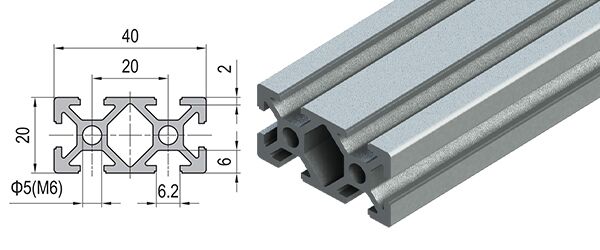
| Slot | Fits 6 mm slot mouth, 10.0 mm groove cavity, 4.3 mm groove depth |
| Length | 10 mm body length along the slot |
| Tolerance | Thread to ISO 965-2 6H, head width -0.2 mm on the groove cavity |
| Surface | Zinc plated (clear trivalent) / passivated stainless |
| MOQ | 5000 |
| Lead Time | 10-18 days after deposit for zinc plated, 15-22 days for 304 |
| Loading Port | Shanghai / Ningbo |
| Supply Ability | 8 million pieces per month |
| Payment Terms | T/T 30% deposit + 70% before shipment | L/C at sight |
| Trade Terms | FOB | CIF | EXW |
| Certifications | ISO 9001:2015 | ISO 965-2 thread | RoHS | REACH |
Fastening elements · 20 series · M5
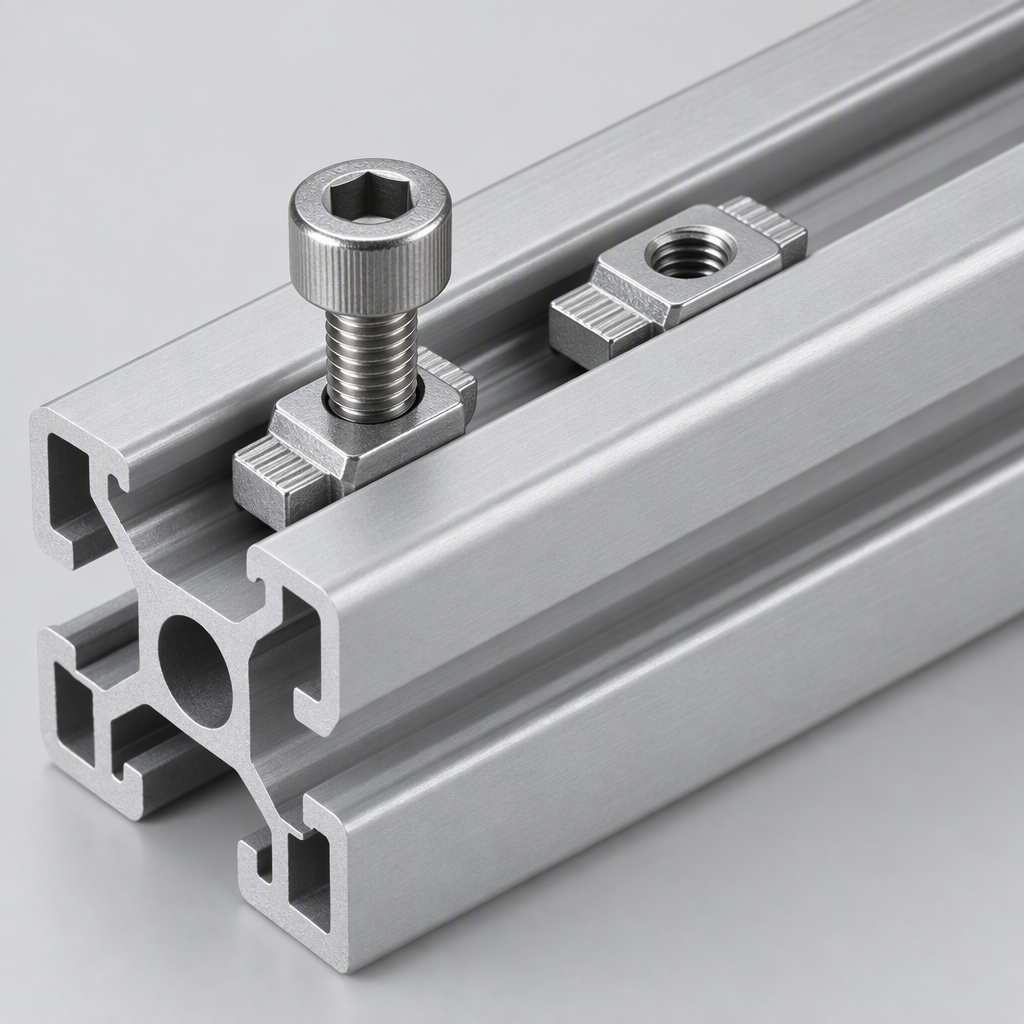
A 20 series T-slot nut is a hammer-head nut with an M5 thread that sits in the 6 mm groove of a 20 x 20 mm aluminium extrusion. You get it into the slot, run a cap screw down into it, and the head of the nut is trapped behind the two lips of the slot, so tightening the screw pulls the nut against those lips instead of spinning it. One nut and one M5 screw is the whole fixing that holds a bracket, a hinge, a panel clip or a sensor mount onto a 20 series frame.
The size is what sets the limit, and the limit is not the thread. An M5 screw in a 10 mm nut has around 8 mm of engagement, while each lip of a 6 mm slot is only about 1.2 mm thick. Those two numbers describe the whole capability of the fixing: an empirical working torque near 3 N m and a pull-out load of a few hundred newtons. Push past that and one of two things gives way — the screw strips the nut thread, or the slot lips deform and the nut loses its grip on the section. Both are preventable, and which one you meet depends almost entirely on how the nut went into the slot.
Where an M5 nut sits in the 20 series system
Twenty series is the light end of the T-slot family: a 20 x 20 mm envelope with a 6 mm slot, used for guards on small machines, sensor and camera brackets, display frames, light assembly benches and covers. Everything about the system is scaled down, and the fasteners are scaled with it. An M5 nut weighs about 2.5 g in steel and carries a fraction of what a 40 series M8 nut carries, which is the correct trade for a frame whose members are 20 mm square.
The consequence for the buyer is that the accessory range is smaller than it is in 40 series, and the fixings are less forgiving. There is no centre bore to fall back on in most 20 series sections, so the slot nut is not one option among several — it is the connection. The rest of the fastening elements and connecting elements range for 20 series is dimensioned around the same 6 mm groove, which is why a nut bought to the wrong groove cannot be made to work by choosing a different bracket.
| Feature | 20 series slot | M5 T-slot nut |
|---|---|---|
| Slot mouth | 6 mm nominal | 5.7 mm neck, sliding fit in the mouth |
| Groove cavity | 10.0 mm across | 9.6 mm head, retained by the lips |
| Groove depth | approx. 4.3 mm | 3.6 mm head thickness |
| Thread | not tapped | M5 x 0.8 ISO metric coarse |
| Body length | along the slot | 10 mm |
| Unit weight | steel | approx. 2.5 g |
| Working torque | empirical | approx. 3 N m |
| Pull-out, one nut | lip limited | approx. 250 to 400 N |
Pre-install or post-install, and why it decides the build order
There are two ways to get a nut into a 6 mm slot and they are not interchangeable once the frame is assembled. The first is to slide it in from the open end of the extrusion before the end is capped. The second is to hold the nut with its long axis across the slot, drop the head through the 6 mm mouth, and rotate it a quarter turn so the head lies along the groove. The first uses the cheapest nut and the second uses a nut made for the job, and choosing the wrong one shows up late in the build.
On a 20 series frame this matters more than it does on a heavy frame, because the members are short and the frames are often closed on every side. A guard frame assembled and then fitted with a mesh panel has no open end left to slide a nut in from, so a panel clip added at that stage has to be a post-install fixing. Ordering the wrong type is not a small error on a light frame: it means either dismantling the corner or drilling a hole in a 20 mm member, and neither is what the drawing called for.
The build sequence is a purchasing decision. A slide-in nut costs less than a post-install nut, but it forces the frame to be assembled around its fixings. Decide which faces will ever need a new bracket, and buy the post-install type for those faces at the enquiry stage rather than paying for it later in rework.
The two ways a small M5 fixing fails
A light fixing does not fail gradually, it fails at one of two places. The first is the thread: an M5 nut in a 10 mm body has a short column of engagement, and if the screw is over-tightened or reused, the thread in the nut shears and the screw turns freely. The second is the slot itself. The lips of a 6 mm slot are thin, and the load from the nut head is concentrated on two narrow strips; tighten far enough and the aluminium yields, the lips flare, and the nut no longer has anything to bear against. From that point the fixing looks tight but slides under load.
There is also a slow version of the second failure that has nothing to do with over-tightening. Aluminium creeps under a sustained load at quite modest stress, so a joint that is correct on day one can lose a little preload over months of vibration, and once the preload is gone the nut is free to walk along the slot. On a light frame this is rarely dangerous, but it is the reason a re-check of the fixings is part of routine maintenance on equipment that shakes.
| Torque applied to an M5 screw | What usually happens |
|---|---|
| 1 to 2 N m | Secure joint, nut seated, no marking of the slot |
| about 3 N m | Working ceiling, lip starts to take a visible impression |
| 5 to 6 N m | Lip deforms, nut bearing area reduces, joint slackens later |
| 8 N m and above | Thread strips in the nut or the lips flare open |
- Thread stripped in the nut: screw reused many times, or a torque wrench set for M6 used on an M5 screw.
- Slot lip crushed or flared: nut tightened until the aluminium yielded, usually on the softer 6063 sections.
- Nut rotated in the slot: a screw longer than the groove depth bottomed out and pushed the nut off its seating.
- Corrosion staining at the joint: a stainless nut in an aluminium slot in a wet environment without a barrier between the two metals.
Material, and the small weight difference that is not small
The standard nut is carbon steel, zinc plated, and for indoor equipment that is the right choice: it is the cheapest, it has the hardest thread and it will outlast the frame. 304 stainless is specified where the frame is washed down, sited outdoors or exposed to condensate, because the zinc on a plated nut is the first thing to go. 316 is reserved for chloride or chemical exposure, where 304 alone will pit. Aluminium nuts exist mainly for two reasons: to remove the galvanic couple between the nut and the profile, and to save weight on a frame that is handled or moved.
The weight point is worth a number on this size. A steel M5 nut is about 2.5 g and an aluminium one is under 1 g, so on a display frame with two hundred fixings the difference is roughly 300 g. That is not a structural argument, but on a portable or suspended frame it is a real one. The cost of an aluminium nut is a weaker thread, so it belongs on light joints tightened by hand feel, not on a joint that will be torqued repeatedly.
Ordering, price and lead time
We supply the M5 20 series nut in carbon steel zinc plated and in 304 stainless, in both the slide-in and the quarter-turn post-install form, packed in bags of 500 or in bulk cartons. The minimum order is 5,000 pieces per material and type, and mixed orders across the two types are priced on the combined quantity. Unit price falls sharply with volume because these are cold-formed parts, so a 500,000 piece order is a fraction of the price of the minimum order.
Lead time is 10 to 18 days after deposit for zinc plated stock and 15 to 22 days for 304, which needs its own run. Trade terms are FOB, CIF or EXW, payment is T/T 30 % deposit with the balance before shipment, or an L/C at sight. OEM and ODM are both available: we can mark the head with your part number, supply the nut on a custom head width to suit a non-standard groove, or produce a special length for a deep bracket, and we will quote from a sample or a dimensioned sketch.
Frequently asked questions
Will an M5 nut from another supplier fit my 20 series profile?
Only if the groove matches. The 20 mm envelope is widely copied, but the mouth width and the cavity across the groove are not. Send us the section drawing and we will confirm whether our nut retains in your slot, or make the nut to your groove dimensions instead.
What torque should I tighten an M5 T-slot nut to?
Around 3 N m as a working figure, and treat it as an empirical number rather than a standard. It depends on the groove and on how much of the nut length is engaged, so a short nut in a thin-lipped section tolerates less. Tighten by feel on a sample joint first and check that the lips are not marking.
Can I add a fixing to a frame that is already assembled?
Yes, with the post-install nut. It drops through the 6 mm mouth turned across the slot and rotates into place, so a bracket or a panel clip can be fitted to a finished frame without opening a corner. The slide-in type cannot be added after the member ends are capped.
Do you supply these in stainless for outdoor use?
Yes, in 304 as standard and in 316 on request. For a wet or outdoor 20 series frame, 304 is normally enough; specify 316 only where chlorides or chemicals are present. Where appearance matters, an aluminium nut removes the two-metal joint altogether.
What is the minimum order and the lead time?
5,000 pieces per material and type, mixed freely across the two nut types. Lead time is 10 to 18 days after deposit for zinc plated and 15 to 22 days for 304, with FOB, CIF or EXW terms and T/T or L/C payment.
Tell us the groove and the build sequence
Send the 20 series section drawing and say whether the frame is assembled before or after the fixings go in, and we will quote the slide-in or the post-install nut accordingly. Give us the material, the quantity and the head marking you need, and we will come back with unit pricing, the packing and the FOB lead time for a trial order.
Request a QuoteRelated Products
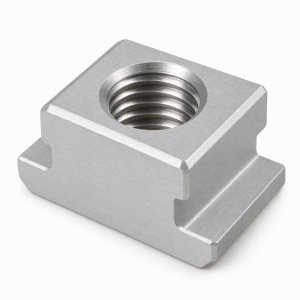
 T-Slot Nut 30 Series M6 Hammer Nut for 30×30 Aluminium Extrusion
M6 hammer-head T-slot nut for the 8 mm groove of 30 x 30 mm…
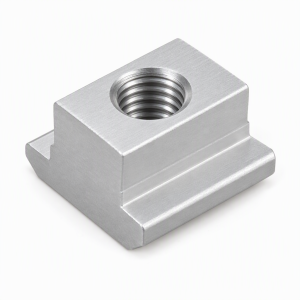
 T-Slot Nut 40 Series M8 Hammer Nut for 40×40 Aluminium Extrusion
M8 hammer-head T-slot nut for the 8 mm groove of 40 x 40 mm…
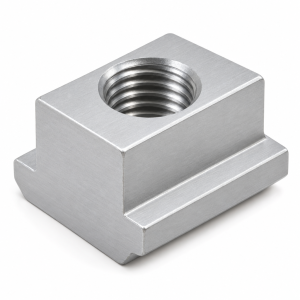
 T-Slot Nut 45 Series M8 Hammer Nut for 45×45 Aluminium Extrusion
M8 hammer-head T-slot nut for the 10 mm slot of 45 x 45 mm…
 T-Slot Nut 50 Series M10 Hammer Nut for 50×50 Aluminium Extrusion
M10 hammer-head T-slot nut for the 10 mm groove of 50 x 50 mm…
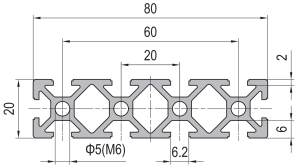 PG20 80×20 mm Ten Slot Aluminium Strut Profile Wide Flat Beam for Cable Tray and Panel Support
80 x 20 mm ten slot PG20 aluminium strut profile in 6063-T5 with a…
 PG20 40×40 mm Eight Slot Aluminium Strut Profile 20 mm Pitch T-Slot Extrusion for Dense Fixtures
40 x 40 mm eight slot PG20 aluminium strut profile in 6063-T5 with two…
 T-Nut and Bolt Set Aluminium Profile Fastener Kit M5 M6 M8 20-40 mm T-Slot Hardware
Matched T-nut, bolt and washer set for aluminium profile frames in M5, M6 and…
 Aluminium Cubic Connector 2020 20×20 mm Three-Way Corner Joint with ABS Cap
A 20 x 20 x 20 mm three-way cubic corner connector for 20 series…
