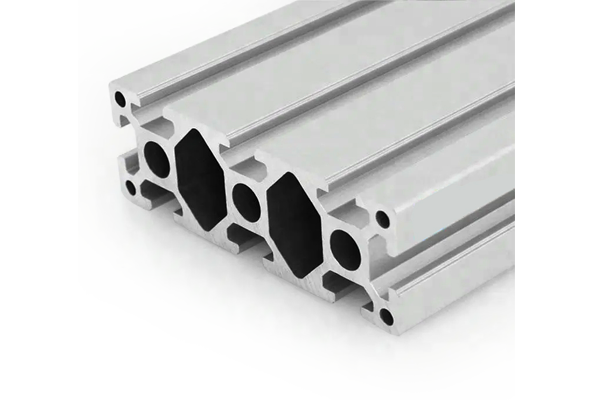
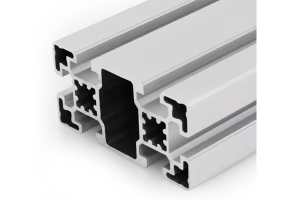
PG40 120×40 mm Eight Slot Heavy Aluminium Strut Profile for Machine Bases
A 120 x 40 mm eight slot heavy PG40 aluminium strut profile with round M6 corner holes and an 11 mm web. For machine base rails that are anchored, tapped and subject to vibration.
| Material | Aluminium |
|---|---|
| Alloy Grade | 6063-T5 |
| Temper | T5 |
| Section Size | 120 x 40 mm |
| Slot | 8 x 10.2 mm groove, 8 mm mouth, 40 mm pitch, outer pair 80 mm apart, M8 |
| Length | 6 m stock, cut to drawing to +/-0.5 mm |
| Tolerance | EN 755-9 / GB/T 6892, wall +/-0.15 mm |
| Surface | Mill finish / clear anodised / black anodised |
| MOQ | 200 |
| Lead Time | 20-30 days after deposit for mill finish |
| Loading Port | Shanghai / Ningbo |
| Supply Ability | 300 t per month |
| Payment Terms | T/T 30% deposit + 70% before shipment | L/C at sight |
| Trade Terms | FOB | CIF | EXW |
| Certifications | ISO 9001:2015 | EN 755-9 | RoHS | REACH |
Structural framing · PG40 heavy beam
A PG40 120 x 40 mm eight slot heavy aluminium strut profile is the heavy-wall version of the standard 120 x 40 mm beam. The envelope, the slot layout, the 40 mm pitch and the 10.2 mm groove are the same; the differences are the internal wall thickness and the corner holes, which are round 5 mm holes tapped M6 rather than the square 5 x 5 mm holes of the standard section. It weighs about 5.4 kg/m against about 4.6 kg/m for the standard version.
A machine base is the application that makes the heavy version necessary rather than merely nice to have, and the reason is not stiffness. A base rail has to do three things the rest of a frame does not: it has to hold anchor bolts that tie the machine to the floor, it has to survive vibration from the process without the joints fretting loose, and it has to carry the concentrated loads from levelling feet and anchor points. All three of those load the corner holes, and that is exactly where the round hole earns its place.
The three differences a round corner hole makes
The corner hole form is the detail that separates the two versions, and it changes three practical things. All three matter on a base rail and none of them shows up in a stiffness calculation.
Square corner holes are for clearance; round ones are for threads. That is the underlying rule. A square hole exists so that a square neck or a carriage bolt cannot rotate. A hole that is going to be tapped should be round, and on a machine base every corner hole is a candidate for tapping.
A machine base has three requirements
Take the three things a base rail has to do and check them against the two sections.
| Requirement | What it loads | Standard version | Heavy version |
|---|---|---|---|
| Anchor bolts to the floor | Corner holes in tension and shear | Square hole, uneven thread, lower pull-out | Round hole, full thread, predictable pull-out |
| Vibration from the process | Joints in reversing load | Thinner web, more fretting at the joint | 11 mm web, joint holds preload better |
| Levelling feet and jacking points | Concentrated bearing on the section | Thinner wall deforms under a foot load | Thicker wall spreads the load |
| Repeated re-levelling during commissioning | Threads cycled several times | Square-hole thread degrades quickly | Round-hole thread survives repeated use |
Why not simply use a bigger section?
The obvious alternative to a heavy 120 x 40 mm base rail is a bigger beam. Sometimes that is right, but on a machine base it usually is not, for three reasons.
First, the envelope is often fixed. A base rail sits inside the machine’s footprint and under its guarding, and there is frequently no room to go deeper or wider. Second, the base rail’s job is not primarily to be stiff — it is to transfer the machine’s loads into the floor and to hold the anchor points, and a bigger beam does not hold a thread any better than a small one. Third, a bigger beam is heavier everywhere, including in the middle of the span where nothing is happening, whereas the heavy wall puts the material where the anchor points and the joints are.
| Option | Effect on stiffness | Effect on the anchor joints | Verdict |
|---|---|---|---|
| Standard 120 x 40 mm | Reference | Square threads, lower reliability | Adequate for a light machine on a level floor |
| Heavy 120 x 40 mm | About 18 per cent more | Round threads, thicker web, holds preload | The base rail answer |
| Deeper beam, 160 x 40 mm | About 2.4 times more | Round corner holes on the heavy version | Use if the envelope allows |
| Larger square section | Much more | Round corner holes | Only if the footprint has room |
Building a machine base
- Set the anchor bolt positions from the floor, not from the machine Drill the floor first and make the base fit the anchors, rather than the other way round. Anchor bolts that do not line up cannot be adjusted afterwards.
- Tap the corner holes before assembly Tapping is easier with the rail on the bench. Use the round corner holes and tap to a depth of at least 1.5 times the bolt diameter.
- Keep the torque inside the aluminium thread limit About 15 N m for an M8 into an aluminium thread, and about 28 N m for an M10. The receiving thread strips before the bolt does.
- Fit the levelling feet before the machine goes on Set the feet and level the base frame first, then lower the machine onto it. Trying to level a base with the machine already on top is much harder.
- Re-torque the anchor points after the first week of running Most preload loss happens early. A scheduled re-torque catches it before it becomes a levelness problem.
Frequently asked questions
What is the difference between this and the standard 120 x 40 mm section?
Wall thickness and corner hole form. This version has round 5 mm corner holes tapped M6 and an 11 mm web; the standard version has square 5 x 5 mm holes. The envelope and slot layout are identical.
Why is a round hole better for tapping?
A round hole takes a continuous thread and clears swarf. A square hole cuts into the thread flank at its four corners and traps chips, so the thread is weaker exactly where the stress is highest.
Can I use the standard version for a machine base?
For a light machine on a level floor with the base bolted through rather than tapped, yes. For an anchored base that is tapped, re-levelled during commissioning and subject to vibration, use the heavy version.
Is aluminium a good material for a machine base?
It has better internal damping than welded steel, it does not need painting and it can be re-configured on site. It is less stiff per unit weight, so a long base rail has to be deeper than a steel one would be.
Do you supply the base as a finished frame?
Yes. Send the footprint, the anchor positions and the machine weight, and we will supply cut, faced and tapped rails, or a complete base frame with feet and anchor plates fitted.
Send the machine footprint and the anchor positions
Tell us the footprint, the anchor bolt positions and the machine weight. We will confirm the base rail, tap the round corner holes to your pattern and quote the frame with feet and anchor plates.
Request a QuoteRelated Products
 PG40 80×40 mm Six Slot Super Light Aluminium Strut Profile for Enclosures
An 80 x 40 mm six slot super light PG40 aluminium strut profile with…
 PG45 90×90 mm Eight Slot Aluminium Strut Profile M10 Column Section
A 90 x 90 mm eight slot PG45 aluminium strut profile with 8 x…
 PG45 90×90 mm Eight Slot Heavy Aluminium Strut Profile for Heavy Machinery Frames
A 90 x 90 mm eight slot heavy PG45 aluminium strut profile with thicker…
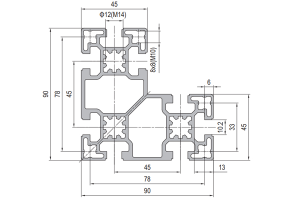 PG45 90×90 mm L-Shape Eight Slot Aluminium Strut Profile Corner Column for Frames
A 90 x 90 mm L-shaped eight slot PG45 aluminium strut profile with two…
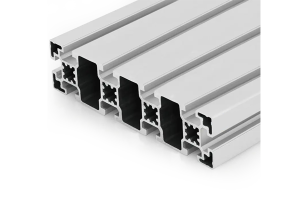 PG45 180 x 45 mm Ten Slot Aluminium Strut Profile Wide Gantry Beam
A 180 x 45 mm ten slot PG45 aluminium strut profile at about 6.20…
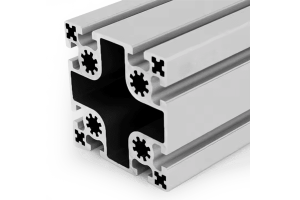 PG50 100×100 mm Eight Slot Aluminium Strut Profile for Heavy Machine Columns
A 100 x 100 mm eight slot PG50 aluminium strut profile with two slots…
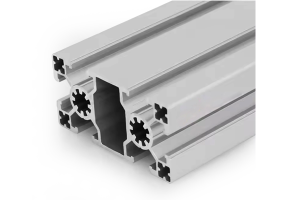 PG50 100×50 mm Six Slot Aluminium Strut Profile Rectangular Machine Beam
A 100 x 50 mm six slot PG50 aluminium strut profile with slots on…
 PG45 90×45 mm Six Slot Aluminium Strut Profile Rectangular Machine Beam
A 90 x 45 mm six slot PG45 aluminium strut profile for machine frames…
