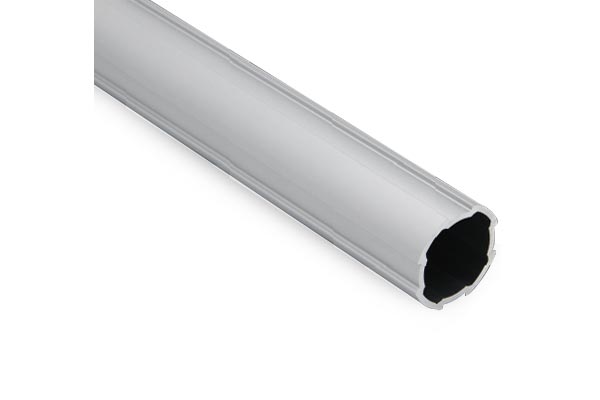
Aluminium Pipe 28 mm OD Round Tube Profile for Lean Pipe Systems
28 mm OD round aluminium tube for lean pipe systems, conveyor rollers and rotating shafts. Isotropic bending stiffness, external clamp connections. Standard lean pipe diameter.
| Material | Aluminium |
|---|---|
| Alloy Grade | 6063-T5 |
| Temper | T5 |
| Section Size | 28 mm OD round tube, 1.0 mm wall |
| Slot | No T-slots; connections via external clamps |
| Length | 4 m stock, cut to +/-0.5 mm |
| Tolerance | EN 755-9, OD +/-0.10 mm |
| Surface | Mill finish / clear anodised / black anodised / hard anodised |
| MOQ | Made to order; small trial lengths available from stock |
| Lead Time | Typically 2 to 3 weeks for mill finish, about a week longer for anodising |
| Loading Port | Shanghai, Ningbo, Qingdao |
| Supply Ability | Extrusion capacity for standard and custom ODs, with in-house cutting and anodising |
| Payment Terms | T/T 30 per cent deposit, balance against copy of bill of lading; L/C at sight for larger orders |
| Trade Terms | FOB, CIF, CFR, EXW |
| Certifications | Mill certificate to EN 10204 3.1 on request, RoHS and REACH declarations |
01What is an aluminium pipe in a lean pipe system?
What makes a round tube different from a T-slot profile?
A T-slot profile has a square or rectangular cross-section with grooves that take slot nuts. A round tube has no grooves and no slots — connections are made with external clamps that grip the tube surface. The cross-section is isotropic: the bending stiffness is the same in every direction, so there is no strong axis or weak axis to worry about.
Why use a pipe instead of a profile?
Three reasons. First, rotating applications: a round tube can be used as a conveyor roller, a shaft or a guide rail without needing a separate bearing surface. Second, lean manufacturing systems: the 28 mm OD tube is the standard diameter for lean pipe joints, used to build carts, racks, flow racks and workstations that can be reconfigured in minutes. Third, aesthetics: round tubes look cleaner than slotted profiles in customer-facing applications.
What is the lean pipe system?
A modular framing system built around 28 mm OD metal tubes and snap-fit joints. The joints come in dozens of configurations — 90 degree elbows, T-junctions, crosses, hinges, castors — and they grip the tube by tightening a screw or by snapping on. No cutting, tapping or machining is needed to build a structure: cut the tube to length and snap the joints on.
02Section data
| Item | Value | Note |
|---|---|---|
| Outer diameter | 28 mm | standard for lean pipe joints |
| Wall | 1.0 mm | standard; 0.8 mm light and 1.2 mm heavy available |
| Inner diameter | 26 mm | 28 – 2 x 1.0 |
| I (cm4) | approx. 0.66 | isotropic, same in all directions |
| Weight | approx. 0.23 kg/m | lighter than a 28 x 28 profile at 0.56 kg/m |
| Alloy | 6063-T5 | EN AW-6063 |
| Surface | mill or anodised | anodised improves clamp grip |
| Standard | EN 755-9 / GB/T 6892 | OD tolerance +/-0.10 mm |
| Length | 4 m stock | cut to +/-0.5 mm |
The 28 mm OD is the global standard for lean pipe joints (also called creform, pipe-and-joint, or flexible tube systems). Other diameters (25 mm, 32 mm) exist but have a smaller joint range. The 1.0 mm wall is the most common; heavier walls (1.2 mm, 1.5 mm) are used for structural applications.
03Isotropic stiffness: the round advantage
The second moment of area of a round tube is the same about every axis through the centre: I = pi/64 x (OD4 – ID4). For the 28 mm OD x 1.0 mm wall tube, that is about 0.66 cm4. There is no strong axis or weak axis, no orientation to get wrong, and no direction in which the tube is weaker than another.
Compare that to a 28 x 28 mm square profile with the same wall: the I about each axis is about 0.89 cm4, which is higher — but only about the two principal axes. About a 45-degree axis, the square profile has a different value (the product of inertia is non-zero), so the stiffness varies with direction. The round tube does not have this problem.
For a rotating shaft or conveyor roller, this is essential: the tube deflects the same amount regardless of which direction the load comes from, so the roller runs true without a preferred bending plane.
04Connections: clamps, not slot nuts
The round tube has no slots, so connections are made with external clamps that grip the tube surface. The lean pipe system uses two types:
| Joint type | How it works | Typical use |
|---|---|---|
| Snap-fit plastic joint | two halves hinge around the tube and latch | light loads, quick reconfiguration, carts and racks |
| Metal clamp joint | two halves bolt around the tube | heavier loads, structural, permanent or semi-permanent |
| Set-screw joint | a grub screw bears on the tube surface | prototype and low-cost, not for vibration |
| Welded joint | the tube is TIG or MIG welded | permanent structures, highest strength, no reconfiguration |
The clamp grip depends on the surface condition of the tube. Mill finish aluminium has a friction coefficient of about 0.3 against a steel clamp; anodised aluminium has about 0.15 (slipperier) but better corrosion resistance. For vibration or high load, use a metal clamp with a knurled bore, or specify a mill finish tube.
05Lean pipe system: what you can build
The lean pipe system is the main application for this tube. It is a modular framing system designed for lean manufacturing environments, where structures are built and rebuilt frequently as the production line changes. Common structures include:
- Flow racks and FIFO lanes: gravity-fed roller conveyors for parts presentation, rebuilt as the line layout changes.
- Workstation frames: height-adjustable tables, tool boards and parts bins that can be reconfigured in minutes.
- Material handling carts: wheeled carts for moving parts between stations, with shelves and handles that snap on.
- Temporary fixtures: assembly jigs and check fixtures that are built, used and dismantled within a production cycle.
- Lean 5S boards: shadow boards for tools and gauges, mounted on a pipe frame that can be moved to the point of use.
06Round tube vs T-slot profile: choosing the right system
Choose the round tube / lean pipe system
- The structure is temporary or frequently reconfigured
- You need rotating members (rollers, shafts, guides)
- Aesthetics matter: customer-facing or cleanroom environments
- The load is light to medium (carts, racks, fixtures, not machine frames)
- Speed of assembly is more important than maximum stiffness
Choose T-slot profiles
- The structure is a machine frame carrying precision loads
- You need slot nuts and sliding fittings along the member
- High stiffness per metre is required (T-slot has higher I)
- The frame carries vibration or dynamic loads
- You need a wider accessory range (hinges, sensors, panels)
07Failure modes to design out
| What goes wrong | Why it happens | Design it out by |
|---|---|---|
| Joint slips under load | the clamp grip is insufficient for the applied force | use metal clamps with knurled bores; add a second clamp for safety |
| Tube bends under load | the 0.66 cm4 I is low compared to T-slot profiles | reduce the span or add intermediate supports; use 1.2 mm wall for stiffness |
| Tube corrodes at the joint | aluminium and steel clamp form a galvanic couple | use anodised tube with plastic-lined clamps, or stainless clamps |
| Roller wobbles on the tube | the tube OD is out of round or the bearing bore is oversize | specify OD tolerance +/-0.10 mm; use precision bearings for rollers |
| Plastic joint cracks in cold | snap-fit joints become brittle below -10 degrees C | use metal clamp joints for cold environments or outdoor use |
08What to check before you order
Procurement checklist for the aluminium pipe
- Confirm the OD: 28 mm is standard for lean pipe. Other diameters have a smaller joint range.
- Confirm the wall: 1.0 mm is standard; 0.8 mm is lighter, 1.2 mm is stiffer.
- Confirm the finish: mill finish for best clamp grip, anodised for corrosion and aesthetics.
- Confirm the joint type: snap-fit plastic, metal clamp, or welded. The tube surface must match the joint requirement.
- Confirm the cut length and tolerance: standard +/-0.5 mm. For conveyor rollers, tighter tolerance on the OD may be needed.
- If the tube is a roller or shaft, confirm the bearing fit and the surface hardness. 6063-T5 is soft; hard anodise or 6061-T6 may be needed.
09Terms used on this page
- Lean pipe
- A modular framing system using round metal tubes and snap-fit joints. Also called creform, pipe-and-joint, or flexible tube.
- Isotropic
- Having the same stiffness in all directions. A round tube is isotropic in bending; a square profile is not.
- OD
- Outer diameter, in mm. The standard lean pipe OD is 28 mm.
- Snap-fit joint
- A plastic or metal joint that grips the tube by latching two halves around it, without tools.
- Clamp
- A two-piece fitting that bolts around the tube, providing higher grip force than a snap-fit.
- Roller
- A rotating tube used as a conveyor surface. The round tube serves as both the structure and the bearing surface.
10Questions buyers ask
What is the standard diameter for lean pipe systems?
28 mm OD is the global standard. The full range of snap-fit joints, clamps, castors and accessories is made for this diameter. 25 mm and 32 mm exist but with a much smaller joint range.
Can I use T-slot accessories on a round tube?
No. T-slot accessories fit into a 10.2 mm groove. A round tube has no groove. Connections are made with external clamps that grip the tube surface.
What wall thickness do I need?
1.0 mm is the standard for lean pipe. For structural applications or longer spans, 1.2 mm or 1.5 mm gives more stiffness. For lightweight carts, 0.8 mm saves weight.
Can it be used as a conveyor roller?
Yes. The tube is cut to the roller width and fitted with end bearings. Specify a tighter OD tolerance (+/-0.10 mm) and a hard anodised surface for wear resistance.
What is the minimum order quantity?
Extrusion is made to order. Small trial lengths are available from stock. Production runs are quoted by the metre or by the tonne.
Can it be supplied in 6061?
Yes. 6063-T5 is standard for its extrudability and surface finish. 6061-T6 is available for rotating shafts or structural applications that need higher strength.
What we need to quote this tube
- The OD and wall thickness, or the lean pipe system reference.
- The cut length for each member and the number of members.
- The finish: mill finish, clear anodised, black anodised, or hard anodised for rollers.
- The joint type if joints are needed: snap-fit plastic or metal clamp.
- The annual or per-order quantity, in metres or in pieces.
- Any certification: mill certificate to EN 10204 3.1, dimensional report.
Send those six items and the quotation comes back with the extrusion price, the cutting charge, the finish surcharge and the lead time broken out separately. Browse the full aluminium profile catalogue and the pipe and joint systems range for related products.
Need this tube quoted for your lean pipe system?
Send the OD, wall, cut list and finish. We quote extrusion, cutting and anodising as separate lines.
Request a quotationRelated Products
 Aluminium I-Beam Profile 40 x 40 mm Structural H-Section Extrusion
Aluminium I-beam (H-section) 40 x 40 mm in 6063-T5. Concentrates material in the flanges…
 Extruded Aluminium Angle Profile 20 to 100 mm 6061 T6 Equal Leg
Extruded aluminium equal leg angle from 20 x 20 x 3 mm to 100…
 Aluminium Angle Extrusion 40x40x5 mm for Frame Assembly and Bracing
40 x 40 x 5 mm aluminium angle extrusion in 6061-T6 for frame assembly…
 Custom Aluminium Extrusion Profile 20 to 100 mm, 6063-T5
Aluminium extrusion profiles supplied to Canada in 6063-T5 and 6061-T6, mill or anodised, with…
 Aluminium Extrusion for Sale 20 to 100 mm Stock Lengths Cut to Size 6063 T5
Aluminium extrusion for sale in three routes: stock lengths, cut to size or a…
 Aluminium Extruders 600 to 4000 Ton Press Capacity 40 to 160 mm Profile
Aluminium extrusion capacity across 600 to 4000 tonne presses, covering profiles up to about…
 Aluminium Extrusion Manufacturing Factory: 20 to 100 mm Profiles
Aluminium extrusion profiles for Gujarat, India, in 6063-T5 and 6061-T6, with anodising film selected…
 Aluminium Extrusion Manufacturers: 30 to 60 Series, 8 mm Slot
Aluminium extrusion profiles for Delhi NCR, India, in 6063-T5. Strut sections from 30 to…
