Aluminium Extrusion Manufacturers: 30 to 60 Series, 8 mm Slot
Aluminium extrusion profiles for Delhi NCR, India, in 6063-T5. Strut sections from 30 to 60 series for trolleys, workstations and guards, with batch colour control and ICD Tughlakabad or Dadri clearance.
| Material | Aluminium |
|---|---|
| Alloy Grade | 6063-T5 |
| Temper | T5 |
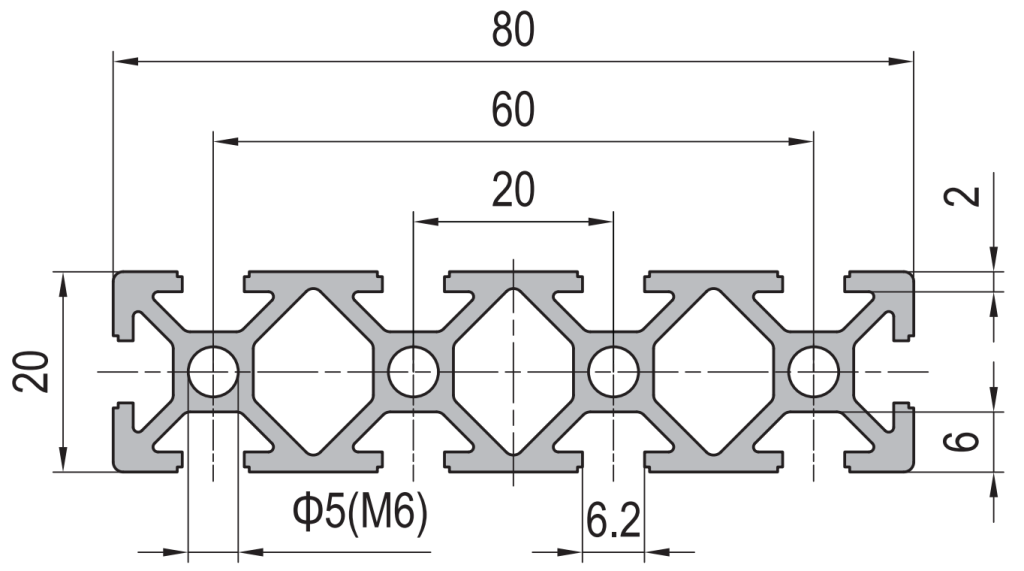
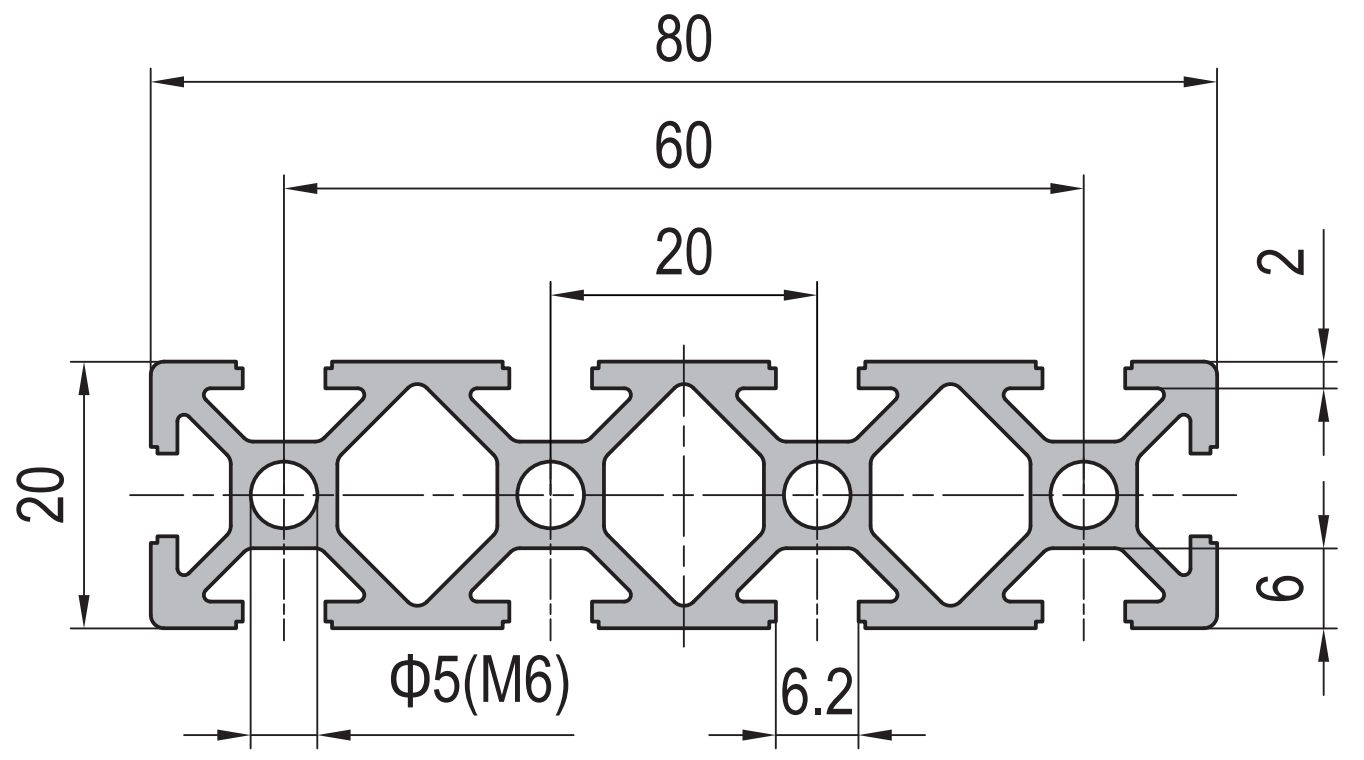
| Section Size | 20 to 60 series strut profiles |
| Slot | 8.2 mm slot on the common sizes, M6 and M8 |
| Length | Saw cut to length, +/-0.5 mm, square or mitred |
| Tolerance | EN 755-9, wall +/-0.15 mm |
| Surface | Mill finish / clear anodised / black anodised / powder coated |
| MOQ | Made to order; mixed containers from several sections |
| Lead Time | 4 to 6 weeks to Delhi NCR including the inland leg and clearance |
| Loading Port | Shenzhen, Shanghai, Ningbo |
| Supply Ability | In-house extrusion, saw cutting, anodising and export packing |
| Payment Terms | T/T 30 per cent deposit, balance against copy of bill of lading; L/C at sight on request |
| Trade Terms | FOB, CIF, CFR, DDP on request |
| Certifications | Mill certificate to EN 10204 3.1, RoHS and REACH declarations, anodising film report |
01Extrusion profiles for Delhi NCR manufacturing
The Delhi NCR belt, Noida, Greater Noida, Gurugram, Manesar, Faridabad and Ghaziabad, is India’s automotive components and white goods corridor. The buyers there order aluminium extrusion for things that move inside a plant: trolleys, workstations, kanban racks, line-side carts, conveyor and robot guarding, and appliance test frames.
That use pattern sets the questions. It is not “which alloy”, it is “will the fifth delivery look like the first” and “how much does the frame weigh against what it carries”. This page answers both, then the clearance side for an import.
How do you control colour between anodising batches?
By measuring, not by eye. Clear anodising is the safest: there is no dye to drift, only film thickness, which is controlled. For dyed work we hold the batch to a Delta E figure against a retained master sample, and we keep the charge record so a later batch can be run to the same parameters.
Why does the section weight matter so much on a trolley?
Because the operator pushes it. A frame that is 20 per cent heavier is 20 per cent harder to start and stop, all day. On a trolley or a line-side cart the right question is not *how strong* but strength per kilogram, and that is a section choice, not an alloy choice.
0230 series versus 40 series for NCR plant furniture
The two series cover almost every trolley, workstation and guard in a Delhi plant. The wrong choice is usually visible within a month as a sagging shelf or an over-built frame.
| Item | 30 series | 40 series | Note |
|---|---|---|---|
| Typical section | 30 x 30, 30 x 60, 30 x 90 mm | 40 x 40, 40 x 80, 40 x 120 mm | both take 8.2 mm slot on the common sizes |
| Slot | 8.2 mm | 8.2 mm | M6 and M8 bolts |
| Weight per metre | about 0.8 to 2.0 kg/m | about 1.3 to 3.4 kg/m | 40 series is roughly 1.6x the mass |
| Load for a 1 m shelf span | up to about 40 kg | up to about 100 kg | indicative, four supports |
| Best for | shelves, light frames, enclosures, ducts | trolleys under load, machine guards, heavy benches | |
| Cost per metre | lower | higher | the difference is material, not process |
- Line-side trolley, light parts: 30 x 30 mm frame, 20 mm shelf pitch. Weight matters more than strength.
- Workstation with a monitor and tools: 30 x 60 mm legs, 30 x 30 mm rails.
- Trolley carrying castings: 40 x 40 mm or 40 x 80 mm, and check the shelf deflection, not just the yield.
- Machine guard and robot fence: 40 x 40 mm, because the guard also has to take an accidental impact.
- Enclosure and control cabinet frame: 20 series, because it is carrying panels, not load.
Deflection, not strength, usually decides it. A shelf that is strong enough but springs 10 mm under load feels wrong to an operator. Design to a deflection limit, and let the section follow.
03Batch colour: what to specify
Anodising is a batch process and the shade depends on the alloy, the film thickness, the electrolyte and the dye, all of which drift a little. Buyers who specify “black” and nothing else will eventually receive two blacks.
| Finish | Colour risk | What to put in the order | Batch strategy |
|---|---|---|---|
| Clear anodised | low, thickness only | 10 to 15 micron, clear | any batch will match closely |
| Black anodised | medium, dye load and thickness | 15 micron, black, master sample | one run per assembly where visible |
| Bronze or champagne | higher, dye sensitive | master sample, plus Delta E limit | one run per project |
| Powder coated RAL | low, RAL is defined | RAL number and gloss level | one powder batch per project |
The practical rule for a Delhi buyer with a visible assembly: order the whole assembly from one anodising run. If the assembly runs to several thousand metres, then a retained master sample plus a Delta E figure is the next best control.
04Inland transport and clearance to Delhi NCR
Delhi NCR is inland, so the container arrives at a west coast port and comes north either by rail to an Inland Container Depot or by road.
| Route | Entry | Inland leg | Suits |
|---|---|---|---|
| West coast by rail | Mundra, Pipavav, Nhava Sheva | rail to ICD Tughlakabad | container loads into south Delhi |
| West coast by rail, north | Mundra, Pipavav | rail to ICD Dadri | Noida, Greater Noida, Ghaziabad |
| Sea to Kolkata, then rail | Kolkata | rail west to Delhi | rarely economic, longer transit |
| Air | Delhi IGI | direct | a few kilos, urgent sample only |
- ICD Tughlakabad is the main inland depot for south Delhi and Faridabad.
- ICD Dadri serves the Noida and Greater Noida belt and is often quicker for those plants.
- 6 m lengths travel by rail and road without difficulty on this corridor; the constraint is the trailer length, not the depot.
- GST and IGST are creditable for a registered business, so the tax is a timing cost on a Delhi import.
05Small batch, many variants: the changeover question
Delhi NCR buyers often run several product variants on one line, which means many short cutting and drilling runs rather than one long one. That changes the quoting structure, and it is worth understanding before comparing two suppliers.
| Order pattern | Dominant cost | How it is quoted | Best route |
|---|---|---|---|
| One section, one cut, large quantity | metal and conversion | per metre | new die if volume is high |
| One section, many lengths | cutting and sorting | per piece, plus setup | cut to size from stock |
| Many sections, small quantity each | setup per section | per piece, setup split | stock lengths, cut locally |
| Many sections, drilled | machining setup | per piece, fixture included | cut and drill to drawing |
The honest advice for a mixed line: buy stock lengths and cut them in your own plant if you have a saw, and buy only the complex drilled parts as finished pieces. The cutting is where the quick-change cost sits.
06Import from China versus a local supplier
Import from China
- A non-standard section or a finish not made locally
- A large quantity where the unit price matters
- A consistent anodising batch across the whole order
- A container can be made up from several sections
- The schedule allows a 4 to 6 week total lead time
Buy from a local supplier
- You need a few lengths this week
- The section is a standard Indian size
- The quantity is small and freight dominates
- You want a local relationship for repeat small orders
- The line cannot wait for a sea shipment
Most NCR buyers run both. The local supplier covers the urgent and the small; the import covers the bulk and the section sizes the local extruders do not carry.
07Failure modes on a Delhi NCR line
| What goes wrong | Why it happens | Design it out by |
|---|---|---|
| Two deliveries do not match in colour | separate anodising runs on one visible assembly | one run per assembly, or a master sample plus Delta E |
| Trolley shelf sags in service | section chosen on strength, not on deflection | design to a deflection limit and step up the section |
| Frame too heavy to push all day | 40 series used where 30 series would take the load | check strength per kilogram, not strength alone |
| Bolt loosens on a moving trolley | vibration on a bolted joint with no locking | use a serrated washer or a thread-locking compound |
| Clearance delay at the ICD | documentation gap, or the depot chosen is the wrong side of the city | match the depot to the plant and prepare the papers before arrival |
| Anodised frame will not earth | the anodised film insulates the joint | mask a bonding pad or use a star washer through the film |
08What to check before you order for Delhi
Procurement checklist for a Delhi NCR order
- Confirm the series and section: for example 30 x 60 mm.
- Confirm the alloy and temper.
- Confirm the finish, and for dyed work the master sample and Delta E.
- Confirm the cut list and the cut tolerance.
- Confirm the deflection limit if the part is a shelf or a trolley deck.
- Confirm the ICD: Tughlakabad or Dadri.
- Confirm the trade term and who clears customs.
- Confirm the documents: mill certificate, dimensional report, film report.
09Questions Delhi NCR buyers ask
Do you supply aluminium extrusion to Delhi NCR?
Yes, in 6063-T5 and 6061-T6, cleared through ICD Tughlakabad or ICD Dadri, or delivered to a Noida, Gurugram or Faridabad plant.
How do you control colour between batches?
Clear anodising by film thickness; dyed work to a master sample and a Delta E figure, from a recorded charge.
Should I use 30 series or 40 series?
30 series for shelves, light frames and enclosures; 40 series for trolleys under load, machine guards and heavy benches.
What bolt fits the slot?
The common 8.2 mm slot takes M6 and M8 with a matching T-nut.
Can you cut and drill to a variant list?
Yes. Send the cut list and the hole pattern; the setup is shared across the variants.
What is the lead time to Delhi?
About four to six weeks including the inland leg and clearance.
What we need to quote a Delhi NCR order
- The section list and the alloy.
- The finish, and the master sample and Delta E for dyed work.
- The cut list and the hole patterns.
- Any deflection limit on shelves and decks.
- The quantity per section.
- The ICD or the delivery address.
- The documents you need.
Send those seven items and the quotation comes back with the material, cutting, drilling, anodising, packing and freight broken out separately. Browse the full aluminium profile catalogue and the strut profiles range.
Building trolleys or workstations in Delhi NCR?
Send the section list, the cut list and the finish. We will advise on the section for the load and quote material, finishing and freight separately.
Request a quotationRelated Products
 Aluminium Extrusion Profile Supply: 15 to 45 Series Kits, 8 mm Slot
Aluminium extrusion profile supply for Ahmedabad in 6063-T5: electrical cabinet frames with a designed…
 Aluminium Extrusion Profiles 20 to 45 Series for OEM, up to 100 mm
Aluminium extrusion profiles for Tamil Nadu in 6063-T5, with full batch traceability from heat…
 Aluminium Extrusion Manufacturer: 45 to 120 mm, 6063-T5
Aluminium extrusion for Chennai in 6063-T5, section supply with port logistics support through Chennai…
 Aluminium Angle Profile 35 x 35 x 4 mm Panel Edge Trim for Guarding
35 x 35 x 4 mm aluminium angle profile with an inner corner slot,…
 L Aluminium Angle 30 x 30 x 4 mm for Washdown Equipment Frames
30 x 30 x 4 mm L aluminium angle for washdown equipment frames. 6061-T6,…
 Aluminium 2020 Extrusion 20 x 20 mm for 3D Printer Frames
20 x 20 mm four slot aluminium 2020 extrusion for 3D printer and desktop…
 Aluminium 2020 Profile 20 x 20 mm for Laboratory Instrument Stands
20 x 20 mm aluminium 2020 profile for laboratory instrument stands. 0.62 kg/m, 6.2…
20 x 20 Aluminium Extrusion 6.2 mm Slot Stock Lengths and MOQ
20 x 20 mm aluminium extrusion with a 6.2 mm slot, supplied in 6…
