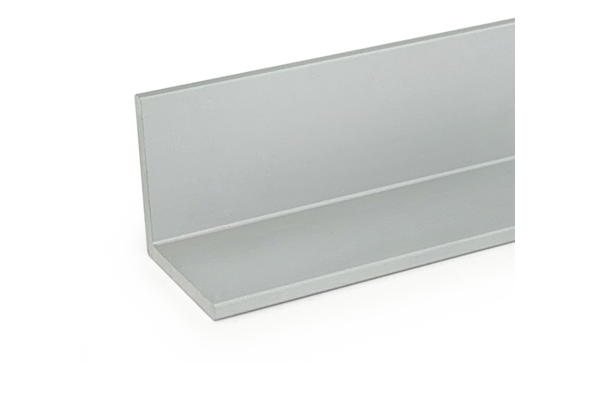
L Aluminium Angle 30 x 30 x 4 mm for Washdown Equipment Frames
30 x 30 x 4 mm L aluminium angle for washdown equipment frames. 6061-T6, cut and mitred to list, anodised after machining.
| Material | Aluminium |
|---|---|
| Alloy Grade | 6061-T6 |
| Temper | T6 |
| Section Size | 30 x 30 x 4 mm |
| Slot | Solid equal leg L section with no slot; holes drilled through on request |
| Length | Cut to list up to 6 m; square, mitred, or radiused outer corner |
| Tolerance | Wall +/-0.15 mm, length +/-0.5 mm, mitre angle +/-0.5 deg |
| Surface | Mill finish / clear anodised / black anodised |
| MOQ | Small quantities from stock; production batches from about 100 m |
| Lead Time | Typically 2 to 3 weeks for mill finish, plus about a week for anodising |
| Loading Port | Shenzhen or Guangzhou |
| Supply Ability | Around 20 tonnes per month of cut and machined angle sections |
| Payment Terms | 30 per cent deposit, balance against copy of documents |
| Trade Terms | FOB, CIF, EXW |
| Certifications | Mill certificate to EN 10204 3.1 on request, RoHS and REACH declarations |
01Why use an L angle in a frame that gets washed down?
Because it is the only shape that gives a corner, an edge and a drip line at the same time. A 30 x 30 x 4 mm L aluminium angle bolted along the inside of a cabinet corner closes the joint, stiffens two panels at once, and — if it is detailed the right way round — puts the only continuous edge where a squeegee can reach it. A square tube does none of that. A flat strip does one of the three.
What follows is not a description of the section. It is about the three places soil collects in an aluminium frame, which of them you can design out, which of them you can only manage, and how the choice of finish and fastener changes the answer. If the frame is going into a food, pharmaceutical or cosmetics environment, this is the part that decides whether the weekly clean takes twenty minutes or two hours.
02Where does soil actually hide in an aluminium frame?
Not on the flat faces. Flat anodised aluminium wipes clean easily. The problems are at discontinuities, and there are three that account for almost every failed hygiene audit on an aluminium frame.
- Blind holes
- A tapped hole that does not go through the section is a cup. It fills with product, then with cleaning fluid, then with product again. Drill through and cap the far end, or use a through-bolt with a sealing washer so there is no cup at all.
- Open joints
- Two mitred ends that meet with a 0.3 mm gap look closed and are not. Capillary action pulls liquid in and it stays there. Either seal the joint with a food-grade sealant as part of assembly, or design the joint open so it can be cleaned — a gap you can get a brush into is better than a gap you cannot see.
- Fastener seats
- A countersunk screw head in aluminium creates a conical crevice around the perimeter. A hex socket head creates an annular one under the head. A domed head with a sealing washer leaves nothing to trap, at the cost of a slightly proud fixing.
The rule that covers all three: if you cannot see it, you cannot clean it, and if you cannot clean it, it will be found. Design for the eye and the brush, not for the drawing.
03Which finish survives a washdown regime?
Three finishes are normally offered on this section, and they behave very differently once detergent is involved. The choice is not about appearance, it is about what happens to the surface after a few thousand cycles.
| Finish | What it is | Under repeated washing | Where it fits |
|---|---|---|---|
| Mill finish | As extruded, no coating | Water marks and white oxide bloom appear quickly; the surface is mildly alkaline and reacts with acidic cleaners | Dry areas only, or where the frame is not visible and not washed |
| Clear anodised, 10 to 15 micron | Electrolytic oxide layer | Stable against most detergents and alcohol sanitisers; not stable against strong alkali or hot caustic | The default for washdown frames and machine skirts |
| Black anodised, 10 to 15 micron | Dyed oxide layer | Same corrosion behaviour as clear, but the dye can fade under UV and repeated alkaline exposure | Where the frame is visible and light control matters more than long term colour |
| Powder coated | Polyester powder, 60 to 80 micron | Good chemical resistance but chips at edges and fixings, and every chip is a crevice | Where colour matching matters and the frame is not in a high impact area |
The one thing that matters more than the finish is when it is applied. Anodising before cutting leaves bare aluminium at every cut face, every drilled hole and every tapped thread. Those bare faces are the only places that corrode, and they are also the places that hold soil. Cut and drill first, then anodise, and if a thread must be masked, mask it deliberately rather than letting it happen.
04Which cleaning agents attack an anodised frame?
Anodised aluminium is amphoteric: it is attacked by both strong acid and strong alkali. Most food-industry detergents are mildly alkaline, which is tolerable. Caustic-based floor and drain cleaners are not, and neither are the strong acid descalers used for milkstone removal.
| Agent | Typical use | Effect on anodised aluminium | Verdict |
|---|---|---|---|
| Neutral detergent | Routine manual cleaning | None at working dilution | Suitable |
| Mild alkaline foam | Protein and fat removal | Slow attack on the oxide layer at high temperature | Suitable if rinsed and not left to dry |
| Sodium hypochlorite | Sanitising | Pitting, especially at cut edges and threads | Avoid, or limit contact time and rinse thoroughly |
| Sodium hydroxide | Heavy soil, drain cleaning | Rapid dissolution of the oxide layer | Not suitable |
| Nitric or phosphoric acid | Descaler | Attacks the oxide layer, stains the surface | Not suitable |
| Isopropyl alcohol | Wipe down, electronics areas | None | Suitable |
Is stainless steel the safer choice?
For the frame itself, often yes — but not automatically. Stainless costs three to five times more per metre, is roughly three times heavier, and has its own chloride stress corrosion problem in hypochlorite environments. Aluminium wins where the load matters, where the frame is large, and where the cleaning chemistry is neutral to mildly alkaline. It loses where caustic is used daily.
Does anodising make the frame non-stick?
No. It makes the surface harder and more corrosion resistant, which makes it easier to clean, but soil still adheres. The cleanability comes from the geometry — radiused corners, no blind holes, no open joints — far more than from the coating.
05How should the frame drain?
Every horizontal surface in a washdown frame will hold water unless it is given somewhere to go. A 30 x 30 mm L angle used as a skirt or a bottom rail creates a horizontal ledge by definition, so it needs a deliberate fall and a deliberate way out.
- Slope horizontal runs at 1 to 2 degrees toward a drain point. On a 1 m rail that is 17 to 35 mm of fall, which is visible and cheap to build in at the cut list stage and expensive to add later.
- Drill a 6 mm weep hole at the low end of every closed rail, and deburr it. A weep hole with a burr holds more water than no hole at all.
- Do not rely on the gap between two panels as a drain. It works until the sealant is applied, and then it does not.
- Keep the bottom rail at least 50 mm above the floor where the floor is washed, so the frame is not standing in run-off.
- Where the frame meets a floor or a plinth, use a radiused coving fillet rather than a square junction. A square internal corner between aluminium and concrete cannot be cleaned with anything wider than a toothbrush.
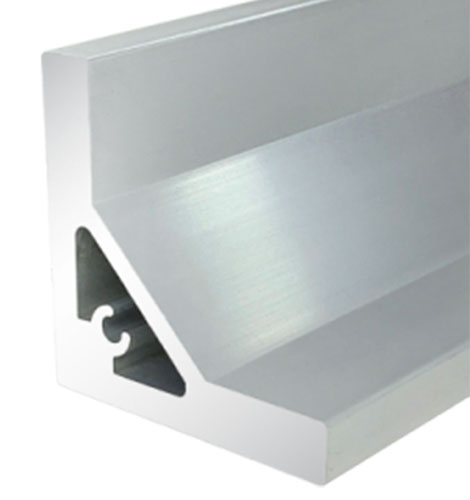
06Which fastener strategy is the cleanest?
There are three ways to join an L angle into a frame, and they rank differently on hygiene, on strength and on how easy the frame is to take apart for a deep clean.
T-nut in a profile slot
- No hole in the visible face at all
- Slot itself must be capped at both ends
- Adjustable during assembly
- Fastener can work loose under vibration
- Needs a slot, so only works against a T-slot profile
Through-bolt with sealing washer
- Hole goes right through, so nothing to trap
- Sealing washer closes the hole to the environment
- Strongest of the three for a given bolt size
- Head is visible and proud
- Cannot be adjusted once sealed
Rivets are the third option and the one to avoid on anything that has to be cleaned periodically. A blind rivet leaves a mandrel hole, and a solid rivet cannot be removed without damaging the section. If the frame will be stripped for cleaning more than once a year, bolted joints with captive nuts are worth the extra cost.
07What an L angle cannot do
It cannot be a hygienic corner on its own. Two mitred L angles meeting at 90 degrees create a vertical seam down the inside of the corner, and that seam is the single most common finding in a hygiene audit of an aluminium frame. The fix is not a different angle — it is a corner that is either sealed as one piece or left open enough to clean, and both of those are assembly decisions rather than purchasing decisions.
It also cannot carry a heavy load at 30 x 30 x 4. At roughly 0.60 kg/m this is a light section; its job is to close and finish, not to carry. Where the same frame has to take a load, step up to the 40 x 40 x 5 at about 1.01 kg/m, or use a T-slot profile and let the angle do only the trimming.
Washdown frame drawing checklist
- Every hole shown as through, or marked as blind with a cap specified
- Joint treatment stated per joint: sealed, open, or gasketed
- Fastener type and head style stated, with sealing washer where through-bolted
- Fall direction and weep hole positions marked on horizontal runs
- Corner treatment: sealed insert, radiused cover, or open cleanable gap
- Finish stated, and whether cut faces are to be re-sealed after anodising
- Cleaning agents the frame will see, so the finish can be checked against them
- Which parts are removable for a deep clean, and how
08Questions from buyers specifying a washdown frame
Related sections and categories
Browse Aluminium Angle Profiles, Aluminium Sections, the 30 x 30 x 4 mm light duty angle, or see the 40 x 40 x 5 mm structural angle for the full section data.
Do you supply the frame as a welded assembly or as loose parts?
Loose parts by default, because a bolted frame can be stripped and cleaned and a welded one cannot. Welded aluminium frames also lose the anodised layer along the weld, which is exactly where corrosion and soil collection start. If a welded frame is required, specify that it is anodised after welding.
Can the angle be supplied with a radiused outer corner?
Yes. The outer corner can be radiused to a stated radius instead of a sharp 90 degree edge, which removes the one edge that a cloth cannot follow. State the radius on the drawing; a 3 to 5 mm radius is normally enough and does not affect the fit against a flat panel.
What tolerance should I expect on the cut length?
Plus or minus 0.5 mm on a CNC saw. For a frame that has to close on itself, that tolerance accumulates around the perimeter, so a frame with eight pieces can be up to 4 mm out on the diagonal if every piece lands at the same end of tolerance. Specify a diagonal check rather than a piece-length check.
Is 6061-T6 the right alloy for a washdown frame?
It is what this section is stocked in, and it machines and anodises well. For a frame that is only closing and trimming, 6063-T5 is the more common choice because it anodises to a more uniform appearance. We can supply either; the difference in service is small compared with the difference in detailing.
How do you handle the slot ends on the slotted variant?
They are capped. An open slot end is a tube that fills with liquid and cannot be drained, so a plastic or aluminium end cap is fitted as part of assembly and listed as a separate line on the quotation.
What to send for a washdown frame quote
- Frame drawing with joints marked and the joint treatment named per joint
- Cleaning agents the frame will be exposed to, and the wash temperature
- Whether the frame is bolted or welded, and whether it must come apart for cleaning
- Section preference, or the frame size if you want a recommendation
- Finish, colour, and whether cut faces need re-sealing
- Quantity in metres, and how many complete frames
- Any radius or coving requirement at floor junctions
If the frame is for an audited environment, send the audit finding you are trying to close. Detailing against a specific finding is faster than detailing against a general standard.
Send the frame drawing and the cleaning regime
Tell us what the frame is washed with, whether it has to come apart for a deep clean, and the finish you need. We will come back with a section, a joint detailing and a price per metre.
Request a quotationRelated Products
 Aluminium 2020 Extrusion 20 x 20 mm for 3D Printer Frames
20 x 20 mm four slot aluminium 2020 extrusion for 3D printer and desktop…
 Aluminium 2020 Profile 20 x 20 mm for Laboratory Instrument Stands
20 x 20 mm aluminium 2020 profile for laboratory instrument stands. 0.62 kg/m, 6.2…
20 x 20 Aluminium Extrusion 6.2 mm Slot Stock Lengths and MOQ
20 x 20 mm aluminium extrusion with a 6.2 mm slot, supplied in 6…
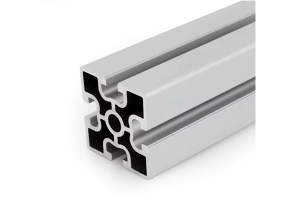 Aluminium 60 x 60 mm Four Slot Extrusion for Robot Cell Gantries
60 x 60 mm four slot aluminium extrusion for robot cell gantry columns and…
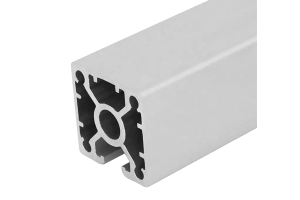 Aluminium 4040 Extrusion 40 x 40 mm Single Slot for Machine Fixtures
40 x 40 mm single slot aluminium 4040 extrusion for machine fixture bases. Three…
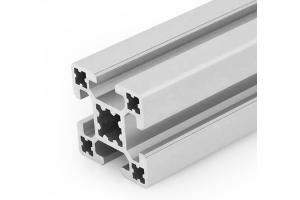 Aluminium 40 Series Extrusion 40 x 40 mm for PV Module Lines
40 x 40 mm aluminium 40 series extrusion for photovoltaic module lines. Four slots,…
 Anodised Aluminium Profile 40 x 40 mm AA15 Clear Finish for Visible Frames
40 x 40 mm anodised aluminium profile in 6063-T5 with an AA15 clear anodised…
 Aluminium Lean Pipe Joint System 28 mm for Kaizen Cart Frames
28 mm lean pipe joint system in aluminium tube with a 1.0 mm wall,…
