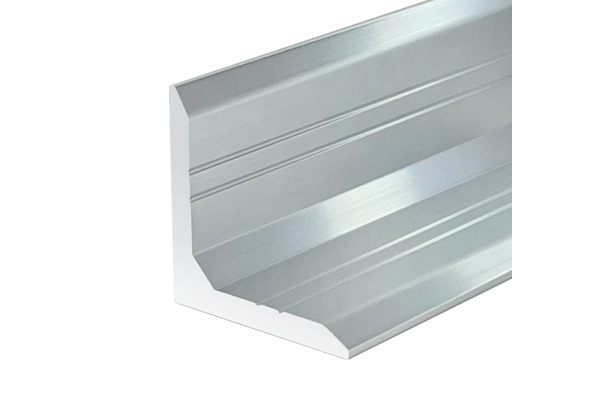
Extruded Aluminium Angle Profile 20 to 100 mm 6061 T6 Equal Leg
Extruded aluminium equal leg angle from 20 x 20 x 3 mm to 100 x 100 x 15 mm in 6061-T6. One controlled root radius, uniform wall to ±0.15 mm, no slot, cut to any length.
| Material | Aluminium |
|---|---|
| Alloy Grade | 6061-T6 |
| Temper | T6 |
| Section Size | 20 x 20 x 3 mm to 100 x 100 x 15 mm equal leg angle |
| Slot | Not applicable, this is a solid extruded angle with no slot |
| Length | Saw cut to length, ends square or 45 degree mitre, +/-0.5 mm |
| Tolerance | EN 755-9 and GB/T 6892, wall +/-0.15 mm |
| Surface | Mill finish / clear anodised / black anodised / powder coated |
| MOQ | Made to order; standard sizes from stock |
| Lead Time | Typically 1 to 2 weeks for cutting and drilling, plus a week for anodising |
| Loading Port | Shanghai, Ningbo, Qingdao, Shenzhen |
| Supply Ability | In-house extrusion, saw cutting, drilling and surface finishing |
| Payment Terms | T/T 30 per cent deposit, balance against copy of bill of lading |
| Trade Terms | FOB, CIF, CFR, EXW |
| Certifications | Mill certificate to EN 10204 3.1 on request, RoHS and REACH declarations |
01What is an extruded aluminium angle?
An extruded aluminium angle is a solid L section pushed through a die while the metal is still hot and plastic, so the two legs and the corner come out as one single piece of metal with no weld, no fold and no seam. The section we make runs from 20 x 20 x 3 mm up to 100 x 100 x 15 mm, all in 6061-T6, with an equal leg on both sides and a wall held to ±0.15 mm.
The important words are *extruded* and *unequal*. Extruded means the corner radius, the wall and the surface all come from one die, so they are consistent for kilometre after kilometre. Unequal angles (legs of different length) are also made to order; the catalogue sizes are equal leg because that is what 90 per cent of buyers order.
Is a rolled or bent angle the same as an extruded angle?
No, and the difference shows up at the corner. A bent angle is folded from sheet, so the inside of the corner is a sharp crease with a measurable thinning of the wall, and the outside is stretched. An extruded angle has one controlled root radius equal to one wall thickness, and the wall is the same on both legs. If the corner has to carry a bolt or a weld, that difference matters.
Why does the wall tolerance sit at ±0.15 mm?
Because that is what a nitrogen-quenched 6061-T6 extrusion die holds after the run has stabilised. Tighter tolerances are possible on small sections but the reject rate and the price both climb. ±0.15 mm covers the draw-down at the die and the slight wall thinning that happens at the start of a billet in a long run.
02Extrusion versus bending versus roll forming
A buyer who only needs an L shape has three ways to get one. They are not interchangeable, and the cheapest one is rarely the right one for a load path.
| Method | How it is made | Wall at corner | Length freedom | Cost shape |
|---|---|---|---|---|
| Extrusion | hot billet pushed through a die | uniform, one root radius | any length from one die | high die cost, low unit cost |
| Press bending | sheet folded on a brake | thinned and creased | coil length, one bend at a time | no die cost, high labour cost |
| Roll forming | sheet run through rolls | thinned, gradual curve | coil length | medium tooling, very low unit cost |
| Milling from plate | solid block machined | full, square corner | one part at a time | no tooling, very high unit cost |
For anything under about 3 m of total length, bending from sheet can be cheaper because there is no die. Above that, extrusion wins on unit cost. Milling from plate only makes sense for prototypes where you need a perfectly sharp inside corner and the quantity is a handful of pieces.
The rule of thumb: if the corner is a load path or a bolt passes near it, buy extruded. If the angle is only a trim or a cover and the quantity is tiny, bent sheet is fine.
03How the die and the root radius work
The angle dies we run are flat dies, not porthole dies, because the section is open and there is nothing to weld back together behind the die face. The metal spreads from the billet into the two legs and the corner in one pass. That is why the corner is sound: there is no seam to hide.
The root radius, the arc inside the corner, cannot be smaller than one wall thickness. On a 40 x 40 x 5 mm angle the inside radius is therefore about 5 mm, and the outside radius about 10 mm. Buyers who ask for a sharp inside corner are usually thinking of a machined part; an extrusion physically cannot deliver it, and a drawing that specifies a 1 mm inside radius on a 5 mm wall will be rejected by any extruder.
| Section | Wall | Inside radius | Outside radius | Weight |
|---|---|---|---|---|
| 20 x 20 x 3 mm | 3 mm | approx. 3 mm | approx. 6 mm | approx. 0.30 kg/m |
| 30 x 30 x 4 mm | 4 mm | approx. 4 mm | approx. 8 mm | approx. 0.60 kg/m |
| 35 x 35 x 4 mm | 4 mm | approx. 4 mm | approx. 8 mm | approx. 0.71 kg/m |
| 40 x 40 x 5 mm | 5 mm | approx. 5 mm | approx. 10 mm | approx. 1.01 kg/m |
| 100 x 100 x 15 mm | 15 mm | approx. 15 mm | approx. 30 mm | approx. 5.13 kg/m |
04Wall thickness tolerance and what drives it
The wall tolerance of ±0.15 mm is not a marketing number, it is the practical floor for a 6061-T6 angle on a press of this size. Three things move the wall during a run: the billet temperature drifting between the front and the back of the billet, the ram speed as the die heats up, and the die wear over the life of the die. All three are held by the press controller, and the result is checked with a micrometer at the start and the end of every run.
| What moves the wall | Effect | How it is held |
|---|---|---|
| Billet temperature drift | wall thins toward the back of the billet | billet preheat logged, front to back within 15 C |
| Ram speed change | wall grows as the die heats | ram profile set on the press controller |
| Die wear over the run | wall grows slightly | die replaced on a metre count, not on failure |
| Cooling distortion after quench | slight bow along the length | stretch straightened, then checked for straightness |
If your application needs a tighter wall, the honest answer is to machine the angle after extrusion rather than to demand a tighter die. A machined face holds ±0.05 mm; an as-extruded face does not.
05Size selection for the common corner jobs
Most buyers arrive knowing the load and not the section. This table turns the load into a starting size; it is indicative, and a drawing still beats a rule of thumb.
| Use | Starting size | Why | Wall note |
|---|---|---|---|
| Display frame corner | 20 x 20 x 3 mm | light and cheap, reads finished | 3 mm, no slot |
| Panel edge trim | 30 x 30 x 4 mm | enough leg to cover a panel edge | 4 mm, M5 or M6 only |
| Shelf bracket | 35 x 35 x 4 mm | a step up in stiffness for the same wall | 4 mm, M6 |
| Machine frame corner | 40 x 40 x 5 mm | carries a real moment, takes M8 | 5 mm, M6 or M8 |
| Heavy gusset / base angle | 100 x 100 x 15 mm | load path into a floor or a base | 15 mm, M12 and up |
06Mill finish, anodised and how the extrusion surface behaves
The as-extruded surface carries faint die lines along the length. They are cosmetic and they disappear under anodising or powder coating. Mill finish is the cheapest and is fine where the angle is structural and hidden.
- Mill finish: no extra process, die lines visible, suitable for hidden structure.
- Clear anodised: 10 to 15 micron, keeps the metal look, removes the die lines, and is the default for visible frames.
- Black or coloured anodised: 10 to 15 micron, batch colour is controlled but assembly of two runs can show a shade step.
- Powder coated: any RAL colour, thicker film than anodising, good for outdoor and for a brand colour.
Anodising is an insulator. If the angle is part of an electrical earth path, mask a bonding point before anodising or grind a small patch back to bare metal at assembly.
07Why extruded angle, and when to step up
Choose extruded equal leg angle
- The corner carries load or a bolt lands on it
- You need one wall thickness on both legs
- The length is over about 3 m
- You want a visible, consistent finished edge
- The quantity justifies a die, or the size is standard
Choose another form
- The part is a one-off prototype with a sharp inside corner
- The quantity is a few metres and there is no die budget
- You need an unequal leg in a size not carried
- The part needs a closed box or a slot, not an L
- The load is dynamic and needs a closed section
08Failure modes to design out
| What goes wrong | Why it happens | Design it out by |
|---|---|---|
| Drawing rejected as unmachinable | inside radius specified below one wall thickness | set the drawing inside radius to at least the wall |
| Bolt tears out at the corner hole | edge distance under 2x the hole diameter | keep an M6 hole at least 12 mm from the edge on a 4 mm wall |
| Anodised shade step between deliveries | two anodising runs on one assembly | order the whole assembly from one anodising run |
| Angle bows along a long length | straightening skipped, or a long unsupported span | specify stretch straightened and add support points |
| Face not flat after coating | thick powder film on a face used as a datum | mask datum faces, or allow for the film in the tolerance |
09What to check before you order extruded angle
Procurement checklist for extruded aluminium angle
- Confirm the leg size and wall: for example 40 x 40 x 5 mm.
- Confirm equal leg or unequal and the two leg lengths.
- Confirm the alloy and temper: 6061-T6 is standard.
- Confirm the cut length and the end cut: square or 45 degree mitre.
- Confirm the hole pattern if the angle is drilled to drawing.
- Confirm the finish: mill, anodised or powder coated.
- Confirm the quantity in metres or pieces, and the packing.
10Questions buyers ask
What is the difference between extruded and bent aluminium angle?
An extruded angle is pushed through a die as one piece of metal, so the corner has one controlled root radius and the wall is uniform. A bent angle is folded from sheet, so the corner is creased and the wall thins there.
What is the smallest inside radius you can extrude?
One wall thickness. On a 5 mm wall the inside radius is about 5 mm. A sharper corner has to be machined, not extruded.
What wall tolerance do you hold?
±0.15 mm to EN 755-9 and GB/T 6892 on the standard range. Tighter than that is achieved by machining the face, not by the die.
What sizes are available?
From 20 x 20 x 3 mm up to 100 x 100 x 15 mm in equal leg. Smaller and unequal sections are made to order.
Which alloy and temper?
6061-T6 as standard. 6063-T5 is available where the part is welded.
How is it cut and finished?
CNC saw cut to length, ends square or mitred to ±0.5 degrees, then mill, anodised or powder coated.
What we need to quote an extruded angle
- The leg size and wall, for example 40 x 40 x 5 mm.
- Equal or unequal legs, and the two leg lengths.
- The alloy and temper: 6061-T6 or 6063-T5.
- The cut length and end cut: square or mitre.
- The hole pattern if drilled.
- The finish: mill, anodised or powder coated.
- The quantity in metres or pieces.
Send those seven items and the quotation comes back with the extrusion, cutting, drilling and finish broken out separately. Browse the full aluminium profile catalogue and the angle profiles range.
Need an extruded angle quoted for a real corner load?
Send the leg size, the wall, the cut list and the finish. We quote the extrusion, cutting, drilling and anodising as separate lines.
Request a quotationRelated Products
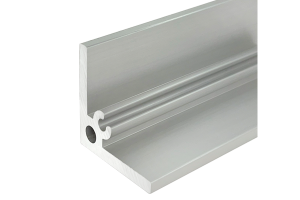 Aluminium Angle Extrusion 40x40x5 mm for Frame Assembly and Bracing
40 x 40 x 5 mm aluminium angle extrusion in 6061-T6 for frame assembly…
 Custom Aluminium Extrusion Profile 20 to 100 mm, 6063-T5
Aluminium extrusion profiles supplied to Canada in 6063-T5 and 6061-T6, mill or anodised, with…
 Aluminium Extrusion for Sale 20 to 100 mm Stock Lengths Cut to Size 6063 T5
Aluminium extrusion for sale in three routes: stock lengths, cut to size or a…
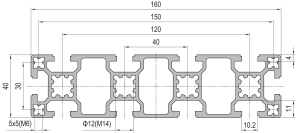 Aluminium Extruders 600 to 4000 Ton Press Capacity 40 to 160 mm Profile
Aluminium extrusion capacity across 600 to 4000 tonne presses, covering profiles up to about…
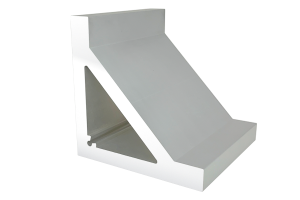 Aluminium Extrusion Manufacturing Factory: 20 to 100 mm Profiles
Aluminium extrusion profiles for Gujarat, India, in 6063-T5 and 6061-T6, with anodising film selected…
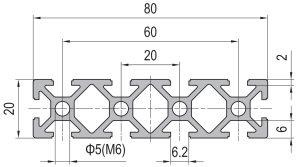 Aluminium Extrusion Manufacturers: 30 to 60 Series, 8 mm Slot
Aluminium extrusion profiles for Delhi NCR, India, in 6063-T5. Strut sections from 30 to…
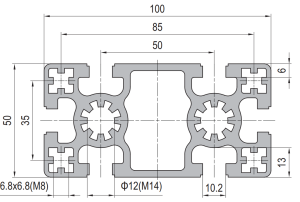 Aluminium Extrusion Profile Supply: 15 to 45 Series Kits, 8 mm Slot
Aluminium extrusion profile supply for Ahmedabad in 6063-T5: electrical cabinet frames with a designed…
 Aluminium Extrusion Profiles 20 to 45 Series for OEM, up to 100 mm
Aluminium extrusion profiles for Tamil Nadu in 6063-T5, with full batch traceability from heat…
