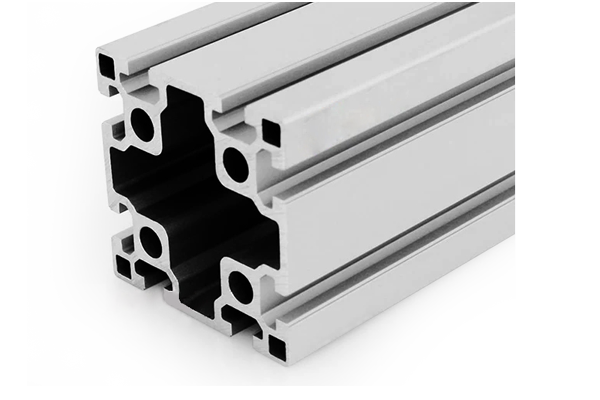
90 x 90 mm Aluminium Profile Supply: Stock Planning and Lead Time
90 x 90 mm eight-slot aluminium extrusion in 6063-T5 for multi-site supply across Maharashtra. 7.60 kg/m, shipped as one lot with labelled bundles and a single anodising rack load per colour.
| Material | Aluminium |
|---|---|
| Alloy Grade | 6063-T5 |
| Temper | T5 |
| Section Size | 90 x 90 mm, eight slots |
| Slot | 8 x 10.2 mm groove, 10 mm mouth, 45 mm pitch, outer pair 45 mm apart |
| Length | 6 m stock; cut to list to +/-0.5 mm |
| Tolerance | EN 755-9, wall +/-0.15 mm; straightness 1.5 mm per metre; twist 2 degrees |
| Surface | Mill finish, or anodised AA15 / AA20 to EN ISO 7599; clear or black; single rack load |
| MOQ | 150 m, or 500 m for a mixed load to two or more sites |
| Lead Time | 25 to 35 days after deposit, plus 16 to 24 days ocean and 1 to 6 days inland depending on the city |
| Loading Port | Shanghai / Ningbo |
| Supply Ability | 600 t per month extrusion with in-house anodising |
| Payment Terms | T/T 30% deposit + 70% before shipment | L/C at sight |
| Trade Terms | FOB | CIF | DAP |
| Certifications | Mill certificate per heat, coating thickness and seal report per anodising lot, one set for the whole quantity |
01Where should the stock actually sit?
One place, in almost every case. The instinct is to hold a little stock at each site so that nobody waits, and the arithmetic usually says the opposite: three small stocks carry more total capital than one larger one, because each has to cover its own variability, and none of them can help the others.
The exception is when the sites are far enough apart that a transfer costs more than the extra stock. Pune to Nagpur is about 700 km, which is a day and a half by road and a real cost per tonne. Beyond roughly 500 km, a second stocking point starts to make sense for fast-moving sections, and for a slow-moving section like 90 x 90 it usually still does not.
- Central stock at one site, with a defined transfer time to the others. That time becomes part of the lead time, not a surprise.
- Keep a small buffer at the second site only for the sections that are used weekly, not for the ones used quarterly.
- For a section at 7.60 kg/m, a 6 m length is 46 kg: handling needs two people or a trolley, which affects how much stock a small site can physically hold.
- Do not stock the same section at three sites in three anodising lots. That is the colour problem waiting to happen, described below.
02How much safety stock does the distance actually require?
The standard model is safety stock equals Z times the standard deviation of demand times the square root of the lead time, with demand and lead time in the same unit. The square root is the part people skip, and it is the part that makes distance less frightening than it feels.
A worked example. Suppose the demand for this section is 120 m a day with a standard deviation of 40 m, and the replenishment lead time is 12 days for a domestic transfer. At a 95 percent service level, Z is 1.65. Safety stock is 1.65 times 40 times the square root of 12, which is about 228 m. If the lead time doubles to 48 days for an import, safety stock becomes 1.65 times 40 times the square root of 48, about 456 m. Doubling the lead time increases the buffer by a factor of two, not four.
| Lead time | Square root | Safety stock at Z 1.65, sigma 40 | Comment |
|---|---|---|---|
| 6 days | 2.45 | 162 m | Domestic transfer, close sites |
| 12 days | 3.46 | 228 m | Domestic transfer, Pune to Nagpur |
| 24 days | 4.90 | 323 m | Import plus inland |
| 48 days | 6.93 | 457 m | Import plus a slow sailing |
The model is only as good as the standard deviation, and most buyers do not have one. If you have three months of issue data, you can calculate it. If you do not, start with a buffer equal to two weeks of average demand and adjust after a quarter, rather than trying to derive a number you cannot support.
03What does the lead time map look like?
Four destinations matter for most Maharashtra buyers, and the difference between them is inland transit rather than ocean. The ocean leg is common to all of them.
| Destination | Ocean leg | Inland from port | Total to site |
|---|---|---|---|
| Mumbai and Navi Mumbai | 16 to 22 days to Nhava Sheva | Same day to 1 day | 17 to 23 days |
| Pune | 16 to 22 days to Nhava Sheva | 2 to 3 days | 18 to 25 days |
| Nashik | 16 to 22 days to Nhava Sheva | 2 to 4 days | 18 to 26 days |
| Nagpur | 16 to 24 days to Nhava Sheva or Mundra | 4 to 6 days | 20 to 30 days |
| Aurangabad | 16 to 22 days to Nhava Sheva | 3 to 5 days | 19 to 27 days |
Add the production lead time to these figures, not to the sailing alone. For a 90 x 90 with an existing die and mill finish, production is 12 to 20 days, so a Nagpur delivery is realistically 32 to 50 days from order. That number, not the sailing, is what the safety stock has to cover.
04What does a monsoon do to stored anodised stock?
It pits it, in the slots, where water sits. An anodic film is corrosion resistant because it is a barrier, and a barrier works while it is intact and while the environment is not permanently wet. Water standing in an open slot for weeks is the one condition the film handles worst, and the pits that form are inside the slot where nobody sees them until assembly.
The practical controls are cheap: store under cover, store at an angle so water runs off rather than sitting, keep the bundles off a damp floor on timber, and do not remove the interleaving until the material is issued. For long storage, a strippable tape on the open slots costs very little.
Monsoon storage checklist
- Covered shed, not open yard, from June to September.
- Bundles on timber bearers, not directly on a concrete floor that draws damp.
- Stored at a slight angle along the length, so water cannot pool in a slot.
- Interleaving left in place until issue, not stripped on receipt.
- FIFO discipline, because the bundle that sits for a year is the one that pits.
05How do you keep one batch traceable across three cities?
By treating the batch as a unit and splitting it deliberately, rather than by ordering three times and hoping. The mechanism is simple: one extrusion lot, one anodising rack load, one heat number, split into bundles that are labelled with the same reference before they leave.
The failure mode is subtle. Two anodising lots of the same section look identical in isolation and different side by side, because film thickness varies with position on the rack and a thicker film reads darker. If the two lots go to two cities, nobody notices until a project spans both sites.
One lot, split by bundle
- Single heat number and single anodising rack load
- Colour is consistent across all sites
- One set of certificates covers the whole delivery
- Requires ordering the total quantity at once
Three separate orders
- Three heat numbers and three rack loads
- Colour difference is likely and hard to attribute
- Three sets of certificates to reconcile
- Lower commitment per order, higher total risk
The cost of the single lot is that the total quantity has to be committed at once, which is working capital. The cost of three lots is a colour mismatch across sites, which is usually more expensive and much harder to fix after the frames are built.
06What five numbers should be on the enquiry?
A multi-site enquiry needs the split and the schedule, not just the total.
- Total quantity and split
- metres per site, because the bundle allocation follows the split
- Delivery dates per site
- staggered deliveries change the production planning
- Finish and colour
- one rack load per colour, stated so the lots are not split
- Length and cut
- 6 m stock or cut to list, per site
- Storage at destination
- covered or open, because it changes the packing advice
- Section
- 90 x 90 mm eight slot at 7.60 kg/m, or the heavy wall at 9.00 kg/m
Send the split by city and the delivery dates
- 90 x 90 mm, 6063-T5, eight 10.2 mm slots, 7.60 kg/m
- 900 m total, split 400 Pune, 300 Nashik, 200 Nagpur
- AA15 anodised clear, one rack load for the whole quantity
- Bundles labelled by destination before dispatch
- Covered storage confirmed at each site
Ask for the whole quantity in one anodising rack load even when it ships to three cities. It is the only way the colour stays consistent, and splitting the anodising is how multi-site projects end up with two shades.
Related sections and categories
The 90 x 90 is listed under 45 Series Aluminium Profiles, with the heavy wall version at 9.00 kg/m. For lighter frame work the 45 x 90 mm six slot section at 4.10 kg/m halves the freight per metre.
Should I hold stock at each site or centrally?
Centrally, in almost every case. Three small stocks carry more total capital than one larger one, because each has to cover its own demand variability and none can help the others. A second stocking point starts to make sense beyond roughly 500 km, and only for sections used weekly rather than quarterly.
How do I calculate the safety stock for a long lead time?
Safety stock equals Z times the standard deviation of demand times the square root of the lead time. At a 95 percent service level Z is 1.65. With a daily standard deviation of 40 m and a 48 day lead time, the buffer is about 457 m. The square root is the important part: doubling the lead time doubles the buffer rather than quadrupling it.
Does anodised stock corrode in a monsoon?
It pits, particularly inside open slots where water sits for weeks. The film is a barrier and it handles that environment poorly when it is permanently wet. Store under cover, on timber bearers, at a slight angle so water runs off, and leave the interleaving in place until issue.
How do I keep colour consistent across three cities?
One extrusion lot and one anodising rack load for the whole quantity, split into labelled bundles before dispatch. Film thickness varies with position on the rack and a thicker film reads darker, so two rack loads of the same section can look different side by side while each looks fine alone.
What is the realistic lead time to Nagpur?
About 32 to 50 days from order, made up of 12 to 20 days production, 16 to 24 days ocean to Nhava Sheva or Mundra, and 4 to 6 days inland. Quoting the sailing alone understates it by roughly three weeks, which is the gap that safety stock has to cover.
Send the split by city and the delivery dates
Tell us how the metres divide across sites, when each one needs material, and whether storage is covered. We will come back with a bundle plan, one rack load per colour, and certificates issued once for the lot.
Request a quotationRelated Products
 50 x 50 mm Aluminium Profile for Precision and Aerospace Fixtures
50 x 50 mm four-slot aluminium extrusion in 6063-T5 for inspection and assembly fixtures.…
 45 x 60 mm Aluminium Profile Solutions for Windows and Facades
45 x 60 mm four-slot aluminium extrusion in 6063-T5 for shopfront, screen and facade…
 40 x 40 mm Light Aluminium Profile for Mining Equipment
40 x 40 mm four-slot aluminium extrusion in 6063-T5 from 1.30 kg/m, for guards…
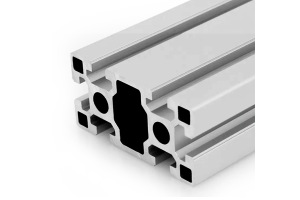 Custom 45 x 90 mm Aluminium Extrusion: Dies, Tooling and Lead Time
45 x 90 mm six-slot aluminium extrusion in 6063-T5 from a China plant. 4.10…
 T-Slot Reducing Profile
Reducing insert that narrows a wide T-slot to accept standard nuts and accessories from…
 Joining Plate PG45-4545
Joining plate for two 45 × 45 mm profiles at 90°, sized to the…
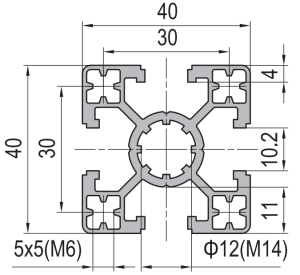 Strut Aluminium Profile 40×40 mm 4-Slot T-Slot Extrusion Machine Frame
40 x 40 mm four-slot T-slot strut aluminium profile in 6063-T5 with M6 slots…
 Strut Aluminium Profile 20×40 mm 2-Slot T-Slot Extrusion for Light Frames
20 x 40 mm two-slot T-slot strut aluminium profile in 6063-T5 with two M6…
