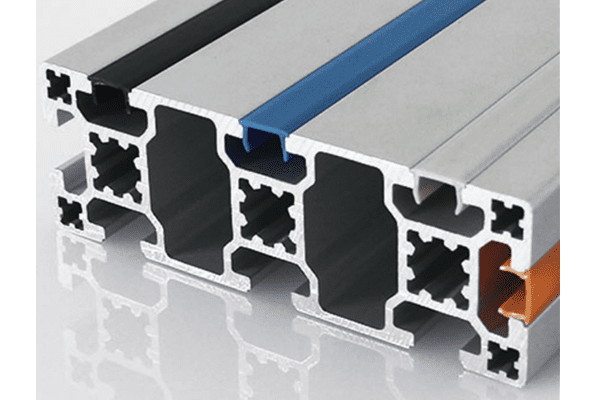
T-Slot Cover Profile
Snap-in T-slot cover strip that closes the open slot on aluminium framing profiles, giving a smooth cleanable face and concealing cable and fasteners inside the slot.
| Material | Rigid PVC / flexible TPE |
|---|---|
| Alloy Grade | Not applicable (polymer accessory) |
| Temper | custom |
| Section Size | Fits 6, 8 and 10 mm T-slots |
| Slot | 6.2 / 8.2 / 10.2 mm cover width |
| Length | Cut to member length, or 2 m lengths |
| Tolerance | ±0.2 mm on cover width |
| Surface | Extruded, UV stabilised |
| MOQ | 500 |
| Lead Time | 15-25 days after deposit |
| Loading Port | Shanghai / Ningbo |
| Supply Ability | 400,000 m per month |
| Payment Terms | T/T 30% deposit + 70% before shipment | L/C at sight |
| Trade Terms | FOB | CIF | EXW |
| Certifications | ISO 9001:2015 | RoHS | REACH | food-contact grade on request |
Profile accessories · Slot closure
A T-slot cover profile is a strip that snaps into the open slot of an aluminium framing profile and closes it flush with the anodised face. It is not a trim piece. It changes the surface the frame presents: an open slot is a dirt trap with two exposed edges, and a covered slot is a smooth, wipeable face with no gap to collect swarf, flour or coolant mist.
The second job is concealment. The slot is where cables, air lines and the heads of fasteners live. Covering it turns an untidy run of exposed wiring into a duct that is part of the structure. We extrude the strip in PVC, in black, grey and white, and supply it cut to your member lengths or in 2 m lengths for site fitting.
Open slot or closed slot: what actually changes
Two framing projects can look identical on a drawing and behave completely differently in service because of this one strip. Where the frame stands in a clean assembly hall, an open slot is fine. Where it stands in a machine shop, a bakery or a pharmaceutical suite, the slot is the one place on the frame that cannot be cleaned properly — the slot mouth is narrower than the slot interior, so a cloth cannot reach the bottom of it.
Specifying a cover is therefore a decision about the environment the frame lives in, not about appearance. The appearance benefit is real but secondary.
| Slot | Cover width | Profile face | Cover strip code |
|---|---|---|---|
| 6 mm (20 series) | 6.2 mm | 20 × 20 / 20 × 40 | TC-06 |
| 8 mm (30 / 40 series) | 8.2 mm | 30 × 30 to 40 × 80 | TC-08 |
| 10 mm (45 / 50 series) | 10.2 mm | 45 × 45 to 50 × 100 | TC-10 |
| 8 mm heavy wall | 8.2 mm | 40 × 80 to 80 × 80 | TC-08H |
The three ways a cover strip is used
How the strip is retained
Two retention systems are used, and the choice depends on whether the cover has to come off again. A snap-in strip has moulded barbs that press into the slot groove and hold by friction; it can be peeled out with a blade and re-used, which is what you want where cable is added after assembly. A press-in strip with a harder barb is a fit-and-forget part and will not fall out under vibration.
Both are supplied in a rigid PVC and a flexible TPE grade. The flexible grade is used where the cover follows a bend or where a cable has to be pushed out of the slot later without removing the strip.
Practical point: tell us the member cut list and which faces are exposed. We will supply the cover cut to length and bagged with the matching member, so an OEM kit assembles without the fitter cutting strip on site — which is where the burrs and the gaps come from.
Cover strip and the other slot components
A cover strip does not replace the other parts that live in the slot. A T-slot nut still has to enter the slot to take a bolt, and a reducing profile changes the slot width rather than closing it. On a frame where both are needed, the sequence matters: fit the fasteners and the joint plates first, then run the cable, then fit the cover over the section of slot between joints.
That is why cover strip is normally ordered with the frame rather than after it. Ordered late, it is cut on site and the lengths are wrong.
Frequently asked questions
Will the cover fit a slot from another profile supplier?
Only if the slot mouth and the internal groove geometry match. Cover strip is extruded to the slot of a specific section, so an 8 mm cover from one range may not retain in an 8 mm slot with a different groove depth. Send the section drawing and we will confirm.
Can the cover be fitted after the frame is built?
Yes. Snap-in strip is designed for that and can be fitted or removed with a blade, which is why it is the normal choice where cable is added later.
Does covering the slot weaken the joint?
No. The cover sits in the slot mouth and carries no structural load. Joint plates and connectors are fitted before the cover goes on.
Is the cover available in a colour other than black?
Grey and white are held as standard, and a colour matched to a specific anodising or to a corporate shade is available on extrusion from around 500 kg.
Can the cover double as a cable duct?
Yes. A cover over a slot that carries cable forms a closed duct. Where cables leave the frame, they exit through a conduit end cap with a radiused entry rather than through a hole cut in the cover.
Close the slot at the drawing stage, not on site
Send the member cut list and tell us which faces are exposed. We will return the cover size, the metreage and FOB pricing, and supply the strip cut to length and bagged with the matching members.
Request a QuoteRelated Products
 Aluminium Conduit End Cap
Snap-fit or screw-fixed end caps for aluminium conduit profiles from 40x40 to 80x200 mm,…
 Aluminium Profile End Cap
Push-fit end caps for T-slot framing profiles from 15 to 60 series, sized to…
 T-Slot Reducing Profile
Reducing insert that narrows a wide T-slot to accept standard nuts and accessories from…
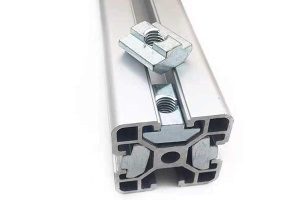 T-Nut and Bolt Set Aluminium Profile Fastener Kit M5 M6 M8 20-40 mm T-Slot Hardware
Matched T-nut, bolt and washer set for aluminium profile frames in M5, M6 and…
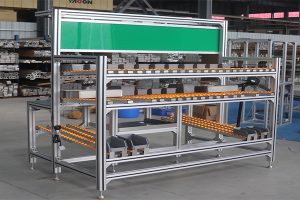 Assembly Line Workstation Aluminium Profile Frame 40×40 mm T-Slot Workbench Structure
A re-configurable assembly workstation frame in 40 x 40 mm T-slot aluminium profile with…
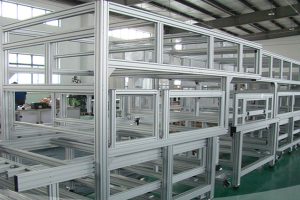 Aluminium Framing Extrusion Kit 40×40 mm 40 Series Cut List for Machine Frames
A cut-to-length aluminium framing extrusion kit in the 40 series: profile cut to a…
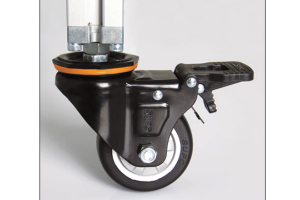 Aluminium Profile Castors
Castors for aluminium profile frames in seven configurations — plate fixed, swivel, braked and…
 Swivel Ball Foot
Self-aligning levelling foot with a ball-and-socket joint between stem and pad, keeping the pad…
